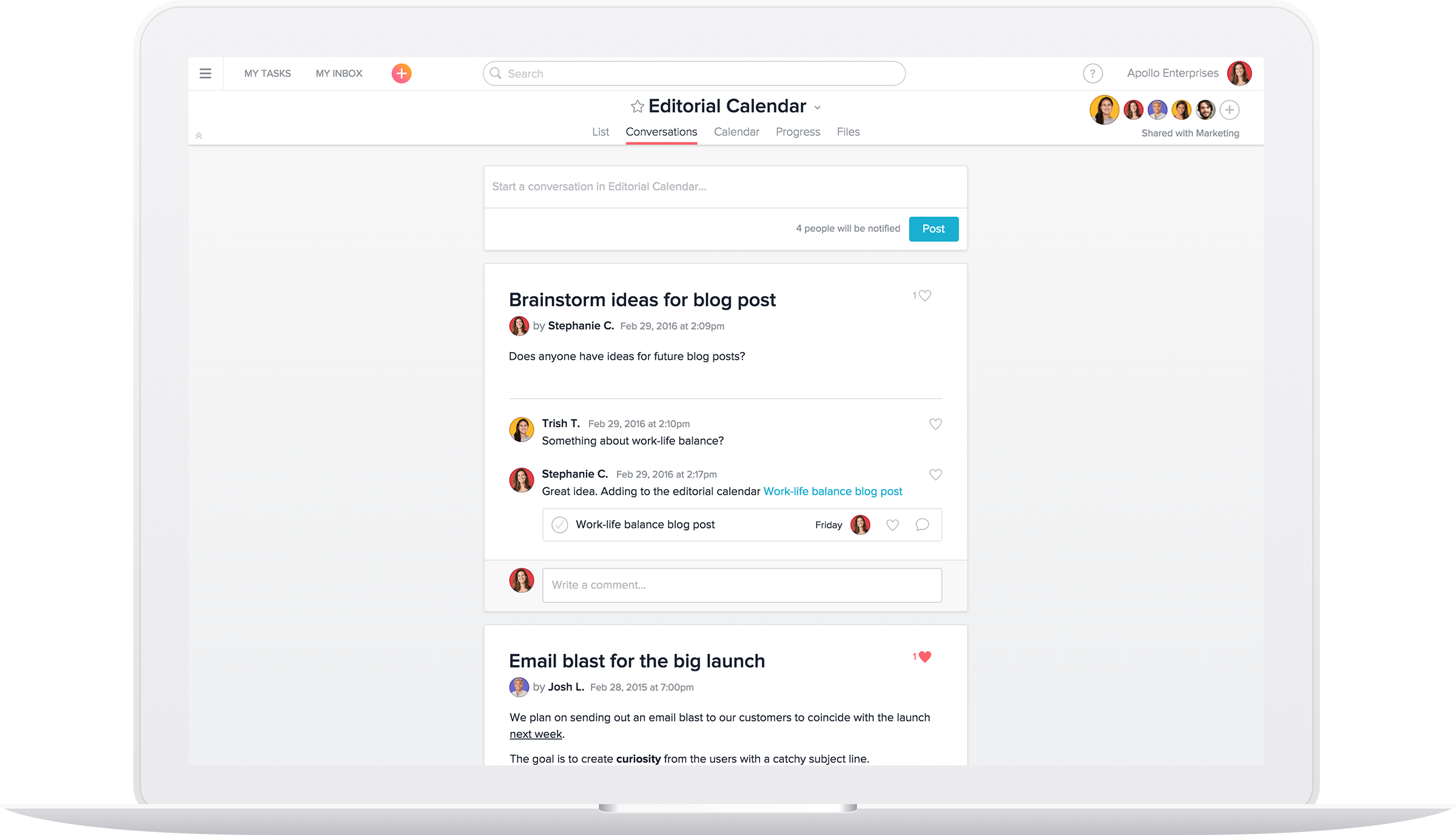
Asana is a web and mobile project management app. With tasks, projects, conversations, and dashboards, Asana lets an entire team know who's doing what by when, enabling workload balancing. Users can also add integrations for GANTT charts, time tracking and more.
$13.49
per month per user
Freehand by InVision
Score7.7 out of 10
N/A
Freehand, from InVision headquartered in New York, is an online whiteboard that enables teams to plan, brainstorm, and draw together. It aims to give everyone a simple way to visually represent ideas with charts, diagrams, and drawings. Whether for mind mapping, creating a customer journey map, or drafting up an org chart, Freehand can help teams make ideas and plans visual.
$4
per month per user
Pricing
Asana
Freehand by InVision
Editions & Modules
Starter
$13.49
per month per user
Advanced
$30.49
per month per user
Enterprise
Contact Sales
Personal
Free
Freehand Free
$0
per year per user
Freehand Pro
$4
per month per user
Freehand Enterprise
Custom Quote
Offerings
Pricing Offerings
Asana
Freehand by InVision
Free Trial
Yes
Yes
Free/Freemium Version
Yes
Yes
Premium Consulting/Integration Services
Yes
No
Entry-level Setup Fee
Optional
No setup fee
Additional Details
A discount is offered for annual billing.
—
More Pricing Information
Community Pulse
Asana
Freehand by InVision
Considered Both Products
Asana
No answer on this topic
InVisionApp Inc.
Verified User
Chose Freehand by InVision
InVision Freehand is simple to use and doesn't have all the bells and whistles Figma offers - and its simplicity has a place in the workspace tech stack. We haven't tried Figma Jam yet - even though we use Figma, we still prefer Invision.
A de minimis incentive was given to thank the reviewer for their time. The incentive was not used to bias or drive a particular response, nor was the incentive contingent on a positive endorsement. More Info
Verified User
Chose Freehand by InVision
I used to build everything out in Adobe Ai, if you can believe it. Ha! It was very challenging to share and update, but it did provide a large canvas to work on. Sometimes it would get so large it couldn't be opened anymore, and the document would fail. It was pretty crappy and …
A de minimis incentive was given to thank the reviewer for their time. The incentive was not used to bias or drive a particular response, nor was the incentive contingent on a positive endorsement. More Info
Verified User
Chose Freehand by InVision
Drawing in Miro isn't nearly as frictionless, and it gets slow much easier. Miro tries to make things more "put together" and often times you just need to make a mess.
A de minimis incentive was given to thank the reviewer for their time. The incentive was not used to bias or drive a particular response, nor was the incentive contingent on a positive endorsement. More Info
The usability of Asana is broad since it's available in a variety of platforms that are widely used nowadays. I think that it would be great for people who are constantly on the move and switching devices, since it has allowed me to work from my phone, too. I also think that Asana has proven itself to handle a large quantity of work
InVision Freehand has quickly evolved to be a very robust solution for our pre-design process and collaboration with stakeholders and other product teams. It has brought a lot more hands-on workshopping opportunities and created engaging spaces for cross functional teams. Internally to our design org we are able to prototype ideas faster and generate insights or changes BEFORE going into more hi-fidelity design tools or processes.
A de minimis incentive was given to thank the reviewer for their time. The incentive was not used to bias or drive a particular response, nor was the incentive contingent on a positive endorsement. TR verified that a representative sample of customers was invited. More Info
Through it, we were able to communicate and cooperate with the rest of the team to complete the work in the required manner and at the appropriate time.
A de minimis incentive was given to thank the reviewer for their time. The incentive was not used to bias or drive a particular response, nor was the incentive contingent on a positive endorsement. More Info
A de minimis incentive was given to thank the reviewer for their time. The incentive was not used to bias or drive a particular response, nor was the incentive contingent on a positive endorsement. More Info
The resolution: Our webpage designs always pass the resolution threshold to where freehand starts to work its compression. During presentations, it can be a little embarrassing when we can't read the copy because it looks like potatoes.
Embedding videos: GIFs are only good to a certain point, and creating Vimeo embeds is tedious. I wish I could embed MP4s or web assets a lot quicker.
Touchpad panning: I can't tell you how many times I've "gone back" in my browser when I'm just trying to pan across the freehand. Has honestly made me wanna force quit on many occasions.
Sticky notes and text in shapes: Overall, it's really hard to use the sticky notes and text inside rectangles without the text just getting all over the place. It's different sizes, it gets too tiny, it gets way too big, and overall, it just doesn't look professional, even with a lot of fussing.
No ability to crop/mask an image. Nice to have, but sometimes we just need to delete a chunk off a screenshot, and it requires opening PS or taking a screenshot to edit anything.
Wish there was a way to have "internal comments" that are not visible to our clients.
A de minimis incentive was given to thank the reviewer for their time. The incentive was not used to bias or drive a particular response, nor was the incentive contingent on a positive endorsement. More Info
A de minimis incentive was given to thank the reviewer for their time. The incentive was not used to bias or drive a particular response, nor was the incentive contingent on a positive endorsement. More Info
Honestly as in any organization it's up to budget. I feel like every organization I go to I'm constantly striving to keep InVision as part of the main funded tools used by the team especially in a remote environment. I feel there is a push to move to Figma and Zooms new white boarding tool but I'm still not a fan of Zoom's tool. Microsoft also created a white boarding tool which has been buggy.
A de minimis incentive was given to thank the reviewer for their time. The incentive was not used to bias or drive a particular response, nor was the incentive contingent on a positive endorsement. More Info
It is very user-friendly. Takes a new employee an hour to start figuring out how the system works. That's an important factor. You don't want to encounter the issue where employees need a week to understand how the system works. For example, JIRA, I tried using it for a week and I still don't understand the complicated layout. Asana has a simple interface. Once you see it, you get it type of program.
A de minimis incentive was given to thank the reviewer for their time. The incentive was not used to bias or drive a particular response, nor was the incentive contingent on a positive endorsement. More Info
Color Selection can be tricky when changing colors for shapes and text I've seen other users struggle with creating sticky notes and getting text to fit in the box properly and had to abandon the tool for a workshop for this reason After having a demo, I learned of new features I wasn't using. I don't know it would have been intuitive to find on my own.
A de minimis incentive was given to thank the reviewer for their time. The incentive was not used to bias or drive a particular response, nor was the incentive contingent on a positive endorsement. More Info
For availability, we never have to even think about whether inVision Freehand is going to be available for us to work with. There has never been a time when we have opened up the application and had any issues of any kind. I can't imagine why anyone would work with a platform that is unreliable. inVision Freehand is realibel, stable, and getting better all the time. Whether it's their built-in tools or the expanding of Templates to work with Freehand has been a reliable go-to platform for us.
A de minimis incentive was given to thank the reviewer for their time. The incentive was not used to bias or drive a particular response, nor was the incentive contingent on a positive endorsement. More Info
It is a little slow when bringing artboards from Sketch to Freehand using Craft. I have had some issues loading and redrawing pages when I have a lot of images on my freehand board. It gives me an error message while I am in the file and starts to reload and redraw all the photos again. Not sure if it has a limit on how many images it can handle on a board at a time.
A de minimis incentive was given to thank the reviewer for their time. The incentive was not used to bias or drive a particular response, nor was the incentive contingent on a positive endorsement. More Info
I haven't had to use their support so I can't rate it. The fact that I haven't needed them reflects the ease of use of the product. I would recommend that any new users schedule a complete demo of the product to ensure that they are using it to it's fullest (there's a lot of useful features).
A de minimis incentive was given to thank the reviewer for their time. The incentive was not used to bias or drive a particular response, nor was the incentive contingent on a positive endorsement. More Info
I haven't had to use the support team for anything, which is great news because that means the product usually works as expected! In terms of online support, I've been able to find videos that show how new features work. Also, many of the people I work with have experience with the tools so they are a great resource for me.
A de minimis incentive was given to thank the reviewer for their time. The incentive was not used to bias or drive a particular response, nor was the incentive contingent on a positive endorsement. More Info
The implementation is pretty much easy-peasy and plug-n-play. We simply download the applications and install, signed in and were good to go. I really cannot imagine that there would be anyone who would have any difficulty whatsoever in getting started in more than just a few minutes. It's really how implementing these officewide improvements should always go.
A de minimis incentive was given to thank the reviewer for their time. The incentive was not used to bias or drive a particular response, nor was the incentive contingent on a positive endorsement. More Info
Asana is a top-tier project management software that helps us organize and track projects from start to finish. It allows us to apply tasks/to-dos to multiple projects without duplication, divide complex projects into smaller tasks, and track project progress. It also helps us organize work on Kanban boards or linear lists. It stands out from the crowd in a big way compared to the competition.
Miro (formerly Realtime Board) is the original product concept for this tool and I used it for 3-4 years for product development. Invision is aesthetically a carbon copy of the tool but lacks in fine usability controls. We actually didn't choose Freehand, it just came as an added tool under our Invision subscription. It's helpful but knowing the previous tool, it's been a hard sell because it's just not as good. Again, it's really fine tuned usability things like navigation, zoom, switching from tool to tool, selecting and deselecting, etc
A de minimis incentive was given to thank the reviewer for their time. The incentive was not used to bias or drive a particular response, nor was the incentive contingent on a positive endorsement. More Info
Getting set up with inVision Freehand was super simple. We figured how many of our team members were going to be using it and we set up our account knowing that. There were no negotiations, contract hassles or anything that would have been a waste of our time, efforts or resources.
A de minimis incentive was given to thank the reviewer for their time. The incentive was not used to bias or drive a particular response, nor was the incentive contingent on a positive endorsement. More Info
Not everyone in the company has access to Invision, and they can't view the links I provide to them. I also wish everyone could view a file without logging in to the enterprise account. It comes in handy when I am doing focus-group studies or other studies with our customers that don't have Freehand. Unfortunately, if that is possible, I don't know how to do that.
A de minimis incentive was given to thank the reviewer for their time. The incentive was not used to bias or drive a particular response, nor was the incentive contingent on a positive endorsement. More Info
A de minimis incentive was given to thank the reviewer for their time. The incentive was not used to bias or drive a particular response, nor was the incentive contingent on a positive endorsement. More Info
A de minimis incentive was given to thank the reviewer for their time. The incentive was not used to bias or drive a particular response, nor was the incentive contingent on a positive endorsement. More Info
A de minimis incentive was given to thank the reviewer for their time. The incentive was not used to bias or drive a particular response, nor was the incentive contingent on a positive endorsement. More Info