Aurea Process (formerly CX Process) from Aurea Software in Austin is a business process management offering, based on Savvion BPM.
$200,000
per year
Bonita Platform
Score 4.0 out of 10
N/A
Bonita is an open-source business process and workflow management platform created by the French National Institute for Research in Computer Science. It is available as a free community edition or as a commercial subscription product.
N/A
Databricks Data Intelligence Platform
Score 8.8 out of 10
N/A
Databricks offers the Databricks Lakehouse Platform (formerly the Unified Analytics Platform), a data science platform and Apache Spark cluster manager. The Databricks Unified Data Service provides a platform for data pipelines, data lakes, and data platforms.
$0.07
Per DBU
Pricing
Aurea Process
Bonita Platform
Databricks Data Intelligence Platform
Editions & Modules
License
$200,000
per year
No answers on this topic
Standard
$0.07
Per DBU
Premium
$0.10
Per DBU
Enterprise
$0.13
Per DBU
Offerings
Pricing Offerings
Aurea Process
Bonita Platform
Databricks Data Intelligence Platform
Free Trial
No
No
No
Free/Freemium Version
No
Yes
No
Premium Consulting/Integration Services
No
Yes
No
Entry-level Setup Fee
No setup fee
No setup fee
No setup fee
Additional Details
—
—
—
More Pricing Information
Community Pulse
Aurea Process
Bonita Platform
Databricks Data Intelligence Platform
Features
Aurea Process
Bonita Platform
Databricks Data Intelligence Platform
Reporting & Analytics
Comparison of Reporting & Analytics features of Product A and Product B
Aurea Process
5.3
1 Ratings
38% below category average
Bonita Platform
6.4
43 Ratings
20% below category average
Databricks Data Intelligence Platform
-
Ratings
Dashboards
6.01 Ratings
6.041 Ratings
00 Ratings
Standard reports
6.01 Ratings
5.540 Ratings
00 Ratings
Custom reports
4.01 Ratings
7.740 Ratings
00 Ratings
Process Engine
Comparison of Process Engine features of Product A and Product B
Aurea Process
5.8
1 Ratings
36% below category average
Bonita Platform
7.7
53 Ratings
8% below category average
Databricks Data Intelligence Platform
-
Ratings
Process designer
6.01 Ratings
9.052 Ratings
00 Ratings
Process simulation
7.01 Ratings
6.910 Ratings
00 Ratings
Business rules engine
5.01 Ratings
8.242 Ratings
00 Ratings
SOA support
5.01 Ratings
6.440 Ratings
00 Ratings
Process player
7.01 Ratings
6.78 Ratings
00 Ratings
Model execution
5.01 Ratings
6.948 Ratings
00 Ratings
Support for modeling languages
00 Ratings
9.038 Ratings
00 Ratings
Form builder
00 Ratings
8.148 Ratings
00 Ratings
Collaboration
Comparison of Collaboration features of Product A and Product B
Aurea Process
4.0
1 Ratings
70% below category average
Bonita Platform
5.9
24 Ratings
34% below category average
Databricks Data Intelligence Platform
-
Ratings
Social collaboration tools
4.01 Ratings
5.924 Ratings
00 Ratings
Content Management Capabilties
Comparison of Content Management Capabilties features of Product A and Product B
The tool has potential. Its capabilities and visual aspects could be considered rather basic but this might improve, particularly if the business intelligence/analytics aspect is leveraged. Once running well, it could allow (perhaps smaller) companies to successfully improve their customers' experiences through digitalizing customer journey - and we all know that customer loyalty goes a long way. However, whether or not the tool is comprehensive enough to deliver this for larger companies with more complex, multi- and omni-channel interactions is yet to be seen...
Well suited for low code/no code applications centered around approval flows. It has built-in task management for users to see their pending actions, comments, statuses, etc. It has a very nice design for process flows. Less appropriate may be for generic type applications with complex screens and logic within those screens that need a lot of data to process.
Medium to Large data throughput shops will benefit the most from Databricks Spark processing. Smaller use cases may find the barrier to entry a bit too high for casual use cases. Some of the overhead to kicking off a Spark compute job can actually lead to your workloads taking longer, but past a certain point the performance returns cannot be beat.
Bonita seems particularly suited for processes requiring a great deal of human interaction. Its user model allows you to control access to business processes in a fine-grained way. This allows for business processes to move smoothly between users and services as the process advances.
The definition and usage of custom forms from the latest version of Bonita seems particularly powerful. It allows for a thorough customization of the look-and-feel and does not require complex developments.
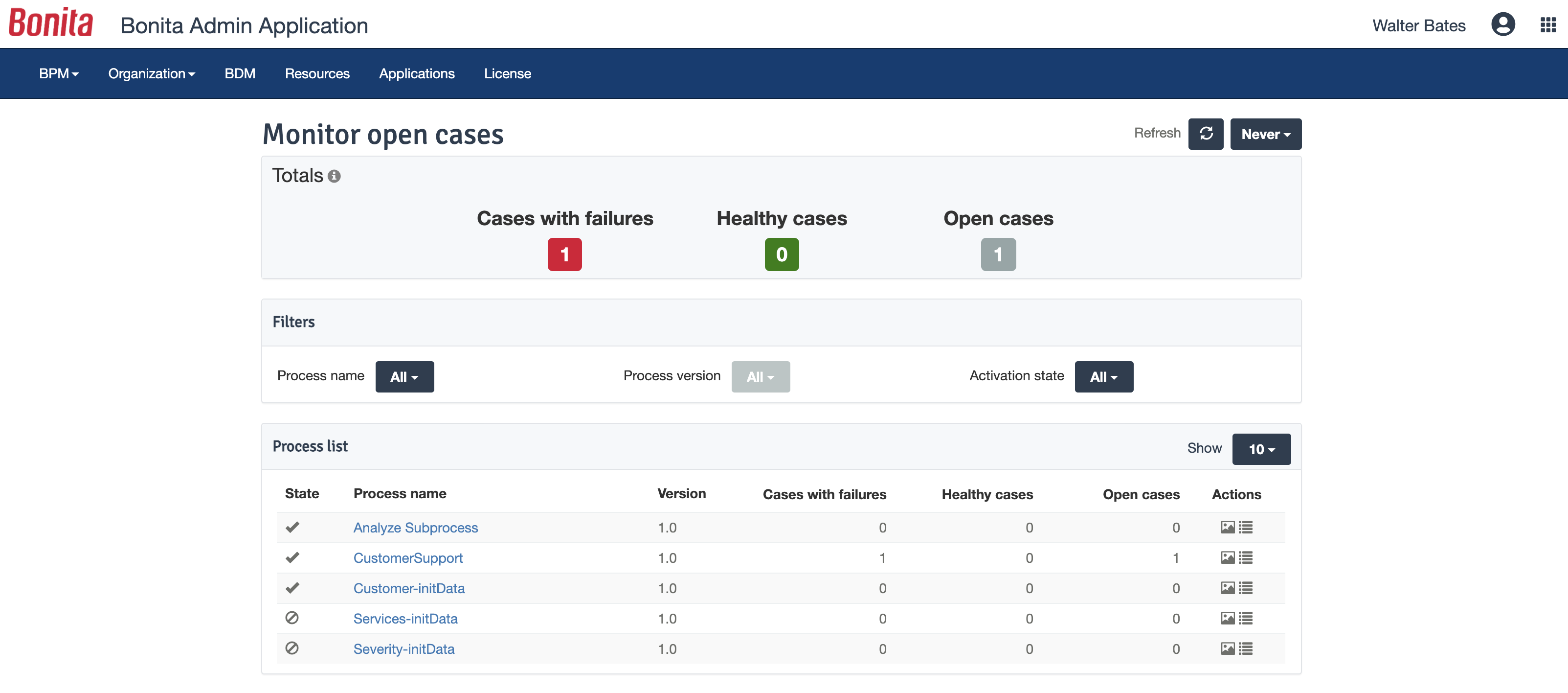
The web interface and administration section have greatly improved in the latest versions. Installation and configuration of processes has become more flexible and more structured. The administration section gives a good view on failed processes, allowing to analyse problems in an efficient way.
There is a learning curve beyond the boot camps that needs to be addressed with more structured curriculum.
The full stack technologies are industry standard, but these [are] challenging to learn and could use a learning path and orientation. There's probably opportunity for third-parties here to help with learning and adoption.
Bonita Platform has allowed us to develop GUI relatively fast using its UI Designer while being able to seamlessly integrate our business logic in Java in a BPMN2 process diagram. It gives a nice productivity boost but still requires programming know-how to be able to deliver the final solution to your business problems.
Because it is an amazing platform for designing experiments and delivering a deep dive analysis that requires execution of highly complex queries, as well as it allows to share the information and insights across the company with their shared workspaces, while keeping it secured.
in terms of graph generation and interaction it could improve their UI and UX
Engine itself is efficient enough for most cases I dealt with. It can also be extended by clustering. I have done performance tests with JMeter and only managed to induce the crash of... JMeter. If there are efficiency issues they usually concern bad design/implementation of created apps or bottlenecks in integrated systems. Although I have met two cases with efficiency loss.
1. Java 7 related PermGen saturation caused by big number of installed apps (there is no jar dependency reusal between apps option).
2. Big number of waiting event handlers in processes stresses the database.
One of the best customer and technology support that I have ever experienced in my career. You pay for what you get and you get the Rolls Royce. It reminds me of the customer support of SAS in the 2000s when the tools were reaching some limits and their engineer wanted to know more about what we were doing, long before "data science" was even a name. Databricks truly embraces the partnership with their customer and help them on any given challenge.
The most important differentiating factor for Databricks Lakehouse Platform from these other platforms is support for ACID transactions and the time travel feature. Also, native integration with managed MLflow is a plus. EMR, Cloudera, and Hortonworks are not as optimized when it comes to Spark Job Execution. Other platforms need to be self-managed, which is another huge hassle.
Respect of BPMN standard over the long term. Good enhancements by Bonitasoft for new use cases, for example the introduction of a real form editor even if it has been technically difficult to manage. Once done though, we have far greater possibility of human interaction.
As our customers vary in size and maturity, the ROI ranges accordingly.
For younger, smaller businesses this is a useful tool. Digitalization of he customer journey has certainly helped save time and efforts in many cases.
For more mature market players the tool is not always comprehensive enough. Dashboard and report personalization take time and efforts, and sometimes it feels that a dedicated BI tool would be a more suitable solution.