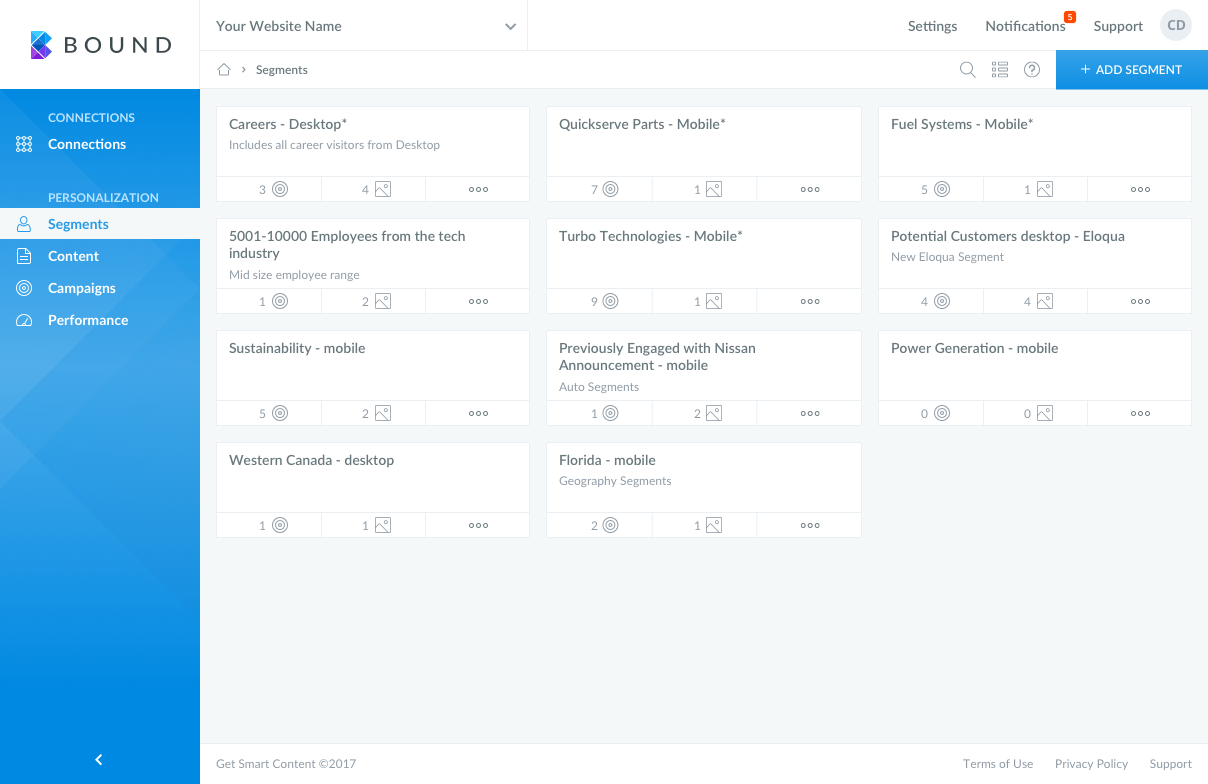
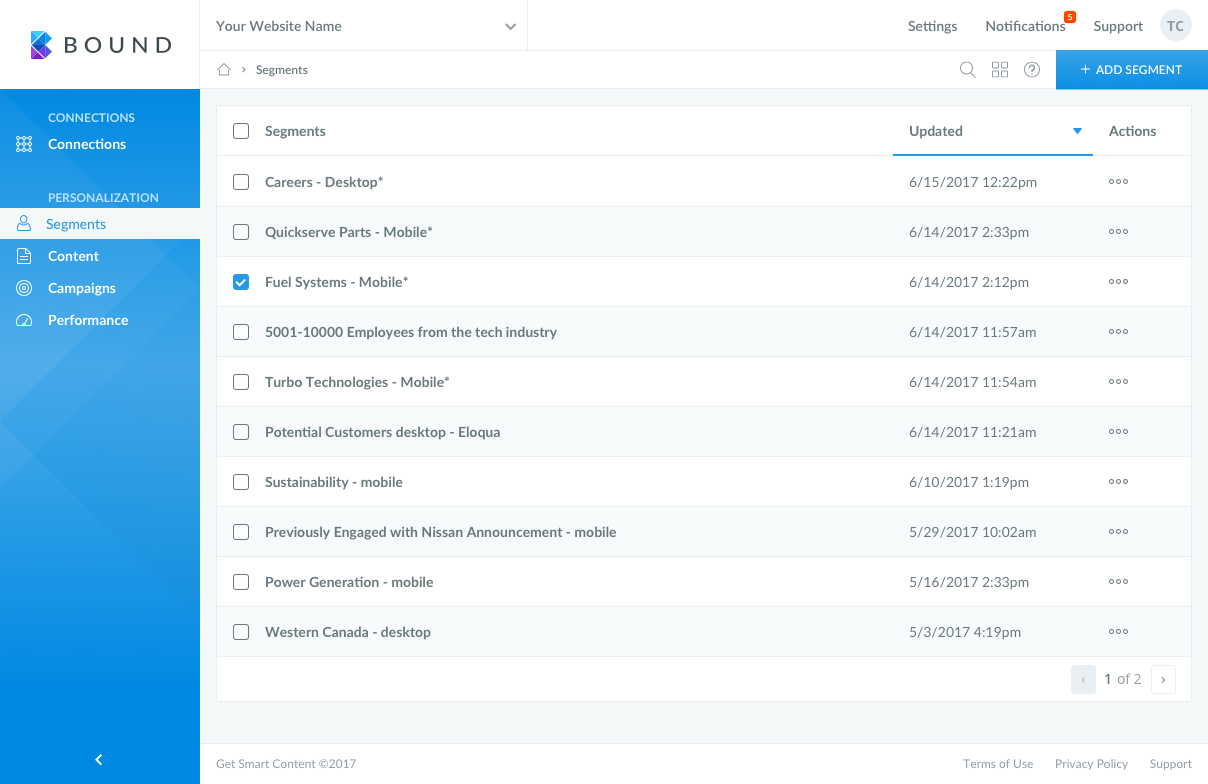
Bound (formerly Get Smart Content) is a website segmentation and targeting platform that enables marketers to read a website visitor's digital body language and serve relevant content based on the person's stage in the buying journey. Using behavioral, demographic, and firmographic data, Bound creates personalized web experiences for both anonymous and known website visitors to increase the effectiveness of marketing efforts and dramatically reduce the buyer's path to conversion. Bound partners…
N/A
Google Content Experiments (discontinued)
Score 7.3 out of 10
N/A
Google Content Experiments was a tool that can be used to create A/B test from within Google Analytics. It has been discontinued since 2019, and Google now recommends using its Google Optimize service for A/B testing.
It has the inability to export subject line or ISP complaints that require manual pulling by each campaign when needed. Results from variable tests are also reported only as a percentage of chosen KPI (opens, clicks, etc.). There's no ability to see hard numbers from the tests …
Get Smart Content is what we primarily use to serve up segmented content. The only other method or tool we've used to do so while leveraging our Demandbase variables is Optimizely. We selected Get Smart Content because they make the process of segmentation using Demandbase …
Get Smart Content is quite cost effective, simple to use with great support. The support systems and simplicity based on other products used and evaluated is the best in the industry.
Google Content Experiments is a free tool and the leading tool in the industry. It's pretty simple to set up a test and use content experiments to monitor objectives once Google Analytics is installed. Less experienced team members can run tests with some training. There are …
It frankly was down to cost. Other platforms offer better targeting etc., however, we found that unless we could demonstrate early value - we didn't get budget sign off. Our teams aren't usually large enough to justify the cost and time to invest in a more complex platform - so …
Google Website Optimizer was a better product but has been discontinued. We have also used Test and Target , which has more features but we have been doing fine with Google Content Experiments. Most testing situations can be handled with Google Content Experiments.
Google Content Experiment cannot compete with Adobe Test and Target, Quadratics or even Optimizley. It is harder to use with no editing interface, so pages must be actually developed. It doesn't allow for any advanced segmenting or multivarient testing. But it is free, so …
Google CE is free, Optimizely isn't plus only until recently I found out that Optimizely can work with multiple goals, however, this was found by meeting their employees at a trade show and not via their website.
We'd use content experiments as a complimentary testing tool alongside more comprehensive testing packages out there. As a free testing tool it does the job for basic A/B testing.
If you are looking for a more advanced great value for money solution I would recommend investigating Visual Website Optimizer. For a more powerful enterprise level solution with the option to have a fully managed service I would recommend Maxymiser.
Google Content Experiments provides significantly more insight, historical data and analysis than Unbounce. However, if you do need a solution that offers a WYSIWYG editor, landing page hosting, and limited reporting and testing, Unbounce is a good all-in-one solution and that …
Verified User
Anonymous
Chose Google Content Experiments (discontinued)
GCE isn't better or worse than any of these, it's just different. When I have the time to build a new page, setup the testing scripts, and go - then I'll use GCE. If I'm doing multivariate I use VWO. If I'm testing a quick button or headline change, I use Optimizely or UnBounce.
Google CE does a great job streamlining tools and features. Optimizely does not offer nearly the same amount of tools or resources that G CE does. I would use CE in the future but stay away from Optimizely. Google also has a lot more resources for accruing knowledge on it …
Features
Bound
Google Content Experiments (discontinued)
Testing and Experimentation
Comparison of Testing and Experimentation features of Product A and Product B
Bound
9.7
Ratings
14% above category average
Google Content Experiments (discontinued)
9.2
Ratings
9% above category average
a/b experiment testing
10.00 Ratings
9.00 Ratings
Split URL testing
9.00 Ratings
10.00 Ratings
Multivariate testing
9.00 Ratings
10.00 Ratings
Multi-page/funnel testing
10.00 Ratings
9.00 Ratings
Cross-browser testing
10.00 Ratings
8.00 Ratings
Mobile app testing
9.00 Ratings
8.00 Ratings
Test significance
10.00 Ratings
9.00 Ratings
Visual / WYSIWYG editor
10.00 Ratings
10.00 Ratings
Advanced code editor
10.00 Ratings
9.00 Ratings
Page surveys
10.00 Ratings
8.00 Ratings
Visitor recordings
9.00 Ratings
8.00 Ratings
Preview mode
10.00 Ratings
8.00 Ratings
Test duration calculator
10.00 Ratings
10.00 Ratings
Experiment scheduler
9.00 Ratings
10.00 Ratings
Experiment workflow and approval
10.00 Ratings
8.00 Ratings
Dynamic experiment activation
9.00 Ratings
10.00 Ratings
Client-side tests
10.00 Ratings
10.00 Ratings
Server-side tests
10.00 Ratings
10.00 Ratings
Mutually exclusive tests
10.00 Ratings
10.00 Ratings
Audience Segmentation & Targeting
Comparison of Audience Segmentation & Targeting features of Product A and Product B
Bound
9.8
Ratings
11% above category average
Google Content Experiments (discontinued)
10.0
Ratings
13% above category average
Standard visitor segmentation
10.00 Ratings
10.00 Ratings
Behavioral visitor segmentation
10.00 Ratings
10.00 Ratings
Traffic allocation control
9.00 Ratings
10.00 Ratings
Website personalization
10.00 Ratings
10.00 Ratings
Results and Analysis
Comparison of Results and Analysis features of Product A and Product B
Google Content Experiments is suited for large and small organizations, no matter your organizational goals. It is not recommended for organizations that are only interested in qualitative data, as there are other tools for receiving specific user experience feedback. It is also not recommended that you implement tests without some sort of goal in mind.
When you need to measure against event-based goals
If you need to see how the test variations performed against secondary goals
Given that the the platform requires you actually code a new page with a unique URL, this tool can be good for radical redesigns.
Great insights into other information about your testing groups, like whether or not they're mobile, screen size, browser, or really any dimension available in GA.
There are some additions we would like to see, such as a better experience in the Performance section. It'd be great if we could see an overall view of the metrics instead of having to drill down. We do a monthly KPI report which takes me a while to create due to the back and forth nature of comparing metrics within Get Smart Content. I also have to use Google Analytics to help with this.
We had some issues with the tool not updating Eloqua contacts, but that has since been resolved. The process for discovering the cause of the problem was lengthy and frustrating.
It would be great if you could see metrics of an A/B test within the campaign/rule, instead of having to go to the Performance section and find it. A small snapshot of info would be very helpful and it would allow us to compare and update the rule without leaving that page.
Content Experiments just makes it is simple and easy to implement A|B tests. We will be evaluating other tools in search of a more robust system for multivariate and cross-page testing, such as Optimizely or Visual Website Optimizer. However, for basic testing, you can't really beat it.
Using the free tool, overall "live support" is limited. However, there are plenty of online resources to get started. If you need handheld support, it is best to upgrade the service or hire a developer through one of Google's partner agencies. There could be more support for understanding what makes a test useful or not.
Get Smart Content is what we primarily use to serve up segmented content. The only other method or tool we've used to do so while leveraging our Demandbase variables is Optimizely. We selected Get Smart Content because they make the process of segmentation using Demandbase variables easy
Google Website Optimizer was a better product but has been discontinued. We have also used Test and Target , which has more features but we have been doing fine with Google Content Experiments. Most testing situations can be handled with Google Content Experiments.
Doing good experiments/Optimize has helped to take out the guesswork of the things we want to implement.
We have done fairly complex changes such as changing navigation and managed to see improvements outcomes immediately before we have to request developer.
Our teams have become more data centric in how they approach changes.