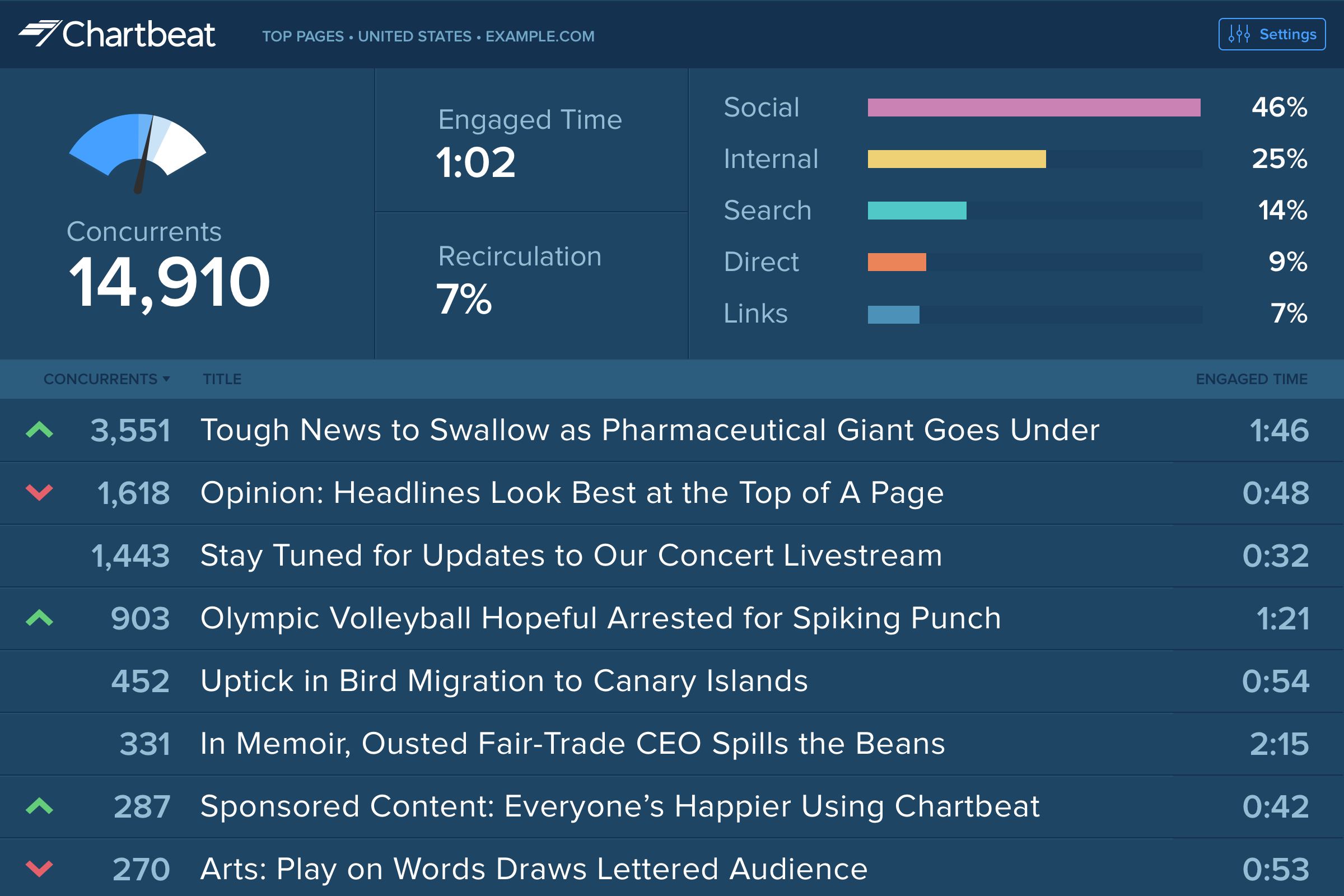
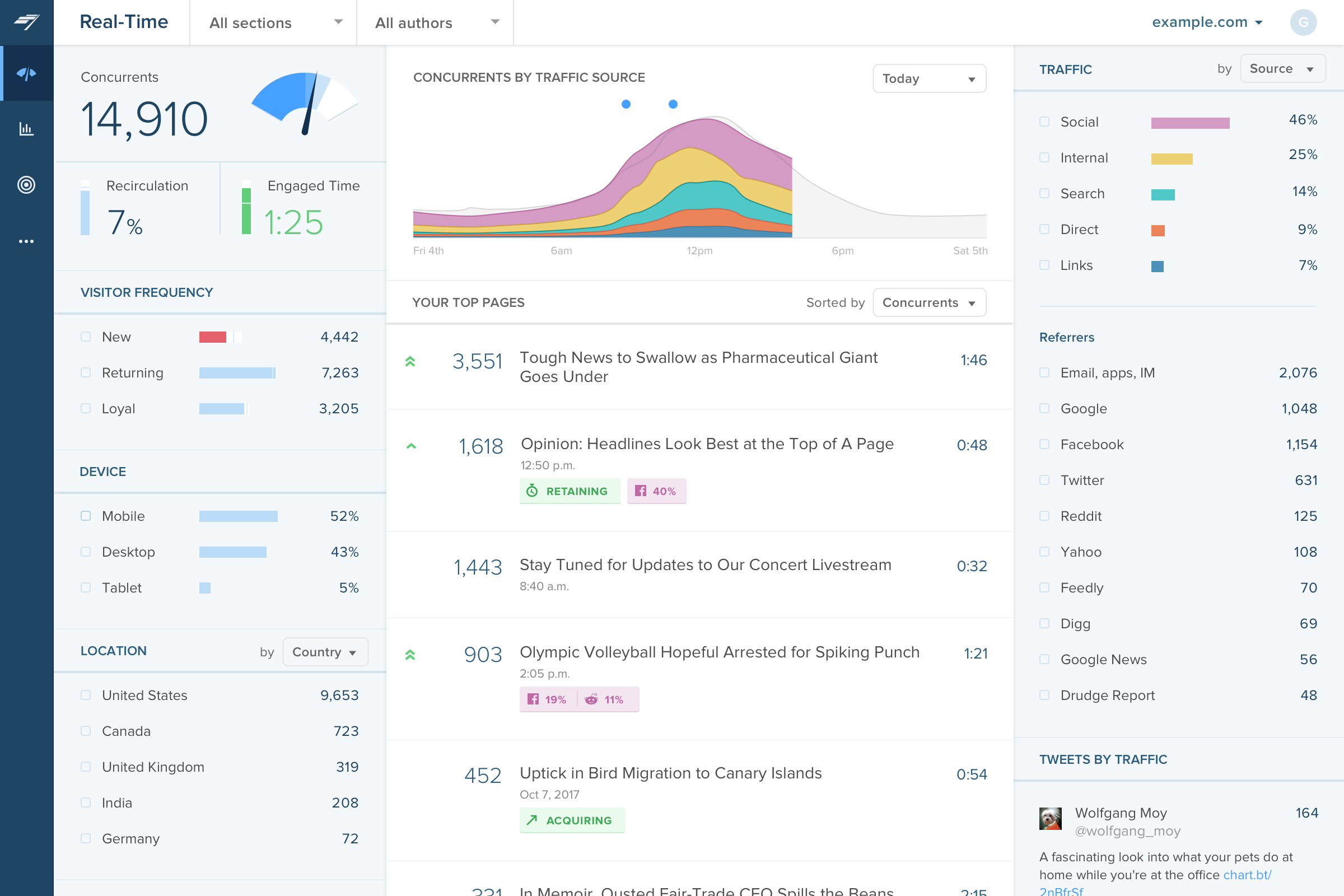
Chartbeat delivers real-time analytics, insights, and transformative tools for content teams around the world, to help improve audience engagement, inform editorial decisions, and increase loyalty.
N/A
Optimal
Score8.5 out of 10
N/A
Optimal Workshop, a company in New Zealand, offers their suite of user research tools on a subscription basis, including the Treejack information architecture tool, OptimalSort card sorting test, Chalkmark first-click testing, and other tools.
$2,388
per year
Pricing
Chartbeat
Optimal
Editions & Modules
No answers on this topic
Starter
$2388
per year
Enterprise
Custom
Offerings
Pricing Offerings
Chartbeat
Optimal
Free Trial
Yes
No
Free/Freemium Version
No
No
Premium Consulting/Integration Services
Yes
No
Entry-level Setup Fee
No setup fee
No setup fee
Additional Details
Chartbeat pricing is based on monthly site page views. Discounts are applied to multi-year contracts. The Basic Plan includes the Real-time Dashboard, Historical Dashboard, Heads Up Display, Reports, Big Board, iOS and Android app, and Real-time API endpoints.
The Plus Plan includes all of the Basic Plan features, plus ONE of the following Premium features: Headline Testing, Advanced Queries, or Multi-Site View.
The Premium Plan includes all of the Basic Plan features, plus ALL Premium features: Headline Testing, Advanced Queries, Multi-Site View, and enterprise-level support and custom trainings.
The main point of benefit is the realtime data. This is vital to our team as we are publishing a lot of content per day, so we have a busy homepage to manage and it's important to know which content is performing well. We also like to get an understanding as quickly as possible - which Chartbeat offers - of where traffic is coming from. Often we will see an example where a page is getting high traffic from Google, for example, and we know that might not need to be placed so prominently on the homepage because the traffic is arriving to us externally anyway. Without that depth of understanding what is performing best and why - updated immediately, unlike in Google Analytics now - our homepage would not be as well optimised for users coming to us direct
A de minimis incentive was given to thank the reviewer for their time. The incentive was not used to bias or drive a particular response, nor was the incentive contingent on a positive endorsement. More Info
Optimal Workshop is great for UX testing for those with a budget to do so. This may be a little on the expensive side for smaller businesses, but definitely not anything crazy expensive. The insights that you get out of these tests are invaluable and can be the difference between launching a site and succeeding/failing.
A de minimis incentive was given to thank the reviewer for their time. The incentive was not used to bias or drive a particular response, nor was the incentive contingent on a positive endorsement. More Info
Tree Testing - it is a very simple and easy to use system, that provides the data needed from a tree test
Card sorting - provides a system for users to participate in navigation menu layouts. We looked into several options, but this seemed very intuitive for users.
A de minimis incentive was given to thank the reviewer for their time. The incentive was not used to bias or drive a particular response, nor was the incentive contingent on a positive endorsement. More Info
Source of traffic needs improvement. Search and social make sense, but "internal" and "links" is a grey area. It would be helpful to define those with an organization and provide an information icon so users can easily remember what each of those buckets is tracking.
More ways to customize the real-time board. For example, with video content, that's great that I can see a user has started a video, but what is the completion rate, was that only on O&O or can that track Facebook, too?
Would like to see demo (age) information included as a way to slice the data so I can see what's working with my older and younger demo.
A de minimis incentive was given to thank the reviewer for their time. The incentive was not used to bias or drive a particular response, nor was the incentive contingent on a positive endorsement. TR verified that a representative sample of customers was invited. More Info
The recruitment panelists are not professional, nor do they take the tasks seriously. You are going to get a lot of bad data.
They are HQ'd outside the US and must have a small team because the customer service is the absolute WORST I've experienced in their industry.
They pride themselves on documentation, but when they fail to document something they blame the customer for the mistake.
There are way too many limitations with the tool after you launch, limited integrations, and poor survey questionnaire options. The tool itself is far too basic for most sites, especially B2B.
I gave Chartbeat a 5 for a renewal rating, because, while it delivers clear and understandable content, Google Analytics also provides many of the same features for free. For a small to medium website, I believe it would be more cost effective to use Google Analytics. A website with a high amount of traffic, however, could merit spending the money on Chartbeat to maximize their potential.
I am able to "set it and forget it," keeping it up on my monitor for either constant checking or just keeping an eye on the numbers during the day. I'm also able to keep track of what times are perfect to post a story and which stories rack up the most traffic.
A de minimis incentive was given to thank the reviewer for their time. The incentive was not used to bias or drive a particular response, nor was the incentive contingent on a positive endorsement. More Info
I would rate Optimal Workshop's overall usability 9 out of 10 due to several key factors. Firstly, the platform has a user-friendly interface makes navigation straightforward, even for first-time users. The tools and features are well-organized, ensuring users can quickly find what they need without unnecessary complexity. Secondly, the platform is highly intuitive, meaning users can easily understand how to perform tasks without extensive guidance. This is supported by clear and concise instructions throughout the application, reducing the learning curve significantly.
Additionally, the learnability of Optimal Workshop is exceptional. New users can become proficient in a short amount of time, thanks to its well-thought-out design and helpful onboarding materials. Even more advanced features are presented in a way that feels approachable and manageable. Finally, the platform supports a seamless workflow, allowing users to focus on their research or tasks rather than struggling with the software. These qualities collectively make Optimal Workshop a reliable and efficient tool for many projects, justifying its high usability rating.
A de minimis incentive was given to thank the reviewer for their time. The incentive was not used to bias or drive a particular response, nor was the incentive contingent on a positive endorsement. More Info
I have had limited experience of support for Chartbeat but whenever I have needed help it has been there. Recently there was an issue of seeing different forms of data in real time - app and otherwise effectively, and the issue was being clearly dealt with and communicated back to us.
A de minimis incentive was given to thank the reviewer for their time. The incentive was not used to bias or drive a particular response, nor was the incentive contingent on a positive endorsement. More Info
We’ve never had to use much of their support services since the platform is very easy to use, we have however needed to transfer ownership between team members due to people leaving or other circumstances. Under those situations, the support offered to us has been been very quick and efficient and we never had to nudge them much to get the job done.
A de minimis incentive was given to thank the reviewer for their time. The incentive was not used to bias or drive a particular response, nor was the incentive contingent on a positive endorsement. More Info
Omnilytics is more robust, detailed, and catered for an intermediate media user, while I think Chartbeat is a more user-friendly and beginner-oriented piece of technology. That being said, there is an impressive amount of lift for Chartbeat, and it's evident that simplicity is the key to using a software daily (which is absolutely the point in the content world).
A de minimis incentive was given to thank the reviewer for their time. The incentive was not used to bias or drive a particular response, nor was the incentive contingent on a positive endorsement. More Info
For the price as it is very convenient for first-time beginners, its intuitiveness both for the one who is designing the activities and for those who have to interact with them. The fact that it collects and gathers the data into insights of the overall responses collected by all users.
A de minimis incentive was given to thank the reviewer for their time. The incentive was not used to bias or drive a particular response, nor was the incentive contingent on a positive endorsement. More Info
A de minimis incentive was given to thank the reviewer for their time. The incentive was not used to bias or drive a particular response, nor was the incentive contingent on a positive endorsement. More Info
A de minimis incentive was given to thank the reviewer for their time. The incentive was not used to bias or drive a particular response, nor was the incentive contingent on a positive endorsement. More Info