Cisco Duo is a two-factor authentication system (2FA), acquired by Cisco in October 2018. It provides single sign-on (SSO) and endpoint visibility, as well as access controls and policy controlled adaptive authentication.
$3
per month per user
Cisco Identity Services Engine (ISE)
Score9 out of 10
N/A
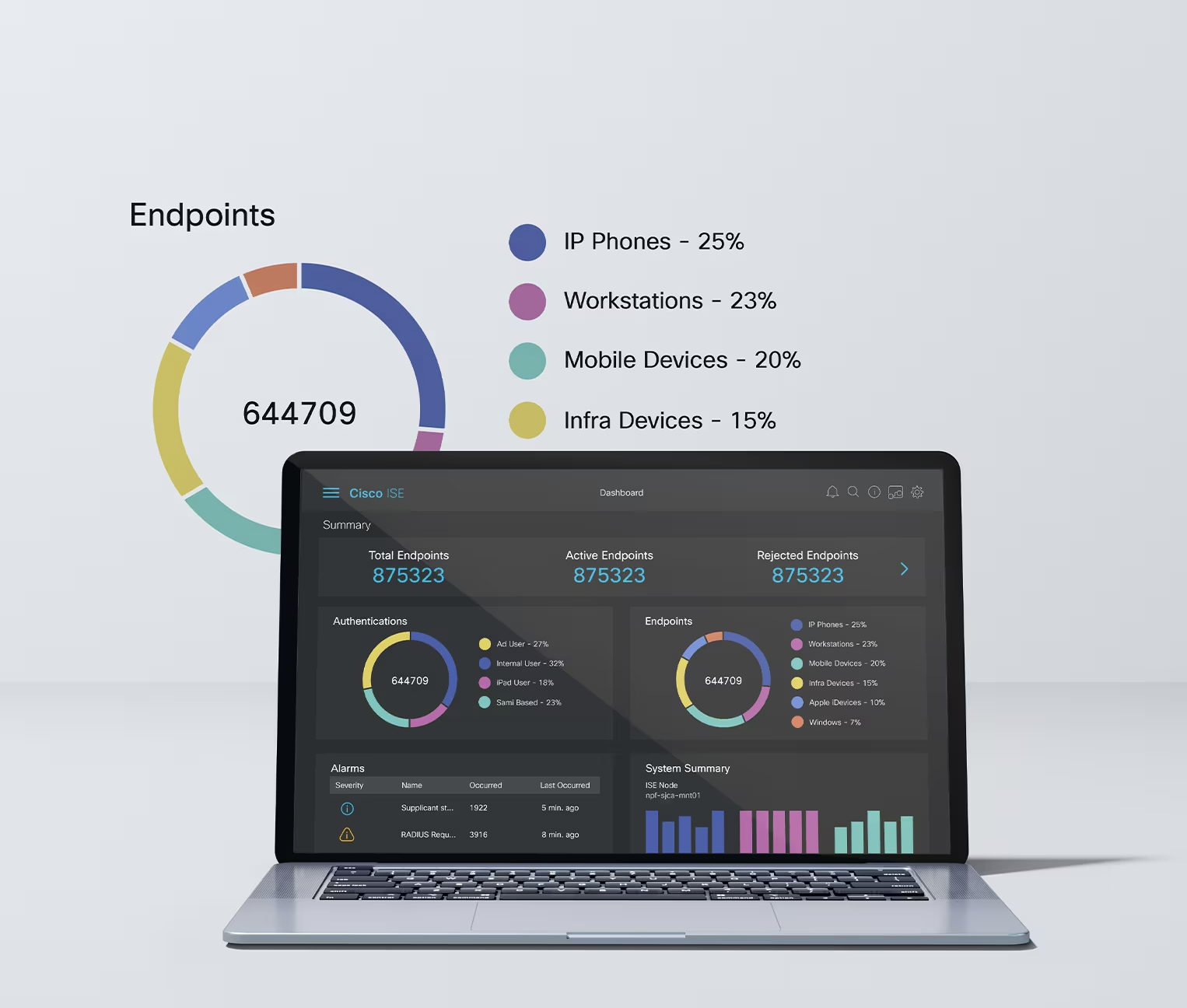
The Cisco Identity Services Engine (ISE) offers a network-based approach for adaptable, trusted access everywhere, based on context. It gives the user intelligent, integrated protection through intent-based policy and compliance solutions.
Ultimately we ended up going with Cisco Duo because we are a Cisco shop. All of our networking infrastructure, our phones, our wireless environment is Cisco based. It made logical sense to stay with a product that we already have a line of support with. With a smaller …
A de minimis incentive was given to thank the reviewer for their time. The incentive was not used to bias or drive a particular response, nor was the incentive contingent on a positive endorsement. TR verified that a representative sample of customers was invited. More Info
A de minimis incentive was given to thank the reviewer for their time. The incentive was not used to bias or drive a particular response, nor was the incentive contingent on a positive endorsement. More Info
A de minimis incentive was given to thank the reviewer for their time. The incentive was not used to bias or drive a particular response, nor was the incentive contingent on a positive endorsement. More Info
Verified User
Chose Cisco Identity Services Engine (ISE)
We use Cisco Identity Services Engine to complement the products in our security architecture.
A de minimis incentive was given to thank the reviewer for their time. The incentive was not used to bias or drive a particular response, nor was the incentive contingent on a positive endorsement. TR verified that a representative sample of customers was invited. More Info
System engineer in Information Technology at IT PRO CANADA (Retail, 11-50 employees)
Chose Cisco Identity Services Engine (ISE)
Cisco Identity Services Engine (ISE) stands out due to its comprehensive network access control and security features. Unlike Cisco ASA 5500-X with FirePOWER Services, which focuses on firewall and intrusion prevention, ISE provides detailed endpoint profiling, posture …
A de minimis incentive was given to thank the reviewer for their time. The incentive was not used to bias or drive a particular response, nor was the incentive contingent on a positive endorsement. TR verified that a representative sample of customers was invited. More Info
Verified User
Chose Cisco Identity Services Engine (ISE)
So the security team selected Forescout because of its inventory functionality. We have had to utilize Cisco ISE though to actually push the SGT Policies as well as the SGACL mappings and the SXP Propagation across the switch infrastructure. There is a lot more configuration …
A de minimis incentive was given to thank the reviewer for their time. The incentive was not used to bias or drive a particular response, nor was the incentive contingent on a positive endorsement. More Info
IT Security Manager in Information Technology at Paraco Gas Corporation (Oil & Energy, 501-1000 employees)
Chose Cisco Identity Services Engine (ISE)
Cisco Identity Services Engine (ISE) Stacks up nicely alongside them and we chose Cisco because our business is a Cisco shop and keeping our number of support vendors low is a big way that we keep things simple resulting in a low headcount in the IT Dept. We use it in …
A de minimis incentive was given to thank the reviewer for their time. The incentive was not used to bias or drive a particular response, nor was the incentive contingent on a positive endorsement. More Info
For secure access to apps and business data, I recommend Cisco Duo. It offers SSO, MFA, and Passwordless access, ensuring teams can securely access business data. It is easy to customize and comes with top-tier security features. It protects business data, apps, and users.
A de minimis incentive was given to thank the reviewer for their time. The incentive was not used to bias or drive a particular response, nor was the incentive contingent on a positive endorsement. TR verified that a representative sample of customers was invited. More Info
Well suited... I've used it for both wired and wireless access, and it's perfect for that. In addition to enforcing security on the port, you can also lock down east-west traffic. When you get to the point where you're configuring secure group tags and things like that, you can keep people from getting to places they shouldn't. Basically, you could turn your entire network into a firewall if you wanted to. You can secure access based on the identity of any given user through role-based authentication. For example, if you have salespeople and you don't want them accessing your financial or PCI environment, they authenticate as a salesperson and you can completely stop them from getting to any of that. That's really important, especially for us. Our payment card infrastructure servers are heavily locked down. Granted, in our situation, we firewall all that off anyway, but you still don't want some random individual to be able to even attempt that sort of thing. That's what it's really good for. I'm trying to think of a weakness. I don't know. We don't really struggle with it. There's nothing that I use it for where I wish it were better, at least not that I can think of offhand. I'm sure there are things, I just can't think of anything off the top of my head.
A de minimis incentive was given to thank the reviewer for their time. The incentive was not used to bias or drive a particular response, nor was the incentive contingent on a positive endorsement. More Info
We use Cisco Duo with different type of device and application, but we never face any difficulties to integrate Cisco Duo with any of them.
We integrated Cisco Duo with some of our active directory and some of the OS are quite old but Cisco Duo works totally fine with them.
The end user application is very easy to use. We never had any complain from non tech team members of having trouble of using Cisco Duo.
There are several authentication methods available rather than passcode. I personally like the push notification which is always on time and quite fast.
A de minimis incentive was given to thank the reviewer for their time. The incentive was not used to bias or drive a particular response, nor was the incentive contingent on a positive endorsement. More Info
A de minimis incentive was given to thank the reviewer for their time. The incentive was not used to bias or drive a particular response, nor was the incentive contingent on a positive endorsement. TR verified that a representative sample of customers was invited. More Info
Should have device to device connection ability whereas internet is not met.
Changes of device can be sorted and easily made using a second email address or any other identification method.
Troubleshooting should be easy to sort out. One time, a Duo admin deleted the authentication group, and some employees were not getting push notifications. It was very hard to find out the cause. Duo should have some troubleshooting finder.
Sometimes push notifications are delayed, and the code does not work. At that time, we need to enroll the device again. Not sure why it happens. Duo should give reasons for the error.
A de minimis incentive was given to thank the reviewer for their time. The incentive was not used to bias or drive a particular response, nor was the incentive contingent on a positive endorsement. More Info
There are a lot of competing solutions on the market; however, Duo "just works", and there is little to no learning curve for the new members to be acclimated to it. As long as that continues I see it as the preferred option moving forward
A de minimis incentive was given to thank the reviewer for their time. The incentive was not used to bias or drive a particular response, nor was the incentive contingent on a positive endorsement. TR verified that a representative sample of customers was invited. More Info
A de minimis incentive was given to thank the reviewer for their time. The incentive was not used to bias or drive a particular response, nor was the incentive contingent on a positive endorsement. TR verified that a representative sample of customers was invited. More Info
La interfaz es intuitiva y fácil de navegar, lo que permite a los usuarios administrar sus dispositivos y acceder a las políticas sin problemas. La integración con las aplicaciones SSO y SaaS facilita aún más el proceso de acceso, mejorando la experiencia del usuario.
A de minimis incentive was given to thank the reviewer for their time. The incentive was not used to bias or drive a particular response, nor was the incentive contingent on a positive endorsement. More Info
For us the solution is very easily useable on its own. Perhaps that has to do because we started using ISE in the 1.2 days and have seen it grow during the years. Policy creation, etc. is all very visible and thus easy to use. Deployment of multiple nodes is also incredibly easy and flexible. You can easily add or remove nodes as you wish.
A de minimis incentive was given to thank the reviewer for their time. The incentive was not used to bias or drive a particular response, nor was the incentive contingent on a positive endorsement. More Info
In the last 5+ years we've been using Duo, there may have been 1 outage that impacted us. We do receive periodic notifications of issues but, for the most part, they impact carriers or functionality that we either don't use, or do not care about.
We do have to occasionally reboot the servers when they get low on memory, but we're also a few versions behind. Availability has generally been pretty good though with no major outages in the time that we've had it implemented.
A de minimis incentive was given to thank the reviewer for their time. The incentive was not used to bias or drive a particular response, nor was the incentive contingent on a positive endorsement. TR verified that a representative sample of customers was invited. More Info
A de minimis incentive was given to thank the reviewer for their time. The incentive was not used to bias or drive a particular response, nor was the incentive contingent on a positive endorsement. TR verified that a representative sample of customers was invited. More Info
I have not needed direct support for Cisco Secure Access by Duo as I have not had a problem with it, but I have full confidence that the support is outstanding. It is now a core component of the corporate technology stack - a problem would mean a serious degradation in the ability of the company to function.
A de minimis incentive was given to thank the reviewer for their time. The incentive was not used to bias or drive a particular response, nor was the incentive contingent on a positive endorsement. More Info
Cisco support is second to none, both in terms of how you access support but also the knowledge of the individual support teams. If you focus on one technology and provide "manufacturer support" then you can rest assured that you are accessing Cisco's top individuals. I feel like this is a USP for Cisco support.
A de minimis incentive was given to thank the reviewer for their time. The incentive was not used to bias or drive a particular response, nor was the incentive contingent on a positive endorsement. More Info
A de minimis incentive was given to thank the reviewer for their time. The incentive was not used to bias or drive a particular response, nor was the incentive contingent on a positive endorsement. TR verified that a representative sample of customers was invited. More Info
Documentation could have been better. I had to piece together different KB/admin guides to make certain things work and I also had to use third-party guides to get bits of information that were missing from Cisco Duo documentation. Support was also engaged multiple times to figure out an issue and after some back and forth it was usually determined that the information I needed was hidden somewhere else and had no direct correlation with the document that was linked from the platform.
A de minimis incentive was given to thank the reviewer for their time. The incentive was not used to bias or drive a particular response, nor was the incentive contingent on a positive endorsement. More Info
I think our system integrators lacks some competencies and this has led to an implementation that is still perfectible. (i.e. dedicating an interface for intra-cluster communication)
A de minimis incentive was given to thank the reviewer for their time. The incentive was not used to bias or drive a particular response, nor was the incentive contingent on a positive endorsement. More Info
Ultimately we ended up going with Cisco Duo because we are a Cisco shop. All of our networking infrastructure, our phones, our wireless environment is Cisco based. It made logical sense to stay with a product that we already have a line of support with. With a smaller support / tech group we depend on outside Cisco support. That support is already here for us, so we stayed with a Cisco product.
A de minimis incentive was given to thank the reviewer for their time. The incentive was not used to bias or drive a particular response, nor was the incentive contingent on a positive endorsement. TR verified that a representative sample of customers was invited. More Info
I think all give some visibility of device monitoring and management, but Cisco Identity Services Engine gives a good way to manage more details about the device in a centralized way that gives a wider range of monitoring and control than the other softwares individually. I don't think Cisco Identity Services Engine eliminates the need for these other software as of now, but there is potential for Cisco Identity Services Engine to be able to take over more of these roles.
A de minimis incentive was given to thank the reviewer for their time. The incentive was not used to bias or drive a particular response, nor was the incentive contingent on a positive endorsement. TR verified that a representative sample of customers was invited. More Info
A de minimis incentive was given to thank the reviewer for their time. The incentive was not used to bias or drive a particular response, nor was the incentive contingent on a positive endorsement. TR verified that a representative sample of customers was invited. More Info
It's fully customised and comprehensive. only thing is you need to know what you want. Proper research and planning would save lots of time and effort .
A de minimis incentive was given to thank the reviewer for their time. The incentive was not used to bias or drive a particular response, nor was the incentive contingent on a positive endorsement. TR verified that a representative sample of customers was invited. More Info
Cisco Duo has saved us from automated attacks on VPN. We had an instance is 2024 where our VPN was being brute force attacked, and we had several users' weak passwords compromised; however the VPN security groups, and the MFA kept the attacks from gaining access. We've since replaced our firewall with capabilities for limitations on country access for VPN, and beefed up our password complexity settings,
A de minimis incentive was given to thank the reviewer for their time. The incentive was not used to bias or drive a particular response, nor was the incentive contingent on a positive endorsement. More Info
I don't know about negatives because we haven't seen it right now, but positive impact is one is the roadmap we have. And now since we are going ahead with doing the deployment of Cisco ISE, we see that we are getting closure to, so at the end of the day, we have to make sure that operationally we stay excellent. So that's where operational excellence comes in. Cisco ISE is basically addressing that for us. Right now we are in a situation if there is a WIFI issue or if there is an authentication issue, it gets really difficult to isolate the problem. But with Cisco ISE , this functionality is going to come in. So we believe that it would be a good ROI.
A de minimis incentive was given to thank the reviewer for their time. The incentive was not used to bias or drive a particular response, nor was the incentive contingent on a positive endorsement. TR verified that a representative sample of customers was invited. More Info