
Chose IBM Cloudant
IBM Cloudant vs. Firebase vs. MongoDB
IBM Cloudant vs. Firebase vs. MongoDB
| Product | Rating | Most Used By | Product Summary | Starting Price |
|---|---|---|---|---|
 IBM Cloudant | N/A | Cloudant is an open source non-relational, distributed database service that requires zero-configuration. It's based on the Apache-backed CouchDB project and the creator of the open source BigCouch project. Cloudant's service provides integrated data management, search, and analytics engine designed for web applications. Cloudant scales your database on the CouchDB framework and provides hosting, administrative tools, analytics and commercial support for CouchDB and BigCouch. Cloudant is often… | $1 per month per GB of storage above the included 20 GB | |
 Firebase | N/A | Google offers the Firebase suite of application development tools, available free or at cost for higher degree of usages, priced flexibly accorded to features needed. The suite includes A/B testing and Crashlytics, Cloud Messaging (FCM) and in-app messaging, cloud storage and NoSQL storage (Cloud Firestore and Firestore Realtime Database), and other features supporting developers with flexible mobile application development. | $0.01 Per Verification | |
 MongoDB | N/A | MongoDB is an open source document-oriented database system. It is part of the NoSQL family of database systems. Instead of storing data in tables as is done in a "classical" relational database, MongoDB stores structured data as JSON-like documents with dynamic schemas (MongoDB calls the format BSON), making the integration of data in certain types of applications easier and faster. | $0.10 million reads |
| IBM Cloudant | Firebase | MongoDB | ||||||||||||||||||||||
|---|---|---|---|---|---|---|---|---|---|---|---|---|---|---|---|---|---|---|---|---|---|---|---|---|
| Editions & Modules |
|
|
| |||||||||||||||||||||
| Offerings |
| |||||||||||||||||||||||
| Entry-level Setup Fee | No setup fee | No setup fee | No setup fee | |||||||||||||||||||||
| Additional Details | — | — | Fully managed, global cloud database on AWS, Azure, and GCP | |||||||||||||||||||||
| More Pricing Information | ||||||||||||||||||||||||
| IBM Cloudant | Firebase | MongoDB | |
|---|---|---|---|
| Considered Multiple Products | IBM Cloudant  Denis Voloshko platform manager Chose IBM Cloudant Cloudant extends features of CouchDB, but you don't have to host it for yourself. IBM does this for you. Also Cloudant is free if you are under $50 per month. And there is integration with other IBM products, like dashDB (for analytics).Cloudant has CouchApps and it's a feature …  Wes Wilson CTO (Chief Technical Officer) Chose IBM Cloudant It's easier to use than Dynamo, more open than Firebase, and has better documentation that CouchDB... it might not be fair to compare Modulus, Modulus obviously suffers from some scalability issues and might not be in the same class... but its a hosted DB service we had some …  Pankaj Choudhary Sr. Android Developer Chose IBM Cloudant IBM cloudant documentation is very easy to understand and because of that the implementation is also very easy. We found some difficulties in case of aws documents implementation. Performance of the cloudant database is also high as compare to the other databases. Indexing and …  Jagmeet singh Software Developer Chose IBM Cloudant IBM Cloudant is great for quick deployment and configs of a database service, especially when it comes to rapid prototyping. In a research capacity, we need to spin up web services and run experiments quickly. IBM Cloudant is a fuss-free database service [that] aids in this …  Jerry Ebherson Sanchez Aguado Gestión de proyectos Chose IBM Cloudant The gap that we wanted to cover was to deploy a self-managed CouchDB environment, which would allow us the bidirectional replication of Databases through several physical locations of the same client. IBM Cloudant was the best choice after evaluating some other platforms with …  Saket Nalegaonkar Senior Application Developer -IoT Chose IBM Cloudant As its documentation and help are always available, it's easier to manage than any other database mentioned.  Deepak Kaul CTO Chose IBM Cloudant In our case it was a no-brainer since we were using IBM Cloud. In comparison to DB2 the ease of use and JSON support was the key.  Naresh Jasotani Director - Data and Analytics Services (Presales) Chose IBM Cloudant IBM Cloudant DB is backed by CouchDB and that too hosted on IBM Cloud is the key. Concurrency and durability is the key here. In-memory capabilities are non-existent on the IBM Cloudant DB.  Romualdo Gobbo Owner Chose IBM Cloudant All other NoSQL document-centric DB must be installed on premise on in the cloud as complicated clusters. The "as a service" formula and the open source origin were the same reasons for Cloudant choice, freeing us of all system and administration tasks!  Justin Saul Senior Director - SeniorAdvisor.com Chose IBM Cloudant Cloudant is a database as a service with a strong support team. The feature set is comparable to other solutions but not all are managed services, or have easy scalability, or can demonstrate production level reliability and performance.  Bryan Redeagle Developer Chose IBM Cloudant The technology behind Cloudant (BigCouch) is no better or worse than any of these. They are all good for different reasons. What makes Cloudant my choice against them is the hosted portion. These are all just databases that I would have to manage. Cloudant is managed for me, … | Firebase  Yash Trivedi Software Engineer III Chose Firebase Firebase is easy to manage and scale really well for web application services. It offers better authentication and is easy to implement. For real-time analytics on web applications, it works very well. Firebase offers more features compared to other services especially it can … |  MongoDB  Sagiv Frankel Senior Software Engineer Chose MongoDB Your default choice should not be MongoDB in my opinion. Most user-facing systems are relational by nature so a well known and reliable SQL database would be easier to maintain and simpler to develop long term. If you highly value speed of development go with Firebase. If you … |
| IBM Cloudant | Firebase | MongoDB | |||||||||||||||||||||||||||||||
|---|---|---|---|---|---|---|---|---|---|---|---|---|---|---|---|---|---|---|---|---|---|---|---|---|---|---|---|---|---|---|---|---|---|
| NoSQL Databases |
|
| IBM Cloudant | Firebase | MongoDB | |
|---|---|---|---|
| Small Businesses |  Redis Software Score 9.1 out of 10 |  Visual Studio Score 8.8 out of 10 | IBM Cloudant Score 7.4 out of 10 |
| Medium-sized Companies | Redis Software Score 9.1 out of 10 | Visual Studio Score 8.8 out of 10 | IBM Cloudant Score 7.4 out of 10 |
| Enterprises | Redis Software Score 9.1 out of 10 | Visual Studio Score 8.8 out of 10 | IBM Cloudant Score 7.4 out of 10 |
| All Alternatives | View all alternatives | View all alternatives | View all alternatives |
| IBM Cloudant | Firebase | MongoDB | |
|---|---|---|---|
| Likelihood to Recommend | 7.0 (45 ratings) | 4.1 (29 ratings) | 10.0 (79 ratings) |
| Likelihood to Renew | 7.3 (1 ratings) | - (0 ratings) | 10.0 (67 ratings) |
| Usability | 7.7 (5 ratings) | 4.1 (4 ratings) | 10.0 (15 ratings) |
| Availability | 8.2 (1 ratings) | - (0 ratings) | 9.0 (1 ratings) |
| Performance | 8.2 (1 ratings) | - (0 ratings) | - (0 ratings) |
| Support Rating | 8.6 (4 ratings) | 7.3 (6 ratings) | 9.6 (13 ratings) |
| Online Training | 7.3 (2 ratings) | - (0 ratings) | - (0 ratings) |
| Implementation Rating | 8.2 (4 ratings) | - (0 ratings) | 8.4 (2 ratings) |
| Configurability | 8.5 (3 ratings) | - (0 ratings) | - (0 ratings) |
| Product Scalability | 9.6 (23 ratings) | - (0 ratings) | - (0 ratings) |
| Vendor pre-sale | 9.1 (1 ratings) | - (0 ratings) | - (0 ratings) |
| IBM Cloudant | Firebase | MongoDB | |
|---|---|---|---|
| Likelihood to Recommend | IBM
| Google
| MongoDB
 Kendal Droddy Senior System Engineer |
| Pros | IBM
Naresh Jasotani Director - Data and Analytics Services (Presales) | Google
 Sam Lepak Head of Digital Marketing | MongoDB
 Ronald Melendez Desarrollador de software |
| Cons | IBM
| Google
 Evan Laird Chief Marketing Officer | MongoDB
 Joshua Weaver Developer |
| Likelihood to Renew | IBM
 victor pease solano General Manager | Google No answers on this topic | MongoDB
 Jon Kern Manager Strategic Products |
| Usability | IBM
Bryan Redeagle Developer | Google
 Brenton Colton Analytics Lead Consultant | MongoDB
 Jose Manuel Ortega Software Engineer && Security researcher |
| Reliability and Availability | IBM
| Google No answers on this topic | MongoDB No answers on this topic |
| Performance | IBM
| Google No answers on this topic | MongoDB No answers on this topic |
| Support Rating | IBM
 Nicolas Peeters VP of Engineering | Google
| MongoDB
 Mehmet Fatih Onal Technical Architect |
| Online Training | IBM
victor pease solano General Manager | Google No answers on this topic | MongoDB No answers on this topic |
| Implementation Rating | IBM
Nicolas Peeters VP of Engineering | Google No answers on this topic | MongoDB
 Tom Maiaroto Sr. Platform Developer / UX Designer / Optimization Engineer |
| Alternatives Considered | IBM
| Google
| MongoDB
 Oleg Chumin Java Software Engineer |
| Scalability | IBM
Wes Wilson CTO (Chief Technical Officer) | Google No answers on this topic | MongoDB No answers on this topic |
| Return on Investment | IBM
| Google
| MongoDB
 Jeff Sherard Senior Leader |
| ScreenShots | MongoDB Screenshots     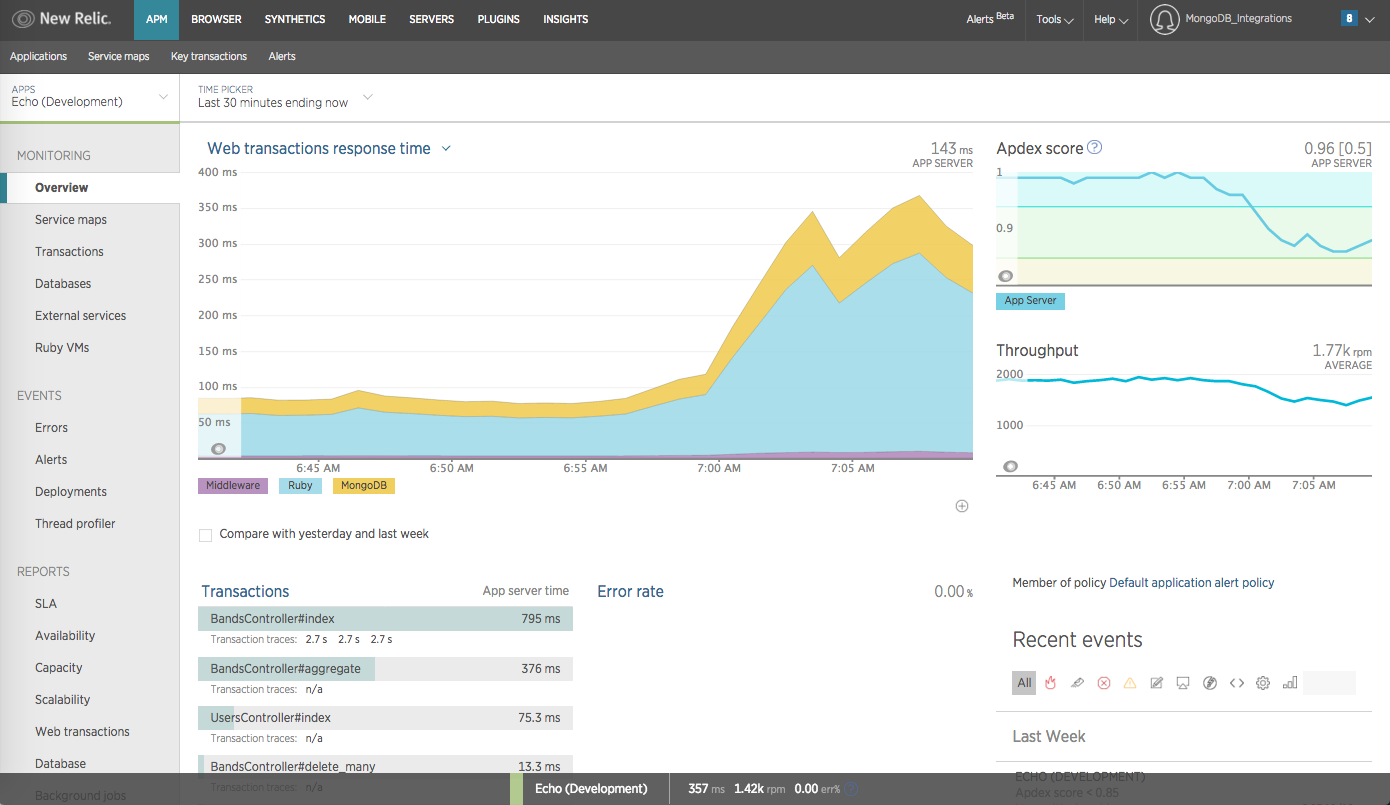 |