DigitalOcean is an infrastructure-as-a-service (IaaS) platform from the company of the same name headquartered in New York. It is known for its support of managed Kubernetes clusters and “droplets” feature.
$5
Starting Price Per Month
Splunk Observability Cloud
Score 8.4 out of 10
N/A
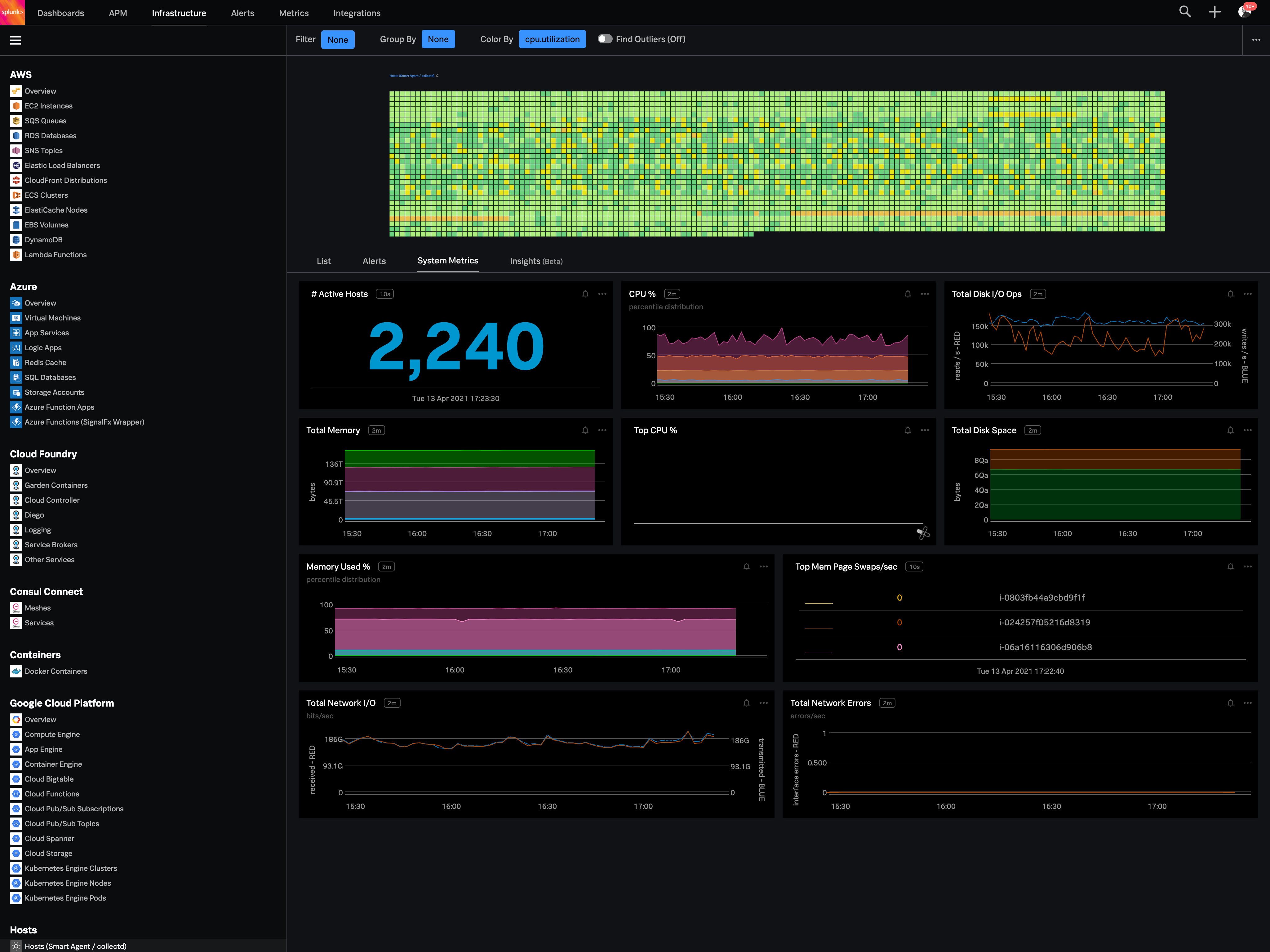
Splunk Observability Cloud aims to enable operational agility and better customer experience through real-time AI-driven streaming analytics allowing accurate alerts in seconds. It is designed to shorten MTTD and MTTR by providing real-time visibility into cloud infrastructure and services.
DigitalOcean is perfect for hosting client websites, running marketing tools, and managing media storage with Spaces and CDN. The use of Droplets to quickly launch landing pages or WordPress sites for campaigns is a Godsend. It’s great for fast, cheap, and scalable solutions. But for complex microservices or projects needing strict compliance (like HIPAA), DigitalOcean may not always be the best fit, but that depends heavily on your project.
Its great if you need real-time visibility across complex or regulated environments. Also strong for hybrid or multi-cloud setups where uptime, observability and fast IR are required. It’s probably overkill for smaller teams or environments that don’t have constant changes or compliance reporting needs. It's expensive and has a steep learning curve. Also, in my opinion, do not get yourself into a consumption based model. Costs can certainly get out of control quickly.
The first one is its Kubernetes container monitoring.
I really like this features because as we know how much K8s is vast and to manually monitor each part of the Kubernetes it takes so much time but Splunk Observability Cloud makes it easier. And even once we integrate K8s with Splunk Observability Cloud it gives us some prebuilt dashboards which gives holistic view of our Cluster and its nodes, pods, etc.
The dashbaord feature of Splunk Observability Cloud, it gives us full flexibility to customize our dashboard with a wide range of predefined chart types.
Now it also supports OTEL, which is a plus point for observability. As now everyone is moving towards Otel and in current market there are only few tools who supports OTEL based integrations, Splunk Observability Cloud is one out of them.
Some products/services available on other Cloud providers aren't available, but they seem to be catching up as they add new products like Managed SQL DBs.
While they have FreeBSD droplets (VMs), support for *BSD OSs is limited. I.e. the new monitoring agent only works on Linux.
There are no regions available on South America.
They don't seem to offer enterprise-level products, even basic ones as Windows Server, MS SQL Server, Oracle products, etc.
You can use table-like functionality to generate dashboards, but these queries are heavy on the system.
It could be easier to give insight into what type of line parsing is used for specific documents in a company-managed environment and/or show ways to gain the insights needed.
I would like to see ways to anonymize specific data for shared reports without pre-formatting this in a dashboard on which reports could be based.
Good: Stable system with low error rate Easy to use for simple use cases Bad: UI is not very clear for complex usage Mobile view (when logged in from phone) is bad No library for .net
I honestly can't think of an easier way to set up and maintain your own server. Being able to set up a server in minutes and have fully control is awesome. The UX is incredibly intuitive for first-time users as well so there's no reason to be intimidated when it comes to giving DigitalOcean a shot.
When there is an issue, it’s a win if one can easily identify the root cause. To do the same, it should allow the user to dig deep with multiple data points and compare the data and identify the anomaly. In this use case, it’s good to drive from Splunk 011y.
They have always been fast, and the process has been straight-forward. I haven't had to use it enough to be frustrated with it, to be honest, and when I have an issue they fix it. As with all support, I wish it felt more human, but they are doing aces.
DigitalOcean is an inexpensive product as compared to other products available in the market. The UI is easy and the beginner can also understand the UI with the step by step guide. It provides a lot of custom features and the user needs to pay only for what they are using. Amazon has a complex UI and is on the expensive side. DigitalOcean is simple to use and is easily manageable and the servers can easily be set up without additional cost and such.
Splunk Infrastructure Monitoring provides far superior options for anybody using a complex hybrid multi-cloud environment and allows both your SOC and NOC to work together on the same data while driving their own insights. We found other products are still in the old world view of servers and agents residing together within a single data centre, but modern apps are no longer like this.
Positive - Elastic computer instances make it possible to pay for only for what you need.
Positive - Competitive pricing - some of the products that DigitalOcean offers are much cheaper than those offered by competitors.
Negative - Having to go to other cloud computing platforms for more specific, advanced services like Computer Vision optimized services, GPU cloud compute instances, etc...