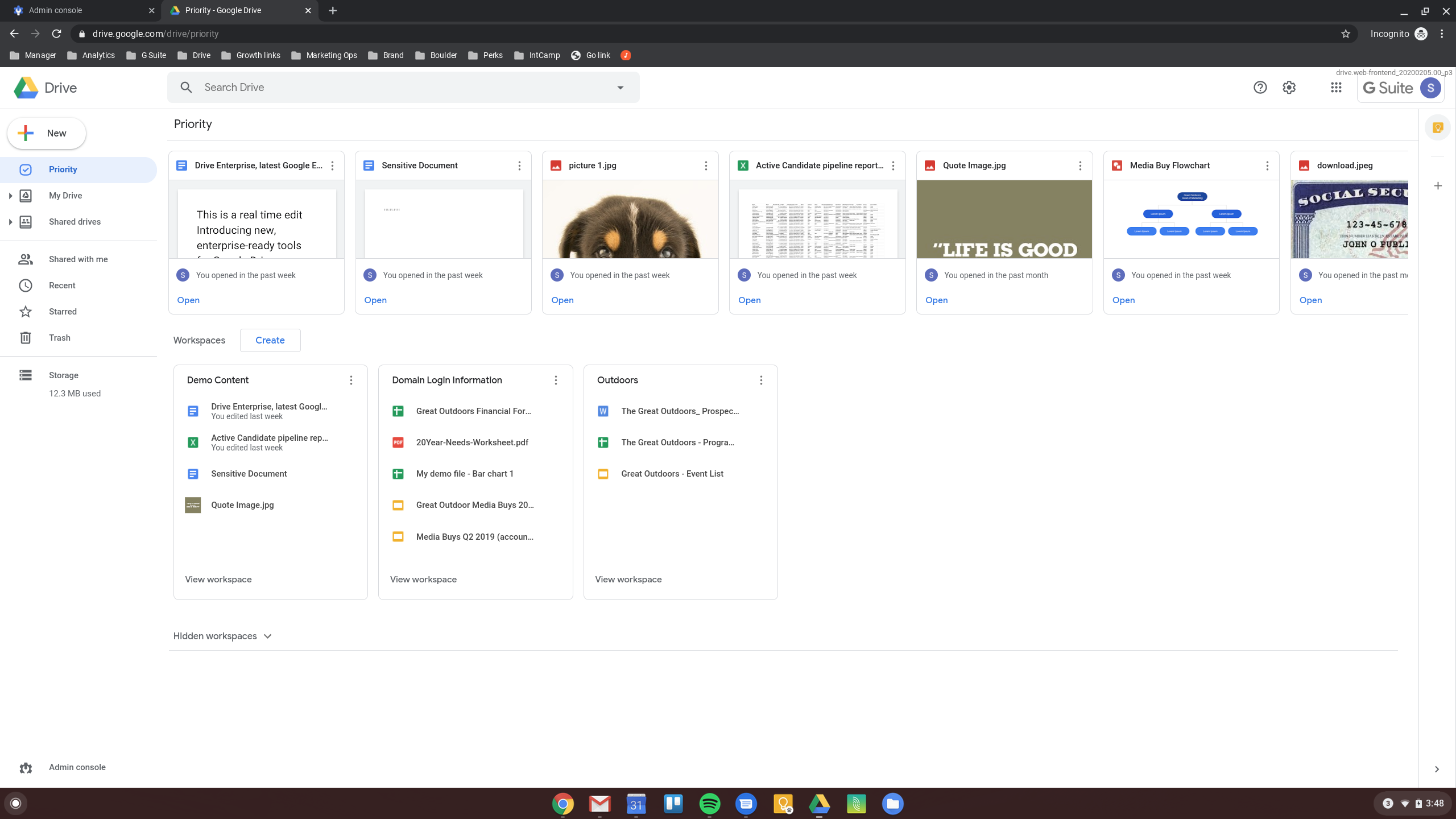
Google Drive is a cloud file storage, synchronization, and collaboration platform and service, that features Google Docs, Sheets, and Slides for document editing and presentation.
$6
per month
Oracle Hyperion (legacy)
Score 7.5 out of 10
N/A
Oracle's Corporate Performance Management suite was acquired from Hyperion in 2007. Hyperion customers are encouraged to migrate to Oracle Fusion Cloud EPM.
N/A
Pricing
Google Drive
Oracle Hyperion (legacy)
Editions & Modules
Basic
$6.00
per month
Business
$12.00
per month
Enterprise
Contact Vendor for Quote
per month
No answers on this topic
Offerings
Pricing Offerings
Google Drive
Oracle Hyperion (legacy)
Free Trial
Yes
No
Free/Freemium Version
Yes
No
Premium Consulting/Integration Services
No
No
Entry-level Setup Fee
No setup fee
No setup fee
Additional Details
Discounts are available for students, educators, and non profit organizations.
—
More Pricing Information
Community Pulse
Google Drive
Oracle Hyperion (legacy)
Features
Google Drive
Oracle Hyperion (legacy)
File Sharing & Management
Comparison of File Sharing & Management features of Product A and Product B
Google Drive
8.0
219 Ratings
4% below category average
Oracle Hyperion (legacy)
-
Ratings
Versioning
8.3193 Ratings
00 Ratings
Video files
7.2188 Ratings
00 Ratings
Audio files
7.8182 Ratings
00 Ratings
Document collaboration
8.8216 Ratings
00 Ratings
Access control
7.6214 Ratings
00 Ratings
File search
7.5218 Ratings
00 Ratings
Device sync
8.9204 Ratings
00 Ratings
Cloud Storage Security & Administration
Comparison of Cloud Storage Security & Administration features of Product A and Product B
Google Drive
8.3
213 Ratings
4% below category average
Oracle Hyperion (legacy)
-
Ratings
User and role management
8.6200 Ratings
00 Ratings
File organization
7.5211 Ratings
00 Ratings
Device management
8.799 Ratings
00 Ratings
Cloud Storage Platform
Comparison of Cloud Storage Platform features of Product A and Product B
Google Drive
8.7
212 Ratings
1% above category average
Oracle Hyperion (legacy)
-
Ratings
Performance
8.9210 Ratings
00 Ratings
Reliability
8.8212 Ratings
00 Ratings
Storage Reports
8.587 Ratings
00 Ratings
Budgeting, Planning, and Forecasting
Comparison of Budgeting, Planning, and Forecasting features of Product A and Product B
Google Drive
-
Ratings
Oracle Hyperion (legacy)
10.0
22 Ratings
11% above category average
Long-term financial planning
00 Ratings
10.017 Ratings
Financial budgeting
00 Ratings
10.020 Ratings
Forecasting
00 Ratings
10.021 Ratings
Scenario modeling
00 Ratings
10.016 Ratings
Management reporting
00 Ratings
10.021 Ratings
Analytics and Reporting
Comparison of Analytics and Reporting features of Product A and Product B
It is possible to share files and folders with up to 200 email addresses, as well as with persons outside the company.Use the drop-down arrow to select who may see, comment on, or change the file or folder before sending out an invitation.I am very much impressed with this feature
Well suited: For use in multiple offices around the world. I was able to obtain financial reporting data from 5 foreign offices and then consolidate their data with 3 domestic USA offices to prepare a consolidated financial statement. Less Appropriate: Translating the financial value for consulting services could be a bit challenging because that required human interaction and judgement. It would have been great to be able to set up some software to be able to interpret this and let it run for all future project work revenue projection.
Any user with access can store a file using different platforms like Android, IOS, Windows, or Ubuntu (Desktop version)
You can share files with any number of different users with different access rights or you can even keep it public by providing the access link and assign different rights for public access
You can open Excel/Word files using google software Sheets/Docs in the browser environment without having to install software like Microsoft Office etc on your Windows OS
This product handles budgeting by Employee and/or Position very well. It is highly flexible and allows Hyperion administrators the ability to develop a planning application that fits a variety of different business needs.
It is great at calculating benefits using business rules to automate the population of these fringe costs in the overall budget planning process. This greatly reduces user error.
It allows you to seed the operating budget based on changes to key drivers, such as percentage increases, flat dollar increases and more detailed changes using business rules.
Allows visibility into the plans for each unit across the organization, rolled up into an overall budget for the campus.
It handles the creation of budgets with multiple chartfield segments or dimensions, which most other budgeting systems cannot handle well. It can aggregate these very quickly.
Having a little bit more control and clarity over what is shared and how it is shared would be a useful improvement.
Could be more robust and flexible as far as assigning restrictions.
Google Sheets could be enhanced because Excel really is not there yet as a product with equal capabilities as there are still quite a few limitations to the functionality.
One pain point for us is the consolidation and translation process. Needing to translate the data over and over again is frustrating and there is no visibility into how many users are running a translation. If multiple users attempt to translate the same data set, say goodbye to your performance but you have no way of knowing! (Unless you want to pull up a task audit which is not a very realistic expectation). It has the been the quickest way for us to bring the system to it's knees. The consolidation process performs in direct correlation to the complexity of the calculation/consolidation rules. So, while the product is extremely flexible, you still have to be careful how you design your rules and calculations to make sure that you do it on the smallest subset of data as possible to avoid large processing times. This makes sense, but requires some significant expertise that most organizations do not have in-house.
The Hyperion Financial Reporting product is ridiculously outdated and clunky to use. The interface for designing reports is not intuitive, and not easy to modify once a report is built. I think there must be a strategic decision to move away from it and go to something more like Oracle BI because I just can't understand why in the world they don't update the reporting product. It also requires a significant level of expertise to be able to use. Not a great solution at all if you want multiple end-users to create reports in something other than Excel. Nobody except the HFM admin (which I used to be) in our company even touches this module.
Another pain point is the amount of IT support that is required to run this thing, and again, specialized knowledge of Hyperion products and how they work is required for IT to adequately support it. This goes for application servers and the Oracle database that the applications are running on.
It's perfect for me. It keeps things saved and is easy to remove items if needed. Also, I very much enjoy the formatting options. Along with the integrations it has for SSO. Overall, this is the most user friendly system I have ever come across.
We're in the middle of the road because we are not sure that other products on the market fit the bill for what we need yet. Hyperion is expensive and burdensome from an administrator and maintenance standpoint, but it still seems to be the best solution for what we need. Show us an equally capable SaaS consolidation product and we'll talk again.
It's easy enough to use for computer users of all ages and skill levels. I am an advanced user, and I think the hardest part might be showing someone how to download and set up the app on their device if they weren't too familiar with computers, but overall it is very easy to understand.
The documents load fairly quickly and also update in real time, especially given the fact that multiple people can be using it at once. The "Offline" feature works great to allow the user to make edits and access the document without access to the internet, and then sync changes later once they're back.
It takes a few days for customer support to get back to you. Although, I have not had to use support too often. Once you get an email back, they are very thorough and work hard to fix the problem quickly. It is a really great resource and a great way to get the help you need if you're stuck. A phone call also works quickly but you have to call during specific times.
The premium support team provides much needed dedicated customer service which we are after for what we have paid for this service. We are satisfied with the service and support and do not have any instance where there was an issue that requires escalation to get the right support team. Though the incidence of major issues that requires the premium support are less, we prefer to keep this as a safety net.
The effective google workspace using training that my organization received and was conducted by me (as a team lead of the ICT team) was mind-blowing and as a result, our staff is performing well in terms of using the application for their daily jobs than before. Now, in my institution, all teachers and all the administrative personnel are very much interested in cloud storage facilities, in previous my institution was afraid of losing all important documents in the cloud storage. But, after having received the training they are now realized that if anyone has only one google account then he or she can use 15GB of cloud storage freely and they are now happy because now it is not necessary for anyone to carry the traditional pen drive.
It's an extremely easy software to implement, once you sign up for a google account you automatically have access to google drive with a set amount of storage space. The business or Google Suite accounts have more storage space than a regular free account, but setting up and accessing google drive is very easy in both cases
In short, Google Drive is better for independent users who store a normal amount of stuff. OneDrive makes more sense for businesses and teams that are doing heavy-duty storage or large-scale syncing. Realistically, though, most users will fall somewhere in between the two, where either platform would meet their needs.
I use Oracle Hyperion Enterprise Performance Mangement because the company I work at requires me to use it in the Financial Planning sector as most of their data is stored in it. I am open minded and ready to use other performance management tools created by Oracle if my work permits.
Oracle Hyperion allows us to automate and consolidate financial data that used to be performed manually in spreadsheets. From that perspective the ROI is huge.
Oracle Hyperion functionality is extensive and allows us to perform most functions for planning, consolidating and reporting on our financial data.
One negative with Oracle Hyperion is that it is complicated to implement and maintain. It takes expertise at all levels (infrastructure and management) to realize the benefits from it.