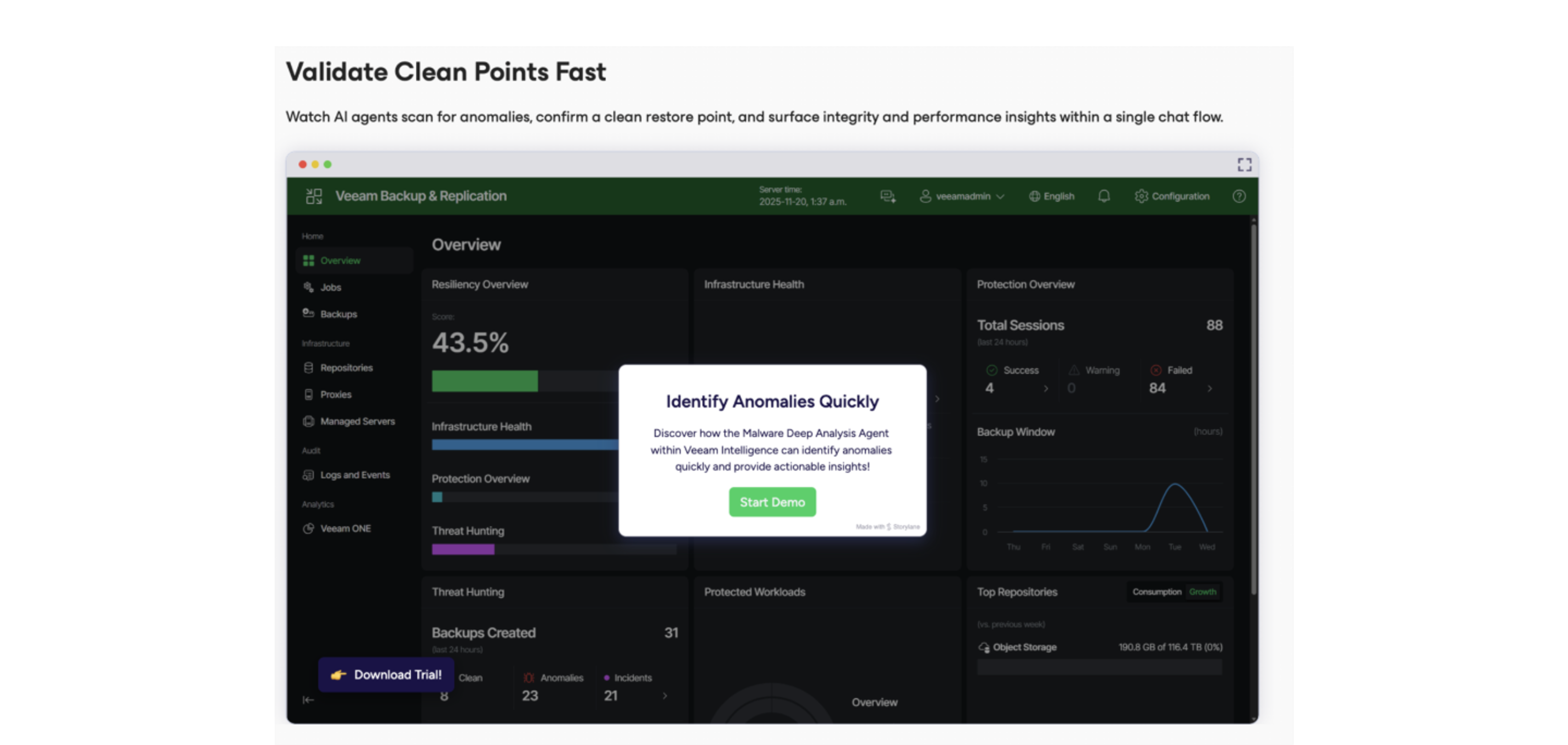
Veeam’s® premier product, Veeam Backup & Replication™, delivers availability for all cloud, virtual, Kubernetes and physical workloads. Through a management console, the software provides backup, archival, recovery and replication capabilities.
$428
per year per 5 instances
Pricing
Hyper-V
Veeam Data Platform
Editions & Modules
Developer
$24.95
per month
Bronze
$49.00
per month
Silver
$89.00
per month
Gold
$135.00
per month
Platinum
$199.00
per month
Veeam Data Platform Essentials
$428
per year per 5 instances
Veeam Data Platform
Contact sales team
Offerings
Pricing Offerings
Hyper-V
Veeam Data Platform
Free Trial
No
Yes
Free/Freemium Version
No
Yes
Premium Consulting/Integration Services
No
Yes
Entry-level Setup Fee
No setup fee
No setup fee
Additional Details
—
Veeam sells through channel partners. Contact a partner for detailed pricing and quotes. Resellers or sales personnel are available for assistance.
Hyper-V is powerful and virtualizes Windows exceptionally well, with less tweaking. It is also cheaper, and allows our clients to budget more for more frequent expansion. Its only real competitor in my opinion is VMware, and that is because vCenter is much more intuitive than …
A de minimis incentive was given to thank the reviewer for their time. The incentive was not used to bias or drive a particular response, nor was the incentive contingent on a positive endorsement. More Info
Technical Support Specialist II / System Admin in Information Technology at TimeTrak Systems, Inc. (Computer Software, 11-50 employees)
Chose Hyper-V
I really do not have a bunch of experience with VMWare or VirtualBox which I know are two other well-known Virtualization software. I have used VirtualBox a few times when I was in college to learn other operating systems, but I don't recall them being as easy to get going and …
A de minimis incentive was given to thank the reviewer for their time. The incentive was not used to bias or drive a particular response, nor was the incentive contingent on a positive endorsement. More Info
Verified User
Chose Hyper-V
It is close, but VMware is still the preferred virtualization solution. It is far more mature and with a larger install base.
A de minimis incentive was given to thank the reviewer for their time. The incentive was not used to bias or drive a particular response, nor was the incentive contingent on a positive endorsement. More Info
A de minimis incentive was given to thank the reviewer for their time. The incentive was not used to bias or drive a particular response, nor was the incentive contingent on a positive endorsement. TR verified that a representative sample of customers was invited. More Info
Verified User
Chose Veeam Data Platform
Veeam is much more robust than ShadowProtect, while also fitting the budget requirements for some very small environments that previously used CloudBerry. We think this is pretty impressive to have both breadth and depth and maintain reasonable price points to keep on budget. …
A de minimis incentive was given to thank the reviewer for their time. The incentive was not used to bias or drive a particular response, nor was the incentive contingent on a positive endorsement. TR verified that a representative sample of customers was invited. More Info
Verified User
Chose Veeam Data Platform
Prior to going with Veeam Backup & Replication, we used Backup Exec to backup up our VMs and data files to tape. The big difference between those two has been the ability of Veeam Backup & Replication to back up to disk first then copy those backups to tape giving us both the …
A de minimis incentive was given to thank the reviewer for their time. The incentive was not used to bias or drive a particular response, nor was the incentive contingent on a positive endorsement. TR verified that a representative sample of customers was invited. More Info
IT Resources Manager in Information Technology at European Commission (Government Administration, 10,001+ employees)
Chose Veeam Data Platform
Xen Orchestra for Citrix XenServer is a complementary product to Veeam, as long as Xen Orchestra addresses Citrix Xen Servers and Veeam does not. Both are great tools, although Xen Orchestra community edition is a whit better than the already free XenCenter, the reference …
A de minimis incentive was given to thank the reviewer for their time. The incentive was not used to bias or drive a particular response, nor was the incentive contingent on a positive endorsement. TR verified that a representative sample of customers was invited. More Info
A de minimis incentive was given to thank the reviewer for their time. The incentive was not used to bias or drive a particular response, nor was the incentive contingent on a positive endorsement. More Info
Senior Network System Administrator in Information Technology at Capital Region BOCES - NERIC (Information Technology & Services, 1001-5000 employees)
Chose Veeam Data Platform
Veeam Backup & Replication has become the standard solution that we are recommending for any of our customers that want to make use of our off-site disaster recovery solution.
A de minimis incentive was given to thank the reviewer for their time. The incentive was not used to bias or drive a particular response, nor was the incentive contingent on a positive endorsement. More Info
Verified User
Chose Veeam Data Platform
For some of the products we can say we compare this with Veeam every year, but until today we have no reason to switch over to another product. Veeam is rolled out in our organization and every admin can work with the Veeam products, so there's no need to switch (yet!).
A de minimis incentive was given to thank the reviewer for their time. The incentive was not used to bias or drive a particular response, nor was the incentive contingent on a positive endorsement. More Info
Senior IT Systems Administrator in Information Technology at APCON (Computer Networking, 51-200 employees)
Chose Veeam Data Platform
Backup Exec requires additional licenses for VM backups. It also did not work well backing up at a remote site. Backup Exec usually takes more of my time to manage. Veeam is better at restoring machines to a smaller time interval since it can do continuous backups. Backup Exec …
A de minimis incentive was given to thank the reviewer for their time. The incentive was not used to bias or drive a particular response, nor was the incentive contingent on a positive endorsement. More Info
Verified User
Chose Veeam Data Platform
Veeam was much simpler and cheaper for us to implement; however we were a very centralized shop. For larger, more diverse workloads, I think HP's solution is a better fit
A de minimis incentive was given to thank the reviewer for their time. The incentive was not used to bias or drive a particular response, nor was the incentive contingent on a positive endorsement. More Info
Verified User
Chose Veeam Data Platform
Our other backup software that we use is StorageCraft ShadowProtect. They are both image based backups, both have the ability to do virtual recovery or bare metal restores. Both can mount backups and pull out data easily.
Where ShadowProtect shines over Veeam is the resiliency …
A de minimis incentive was given to thank the reviewer for their time. The incentive was not used to bias or drive a particular response, nor was the incentive contingent on a positive endorsement. More Info
Verified User
Chose Veeam Data Platform
We really have not used any other solution than Veeam. We were using Backup Exec before and it doesn't handle backup of virtual machines.
A de minimis incentive was given to thank the reviewer for their time. The incentive was not used to bias or drive a particular response, nor was the incentive contingent on a positive endorsement. More Info
Principal Consultant in Information Technology at SyCom Technologies (Information Technology and Services, 51-200 employees)
Chose Veeam Data Platform
Veeam is very reliable as a backup and replication suite. It is also very easy to use. The only two areas where it doesn't fit well for Hyper-V and VMware environments are places were additional technologies are required to backup massive amounts of VMs, and customers that need …
A de minimis incentive was given to thank the reviewer for their time. The incentive was not used to bias or drive a particular response, nor was the incentive contingent on a positive endorsement. More Info
Helpdesk Support Technician in Information Technology at Rogers Machinery Company, Inc. (Civil Engineering, 1001-5000 employees)
Chose Veeam Data Platform
Veeam ONE was more user friendly, more cost effective and was much faster ant backing up and recovery than Backup Exec was. It also had much better Hyper-V integration tools and allowed much better de-duplication than the other.
A de minimis incentive was given to thank the reviewer for their time. The incentive was not used to bias or drive a particular response, nor was the incentive contingent on a positive endorsement. More Info
Hyper-V makes a lot of sense in scenarios that will support several Windows Server-based OS virtual machines. The only limitation of those licensed VMs is the hardware that hosts the Hyper-V role. If you need to deploy many servers running Windows Server OS, it is worth the price. Hyper-V also does a great job of managing the server host's computational resources, including memory, CPU, network, and storage.
A de minimis incentive was given to thank the reviewer for their time. The incentive was not used to bias or drive a particular response, nor was the incentive contingent on a positive endorsement. More Info
It is well-suited for most environments, from Small and medium businesses to large enterprises. But its cost may be prohibitive for smaller businesses with a limited budget. While there are multiple licensing levels, there may be a use case for creating a level between the community edition and the Foundation.
A de minimis incentive was given to thank the reviewer for their time. The incentive was not used to bias or drive a particular response, nor was the incentive contingent on a positive endorsement. More Info
Easy to use GUI - very easy for someone with sufficient Windows experience - not necessarily a system administrator.
Provisioning VMs with different OSes - we mostly rely on different flavors of Windows Server, but having a few *nix distributions was not that difficult.
Managing virtual networks - we usually have 1 or 2 VLANs for our business purposes, but we are happy with the outcomes.
A de minimis incentive was given to thank the reviewer for their time. The incentive was not used to bias or drive a particular response, nor was the incentive contingent on a positive endorsement. More Info
The ease of use in creating jobs and adding clients enables our new and less skilled administrators to work efficiently, quickly, and accurately.
The same ease of use is essential for junior admins as well. Backups are quickly and accurately restored, allowing our networking team to bring clients back to production within expected times.
The ability to create a restore for testing and to remove it quickly has proven to be an excellent asset for our production and DB teams.
A de minimis incentive was given to thank the reviewer for their time. The incentive was not used to bias or drive a particular response, nor was the incentive contingent on a positive endorsement. TR verified that a representative sample of customers was invited. More Info
We manage Hyper-V using both System Center Virtual Machine Manager (SCVMM) and the in-build Hyper-V administration tool, the former being the main product we use as the built-in tool is very light on functionality, unlike VMware ESXi.
Management of storage is not great and quite a shift away from how VMware does it with ESXi; there is no separate panel/blade/window for LUNs/data stores, which means there is a lot of back and forth when trying to manage storage.
A dedicated client with all functionality in one place would be awesome.
Having the equivalent of ESXi's virtual console is something which is absolutely needed.
A de minimis incentive was given to thank the reviewer for their time. The incentive was not used to bias or drive a particular response, nor was the incentive contingent on a positive endorsement. More Info
On occasion, the 'reason' for a failed backup can be a little hard to understand. It would be nice if it were a bit more straightforward.
I would love to run the platform natively on Linux, but I don't think it's an option.
Sometimes, locating the correct update file for the platform software can be a bit confusing. If they had an option to download the correct update file from within the console, that would take some of the guesswork out of it.
A de minimis incentive was given to thank the reviewer for their time. The incentive was not used to bias or drive a particular response, nor was the incentive contingent on a positive endorsement. TR verified that a representative sample of customers was invited. More Info
Cheap and easy is the name of the game. It has great support, it doesn't require additional licenses, it works the same if it is a cluster or stand-alone, and all the servers can be centrally managed from a system center virtual machine manager server, even when located at remote sites.
A de minimis incentive was given to thank the reviewer for their time. The incentive was not used to bias or drive a particular response, nor was the incentive contingent on a positive endorsement. More Info
I really have no complaints about Veeam Backup & Replication. Their service has been excellent and the cost is minimal in comparison to other services I checked out. Implementation wasn't simple and the Veeam Support team was there to help each step of the way.
A de minimis incentive was given to thank the reviewer for their time. The incentive was not used to bias or drive a particular response, nor was the incentive contingent on a positive endorsement. More Info
It is quite intuitive. Junior techs are able to provision and administrate Hyper-V virtual server infrastructure with little to no additional training. Documentation from Microsoft is easily avaliable and decently well written. Hyper-V is reliable and does what it is supposed to. Can be admin from an intuitive gui, or aoutmated with extensive powershell.
A de minimis incentive was given to thank the reviewer for their time. The incentive was not used to bias or drive a particular response, nor was the incentive contingent on a positive endorsement. More Info
It is a very robust solution that has never failed. It also has perfect integration with Windows server volume shadow copies. The processing load is moved from the backup server to the backup proxy. Increased fault tolerance: you can store data on a separate machine, the backup repository. Can perform a bare metal restore.
A de minimis incentive was given to thank the reviewer for their time. The incentive was not used to bias or drive a particular response, nor was the incentive contingent on a positive endorsement. More Info
In the past 2 years our Hyper-V servers have only had a handful of instances where the VM's on them were unreachable and the physical Hyper-V server had to be restarted. One time this was due to a RAM issue with the physical box and was resolved when we stopped using dynamic memory in Hyper-V. The other times were after updates were installed and the physical box was not restarted after the updates were installed.
A de minimis incentive was given to thank the reviewer for their time. The incentive was not used to bias or drive a particular response, nor was the incentive contingent on a positive endorsement. More Info
I give Veeam Data Platform a rating of 9 for availability because it consistently performs reliably in critical data protection and recovery tasks. The platform is designed to minimize downtime, ensuring that backup and recovery processes are accessible when needed.While there may be rare instances of maintenance or minor application errors, these do not significantly affect the overall reliability of the system. Veeam’s strong architecture and features like high availability configurations further enhance its performance, allowing us to trust it in crucial situations. Overall, it has proven to be a dependable solution that meets our organization's needs effectively.
A de minimis incentive was given to thank the reviewer for their time. The incentive was not used to bias or drive a particular response, nor was the incentive contingent on a positive endorsement. More Info
Hyper-V itself works quickly and rarely gave performance issues but this can be more attributed to the physical server specifications that the actual Hyper-V software in my opinion as Hyper-V technically just utilizes config files such as xml, and a data drive file (VHD, VHDX, etc) to perform its' duties.
A de minimis incentive was given to thank the reviewer for their time. The incentive was not used to bias or drive a particular response, nor was the incentive contingent on a positive endorsement. More Info
Veeam does a good job with backing up our servers in a timely manner. We are still at the beginning of our Veeam use and are pleased with the speed at which we can access the system as well as the backups and restore points. Veeam is definitely superior to our previous backup system in terms of speed and accessibility
A de minimis incentive was given to thank the reviewer for their time. The incentive was not used to bias or drive a particular response, nor was the incentive contingent on a positive endorsement. More Info
I gave it a middle of the road rating - as far as getting direct help from Microsoft this never seems to happen. (Good luck getting ahold of them.) Getting help from online support forums is pretty much where I get all my help from. Hyper-V is used quite widely and anything you could need help with is out there and easily searched for on your favorite search engine.
A de minimis incentive was given to thank the reviewer for their time. The incentive was not used to bias or drive a particular response, nor was the incentive contingent on a positive endorsement. More Info
The support team has never asked me to jump through silly hoops or waste time on pointless exercises. They seem to truly have a handle on what may be wrong. In fact, when we were having trouble getting our license renewal setup (because of yet another license migration at Veeam) a support incident got us connected to the right people to get our renewal done in time.
A de minimis incentive was given to thank the reviewer for their time. The incentive was not used to bias or drive a particular response, nor was the incentive contingent on a positive endorsement. More Info
We had in person training from a third party and while it was very in depth it was at a beginner's level and by the time we received the training we had advanced past this level so it was monotonous and redundant at that point. It was good training though and would have provided a solid foundation for learning the rest of Hyper-V had I had it from the beginning.
A de minimis incentive was given to thank the reviewer for their time. The incentive was not used to bias or drive a particular response, nor was the incentive contingent on a positive endorsement. More Info
I rated the in-person training an 8 because it was generally effective and provided a solid foundation for understanding the Veeam Data Platform. The instructors were knowledgeable and engaged, making the sessions interactive. However, I felt that some topics could have been covered in more depth, and additional hands-on exercises would have further reinforced the learning experience. Overall, it was a positive training session that adequately prepared attendees for using the product, but there's room for improvement.
A de minimis incentive was given to thank the reviewer for their time. The incentive was not used to bias or drive a particular response, nor was the incentive contingent on a positive endorsement. More Info
The training was easy to read and find. There were good examples in the training and it is plentiful if you use third party resources also. It is not perfect as sometimes you may have a specific question and have to spend time learning or in the rare case you get an error you might have to research that error code which could have multiple causes.
A de minimis incentive was given to thank the reviewer for their time. The incentive was not used to bias or drive a particular response, nor was the incentive contingent on a positive endorsement. More Info
I gave it a rating of 7 because, although the online training offered valuable content and covered the essential aspects of the Veeam Data Platform, it lacked interactivity and opportunities for direct engagement with instructors. This made it challenging to ask questions or delve deeper into specific topics. Additionally, some sections felt a bit rushed, which could hinder a comprehensive understanding of more complex features. Overall, while the training was useful, improvements in interactivity and pacing could elevate the experience significantly.
A de minimis incentive was given to thank the reviewer for their time. The incentive was not used to bias or drive a particular response, nor was the incentive contingent on a positive endorsement. More Info
initial configuration of hyper-v is intuitive to anyone familiar with windows and roles for basic items like single server deployments, storage and basic networking. the majority of the problems were with implementing advanced features like high availability and more complex networking. There is a lot of documentation on how to do it but it is not seamless, even to experienced virtualization professionals.
A de minimis incentive was given to thank the reviewer for their time. The incentive was not used to bias or drive a particular response, nor was the incentive contingent on a positive endorsement. More Info
Plan the process and then work through your plan, i know this should go without saying but its easy to get sidetracked. You tend to want to just get up and running so you can have that sigh of relief, spend the time to talk to your business stakeholder to see what goals they are trying to accomplish and how that may impact your plans first.
A de minimis incentive was given to thank the reviewer for their time. The incentive was not used to bias or drive a particular response, nor was the incentive contingent on a positive endorsement. More Info
VMware is the pioneer of virtualization but when you compare it with Hyper-V, VMware lacks the flexibility of hardware customization and configuration options Hyper-V has also GPU virtualization still not adequate for both platforms. VMware has better graphical interface and control options for virtual machines. Another advantage VMware has is it does not need a dedicated os GUI base installation only needs small resources and can easily install on any host.
A de minimis incentive was given to thank the reviewer for their time. The incentive was not used to bias or drive a particular response, nor was the incentive contingent on a positive endorsement. More Info
I believe it's not possible to compare these three products, as none of them are as feature-rich as Veeam Data Platform. The addition of Proxmox-VE in version 12 was certainly a game-changer, as we were previously dependent on the VMware environment to access all the features that Veeam Data Platform offers.
A de minimis incentive was given to thank the reviewer for their time. The incentive was not used to bias or drive a particular response, nor was the incentive contingent on a positive endorsement. More Info
Nothing is perfect but Hyper-V does a great job of showing the necessary data to users to ensure that there is enough resources to perform essential functions. You can also select what fields show on the management console which is helpful for a quick glance. There are notifications that can be set up and if things go unnoticed and a Hyper-V server runs out of a resource it will safely and quickly shut down the VM's it needs to in order to ensure no Hardware failure or unnecessary data loss.
A de minimis incentive was given to thank the reviewer for their time. The incentive was not used to bias or drive a particular response, nor was the incentive contingent on a positive endorsement. More Info
In terms of scalability for our company, Veeam was able to cover our backup needs with ease. They have options for even more individualized backup if we were to need them; i.e. if a specific workstation needs its own independent backup. We have not used these resources yet, but I am confident they will be beneficial to our company in the near future.
A de minimis incentive was given to thank the reviewer for their time. The incentive was not used to bias or drive a particular response, nor was the incentive contingent on a positive endorsement. More Info
Massively positive impact on expenses in my company by reducing our storage needs drastically. We were able to reallocate the budget to upgrading our primary Hyper-V server with pure enterprise SSD's as we reduced the storage needs by over 50% and by this we increased performance by over 400%.
We have deployed more than 8 servers with EXTREMELY minimal cost using Hyper-V and not requiring another hardware server to host it. We have leveraged our hardware resources in our 2 servers so well that we were able to add many new services, not in place prior, as we did not have the servers to host them. Now with Hyper-V, we deployed many more servers in VM's, purchased OS's & CAL's, but did not need any hardware, which is the greatest expense of all.
With Hyper-V, our ROI was reduced from 36-40 months on our primary server, down to only 13 months by reducing costs of storage and adding so many more servers, by calculating the "would-be" cost of those servers that was avoided by creating them in Hyper-V.
A de minimis incentive was given to thank the reviewer for their time. The incentive was not used to bias or drive a particular response, nor was the incentive contingent on a positive endorsement. More Info
Positive impact: it "saved our ass" on one occasion. In that particular scenario, we were hit with ransomware.
On another occasion, it provided a means of building a staging environment from our production and saved us a significant amount of time from having to build from scratch.
A de minimis incentive was given to thank the reviewer for their time. The incentive was not used to bias or drive a particular response, nor was the incentive contingent on a positive endorsement. More Info