
Leo van Snippenburg
Owner, CTO
Chose IBM Cloud Databases

| Product | Rating | Most Used By | Product Summary | Starting Price |
|---|---|---|---|---|
 IBM Cloud Databases | N/A | IBM Cloud Databases are open source data stores for enterprise application development. Built on a Kubernetes foundation, they offer a database platform for serverless applications. They are designed to scale storage and compute resources seamlessly without being constrained by the limits of a single server. Natively integrated and available in the IBM Cloud console, these databases are now available through a consistent consumption, pricing, and interaction model. They aim to provide a cohesive… | N/A | |
 MonetDB | N/A | MonetDB is an open source column-oriented relational database management system issued and supported by the Dutch MonetDB development team. | N/A | |
 MongoDB | N/A | MongoDB is an open source document-oriented database system. It is part of the NoSQL family of database systems. Instead of storing data in tables as is done in a "classical" relational database, MongoDB stores structured data as JSON-like documents with dynamic schemas (MongoDB calls the format BSON), making the integration of data in certain types of applications easier and faster. | $0.10 million reads |
| IBM Cloud Databases | MonetDB | MongoDB | ||||||||||||||||||||||
|---|---|---|---|---|---|---|---|---|---|---|---|---|---|---|---|---|---|---|---|---|---|---|---|---|
| Editions & Modules | No answers on this topic | No answers on this topic |
| |||||||||||||||||||||
| Offerings |
| |||||||||||||||||||||||
| Entry-level Setup Fee | No setup fee | No setup fee | No setup fee | |||||||||||||||||||||
| Additional Details | — | — | Fully managed, global cloud database on AWS, Azure, and GCP | |||||||||||||||||||||
| More Pricing Information | ||||||||||||||||||||||||
| IBM Cloud Databases | MonetDB | MongoDB | |
|---|---|---|---|
| Considered Multiple Products | IBM Cloud Databases Leo van Snippenburg Owner, CTO Chose IBM Cloud Databases  Carlo Quiñonez Director of Research Chose IBM Cloud Databases  Dominik Hurnaus Team Lead Backend-Services and Web Chose IBM Cloud Databases We previously hosted our own Redis and RabbitMQ cluster. Before switching to IBM Compose we evaluated Redis Lab, Scalegrid, AWS ElastiCache, CloudAMQP and others. We still host our core database (MongoDB) ourselves.  Sagiv Frankel Freelance Web Developer Chose IBM Cloud Databases UI/UX was much better with ibm compose.  Joshua Dickson Founder & CEO Chose IBM Cloud Databases We evaluated several DBaaS providers, the thing that won out for Compose was its GUI which makes working with the database very easy.  Andrew Raines Backend Software Engineer Chose IBM Cloud Databases We use Amazon Aurora as our primary datastore and use IBM Compose Mongo as an alternative only when Aurora does not cover the use case well. Amazon DynamoDB looks good but doesn't have the same wealth of libraries and support which makes MongoDB easy to use and therefore was …  Rogério Rodrigues Líder de Projetos Chose IBM Cloud Databases I use Watson's cognitive services. I had no IBM database IBM before.  Tyler Johnson Senior Software Architect Chose IBM Cloud Databases Other options are lower priced, however IBM Compose has by far the best interface for managing and editing data within the database. It also has many forms of databases for us to deploy, beyond what we are currently using. So, in the event we need to add other services, we can …  Daniel Bruce Co Founder Chose IBM Cloud Databases It feels very similar but Compose was there first. I haven't used MongoDB Atlas in anger yet but it does seem to be more comprehensive.  Guillermo Alvarado Mejía Co-Founder & CTO Chose IBM Cloud Databases
 Gennady Borukhovich CTO & Co-Founder Chose IBM Cloud Databases It has been a very long time, but at the time, Compose's customer support was incredible compared to MongoLab.  Justin Reynard Owner/CTO Chose IBM Cloud Databases Compose has a better web interface which is why I originally chose them. But now, I'm glad they also offer Redis and other DB's I need for my stack.  Kevin Newman Developer Chose IBM Cloud Databases We had used mlab at one point but found it less reliable than compose.io. Really, we wanted a strong foundation to start from day one and figured a produced backed by IBM would be the way to go. We are still a small startup and don't have a ton of resource to mess around with …  William Pigeon Co-Founder and CTO Chose IBM Cloud Databases I love IBM compose for its simplicity, reliability, scalability, and price. I am uncertain on how the infrastructure is deployed and fault tolerance as we rarely need this. |  MonetDB No answer on this topic |  MongoDB No answer on this topic |
| IBM Cloud Databases | MonetDB | MongoDB | |||||||||||||||||||||||||||||||
|---|---|---|---|---|---|---|---|---|---|---|---|---|---|---|---|---|---|---|---|---|---|---|---|---|---|---|---|---|---|---|---|---|---|
| Database-as-a-Service |
| ||||||||||||||||||||||||||||||||
| NoSQL Databases |
|
| IBM Cloud Databases | MonetDB | MongoDB | |
|---|---|---|---|
| Small Businesses | IBM Cloudant Score 7.4 out of 10 |  InterSystems IRIS Score 8.0 out of 10 | IBM Cloudant Score 7.4 out of 10 |
| Medium-sized Companies | IBM Cloudant Score 7.4 out of 10 | InterSystems IRIS Score 8.0 out of 10 | IBM Cloudant Score 7.4 out of 10 |
| Enterprises | IBM Cloudant Score 7.4 out of 10 |  SAP IQ Score 10.0 out of 10 | IBM Cloudant Score 7.4 out of 10 |
| All Alternatives | View all alternatives | View all alternatives | View all alternatives |
| IBM Cloud Databases | MonetDB | MongoDB | |
|---|---|---|---|
| Likelihood to Recommend | 8.0 (96 ratings) | 7.0 (2 ratings) | 10.0 (79 ratings) |
| Likelihood to Renew | 8.0 (7 ratings) | - (0 ratings) | 10.0 (67 ratings) |
| Usability | 8.0 (7 ratings) | - (0 ratings) | 10.0 (15 ratings) |
| Availability | - (0 ratings) | - (0 ratings) | 9.0 (1 ratings) |
| Support Rating | 1.0 (10 ratings) | - (0 ratings) | 9.6 (13 ratings) |
| Implementation Rating | - (0 ratings) | - (0 ratings) | 8.4 (2 ratings) |
| IBM Cloud Databases | MonetDB | MongoDB | |
|---|---|---|---|
| Likelihood to Recommend | IBM
| MonetDB
 Timothy Suh 서의선 Solution Architect | MongoDB
 Kendal Droddy Senior System Engineer |
| Pros | IBM
| MonetDB
 Kellie Mizel Central Station Operations Manager | MongoDB
 Ronald Melendez Desarrollador de software |
| Cons | IBM
 Alfred Reinold Baudisch Co-Founder and CEO | MonetDB
Timothy Suh 서의선 Solution Architect | MongoDB
 Joshua Weaver Developer |
| Likelihood to Renew | IBM
 BENAOUN Mahdi Software Developer | MonetDB No answers on this topic | MongoDB
 Jon Kern Manager Strategic Products |
| Usability | IBM
| MonetDB No answers on this topic | MongoDB
 Jose Manuel Ortega Software Engineer && Security researcher |
| Support Rating | IBM
Joshua Dickson Founder & CEO | MonetDB No answers on this topic | MongoDB
 Mehmet Fatih Onal Technical Architect |
| Implementation Rating | IBM No answers on this topic | MonetDB No answers on this topic | MongoDB
 Tom Maiaroto Sr. Platform Developer / UX Designer / Optimization Engineer |
| Alternatives Considered | IBM
| MonetDB
Kellie Mizel Central Station Operations Manager | MongoDB
 Oleg Chumin Java Software Engineer |
| Return on Investment | IBM
 Ben Holmes Business Intelligence Supervisor | MonetDB
Timothy Suh 서의선 Solution Architect | MongoDB
 Jeff Sherard Senior Leader |
| ScreenShots | MongoDB Screenshots     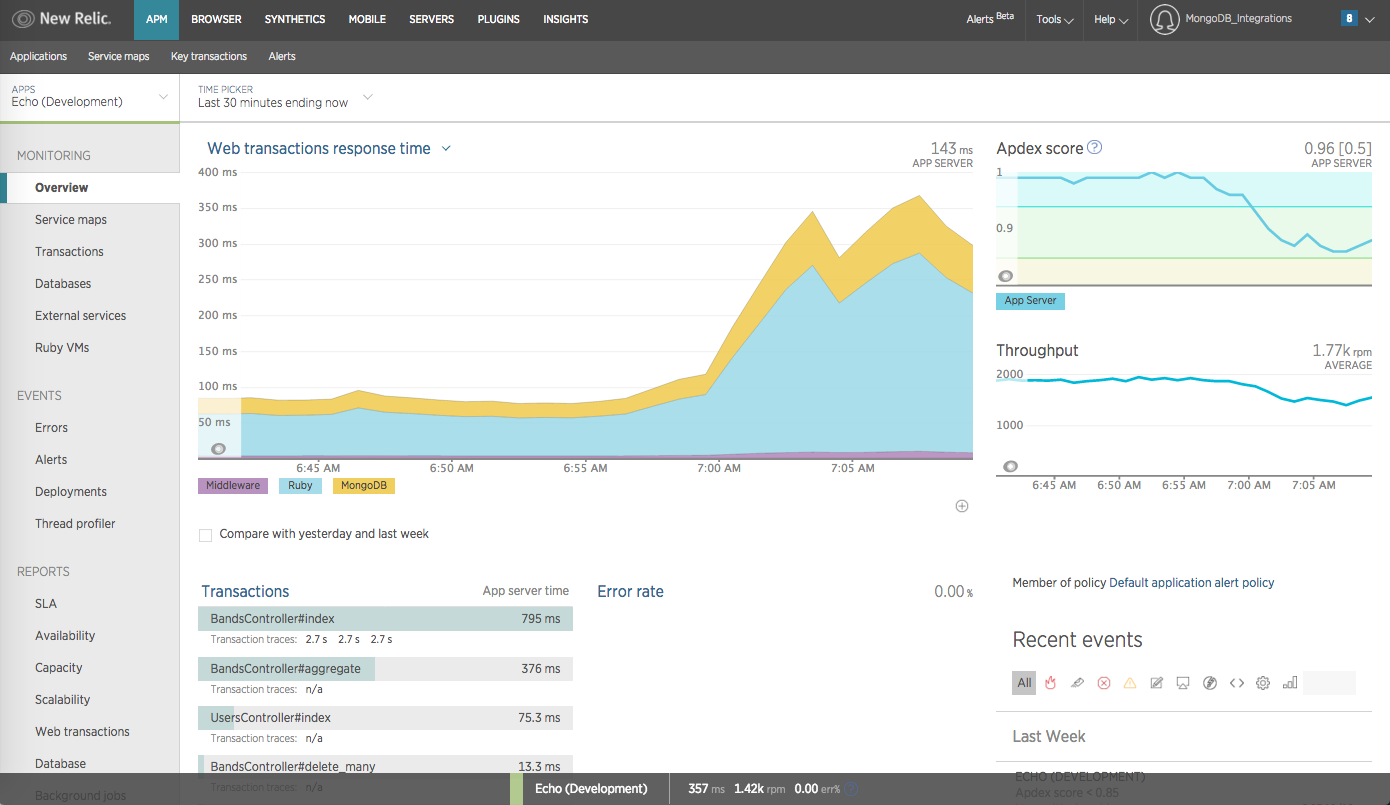 |