Overview
ProductRatingMost Used ByProduct SummaryStarting Price
IBM SPSS Statistics
Score 8.2 out of 10
N/A
SPSS Statistics is a software package used for statistical analysis. It is now officially named "IBM SPSS Statistics". Companion products in the same family are used for survey authoring and deployment (IBM SPSS Data Collection), data mining (IBM SPSS Modeler), text analytics, and collaboration and deployment (batch and automated scoring services).
$105
per month per user
MATLAB
Score 8.8 out of 10
N/A
MatLab is a predictive analytics and computing platform based on a proprietary programming language. MatLab is used across industry and academia.
$49
per student license
Posit
Score 10.0 out of 10
N/A
Posit, formerly RStudio, is a modular data science platform, combining open source and commercial products.N/A
Pricing
IBM SPSS StatisticsMATLABPosit
Editions & Modules
Base
USD 3,830
one-time fee per user
Standard
USD 8,440
one-time fee per user
Professional
USD 16,900
one-time fee per user
Premium
USD 25,200
one-time fee per user
Monthly subscription
USD 105
per month per user
Annual subscription
USD 1,188.00
per year per user
Student
$49
per student license
Home
$149
perpetual license
Education
$250
per year
Education
$500
perpetual license
Standard
$860
per year
Standard
2,150
perpetual license
No answers on this topic
Offerings
Pricing Offerings
IBM SPSS StatisticsMATLABPosit
Free Trial
YesNoYes
Free/Freemium Version
NoNoYes
Premium Consulting/Integration Services
NoNoNo
Entry-level Setup FeeNo setup feeNo setup feeOptional
Additional Details
More Pricing Information
Community Pulse
IBM SPSS StatisticsMATLABPosit
Considered Multiple Products
IBM SPSS Statistics
Chose IBM SPSS Statistics
MATLAB is far more powerful at modeling massive data sets and allows for further individualizations that are often needed at research. MATLAB can also analyze pictures and run analysis on them. However SPSS is very good for what it is meant for.
Chose IBM SPSS Statistics
IBM SPSS Statistics stacks up much better and overall gives the user a much better as well as simpler means to achieve their end goal. It provides a comprehensive set of well tested data management, along with statistical procedures in an easy to use and all in one package …
Chose IBM SPSS Statistics
IBM SPSS Statistics is much easier to use, even in classes with students, compared to other similar data analytic software that I have used previously. I selected it because of this reason and I plan to continue using it in the future. The interface is user friendly and the …
Chose IBM SPSS Statistics
We tend to shy away from open source where possible. with SPSS from our feeder university system for our co-op interns, this is a great transition and a low barrier to getting them working quickly.
Chose IBM SPSS Statistics
For my own statistical analyses, I personally use R and MPlus. However, these tools have a steep learning curve and require dedicated time and a course on their own. In m yopinion, they are not useful for trying to quickly acclimate undergrads to the new world of stats and …
Chose IBM SPSS Statistics
Cost was a leading factor
Chose IBM SPSS Statistics
[IBM] SPSS is by far the best of the statistics software applications in terms of functionality and accessibility, but its biggest drawback is price. SPSS is prohibitively expensive in comparison to the other competing statistics applications such as R and SAS, making the …
Chose IBM SPSS Statistics
SPSS is much easier to learn even for people with basic knowledge of statistics.
Chose IBM SPSS Statistics
Stacks up pretty well, as this is the best geospatial analysis tool next only to ArcGIS, but does almost everything that other packages do almost as well. However, there is a considerable need to improve and include new techniques like the random forest, etc. which IBM SPSS …
Chose IBM SPSS Statistics
I don't really know this. I messed with RStudio and several other programs as I started data evaluation, but since my school required SPSS that is all I ended up really using and working with.
Chose IBM SPSS Statistics
Overall, IBM SSPS outperforms competitors in almost every arena. It's ability to both perform statistical analysis and geospatial analysis is unrivaled. Additionally, it is superior in handling large or complex datasets over many of the other similar programs. The only program …
Chose IBM SPSS Statistics
Other software that I can compare to SPSS include R, Excel and SAS. Overall, SPSS is easier to get familiar with and more user friendly which is why I can see it as more appropriate for taught courses. The computational capabilities are not similar to R, but on the other hand …
Chose IBM SPSS Statistics
I have also used RStudio and SAS previously. In fact, I'm currently using RStudio since our SPSS license has expired. SPSS lacks the capabilities of these other two programs and it is far less intuitive. Larger data sets can be analyzed with R and SAS, but using these programs …
MATLAB
Chose MATLAB
I use MATLAB, R Studio, and SPSS for data analysis needs. Each has their own positives and negatives that they bring to the table. I primarily use MATLAB for modeling due to ease of use and the maintenance of base code in this format.
Chose MATLAB
MATLAB's neurophysiological data pre-processing third-party packages are more scientifically validated compared to support for other software platforms. It also allows for writing code with a greater level of functionality and more capabilities than R-Studio, which is instead …
Chose MATLAB
MATLAB is much better at performing statistical analysis processes. It is a much more powerful program for dealing with large amounts of, or complicated, data sets. While other programs have a more friendly user interface, MATLAB is good if you have some experience with coding, …
Chose MATLAB
MATLAB has a very large database of embedded functions and it is continually growing. Graphics processing is much easier than other similar product for beginners (such as Jupyter notebook and Python). Although it is not an open-source language, lots of learning materials and …
Chose MATLAB
I like the user interface of MATLAB and find it most intuitive compared to any of the other three programs I listed. However, unlike RStudio and Oracle VM VirtualBox, MATLAB is not open source. I do prefer MATLAB over PyCharm, because I find MATLAB to be a bit more intuitive. I …
Chose MATLAB
MATLAB is very similar to R and Python, but has cleaner syntax than R and more in-built functionality than Python. However, both are free and therefore have that significant advantage over MATLAB. SQL is simpler but much more limited in use.
Chose MATLAB
This is the most unpolished and raw product out of these three products which make this product to reach high scale in operations. The in-depth and strong open source support makes it a great product to work with. However, the visualization, UI still needs improvement in MATLAB …
Posit
Chose Posit
RStudio is the free alternative to MATLAB. It works just as well as the other software, and more features can be accessed but to the open-source nature. This software is more commonplace in the research lab setting due to its free cost.
Chose Posit
The most similar products to RStudio that I have used include IBM SPSS and Tableau Prep. In my experience, SPSS is more intuitive and has less of a learning curve; I used it extensively in my undergraduate career in Statistics and Cognitive Science research. While RStudio has …
Chose Posit
SPSS is good for folks who are not as familiar with statistics, and for those who are older or more technologically-experienced and may be overwhelmed by Posit's products. It's also really great for teaching students and getting them exposed. However, because Posit is free, …
Chose Posit
Personally, I would prefer SPSS over RStudio and SAS, but the cost for licenses for SPSS deters me from continuing to go with IBM's statistics software. RStudio has the advantage in that it is low cost and there are a lot of available resources on YouTube available for users …
Chose Posit
In the space of data science tools, code is king. It enables use of standard version control systems like git, access to a wealth of expertise via StackOverflow and others, is commonly used in modern education programs, and more. Other solutions in this space are built on …
Chose Posit
I have tried to work a bit with Jupyer notebooks and Spyder, but both are way less agreeable than RStudio.
Once you taste RStudio, you can't go back!
Chose Posit
Far better integrated and easy to use. The only full-blown Python IDE is PyCharm, and it is a monolith. I used Spyder instead. I was very happy when RStudio added Python support so I can ditch Jupyter Notebooks, which really isn't an IDE but is more like RMarkdown, a small …
Chose Posit
While many of these are great, RStudio is the best for R work. There is also native support in the IDE for combining other languages, like Python, into workflows easily so work across languages can be handled in one location.
Chose Posit

RStudio has a huge repository of packages. There are over 10,000 packages in their central repository and this number is growing at a constant rate. These packages allow you to perform tasks that are not offered by any other statistical software unless you purchase their …

Chose Posit
RStudio is preferable to SPSS and SAS mainly because it is much lower cost to use even having a server license that we pay for the SAS licenses we used to have are too expensive and ultimately we decided to move away from using SAS for our reporting and data modeling needs.
Chose Posit
RStudio absolutely offers everything that SPSS does at zero cost. Yes, there is a bit of learning curve in terms of you needing to equip yourself with R language but that's a good thing as you learn and apply more complex statistical tools and techniques on your datasets. …
Chose Posit
It has the same capabilities as the other mentioned tools.
1)It is freely available.
2)Generates good quality of results.
Chose Posit
Coding in RStudio is more convenient and plot display in RStudio can be more user-defined than JMP Pro.
Chose Posit
In our organization RStudio is the main competitor for STATA. STATA has a larger number of users as it is far more user-friendly and has a large number of canned routines that work really well. RStudio is a niche software ideally suited to work with larger datasets.
Features
IBM SPSS StatisticsMATLABPosit
Platform Connectivity
Comparison of Platform Connectivity features of Product A and Product B
IBM SPSS Statistics
-
Ratings
MATLAB
-
Ratings
Posit
9.3
27 Ratings
11% above category average
Connect to Multiple Data Sources00 Ratings00 Ratings8.026 Ratings
Extend Existing Data Sources00 Ratings00 Ratings10.027 Ratings
Automatic Data Format Detection00 Ratings00 Ratings10.026 Ratings
Data Exploration
Comparison of Data Exploration features of Product A and Product B
IBM SPSS Statistics
-
Ratings
MATLAB
-
Ratings
Posit
9.0
27 Ratings
6% above category average
Visualization00 Ratings00 Ratings8.027 Ratings
Interactive Data Analysis00 Ratings00 Ratings10.024 Ratings
Data Preparation
Comparison of Data Preparation features of Product A and Product B
IBM SPSS Statistics
-
Ratings
MATLAB
-
Ratings
Posit
10.0
26 Ratings
20% above category average
Interactive Data Cleaning and Enrichment00 Ratings00 Ratings10.024 Ratings
Data Transformations00 Ratings00 Ratings10.026 Ratings
Platform Data Modeling
Comparison of Platform Data Modeling features of Product A and Product B
IBM SPSS Statistics
-
Ratings
MATLAB
-
Ratings
Posit
10.0
22 Ratings
17% above category average
Multiple Model Development Languages and Tools00 Ratings00 Ratings10.022 Ratings
Single platform for multiple model development00 Ratings00 Ratings10.022 Ratings
Self-Service Model Delivery00 Ratings00 Ratings10.019 Ratings
Model Deployment
Comparison of Model Deployment features of Product A and Product B
IBM SPSS Statistics
-
Ratings
MATLAB
-
Ratings
Posit
9.9
18 Ratings
15% above category average
Flexible Model Publishing Options00 Ratings00 Ratings10.018 Ratings
Security, Governance, and Cost Controls00 Ratings00 Ratings9.915 Ratings
Best Alternatives
IBM SPSS StatisticsMATLABPosit
Small Businesses

No answers on this topic

IBM SPSS Statistics
IBM SPSS Statistics
Score 8.2 out of 10
Jupyter Notebook
Jupyter Notebook
Score 8.5 out of 10
Medium-sized Companies
Alteryx Platform
Alteryx Platform
Score 9.1 out of 10
Alteryx Platform
Alteryx Platform
Score 9.1 out of 10
Mathematica
Mathematica
Score 7.0 out of 10
Enterprises
Alteryx Platform
Alteryx Platform
Score 9.1 out of 10
Alteryx Platform
Alteryx Platform
Score 9.1 out of 10
Alteryx Platform
Alteryx Platform
Score 9.1 out of 10
All AlternativesView all alternativesView all alternativesView all alternatives
User Ratings
IBM SPSS StatisticsMATLABPosit
Likelihood to Recommend
5.4
(103 ratings)
8.1
(53 ratings)
10.0
(123 ratings)
Likelihood to Renew
8.6
(23 ratings)
-
(0 ratings)
9.7
(17 ratings)
Usability
8.0
(15 ratings)
9.9
(4 ratings)
8.0
(4 ratings)
Availability
6.0
(1 ratings)
-
(0 ratings)
9.4
(3 ratings)
Performance
6.0
(1 ratings)
-
(0 ratings)
-
(0 ratings)
Support Rating
6.4
(12 ratings)
9.5
(7 ratings)
8.9
(9 ratings)
Implementation Rating
8.7
(7 ratings)
-
(0 ratings)
9.3
(4 ratings)
Configurability
5.0
(1 ratings)
-
(0 ratings)
10.0
(1 ratings)
Ease of integration
5.0
(1 ratings)
-
(0 ratings)
-
(0 ratings)
Product Scalability
5.0
(1 ratings)
-
(0 ratings)
8.2
(3 ratings)
Vendor post-sale
5.0
(1 ratings)
-
(0 ratings)
-
(0 ratings)
Vendor pre-sale
5.0
(1 ratings)
-
(0 ratings)
-
(0 ratings)
User Testimonials
IBM SPSS StatisticsMATLABPosit
Likelihood to Recommend
IBM
SPSS's ability to deal with things like survey verbatims is a significant competitive disadvantage. The ability to do most of what researchers do without having to learn to program (think R or Python) is the primary advantage SPSS brings to bear.
Read full review
MathWorks
MATLAB really does best for solving computational problems in math and engineering. Especially when you have to use a lot of functions in your solving process, or if you have a nonlinear equation that must be iteratively solved. [MATLAB] can also perform things like integration and derivation on your equations that you put into it.
Read full review
Posit (formerly RStudio)
In my humble opinion, if you are working on something related to Statistics, RStudio is your go-to tool. But if you are looking for something in Machine Learning, look out for Python. The beauty is that there are packages now by which you can write Python/SQL in R. Cross-platform functionality like such makes RStudio way ahead of its competition. A couple of chinks in RStudio armor are very small and can be considered as nagging just for the sake of argument. Other than completely based on programming language, I couldn't find significant drawbacks to using RStudio. It is one of the best free software available in the market at present.
Read full review
Pros
IBM
  • SPSS has been around for quite a while and has amassed a large suite of functionality. One of its longest-running features is the ability to automate SPSS via scripting, AKA "syntax." There is a very large community of practice on the internet who can help newbies to quickly scale up their automation abilities with SPSS. And SPSS allows users to save syntax scripting directly from GUI wizards and configuration windows, which can be a real life-saver if one is not an experienced coder.
  • Many statistics package users are doing scientific research with an eye to publish reproducible results. SPSS allows you to save datasets and syntax scripting in a common format, facilitating attempts by peer reviewers and other researchers to quickly and easily attempt to reproduce your results. It's very portable!
  • SPSS has both legacy and modern visualization suites baked into the base software, giving users an easily mountable learning curve when it comes to outputting charts and graphs. It's very easy to start with a canned look and feel of an exported chart, and then you can tweak a saved copy to change just about everything, from colors, legends, and axis scaling, to orientation, labels, and grid lines. And when you've got a chart or graph set up the way you like, you can export it as an image file, or create a template syntax to apply to new visualizations going forward.
  • SPSS makes it easy for even beginner-level users to create statistical coding fields to support multidimensional analysis, ensuring that you never need to destructively modify your dataset.
  • In closing, SPSS's long and successful tenure ensures that just about any question a new user may have about it can be answered with a modicum of Google-fu. There are even several fully-fledged tutorial websites out there for newbie perusal.
Read full review
MathWorks
  • It has a very user friendly library which helps users learn this software fairly quickly in a short span of time.
  • The graphical user interface provided by the software is really good.
  • The code that a person writes allows options for debugging.
  • One can visualize the flow of control of their code inside MATLAB.
Read full review
Posit (formerly RStudio)
  • The support is incredibly professional and helpful, and they often go out of their way to help me when something doesn't work.
  • The one-click publishing from RStudio Connect is absolutely amazing, and I really like the way that it deploys your exact package versions, because otherwise, you can get in a terrible mess.
  • Python doesn't feel quite as native as R at the moment but I have definitely deployed stuff in R and Python that works beautifully which is really nice indeed.
Read full review
Cons
IBM
  • collaboration - SPSS lacks collaboration features which makes it near impossible to collaborate with my team on analysis. We have to send files back and forth, which is tedious.
  • integration - I wish SPSS had integration capabilities with some of the other tools that I use (e.g., Airtable, Figma, etc.)
  • user interface - this could definitely be modernized. In my experience, the UI is clunky and feels dated, which can negatively impact my experience using the tool.
Read full review
MathWorks
  • MatLab is pricier than most of its competitors and because of this reason, many organizations are moving towards cheaper alternatives - mostly Python.
  • MatLab is inefficient when it comes to performing a large number of iterations. It gets laggy and often crashes. Python is better in this regard.
  • There is a limited number of hardware options (mostly NI) that can be connected directly to the data acquisition toolbox.
Read full review
Posit (formerly RStudio)
  • Python integration is newer and still can be rough, especially with when using virtual environments.
  • RStudio Connect pricing feels very department focused, not quite an enterprise perspective.
  • Some of the RStudio packages don't follow conventional development guidelines (API breaking changes with minor version numbers) which can make supporting larger projects over longer timeframes difficult.
Read full review
Likelihood to Renew
IBM
Both
money and time are essential for success in terms of return on investment for any kind of research based project work. Using a Likert-scale questionnaire is very easy for data entry and analysis
using IBM SPSS. With the help of IBM SPSS, I found very fast and reliable data
entry and data analysis for my research. Output from SPSS is very easy to
interpret for data analysis and findings
Read full review
MathWorks
No answers on this topic
Posit (formerly RStudio)
There is no viable alternative right now. The toolset is good and the functionality is increasing with every release. It is backed by regular releases and ongoing development by the RStudio team. There is good engagement with RStudio directly when support is required. Also there's a strong and growing community of developers who provide additional support and sample code.
Read full review
Usability
IBM
Probably because I have been using it for so long that I have used all of the modules, or at least almost all of the modules, and the way SPSS works is second nature to me, like fish to swimming.
Read full review
MathWorks
MATLAB is pretty easy to use. You can extend its capabilities using the programming interface. Very flexible capabilities when it comes to graphical presentation of your data (so many different kinds of options for your plotting needs). Anytime you are working with large data sets, or with matrices, MATLAB is likely to be very helpful.
Read full review
Posit (formerly RStudio)
For someone who learns how to use the software and picks up on the "language" of R, it's very easy to use. For beginners, it can be hard and might require a course, as well as the appropriate statistical training to understand what packages to use and when
Read full review
Reliability and Availability
IBM
SPSS can tend to crash when I am trying to do a lot of data. This can slow me down when I need to do a lot of data
Read full review
MathWorks
No answers on this topic
Posit (formerly RStudio)
RStudio is very available and cheap to use. It needs to be updated every once in a while, but the updates tend to be quick and they do not hinder my ability to make progress. I have not experienced any RStudio outages, and I have used the application quite a bit for a variety of statistical analyses
Read full review
Performance
IBM
SPSS does the job, but it can be slow. I do have to plan a lot of time to get through a huge amount of data.
Read full review
MathWorks
No answers on this topic
Posit (formerly RStudio)
No answers on this topic
Support Rating
IBM
I have not contacted IBM SPSS for support myself. However, our IT staff has for trying to get SPSS Text Analytics Module to work. The issue was never resolved, but I'm not sure if it was on the IT's end or on SPSS's end
Read full review
MathWorks
The built-in search engine is not as performing as I wish it would be. However, the YouTube channel has a vast library of informative video that can help understanding the software. Also, many other software have a nice bridge into MATLAB, which makes it very versatile. Overall, the support for MATLAB is good.
Read full review
Posit (formerly RStudio)
Since R is trendy among statisticians, you can find lots of help from the data science/ stats communities. If you need help with anything related to RStudio or R, google it or search on StackOverflow, you might easily find the solution that you are looking for.
Read full review
Implementation Rating
IBM
Have a plan for managing the yearly upgrade cycle. Most users work in the desktop version, so there needs to be a mechanism for either pushing out new versions of the software or a key manager to deal with updated licensing keys. If you have a lot of users this needs to be planned for in advance.
Read full review
MathWorks
No answers on this topic
Posit (formerly RStudio)
We did it at the individual level: anyone willing to code in R can use it. No real deployment involved.
Read full review
Alternatives Considered
IBM
If you have made it this far, you should have a very good idea of how SPSS stacks up the competition (data processing and analytics tools). Even the free ones, such as r Studio or Stata, are leaps and bounds ahead of SPSS. IBM is resting on a reputation developed nearly 30 years ago and has shown no desire to improve.
Read full review
MathWorks
How MATLAB compares to its competition or similar open access tools like R (programming language) or SciLab is that it's simply more powerful and capable. It embraces a wider spectrum of possibilities for far more fields than any other environment. R, for example, is intended primarily for the area of statistical computing. SciLab, on the other hand, is a similar open access tool that falls very short in its computing capabilities. It's much slower when running larger scripts and isn't documented or supported nearly as well as MATLAB.
Read full review
Posit (formerly RStudio)
RStudio was provided as the most customizable. It was also strictly the most feature-rich as far as enabling our organization to script, run, and make use of R open-source packages in our data analysis workstreams. It also provided some support for python, which was useful when we had R heavy code with some python threaded in. Overall we picked Rstudio for the features it provided for our data analysis needs and the ability to interface with our existing resources.
Read full review
Scalability
IBM
IBM Cognos Analytics may have been designed to scale up to a very large number of users however we are a small business with small number of users and the program worked equally well for us. We would highly recommend the product for any business no matter the size, small to large.
Read full review
MathWorks
No answers on this topic
Posit (formerly RStudio)
RStudio is very scalable as a product. The issue I have is that it doesn't necessarily fit in nicely with the mainly Microsoft environment that everybody else is using. Having RStudio for us means dedicated servers and recruiting staff who know how to manage the environment. This isn't a fault of the product at all, it's just part of the data science landscape that we all have to put up with. Having said that RStudio is absolutely great for running on low spec servers and there are loads of options to handle concurrency, memory use, etc.
Read full review
Return on Investment
IBM
  • I found SPSS easier to use than SAS as it's more intuitive to me.
  • The learning curve to use SPSS is less compared to SAS.
  • I used SAS, to a much lesser extent than SPSS. However, it seems that SAS may be more suitable for users who understand programming. With SPSS, users can perform many statistical tests without the need to know programming.
Read full review
MathWorks
  • MATLAB helps us quickly sort through large sets of data because we keep the same script each time we run an analyzation, making it very efficient to run this whole process.
  • The software makes it super easy for us to create plots that we can then show to investors or clients to display our data.
  • We are also looking to create an app for our product, and we will not be able to do that on MATLAB, therefore creating a limiting issue and a new learning curve for a programming language.
Read full review
Posit (formerly RStudio)
  • Using it for data science in a very big and old company, the most positive impact, from my point of view, has been the ability of spreading data culture across the group. Shortening the path from data to value.
  • Still it's hard to quantify economic benefits, we are struggling and it's a great point of attention, since splitting out the contribution of the single aspects of a project (and getting the RStudio pie) is complicated.
  • What is sure is that, in the long run, RStudio is boosting productivity and making the process in which is embedded more efficient (cost reduction).
Read full review
ScreenShots

IBM SPSS Statistics Screenshots

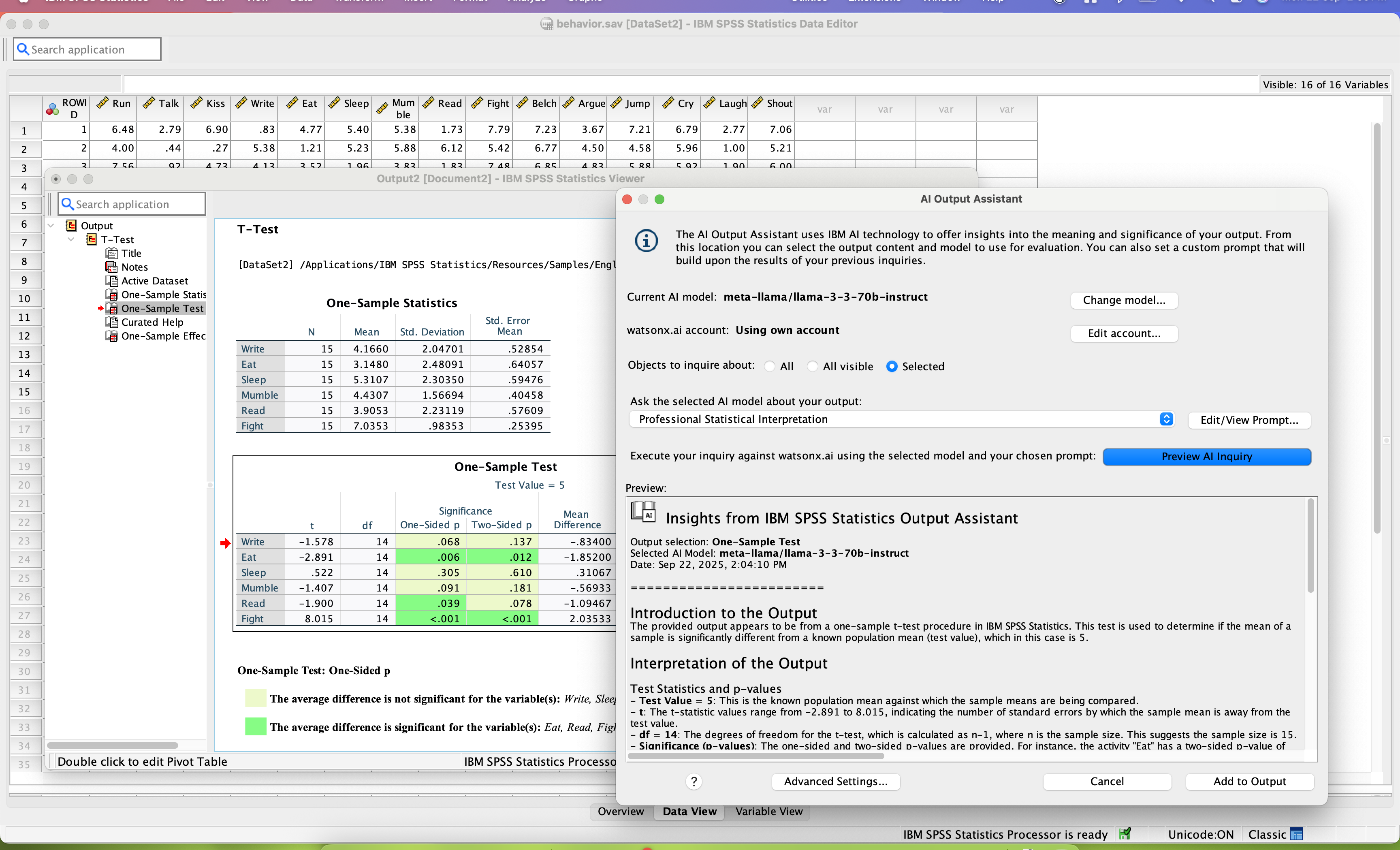
Screenshot of SPSS Statistics Forecasting. This enables users to build time-series forecasts regardless of their skill level.Screenshot of SPSS Statistics Regression. These predict categorical outcomes and apply nonlinear regression procedures.Screenshot of IBM SPSS Statistics Neural Networks. These can discover complex relationships and improve predictive models.Screenshot of IBM SPSS Statistics Curated Help. These can interpret correlation output.Screenshot of IBM SPSS Statistics AI Output Assistant interprets statistical output in easy to consume language

Posit Screenshots

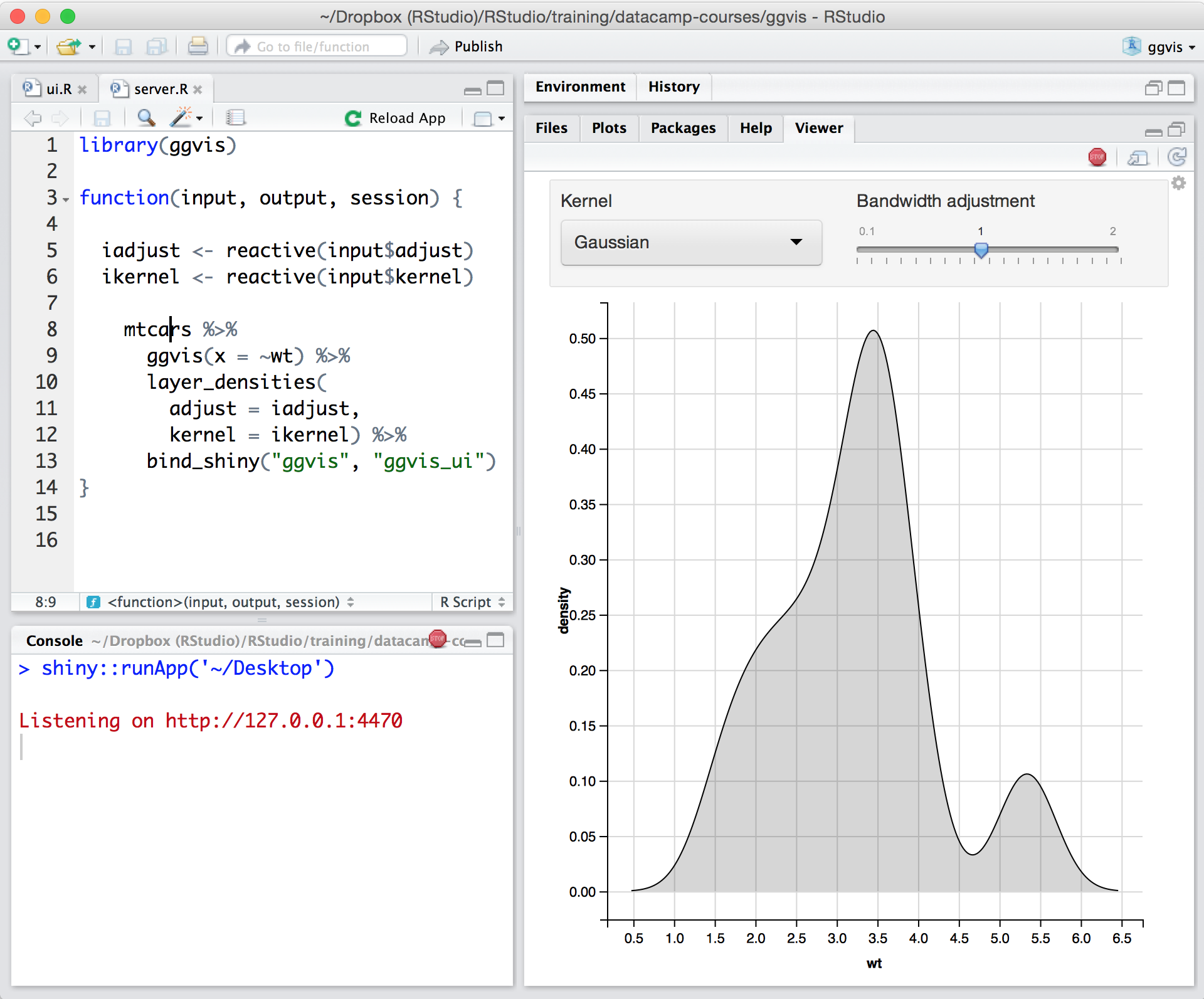
Screenshot of Posit runs on most desktops or on a server and accessed over the webScreenshot of Posit supports authoring HTML, PDF, Word Documents, and slide showsScreenshot of Posit supports interactive graphics with Shiny and ggvisScreenshot of Shiny combines the computational power of R with the interactivity of the modern webScreenshot of Remote Interactive Sessions: Start R and Python processes from Posit Workbench within various systems such as Kubernetes and SLURM with Launcher.Screenshot of Jupyter: Author and edit Python code with Jupyter using the same Posit Workbench infrastructure.