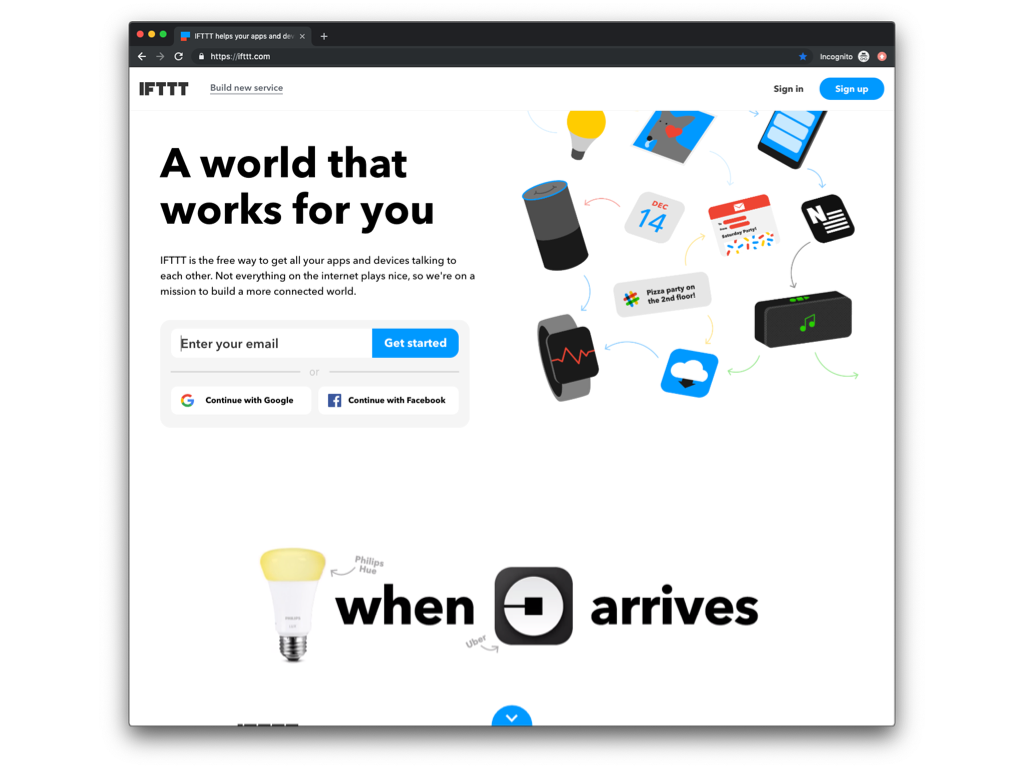
IFTTT is a marketing automation software solution offered by IFTTT. It is scaled for non-technical
users and less complex, generally two-step connectors and API’s.
N/A
Shopify
Score8.7 out of 10
N/A
Shopify is a commerce platform designed for both online stores and retail locations. Shopify offers a professional online storefront, a payment solution to accept credit cards, and the Shopify POS application to power retail sales.
Communications Manager in Marketing at Both Hands Foundation (Non-Profit Organization Management, 1-10 employees)
Chose Shopify
Shopify is superior to almost every other tool we've tried. The only downside would probably be the price is a little higher than other tools. Mojo was a very basic tool that looked terrible and delivered an archaic experience for our customers because all payments had to be …
A de minimis incentive was given to thank the reviewer for their time. The incentive was not used to bias or drive a particular response, nor was the incentive contingent on a positive endorsement. More Info
Because of the multitude of options with IFTTT, it is hard to describe the best use scenarios, but I will share how I use the platform at this time. I use IFTTT to check Craigslist for certain IT equipment postings and email me if that occurs, turning items on and off with geo-fencing and WiFi network presence, and linking my calendar to my to-do list
A de minimis incentive was given to thank the reviewer for their time. The incentive was not used to bias or drive a particular response, nor was the incentive contingent on a positive endorsement. More Info
Shopify allowed us to handle matrix items and combined listings. Both of which we could not do on our previous platform. There was some customization involved but overall, it did what we needed it to. The one downside was that if we want to change anything we would have to reload the entire set of matrix items manually.
A de minimis incentive was given to thank the reviewer for their time. The incentive was not used to bias or drive a particular response, nor was the incentive contingent on a positive endorsement. More Info
IFTTT manages a number of social media accounts quite well. Being able to login to one platform with access to all your accounts is great.
IFTTT is easy to set up. IFTTT has a number of crowd sourced and created formulas that you can use, or if you're looking for something specific you can create your own. This allows for an endless number of combinations and ways to engage with the program.
IFTTT doesn't require constant upkeep. Once you have things setup you can forget about it and it just works.
A de minimis incentive was given to thank the reviewer for their time. The incentive was not used to bias or drive a particular response, nor was the incentive contingent on a positive endorsement. More Info
It's base security and integration with trusted security partners (such as NoFraud) is a game-changer when it comes to reliability and a "hands off approach" for our IT department. The up-time is also very good.
It offers a wide range of verified plugins that are (for the most part) easy to install and use for any specific scenario you're looking for.
It's Analytics area in the admin is actually nice and offers a wide variety of reports that you can run.
A de minimis incentive was given to thank the reviewer for their time. The incentive was not used to bias or drive a particular response, nor was the incentive contingent on a positive endorsement. More Info
The website section "Activity" tends to get very crowded over time. It would benefit from some search and filter functionalities.
Some services lack ingredients. "Ingredients" are attributes passed from one service to another to enhance IFTTT's power. However, some services (like Evernote's notes, for example) currently have too few ingredients available.
It is not possible to link more than two services. It would be great, for example, to have an option to take a mail message and post in multiple social networks and blogs with the same applet.
A de minimis incentive was given to thank the reviewer for their time. The incentive was not used to bias or drive a particular response, nor was the incentive contingent on a positive endorsement. More Info
I would love it if Shopify built an in house app which helped us post UGCs and social proof from platforms such as Instagram, Youtube etc. more seamlessly on our website. Right now, we are able to do it through third party apps but the look and feel is just okay.
A de minimis incentive was given to thank the reviewer for their time. The incentive was not used to bias or drive a particular response, nor was the incentive contingent on a positive endorsement. More Info
There is no better alternative and although Integromat is new and the GUI is slick, they make you pay per push and IFTTT does not. The rest of the competition make you pay per integration or are just not as seamless in usage or have the depth of catalogue. If you use Zapier for instance, it is because they have an integration you have to use, not because Zapier does a better job.
A de minimis incentive was given to thank the reviewer for their time. The incentive was not used to bias or drive a particular response, nor was the incentive contingent on a positive endorsement. More Info
Nothing we have used in the past or have seen thus far even comes close to offering what we get with Shopify Plus, especially for the price. You cannot even come close to getting what we are getting at the price we pay. We are beyond thrilled and Shopify Plus meets and exceeds all of our needs and expectations. We love it!
A de minimis incentive was given to thank the reviewer for their time. The incentive was not used to bias or drive a particular response, nor was the incentive contingent on a positive endorsement. More Info
For the most part, IFTTT is great but it does have its limitations. You may only do one thing at a time. If you want branching logic it can be cumbersome and clunky. This it where something like Microsoft Flow does better. For simplicity, nothing can beat IFTTT for how easy it is to set up and use right out of the box
A de minimis incentive was given to thank the reviewer for their time. The incentive was not used to bias or drive a particular response, nor was the incentive contingent on a positive endorsement. More Info
It is fairly easy to use Shopify regardless of what task you are attempting to perform. Most things are customizable to a degree without requiring coding ability. I have very limited coding experience and have still been able to navigate my way around changing features of the website that require edits to the code with the use of AI and trial-and-error. This previously wasn't possible with the WooCommerce platform.
A de minimis incentive was given to thank the reviewer for their time. The incentive was not used to bias or drive a particular response, nor was the incentive contingent on a positive endorsement. More Info
A de minimis incentive was given to thank the reviewer for their time. The incentive was not used to bias or drive a particular response, nor was the incentive contingent on a positive endorsement. More Info
A de minimis incentive was given to thank the reviewer for their time. The incentive was not used to bias or drive a particular response, nor was the incentive contingent on a positive endorsement. More Info
I have had a few issues with apps over the years. Compared to other services, ITFFF is the best choice but no service is perfect unless you build it yourself for yourself. ITFFF needs more tutorials on how to create a custom platform, but overall I will recommend it as an easy to use, time-saving service.
In terms of support I give Shopify a 9 out of 10 because they're always very friendly and thorough, and they personally can't solve my problem for me they always point me in the proper direction with the proper information I need to move forward
A de minimis incentive was given to thank the reviewer for their time. The incentive was not used to bias or drive a particular response, nor was the incentive contingent on a positive endorsement. More Info
Shopify offered us several trainings to setup a Shopify store, how to build a brand, SEO, product photography etc. All this content have been super helpful in our journey.
A de minimis incentive was given to thank the reviewer for their time. The incentive was not used to bias or drive a particular response, nor was the incentive contingent on a positive endorsement. More Info
A de minimis incentive was given to thank the reviewer for their time. The incentive was not used to bias or drive a particular response, nor was the incentive contingent on a positive endorsement. More Info
A de minimis incentive was given to thank the reviewer for their time. The incentive was not used to bias or drive a particular response, nor was the incentive contingent on a positive endorsement. More Info
I haven't used Zapier extensively, but it seems that IFTTT is much simpler to set up. However, Zapier appears to be a much deeper integration where you can sync a variety of fields of data and customize the sync more than you can with IFTTT. Zapier may be more valuable for someone with a complex need and IFTTT is built for simple solutions for more basic apps.
A de minimis incentive was given to thank the reviewer for their time. The incentive was not used to bias or drive a particular response, nor was the incentive contingent on a positive endorsement. More Info
Big Commerce and SAP Hybris are two other platforms we've investigated and Shopify is by far easiest to use and customize. While it doesn't do everything out of the box, the apps do fill in many gaps. The cost however, is probably the biggest selling point against these other two options.
A de minimis incentive was given to thank the reviewer for their time. The incentive was not used to bias or drive a particular response, nor was the incentive contingent on a positive endorsement. More Info
A de minimis incentive was given to thank the reviewer for their time. The incentive was not used to bias or drive a particular response, nor was the incentive contingent on a positive endorsement. More Info
A de minimis incentive was given to thank the reviewer for their time. The incentive was not used to bias or drive a particular response, nor was the incentive contingent on a positive endorsement. More Info
It got the store up quickly so the client could start selling. She was previously selling products on Etsy and Facebook and wanted to consolidate everything onto one website, so the main thing Shopify solved was to reduce the store owner's time in managing all her products on multiple sites. Also, we had previously built a website on Wix with all the custom functionality and branding she needed - a truly great, high-end website - but it performed so slowly that it was unusable. So the speed at which Shopify can be set up and then works on the page is appreciable.
The website was manageable by the client - she could figure the system out herself after a while so she saved money on costs for hiring developers. She did have to hire developers to customize some of the plug-ins but costs are all relative; it wasn't a high investment compared to building a full e-commerce website. With the complexity and size of her product base and the functionality and branding she wanted to have in a website, and the potential of her business, she would have needed to invest well over $10,000 to get to where she really needs to be. In the end she kept the budget under $5000.00.
Costs kept climbing with plug-ins having to be added with everything. My client became more involved in building the website and began to try multiple plugins, and she did not have the skill base to evaluate the plugins functionalities so she chose plugins that did not do everything she needed, and then ended up paying the plugin developers to customize the plugins. So on one hand, it's pretty amazing to be able to bring up an e-commerce website as quickly as a week or so, but on the other hand if you need anything customized or deeper functionality in regards to product searching and filtering on the web page, and management on the backend, it quickly goes beyond the skills of the average person to manage, and above their expected budget as well. In the end my client really did not get anything close to the functionality for the website we had originally envisioned.
Shopify was the easiest way we could find to bring the client's products to a global market. We evaluated several other platforms and the functionality simple did not seem to be adequate, so Shopify seemed like the only solution that could do enough of what we needed and still stay within this client's budget. Really the problem in this project was not platform per se but that the budget wasn't large enough. Shopify managed to provide a solution for an ecommerce store with thousands of products on a tiny budget, so in the sense of pure functionality it provided the best value of all the platforms we evaluated. The solution still isn't big enough for this client's business though so, without having insights into this client's post-build sales results, my guess is that because her new website did not make her products easier to sort through, and she likely didn't have much more budget left to invest in SEO and other marketing of the website, her sales probably didn't increase substantially as a result of having built the website. So I think this project all in all did not likely have a high ROI.
A de minimis incentive was given to thank the reviewer for their time. The incentive was not used to bias or drive a particular response, nor was the incentive contingent on a positive endorsement. More Info