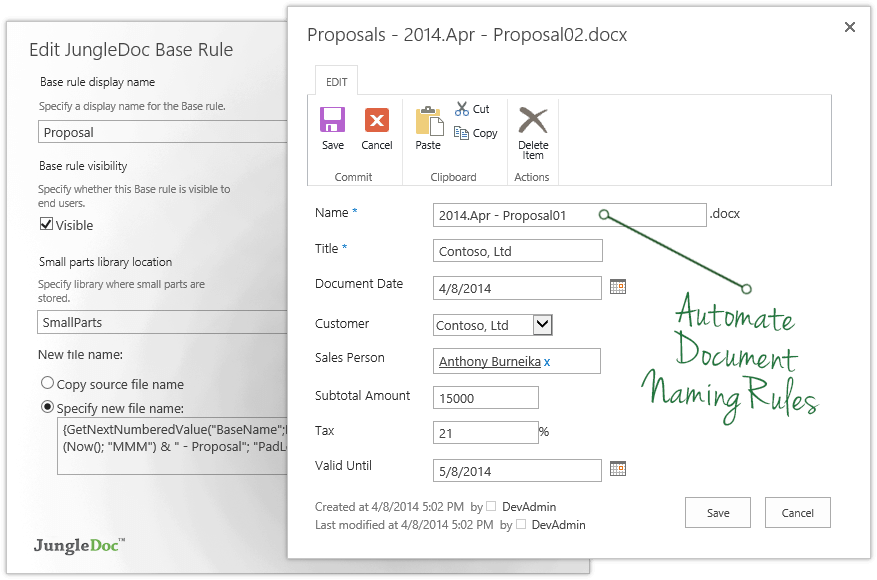
JungleDocs takes properties and parts of an existing document and puts them into a new one. The vendor’s value proposition is that this prevents possible mistakes and saves up to 90% of the user’s time that would be used on inputting and copy-pasting operations. Key features include: Word and PowerPoint document generation and automation Document mail merge from SharePoint lists Template processing engine uses Open XML technology for very fast and…
N/A
OpenText AppEnhancer
Score 6.1 out of 10
N/A
OpenText AppEnhancer (formerly ApplicationXtender from EMC, acquired by OpenText in 2017) is designed to allow users to transform paper and digital content into application-ready information. It scans, stores, retrieves and preserves information and makes itaccessible within Line-of-Business applications and processes. AppEnhancer helps organizations take control of paper and digital documents in both on and off-premises applications, while being enterprise-ready for broader implementations.
N/A
OpenText Documentum
Score 9.0 out of 10
N/A
OpenText acquired Documentum from Dell EMC in 2017, and now supports the enterprise content management (ECM) system. The vendor says users can build content-centric applications and solutions from collaborating on business documents to delivering case-based applications to managing highly precise processes in the most regulated business environments.
N/A
Pricing
JungleDocs
OpenText AppEnhancer
OpenText Documentum
Editions & Modules
No answers on this topic
No answers on this topic
No answers on this topic
Offerings
Pricing Offerings
JungleDocs
OpenText AppEnhancer
OpenText Documentum
Free Trial
Yes
No
No
Free/Freemium Version
No
No
No
Premium Consulting/Integration Services
No
No
No
Entry-level Setup Fee
No setup fee
No setup fee
Optional
Additional Details
Licensed per Web Front End (WFE) Server
—
—
More Pricing Information
Community Pulse
JungleDocs
OpenText AppEnhancer
OpenText Documentum
Considered Multiple Products
JungleDocs
Verified User
Anonymous
Chose JungleDocs
JungleDocs was intuitively easier to use than eFileCabinet and Sharepoint. JungleDocs works with Sharepoint to extend its feature set and make it easier to use. Our team didn't feel that eFileCabinet was suitable for all of our use cases, especially the RFI response …
We are still fairly new to automating our contracts and documents so JungleDocs is the only program we have used so far. Chose to use JungleDocs because offered a free trial and the department already used SharePoint and JungleDocs is compatible with SharePoint.
Technical Analyst / Technical SME / Tech Lead / Business Analyst
Chose OpenText Documentum
Sharepoint and others are a bit late to the party -- they have some nice features, but are leaders in the suite spot areas that we found OpenText helping us with.
Features and underlying technology and development roadmap are much better for both Docushare and Confluence. OpenText product was preselected when I came into the implementation of the project. It should not have been.
Subjective but here's how I see it: Heavy duty (in order of how much they can do and how much they can handle): 1)Documentum, 2)FileNet 3)OpenText Middle duty: 1)WCC-WebCenter Content, 2)Alfresco, 3)M-Files (3rd b/c it is Windows only), 4)Nuxeo (only b/c of its newish approach …
We have evaluated IBM Filenet, Alfresco and Oracle WCM. Documentum has a very strong business process management system, security and scalability. It's not just a web content management system, it's an enterprise content management system with very good capabilities for …
While Livelink has many more modules out of the box and provide some more functionality which can be applied to document lifecycle without writing any customizations, from the support perspective Documentum is much cheaper to support and it is much more stable than Opentext ECM …
There are numerous other products available including SharePoint, Stellent, FileNet, etc. Most offer many of the same solutions and modules that Documentum provides, however some, such as SharePoint, still have significant shortcomings when it comes to true, enterprise-level …
JungleDocs is good at reducing the amount of time it takes to create documents/contracts by auto-populating the documents, but it takes some time to get things started up. Harder for members of the department who are less tech savvy to get the hang of the program so in those cases it has decrease efficiency. But for members who are more familiar with metadata and automation processes, it has improved their efficiency.
I recommend it for any organization that needs to manage all content, either in Marketing, legal or any other place where you need to search, collect, classify and publish content and more efficiently. Imagine a situation where you have marketing, legal, HR and finance working on a project and they need to have access to each other's content, this is where OpenText Application Content Management was a real big win, each individual from a different department was able to find what they were looking for without bothering their colleagues every time. You don't want to go back to this kind of scenario.
What are the document volume, the throughput - currently and expected in year, 3 years etc.? Is the company doing content management on international level, where access from multiple locations is needed - then Documentum can be good investment. What ECM system will be used for - document storage, document lifecycle or retention? Or all of the above? - Documentum works very well if all 3 items are combined, yet for storage there must be cheaper and more easily adaptable solutions available.
It's good at integration with external systems through standard industry supported APIs, including but not limited to web services integration and file system integration.
Good support from major up and downstream technologies such as image capturing and back end ERP, Database, and HR.
Expense. If Documentum costs less it would penetrate more markets. This is often the reason a lighter weight solution is chosen.
Web Publishing. Documentum is not a great solution for replacing CMSs like SiteCore or Drupal. Probably better as an archiving target for parallel publishing to both web and Documentum. Documentum is also not a web hosting solution like some other systems, it is possible to try and consume directly from the repository in real time but it is better to push web content out and consume from another platform.
Development. The price of broad functionality is complexity. Arguably, Documentum drank the kool-aid and tried to become like other enterprise solutions by adapting Java, Windows, etc. in the late '90s and it made them slower, more complex in design, and less stable. They recovered from that but it still requires developers with a few years of experience in Documentum to safely develop in Documentum. The issue is not knowing Java but knowing what to do or not do in an ECM system. This is even more important in regulated ECM/RM systems.
Stability is a key factor as well as its flexibility. Also, any organization that deploys Documentum will have made a significant investment in terms of time and money, so not renewing its commitment can come with a significant cost. That said, the decision to deploy Documentum initially should come only after extensive evaluation, knowing that once deployed it will likely remain the platform of choice.
JungleDocs was intuitively easier to use than eFileCabinet and Sharepoint. JungleDocs works with Sharepoint to extend its feature set and make it easier to use. Our team didn't feel that eFileCabinet was suitable for all of our use cases, especially the RFI response documents. We used a scorecard to rank the products and JungleDocs proved to be the winner.
Subjective but here's how I see it: Heavy duty (in order of how much they can do and how much they can handle): 1)Documentum, 2)FileNet 3)OpenText Middle duty: 1)WCC-WebCenter Content, 2)Alfresco, 3)M-Files (3rd b/c it is Windows only), 4)Nuxeo (only b/c of its newish approach that may lead somewhere) Light duty: 1) BOX (not an ECM but it says it is), 2) EFSS (pick your poison, BOX is an enhanced EFSS), 3) CMSs (some have some ECM capability, none have much)
After this product, the client is able to manage content security and due to it, the client is able to use the business process, and this really reduces effort and increases the profit in business.
It provides integration with SAP easily which really helps the client to manage this effectively and with minimum effort system is ready to use.
Also searching, automated flows also create a bigger impact and reduce a lot manual effort.