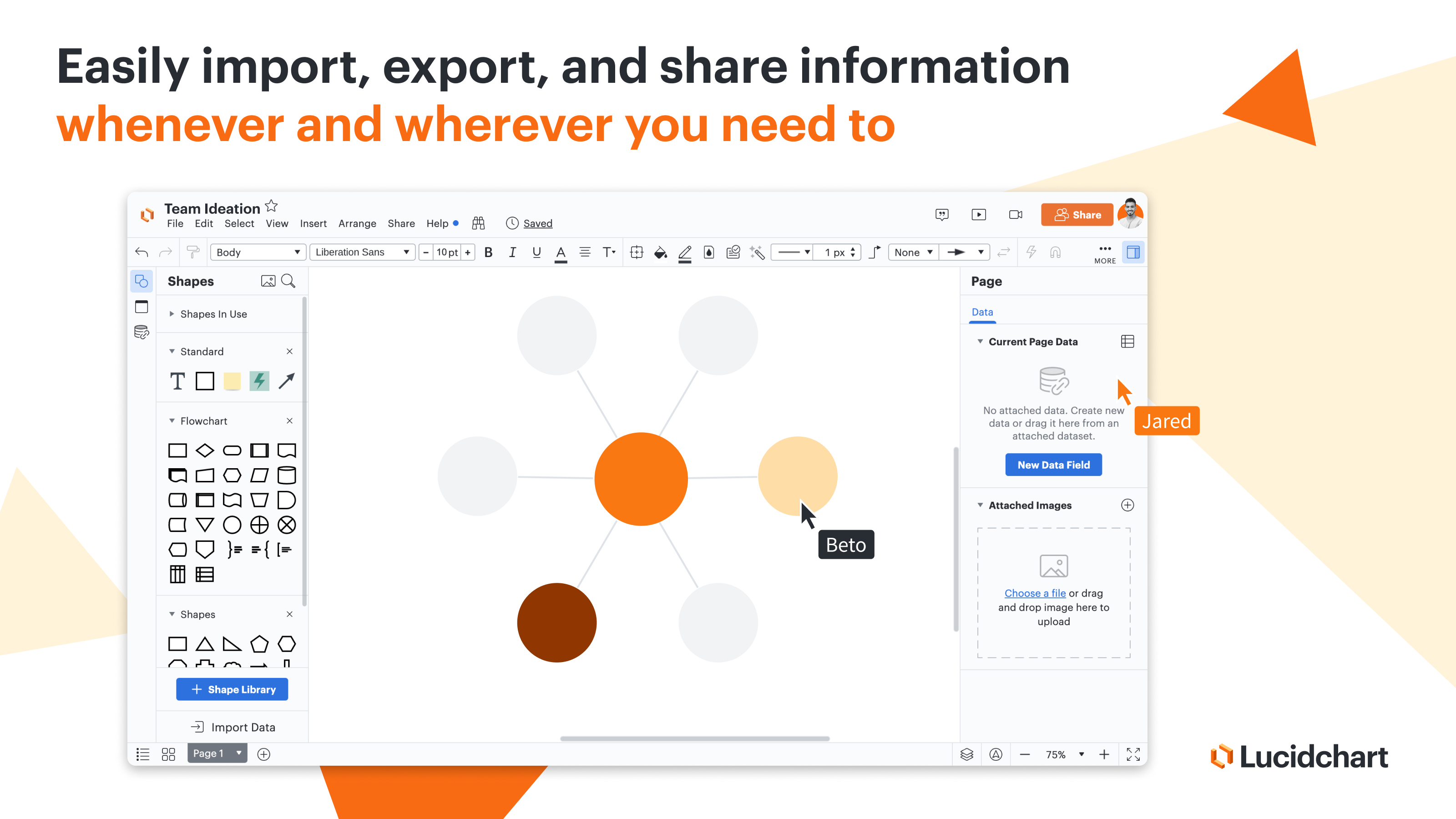
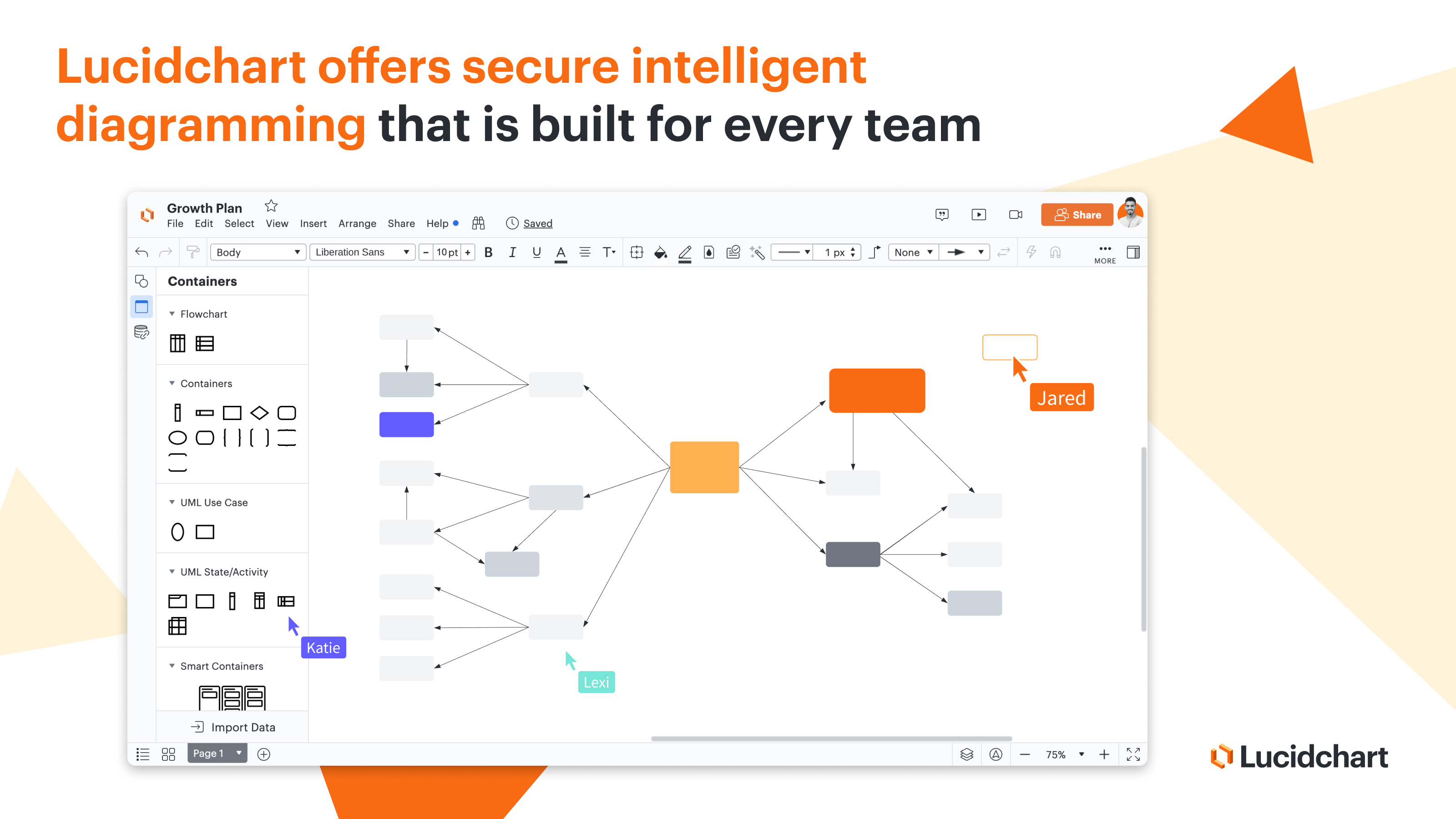
The Lucid Visual Collaboration Suite empowers teams to ideate, plan, design, build, and launch game-changing solutions from a shared infinite canvas.
$0
Mural
Score 7.5 out of 10
N/A
MURAL (formerly Mural.ly) from Tactivos (DBA MURAL) in San Francisco is described by the vendor as a digital workspace and visual collaboration tool, designed for creative teams to make the process of design more efficient for distributed teams, working remotely.
$12
per month
Xmind
Score 8.8 out of 10
N/A
Hong Kong based Xmind offers their diagramming tool featuring a range of templates, alternate brainstorming and presentation modes, a clip art library, and export to a wide variety of file types (e.g. PDF, JPG, Word or Excel, etc.).
Lucid allows for seamless application of theme and design that other platforms struggle with. The number of shapes and design flows is endless with Lucid. I have found that I prefer to use Lucid over a Google Sheet because of the different ways I can present the same information.
We used the free draw.io version. It mostly focuses on cloud architecture diagraming, but it did not meet our needs. In comparison, Lucid is a way more complete solution that can be used across many teams and use cases.
Lucid works best for us because the kind of brings everything together in one place. compared to tools like miro or Microsoft Visio, we don't have to switch between apps for brainstorming and diagramming. its easy to use, collaborative, and fits nicely with the tools we already …
It is not a direct comparison, but both are different uses and specializations. A particular regard for visuals, select Lucid visual due to its competitive, easy-to-use. Examples like process P&ID, Simple process flow diagram, etc.
They're very similar platforms, with only minor differences between them. We consolidated platforms in the organization because we were using both Miro and Lucid, and we picked the one that the other teams used more.
It does what i need it to do. I don't need functions I'm not going to use. I also can't afford to spend a lot (especially when it's not what I want anyway). Lucid Visual Collaboration Suite was the way to go and well worth the money. I never give out 10 out of 10 reviews.
In my opinion, Smartsheet doesn't have nearly the same great tools to diagramming and project management. Pricewise they were comparable so picking Lucid Visual Collaboration Suite was the easiest pick.
I think that many of these tools are great, I use Lucidchart because that's what our company uses. I think Lucidchart is better than draw.io. Canva and Figma are different use cases (for me) than Lucid Visual Collab. Figma I would go to for UI design, while Canva for me is …
Draw.io is probably the closest but not as slick an experience and less collaborative tools (as of when I last used them).
Miro/Canva/Figma/Powerpoint can all mimic the functionality but are not explicitly designed for flow charting so you're fighting the UI as they want to do …
While all of the other platforms we have evaluated and some we even use, Lucid has it's own unique solution and aesthetic that we find to work well for us for many of our different deliverables. There is no "One-App-Does-All" solution out there, however, when it comes to …
Based on my personal experience, Lucid Visual Collaboration Suite is head and shoulders above any other competitor. Canva is good, but not intuitive at all. Miro is good as well, but not nearly as appealing and still lacks some of the logical functions that LucidSpark has. I’ve …
Lucid Visual Collaboration Suite is the best in class for documenting anything technical. It has all the templates you would need to represent anything from AWS, Microsoft as well as workflows for business processes. Other tools might cover just one of each of these things, but …
I've used Visio for block diagramming before, but using Lucid is like having google suite and microsoft 365 in one. We get to make all of our block diagrams as easily as visio, but we get the collaboration and sharing functionality that comes with google suite. It stacks up …
I usually use excalidraw for more ad hoc realtime visualizations, but I usually use Lucid Visual Collaboration Suite charts when I need to work on a visualization to present in a document / presentation
Lucid Visual Collaboration Suite has a more professional feel, an easier way of organizing and a simpler look. Miro, while very similar, has more aggressive color schemes and a more toy like UI that does not inspire as much confidence in our stakeholders.
I did not select Lucid Visual Collaboration Suite. That decision was taken by others in the organization. Given a choice, I am not sure I would have selected Lucid Visual Collaboration Suite. Miro was already established and, with a local client, was a better user experience in …
Very similar to Miro I used Trello at the beginning of the pandemic but completely dropped it when I discover tools like Mural Survey Tools have more capabilities that are required sometimes but asking client to vote directly on the board in different ways serves me well most …
We used Miro as well and it was not as intuitive and easy to use as Mural is. Most take much longer to understand how to operate Miro , whereas this is not the case for Mural. It is very intuitive and offers a cleaner layout
I like it better than Miro because MURAL's more informal feel makes it encourage conversation and use. Miro also let's you bury too much information "inside" the notes making it really easy to lose sight of important data. I like MURAL better than LucidSpark because of how …
Mural has a User Interface that is easier to understand, which allows us to bring newcomers to brainstorm and design sessions without investing time in learning. Mural has more dinamic objects that impact on the presentation and visibility of the work, like having Post it notes …
MURAL has an extensive number of features and shapes and sticky notes to differentiate between the collaborators. The chat feature is amazing on MURAL itself for amazing discussions. Having a Scenario map, empathy map, Persona grid, Team, or opportunity canvas are some of the …
Mural has many more features PLUS it is so much easier to invite guests and get them engaged right away - 100% better experience overall. I felt like Mural had many more features and felt much more like the in-person experience vs. Jamboard. It is well worth the investment in …
I have tested a number of project management, workflow, and whiteboarding tools. All of them have their drawbacks. Some are too prescriptive and too process orientated, whilst others lack the simplicity of MURAL (formerly Mural.ly).
A couple of features I particularly appreciate are the content library (even though it should be improved) and the possibility to use multiple templates from different companies. Also the call feature looks interesting, even though I never used it so far. Overall, MURAL …
Mural was easier to use and share compared with Whiteboard. Whiteboard's functionality is limited. It is also integrated into Teams in an odd way that makes it difficult for team members to refer to old whiteboards. Mural as a stand alone web app is better.
I have had an experience of working with all the three above mentioned tools--Miro, InVision, and Lucidchart--and I can confidently say that MURAL (formerly Mural.ly) beats all these three tools when it comes to performing any kind of online collaboration activities, which …
As Xmind draws a specific focus on mindmaps its functionality is very clear and easy to use. Other mindmap systems make you connect the topics and arrows yourself which can be very frustrating and finnicky. Its presentation is very clear and displayed cleanly.
We used MindManager on Windows for many years and were happy with the product. However, at some point, MindJet dramatically raised the price which we grudgingly accepted. At some point, we switched to Macs and the MindManager on a Mac is a very different product. …
It has a different form. Trello is good for task management. Xmind will give an overall connection between different tasks and how all the tasks interconnect to each other. The reminder function in Trello is good to keep track. However, a bird's eye view in Xmind will put …
Lucid Visual Collaboration Suite is effective for process documentation and knowledge sharing across teams. For us, we used it to map out individual roles and specific tasks within each role to create clear and visual workflows that others can follow at any time. A key scenario where it works well in our business for business continuity during absences another colleague can pick up the role by following the process on Lucid Visual Collaboration Suite with minimal disruption. The visual diagrams are easy to understand and a written document.
Remote Collaboration: In a remote or distributed work environment, Mural shines. It enables teams to collaborate effectively in real-time, bridging geographical gaps and facilitating virtual meetings, workshops, and brainstorming sessions. Workshop Facilitation: For facilitators leading workshops or team-building activities, Mural provides interactive templates and tools for engaging participants and achieving specific objectives.
Writing longer paragraphs in the note field is very limited.
Integration with GitHub.
Integration with Confluence.
XMind uses a proprietary document format which is not indexed by search programs on a PC or a Mac. This means that one cannot search in the content of the XMind documents.
Serverless. You don't need to install another program to create diagrams, you just open a new tab and there you are, ready to go.
Collaboration. You don't need to update your colleague diagram by creating a new file and creating a new file version, you both are in the same diagram and you and all the team are free to update it at any time, at the same time, you are seeing the same thing. That is really helpful and time-saving.
Shapes. It has any shape that you can think of and Lucidchart is always updating them, I can create an Azure solution architecture, an AWS one, an old on-premise solution. Or just put standard shapes to describe a business process. Providing so many specific shapes help the diagram to express specific information, and for specific teams, that's less text and more visual information, you don't need to put a text below a standard database shape (this is an Azure SQL database), you just put the azure shape and done. That....is beautifully helpful.
The usability of Lucid Visual Collaboration Suite is bar none and incomparable to any other tool used in the past. There is such a vast offering that covers all the needs of any user in industries far and wide. It is no doubt that this is a firm recommendation for anyone and everyone to utilize this tool for all their needs.
Overall, MURAL is really easy to use, but there are a couple downsides. It's really easy to make areas of the board consistent because double clicking adds stickies that match those around the current one. It's really easy to connect the elements. And it's really easy to organize elements. Inconsistent controls, Panning, Line Connections, and latency are the only issues I had. My biggest issue is that the MURAL mouse buttons are very different from most similar software. This always causes me problems switching to a graphics software or 3D modelling software. Because MURAL uses the same button to pan and move elements, it's really easy to move things when panning around. The lines can also be a (sometimes huge) problem because thew will occasionally disappear or connect to things incorrectly. I think this is tied to latency issues which, in addition to causing phantom lines, can sometimes cause confusion to your team.
Commands and controls extremely easy to navigate and use. Ability to import mindmaps and collaborate also contribute to a very pleasant usability experience
I would rate the overall support for Lucidchart as a 9. The support provided is generally robust and responsive. Their help center, tutorials, and webinars offer extensive resources for users. The ticket-based support system is effective, providing timely resolutions to most issues. Moreover, they actively gather user feedback, demonstrating a commitment to continuous improvement
The support around a bug in the tool which prevented the correct printing of diagrams. Support came back after a few days, and there was no workaround. Eventually, the bug was fixed in a future release. The company does not pay much attention to user forums. With better support and plugin mechanism for user contributions, the product would be more convincing.
Based on my personal experience, Lucid Visual Collaboration Suite is head and shoulders above any other competitor. Canva is good, but not intuitive at all. Miro is good as well, but not nearly as appealing and still lacks some of the logical functions that LucidSpark has. I’ve also used Apple FreeForm quite a bit, which is a free software with Apple. Once again you can accomplish the same things in any of these software, but Lucid Visual Collaboration Suite is so much better to the point that it is 3-4 times faster to use Lucid than Free Form or Canva.
I like it better than Miro because MURAL's more informal feel makes it encourage conversation and use. Miro also let's you bury too much information "inside" the notes making it really easy to lose sight of important data. I like MURAL better than Lucidspark because of how fast the pages load, especially links within the board. Any app is better than Microsoft whiteboard which is appalling unusable and feature incomplete.
As Xmind draws a specific focus on mindmaps its functionality is very clear and easy to use. Other mindmap systems make you connect the topics and arrows yourself which can be very frustrating and finnicky. Its presentation is very clear and displayed cleanly
Though I can't necessarily provide hard numbers, I can confidently say that Lucidchart has saved countless hours for myself and my teams as we don't need to try to develop some type of complex diagram using markup or any kind of code.
I have previously been able to build a complete ERD using Lucidchart in a past position, which the company never had before. It ended up being used by countless teams in the company and ultimately in a large-scale data stack migration effort.