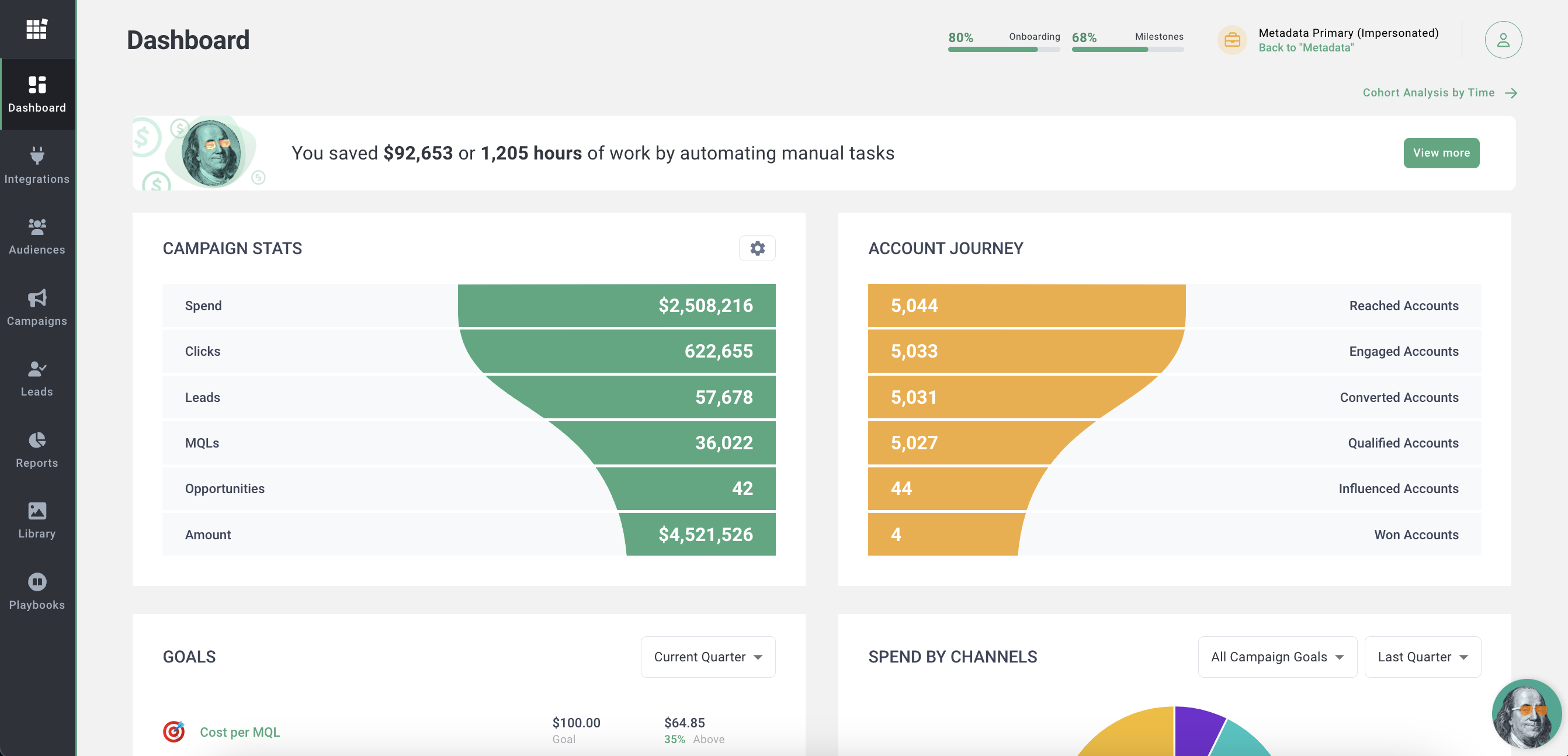
Based in San Francisco, Metadata.io is a Demand Generation and ABM platform designed to execute thousands of B2B campaigns in a matter of hours, automatically optimizing campaigns for pipeline impact at a high velocity.
$24,000
per year
StackAdapt
Score7.2 out of 10
N/A
StackAdapt, headquartered in Toronto offers their native advertising specialized DSP, supporting programmatic advertising with audience discovery, B2B targeting, and engagement analytics among other features.
Metadata is well suited when you have a really large ad budget (>50k per month at least). This is because the power of metadata lies in the ability to quickly set up and run a large number of experiments (combinations of channel, audience, creative, and conversion assets). To evaluate these variations, all of them need a large number of impressions, clicks, and conversions to be statistically relevant. If your budget is smaller, you will either have a very small number of experiments (not fully utilizing the power of metadata), or your experiments will not have enough clicks to make informed decisions. We had expected a better explanation of this from metadata before signing up.
A de minimis incentive was given to thank the reviewer for their time. The incentive was not used to bias or drive a particular response, nor was the incentive contingent on a positive endorsement. More Info
StackAdapt's programmatic buys are great for a quick awareness campaign to reach the most eyeballs. Solid user segmentation from 3rd party sources that is available almost immediately. The platform is less proficient at converting users, though I've never had sufficient volume to test if this works better for enterprise-level clients with more conversion data
A de minimis incentive was given to thank the reviewer for their time. The incentive was not used to bias or drive a particular response, nor was the incentive contingent on a positive endorsement. More Info
A de minimis incentive was given to thank the reviewer for their time. The incentive was not used to bias or drive a particular response, nor was the incentive contingent on a positive endorsement. More Info
Audience targeting - there are so many options for both B2C and B2B audiences, from browsing behavior audiences to account-based marketing audiences to CRM lists. There's a way to find your ideal audience no matter their industry.
Pixel setup and management are pretty easy. It uses a universal pixel that you can easily place on your site. We use Google Tag Manager for this. Then, you can create any number of conversion events and easily implement them, also with Google Tag Manager, so we can trust we're getting good tracking.
It seems many display ad platforms lack optimization tools, but StackAdapt makes it easy to adjust, add, or remove audiences, pause certain website categories, exclude batches of websites, pause individual ads, and really fine-tune the targeting as you see what works and what doesn't.
A de minimis incentive was given to thank the reviewer for their time. The incentive was not used to bias or drive a particular response, nor was the incentive contingent on a positive endorsement. More Info
If you don't have a large budget and audience it's hard to meaningfully optimize. If I have 4 ad creatives, to 2 audience groups on FB and LinkedIn, that creates 16 experiments, each of which needs an ample enough budget, say $40/day, that's now $640 per day or $19K per month.
Limited ability to edit ads after they've been launched. You usually have to stop the ad, clone it, and launch a new campaign.
Can't add new ads to existing campaigns which limits the ability to optimize. If I start an MD campaign with 4 ads, and in a few weeks we see that one is working well and the other 2 are not performing, I can pause those (or it can autopause by rules), but I can't add 2 more new creatives to the mix against the high performer. I'd have to either stop the high performer, and recreate it in a new campaign (losing likes and comments), OR - leave the high performer in the first campaign, and create. a second campaign with the new ones, which will only optimize against each other.
Limited to a single conversion event on a landing page. I'm not able to choose either a Demo Request OR a Sign-Up conversion, I can only choose one.
Google search ads are doable but aren't necessarily more feature-rich or easy-to use than native, so there's no value added to doing it through Metadata in my opinion aside from unifying ad reporting.
A de minimis incentive was given to thank the reviewer for their time. The incentive was not used to bias or drive a particular response, nor was the incentive contingent on a positive endorsement. More Info
There has been occasional slopping maintenance of the campaigns, and we have to follow up with questions about spending spikes or significant changes in delivery CPMs.
Account rep knowledge can sometimes be lacking. When we question our reps about performance, we sometimes get confusing or nonsensical answers.
The reporting UI is definitely clunky and unintuitive.
A de minimis incentive was given to thank the reviewer for their time. The incentive was not used to bias or drive a particular response, nor was the incentive contingent on a positive endorsement. More Info
The platform is easy to use and understand whether it is being used as self-serve or a managed service. The audience targeting is solid, and array of placements is versatile. With these, the level of engagement for video content is usually great
A de minimis incentive was given to thank the reviewer for their time. The incentive was not used to bias or drive a particular response, nor was the incentive contingent on a positive endorsement. More Info
It is very user friendly and if any team members need further help, we are able to easily access their customer service team for hands on assistance with an actual human being, not a robot. Their team has been incredibly kind, understanding and thorough. It is really a great all in one tool for a business who relies greatly on advertising campaigns.
A de minimis incentive was given to thank the reviewer for their time. The incentive was not used to bias or drive a particular response, nor was the incentive contingent on a positive endorsement. More Info
Support has been exceptional. Our dedicated team is always available and ready to answer any questions that may arise. We receive updates from them on a regular basis and they go above and beyond providing assistance when needed. The team is absolutely one of the bright spots in our relationship with StackAdapt
A de minimis incentive was given to thank the reviewer for their time. The incentive was not used to bias or drive a particular response, nor was the incentive contingent on a positive endorsement. More Info
We chose [Metadata.io] because it was a smaller company and could get more personalized attention. The price was better and they seemed more eager to support us. The feature set was what we were looking for and not more - it was exactly as robust as we needed it to be. Didn't want to pay for features we weren't going to use.
A de minimis incentive was given to thank the reviewer for their time. The incentive was not used to bias or drive a particular response, nor was the incentive contingent on a positive endorsement. More Info
StackAdapt is significantly less expensive than The Trade Desk. StackAdapt doesn't have campaign minimums, unlike The Trade Desk, meaning you can experiment with a lower ad spend to gain client confidence before investing at a larger level. Plus they don't lock you into an annual contract or anything long term. It feels very similar to The Trade Desk but without the high contract.
A de minimis incentive was given to thank the reviewer for their time. The incentive was not used to bias or drive a particular response, nor was the incentive contingent on a positive endorsement. More Info
Huge decrease in CPLs, CPMQL and Cost Per Opportunity
Big improvement in MQL to SQL rates
90%+ of our leads from paid social now have valid business emails, before it was like 30%
Saving us hundreds of hours over the course of the next year doing daily manual optimization and budget management tasks for us so we can focus on strategy and testing new things
A de minimis incentive was given to thank the reviewer for their time. The incentive was not used to bias or drive a particular response, nor was the incentive contingent on a positive endorsement. More Info
Excellent traffic from our ads. Traffic exceeded our forecast.
Excellent management of our budget. We did not spend near as much as we budgeted for the response we received through our test.
The lead conversion was not expected to be high due to the type of content we deployed, but we received zero conversions, well below anticipated when compared to other ads for the same content.
A de minimis incentive was given to thank the reviewer for their time. The incentive was not used to bias or drive a particular response, nor was the incentive contingent on a positive endorsement. More Info