Overview
ProductRatingMost Used ByProduct SummaryStarting Price
Microsoft Access
Score 7.5 out of 10
N/A
Microsoft Access is a database management system from Microsoft that combines the relational Microsoft Jet Database Engine with a graphical user interface and software-development tools.
$139.99
per PC
MySQL
Score 8.3 out of 10
N/A
MySQL is a popular open-source relational and embedded database, now owned by Oracle.N/A
Posit
Score 10.0 out of 10
N/A
Posit, formerly RStudio, is a modular data science platform, combining open source and commercial products.N/A
Pricing
Microsoft AccessMySQLPosit
Editions & Modules
Microsoft Access
$139.99
per PC
No answers on this topic
Offerings
Pricing Offerings
Microsoft AccessMySQLPosit
Free Trial
NoNoYes
Free/Freemium Version
NoNoYes
Premium Consulting/Integration Services
NoNoNo
Entry-level Setup FeeNo setup feeNo setup feeOptional
Additional Details
More Pricing Information
Community Pulse
Microsoft AccessMySQLPosit
Considered Multiple Products
Microsoft Access
Chose Microsoft Access
Microsoft Access is better for novice users. It is very user-friendly and helps beginners learn data base rather than MySQL. MySQL is for more advanced users which have more experience. Access is also good for smaller organizations. It saves money rather than spending more on …
Chose Microsoft Access
Microsoft Access databases are more suitable for us because we are a smaller team. It's easy for us to export the reporting. It's also easy for people to create their own databases as well! Microsoft Access is honestly a one-stop-shop for us, and we figured we were not at a …
Chose Microsoft Access
Tableau is not even a 'switch-out' tool, it's for visualization so it's not a fair comparison. Against other databasing tools, MySQL is still my favorite may be simply due to being a creature of comfort because that's where I first learned to manage DB. However, Microsoft …
Chose Microsoft Access
[Selected Microsoft Access for] employee learning simplicity, attractive graphical environment and features of Microsoft 365 with responsive Microsoft support.
Chose Microsoft Access
Unlike enterprise-level databases, MS Access doesn't require setting up a complex server environment with user security schemes. It's an excellent tool for small scale databases where purchasing and setting up a product like MS SQL Server could be an overkill. Unlike …
Chose Microsoft Access
Microsoft Access is a bit dated compared to other database tools. It is slower, not able to handle quantities of data that are as large as the other tools, and a bit more finicky. However, it is sometimes the preferred tool for some clients. It also has a lower barrier to entry …
Chose Microsoft Access
MS Access is the little brother to all these products. In no way is it as feature-rich as the competition I have selected. It is, however, great when used properly. It does not have the same level of security, availability, access, or recoverability as anything listed above. …
Chose Microsoft Access
Access should be relatively cost effective because it is included in the MS office 365. But it is not suitable for larger organization due to lack of work sharing environment.
Chose Microsoft Access
We selected Microsoft Access for its lower price and because it is easy to use for any user. Previously in the company, because we were small, Excel was used and I can migrate my data from Excel to Access in a fast and simple way. Besides that, it has organized information that …
Chose Microsoft Access
Microsoft Access is a good data management tool. and it excels in that area, which is what we needed the most. It was simple to use and easy to learn. Database management can be done with multiple users in Access. And we can have reports for data summaries, or for any specific …
Chose Microsoft Access
I find access easier to use than base or thunderbird but if you are familiar with Microsoft Office products, the learning curve is lessened by that. There is no comparision to SQL or MySql, but these are meant for larger more robust database applications. Access was actually in …
Chose Microsoft Access
Microsoft Access can be used on the Windows platform, which most organizations use, especially our own, which is one of the reasons why we selected Microsoft Access. Access was also part of the standard Windows image that our company uses when imaging desktops and laptops so …
MySQL
Chose MySQL
We use Oracle Database for another business unit and in the recent past I’ve used Microsoft Access. While every relational database has its positives and negatives, MySQL has proven to be the fastest and most reliable. Its automated backups have saved us time in redoing mass …
Chose MySQL
It would be hard to make a case for the use of Microsoft Access for any but the most simple of internal business applications at this stage, not because it is a bad product but it falls well short of the power and scalability of MySQL and almost any other databse solution out …
Chose MySQL
Our original implementation of MySQL was to replace an Access database that had unfortunately been able to grow beyond its abilities and scope. MySQL seemed to offer all the benefits of Access (easy to set up, use and administer) with none of the downsides (reliability, …
Chose MySQL
MySQL has a GUI which makes it easy for developers to work upon. It has all features like replication, backup and crash recovery. Also since it is freely available it becomes commercially feasible for people to use this DB. Also MySQL can be easily used as a back end for the …
Chose MySQL
Familiarity: With MySQL, I know what to expect, and that goes a long way. Also, since it adheres fairly close to SQL '92, It's relatively easy to construct queries, views, etc. without a steep learning curve. Also, RAM usage is important (this is true of any RDBMS …
Chose MySQL
SQLLite was not a choice on Trust Radius, and it is the only tool that I have used similar to MySQL and the use was several years ago, so I do not remember the exact reason but there was some function that I needed that SQLite could not perform, and I had to download MySQL to …
Chose MySQL
I feel it's way more user friendly than the previous software.
Chose MySQL
Compared to Oracle MySQL is lacking some of the advanced features Oracle provides but through a detailed business and technical requirements capture process it became clear we would not need these very advanced features. Oracle is stronger on the backup and restore side of …
Chose MySQL
MySQL is much more in depth. Microsoft is more for intermediate users while MySQL has a larger of amount of activities one can do.
Posit
Chose Posit
RStudio stacks up pretty well against Anaconda. However, Anaconda might be the first choice for someone who likes Python for their analytics and machine learning needs. In the past, I have found it seamless to connect Jupyter Notebook (in Anaconda suite) to integrate with other …
Chose Posit
There are loads of people in the BI (Business Intelligence) space, of course... but I wouldn't touch any of them because none of them offer anything like the R and Python support that RStudio does. RStudio publishes open-source, they're a public benefit corporation, and they …
Chose Posit
RStudio is a much better environment for R than IBM Data Science Experience as it provides with a much wider variety of tools.
Chose Posit
RStudio is the only GUI which is web-client based. It is also by far the easiest to install out of the the 4 GUIs ive listed avaliable for R. Finally I would say the cleanest and most sleek GUI would be RStudio, which makes it easier for other people I work with to understand.
Features
Microsoft AccessMySQLPosit
Relational Databases
Comparison of Relational Databases features of Product A and Product B
Microsoft Access
7.7
3 Ratings
3% below category average
MySQL
-
Ratings
Posit
-
Ratings
ACID compliance7.02 Ratings00 Ratings00 Ratings
Database monitoring8.02 Ratings00 Ratings00 Ratings
Database locking8.03 Ratings00 Ratings00 Ratings
Encryption7.02 Ratings00 Ratings00 Ratings
Disaster recovery7.73 Ratings00 Ratings00 Ratings
Flexible deployment8.02 Ratings00 Ratings00 Ratings
Multiple datatypes8.03 Ratings00 Ratings00 Ratings
Platform Connectivity
Comparison of Platform Connectivity features of Product A and Product B
Microsoft Access
-
Ratings
MySQL
-
Ratings
Posit
9.3
27 Ratings
11% above category average
Connect to Multiple Data Sources00 Ratings00 Ratings8.026 Ratings
Extend Existing Data Sources00 Ratings00 Ratings9.927 Ratings
Automatic Data Format Detection00 Ratings00 Ratings9.926 Ratings
Data Exploration
Comparison of Data Exploration features of Product A and Product B
Microsoft Access
-
Ratings
MySQL
-
Ratings
Posit
9.0
27 Ratings
6% above category average
Visualization00 Ratings00 Ratings8.027 Ratings
Interactive Data Analysis00 Ratings00 Ratings10.024 Ratings
Data Preparation
Comparison of Data Preparation features of Product A and Product B
Microsoft Access
-
Ratings
MySQL
-
Ratings
Posit
10.0
26 Ratings
20% above category average
Interactive Data Cleaning and Enrichment00 Ratings00 Ratings10.024 Ratings
Data Transformations00 Ratings00 Ratings10.026 Ratings
Platform Data Modeling
Comparison of Platform Data Modeling features of Product A and Product B
Microsoft Access
-
Ratings
MySQL
-
Ratings
Posit
10.0
22 Ratings
17% above category average
Multiple Model Development Languages and Tools00 Ratings00 Ratings10.022 Ratings
Single platform for multiple model development00 Ratings00 Ratings10.022 Ratings
Self-Service Model Delivery00 Ratings00 Ratings10.019 Ratings
Model Deployment
Comparison of Model Deployment features of Product A and Product B
Microsoft Access
-
Ratings
MySQL
-
Ratings
Posit
9.9
18 Ratings
15% above category average
Flexible Model Publishing Options00 Ratings00 Ratings10.018 Ratings
Security, Governance, and Cost Controls00 Ratings00 Ratings9.915 Ratings
Best Alternatives
Microsoft AccessMySQLPosit
Small Businesses
InterSystems IRIS
InterSystems IRIS
Score 8.0 out of 10
InfluxDB
InfluxDB
Score 8.8 out of 10
Jupyter Notebook
Jupyter Notebook
Score 8.5 out of 10
Medium-sized Companies
InterSystems IRIS
InterSystems IRIS
Score 8.0 out of 10
SQLite
SQLite
Score 8.0 out of 10
Mathematica
Mathematica
Score 7.0 out of 10
Enterprises
SAP IQ
SAP IQ
Score 10.0 out of 10
SQLite
SQLite
Score 8.0 out of 10
Dataiku
Dataiku
Score 8.5 out of 10
All AlternativesView all alternativesView all alternativesView all alternatives
User Ratings
Microsoft AccessMySQLPosit
Likelihood to Recommend
5.0
(99 ratings)
8.4
(146 ratings)
10.0
(123 ratings)
Likelihood to Renew
10.0
(15 ratings)
9.0
(5 ratings)
9.7
(17 ratings)
Usability
7.0
(5 ratings)
7.9
(18 ratings)
8.0
(4 ratings)
Availability
8.0
(1 ratings)
-
(0 ratings)
9.4
(3 ratings)
Support Rating
6.4
(5 ratings)
9.0
(3 ratings)
8.9
(9 ratings)
Implementation Rating
10.0
(1 ratings)
8.0
(1 ratings)
9.3
(4 ratings)
Configurability
-
(0 ratings)
-
(0 ratings)
10.0
(1 ratings)
Ease of integration
8.0
(1 ratings)
-
(0 ratings)
-
(0 ratings)
Product Scalability
5.0
(1 ratings)
-
(0 ratings)
8.2
(3 ratings)
User Testimonials
Microsoft AccessMySQLPosit
Likelihood to Recommend
Microsoft
As a Material Purchasing/Planning/inventory tracking application, Microsoft Access serves its purpose well. It's presentation is clean, data entry is simple and the ability to customize search fields is welcome. It does, however, come with some caveats; namely, when setting search filters and the need arises to back up a step or two, with Microsoft Access you have to reset, or "clear all", adding extra steps/time to a query.
Read full review
Oracle
MySQL is best suited for applications on platform like high-traffic content-driven websites, small-scale web apps, data warehouses which regards light analytical workloads. However its less suited for areas like enterprise data warehouse, OLAP cubes, large-scale reporting, applications requiring flexible or semi-structured data like event logging systems, product configurations, dynamic forms.
Read full review
Posit (formerly RStudio)
In my humble opinion, if you are working on something related to Statistics, RStudio is your go-to tool. But if you are looking for something in Machine Learning, look out for Python. The beauty is that there are packages now by which you can write Python/SQL in R. Cross-platform functionality like such makes RStudio way ahead of its competition. A couple of chinks in RStudio armor are very small and can be considered as nagging just for the sake of argument. Other than completely based on programming language, I couldn't find significant drawbacks to using RStudio. It is one of the best free software available in the market at present.
Read full review
Pros
Microsoft
  • Very easy to create entity-relationship diagrams for various tables and designing mock layouts.
  • Really easy to navigate as it hold[s] the classic Microsoft UI. Another good thing is that it comes with the complete MS Office Suite.
  • It is really fast when joining multiple tables no matter what type of join.
  • Works on pretty much same SQL scripts so no need to learn a new language!
Read full review
Oracle
  • Stable - it just runs, with minimal downtime or errors
  • Fast - well-structured data is quickly written and read
  • Secure - MySQL is easy to keep data secure from people and applications that shouldn't see it
  • Easy to use - SQL is industry standard so no problems with adding, editing and reading data stored in MySQL
Read full review
Posit (formerly RStudio)
  • The support is incredibly professional and helpful, and they often go out of their way to help me when something doesn't work.
  • The one-click publishing from RStudio Connect is absolutely amazing, and I really like the way that it deploys your exact package versions, because otherwise, you can get in a terrible mess.
  • Python doesn't feel quite as native as R at the moment but I have definitely deployed stuff in R and Python that works beautifully which is really nice indeed.
Read full review
Cons
Microsoft
  • Microsoft Access has not really changed at all for several years. It might be nice to see some upgrades and changes.
  • The help info is often not helpful. Need more tutorials for Microsoft Access to show how to do specific things.
  • Be careful naming objects such as tables, forms, etc. Names that are too long can get cut off in dialog boxes to choose a table, form, report, etc. So, I wish they would have resizable dialog boxes to allow you to see objects with long names.
  • I wish it could show me objects that are not in use in the database for current queries, tables, reports, forms, and macros. That way unused objects can be deleted without worrying about losing a report or query because you deleted the underlying object.
Read full review
Oracle
  • Learning curve: is big. Newbies will face problems in understanding the platform initially. However, with plenty of online resources, one can easily find solutions to problems and learn on the go.
  • Backup and restore: MySQL is not very seamless. Although the data is never ruptured or missed, the process involved is not very much user-friendly. Maybe, a new command-line interface for only the backup-restore functionality shall be set up again to make this very important step much easier to perform and maintain.
Read full review
Posit (formerly RStudio)
  • Python integration is newer and still can be rough, especially with when using virtual environments.
  • RStudio Connect pricing feels very department focused, not quite an enterprise perspective.
  • Some of the RStudio packages don't follow conventional development guidelines (API breaking changes with minor version numbers) which can make supporting larger projects over longer timeframes difficult.
Read full review
Likelihood to Renew
Microsoft
I and the rest of my team will renew our Microsoft Access in the future because we use and maintain many different applications and databases created using Microsoft Access so we will need to maintain them in the future. Additionally, it is a standard at our place of work so it is at $0 cost to us to use. Another reason for renewing Microsoft Access is that we just don' t have the resources needed to extend into a network of users so we need to remain a single-desktop application at this time.
Read full review
Oracle
For teaching Databases and SQL, I would definitely continue to use MySQL. It provides a good, solid foundation to learn about databases. Also to learn about the SQL language and how it works with the creation, insertion, deletion, updating, and manipulation of data, tables, and databases. This SQL language is a foundation and can be used to learn many other database related concepts.
Read full review
Posit (formerly RStudio)
There is no viable alternative right now. The toolset is good and the functionality is increasing with every release. It is backed by regular releases and ongoing development by the RStudio team. There is good engagement with RStudio directly when support is required. Also there's a strong and growing community of developers who provide additional support and sample code.
Read full review
Usability
Microsoft
Microsoft Access is easy to use. It is compatible with spreadsheets. It is a very good data management tool. There is scope to save a large amount of data in one place. For using this database, one does not need much training, can be shared among multiple users. This database has to sort and filtering features which seem to be very useful.
Read full review
Oracle
I give MySQL a 9/10 overall because I really like it but I feel like there are a lot of tech people who would hate it if I gave it a 10/10. I've never had any problems with it or reached any of its limitations but I know a few people who have so I can't give it a 10/10 based on those complaints.
Read full review
Posit (formerly RStudio)
For someone who learns how to use the software and picks up on the "language" of R, it's very easy to use. For beginners, it can be hard and might require a course, as well as the appropriate statistical training to understand what packages to use and when
Read full review
Reliability and Availability
Microsoft
I don't think the program has ever failed me. It is one of those programs where there is always a solution if you know where to look.
Read full review
Oracle
No answers on this topic
Posit (formerly RStudio)
RStudio is very available and cheap to use. It needs to be updated every once in a while, but the updates tend to be quick and they do not hinder my ability to make progress. I have not experienced any RStudio outages, and I have used the application quite a bit for a variety of statistical analyses
Read full review
Support Rating
Microsoft
While I have never contacted Microsoft directly for product support, for some reason there's a real prejudice against MS Access among most IT support professionals. They are usually discouraging when it comes to using MS Access. Most of this is due to their lack of understanding of MS Access and how it can improve one's productivity. If Microsoft invested more resources towards enhancing and promoting the use of MS Access then maybe things would be different.
Read full review
Oracle
We have never contacted MySQL enterprise support team for any issues related to MySQL. This is because we have been using primarily the MySQL Server community edition and have been using the MySQL support forums for any questions and practical guidance that we needed before and during the technical implementations. Overall, the support community has been very helpful and allowed us to make the most out of the community edition.
Read full review
Posit (formerly RStudio)
Since R is trendy among statisticians, you can find lots of help from the data science/ stats communities. If you need help with anything related to RStudio or R, google it or search on StackOverflow, you might easily find the solution that you are looking for.
Read full review
Implementation Rating
Microsoft
there is no key idea, since it is easy to implement Microsoft Access
Read full review
Oracle
1. Estimate your data size. 2. Test, test, and test.
Read full review
Posit (formerly RStudio)
We did it at the individual level: anyone willing to code in R can use it. No real deployment involved.
Read full review
Alternatives Considered
Microsoft
Excel is a fantastic - robust application that can do so much so easily. Its easy to train and understand. However - excel does not provide a reporting function and that is typically where we will suggest a move to [Microsoft] Access. [Microsoft] Access requires a little more knowledge of data manipulation.
Read full review
Oracle
MongoDB has a dynamic schema for how data is stored in 'documents' whereas MySQL is more structured with tables, columns, and rows. MongoDB was built for high availability whereas MySQL can be a challenge when it comes to replication of the data and making everything redundant in the event of a DR or outage.
Read full review
Posit (formerly RStudio)
RStudio was provided as the most customizable. It was also strictly the most feature-rich as far as enabling our organization to script, run, and make use of R open-source packages in our data analysis workstreams. It also provided some support for python, which was useful when we had R heavy code with some python threaded in. Overall we picked Rstudio for the features it provided for our data analysis needs and the ability to interface with our existing resources.
Read full review
Scalability
Microsoft
No answers on this topic
Oracle
No answers on this topic
Posit (formerly RStudio)
RStudio is very scalable as a product. The issue I have is that it doesn't necessarily fit in nicely with the mainly Microsoft environment that everybody else is using. Having RStudio for us means dedicated servers and recruiting staff who know how to manage the environment. This isn't a fault of the product at all, it's just part of the data science landscape that we all have to put up with. Having said that RStudio is absolutely great for running on low spec servers and there are loads of options to handle concurrency, memory use, etc.
Read full review
Return on Investment
Microsoft
  • Not having to recreate queries or reports every time you want to use them.
  • Once an item is created and saved as part of the database, you save manpower by not having to recreate them.
  • ROI from a usability standpoint is great. Solid product with great functionality that requires low maintenance usually.
Read full review
Oracle
  • As it is an open source solution through community solution, we can use it in a multitude of projects without cost license
  • The acquisition by Oracle makes you need to contract support for the enterprise version
  • If you have knowledge about oracle databases, you can get more out of the enterprise version
Read full review
Posit (formerly RStudio)
  • Using it for data science in a very big and old company, the most positive impact, from my point of view, has been the ability of spreading data culture across the group. Shortening the path from data to value.
  • Still it's hard to quantify economic benefits, we are struggling and it's a great point of attention, since splitting out the contribution of the single aspects of a project (and getting the RStudio pie) is complicated.
  • What is sure is that, in the long run, RStudio is boosting productivity and making the process in which is embedded more efficient (cost reduction).
Read full review
ScreenShots

Posit Screenshots

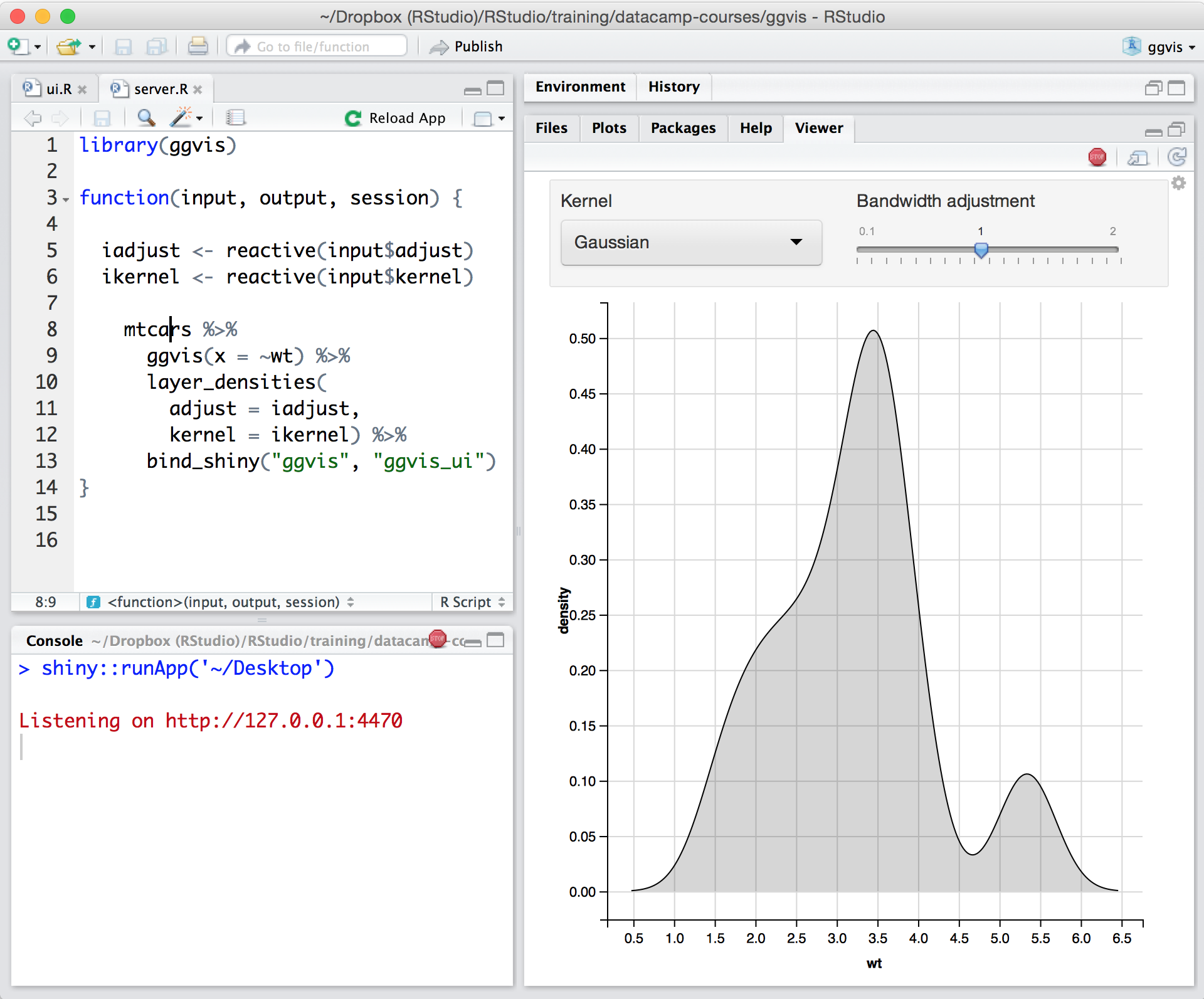
Screenshot of Posit runs on most desktops or on a server and accessed over the webScreenshot of Posit supports authoring HTML, PDF, Word Documents, and slide showsScreenshot of Posit supports interactive graphics with Shiny and ggvisScreenshot of Shiny combines the computational power of R with the interactivity of the modern webScreenshot of Remote Interactive Sessions: Start R and Python processes from Posit Workbench within various systems such as Kubernetes and SLURM with Launcher.Screenshot of Jupyter: Author and edit Python code with Jupyter using the same Posit Workbench infrastructure.