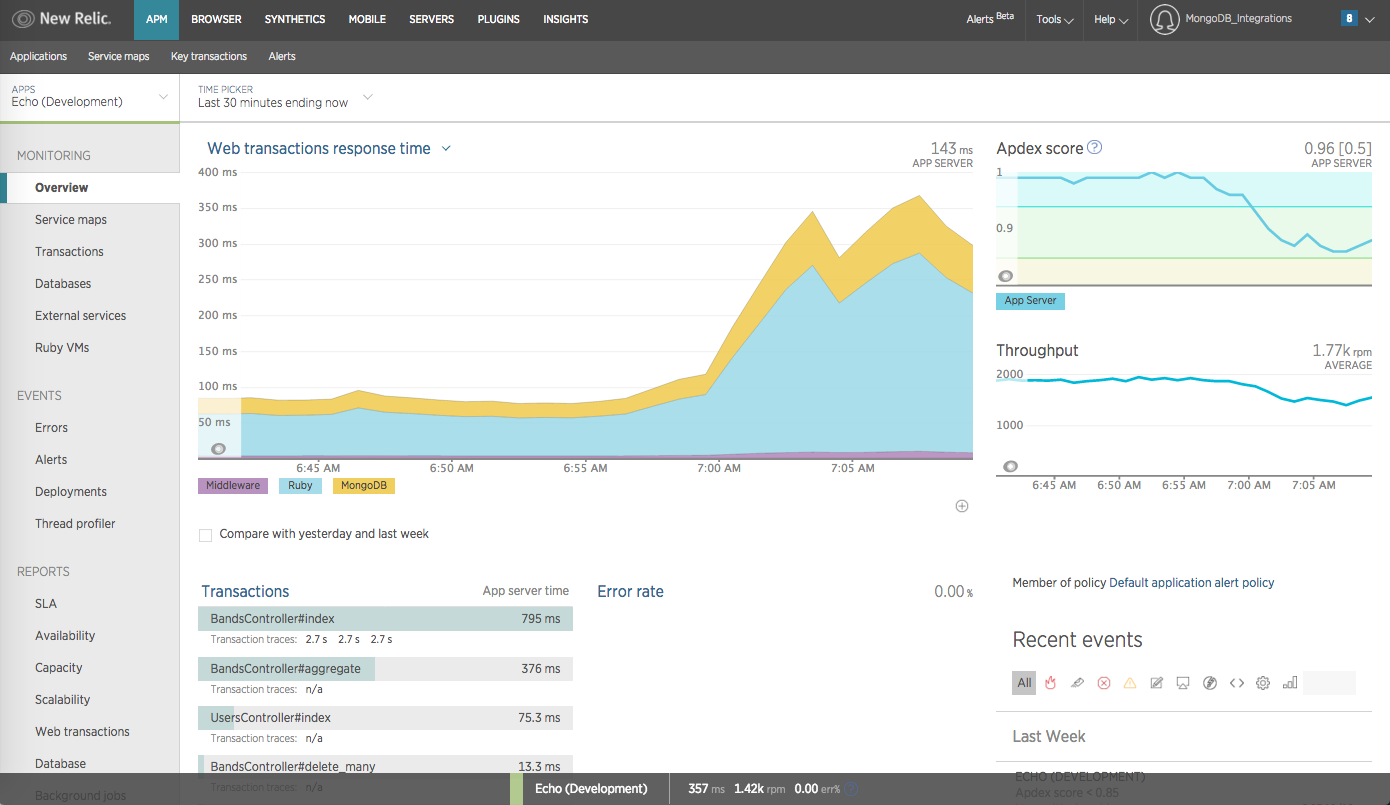
MongoDB is an open source document-oriented database system. It is part of the NoSQL family of database systems. Instead of storing data in tables as is done in a "classical" relational database, MongoDB stores structured data as JSON-like documents with dynamic schemas (MongoDB calls the format BSON), making the integration of data in certain types of applications easier and faster.
$0.10
million reads
SAP HANA Cloud
Score 8.9 out of 10
N/A
SAP HANA is an application that uses in-memory database technology to process very large amounts of real-time data from relational databases, both SAP and non-SAP, in a very short time. The in-memory computing engine allows HANA to process data stored in RAM as opposed to reading it from a disk which means that the data can be accessed in real time by the applications using HANA. The product is sold both as an appliance and as a cloud-based software solution.
$0.95
per month Capacity Units
Azure SQL Database
Score 8.4 out of 10
N/A
Azure SQL Database is Microsoft's relational database as a service (DBaaS).
$0.50
Per Hour
Pricing
MongoDB
SAP HANA Cloud
Azure SQL Database
Editions & Modules
Shared
$0
per month
Serverless
$0.10million reads
million reads
Dedicated
$57
per month
No answers on this topic
2 vCORE
$0.5044
Per Hour
6 vCORE
$1.5131
Per Hour
10 vCORE
$2.52
Per Hour
Offerings
Pricing Offerings
MongoDB
SAP HANA Cloud
Azure SQL Database
Free Trial
Yes
Yes
No
Free/Freemium Version
Yes
No
No
Premium Consulting/Integration Services
No
No
No
Entry-level Setup Fee
No setup fee
Optional
No setup fee
Additional Details
Fully managed, global cloud database on AWS, Azure, and GCP
The flexible structure underlying MongoDB's construction is not found in other competitors; the ability to easily change the structure without affecting other stored documents. It is very ideal for projects that you cannot predict that the structure will change this way. Of …
MongoDB is our go-to database solution for any project, and the more we work with it the more we love it. Some say that NoSQL is pointless... Our developers wholeheartedly disagree, because they love working with it. Though both NoSQL and SQL have their purposes, in most …
Earlier, the cloud-based database of azure was being used, and since it is also a cloud-based database solving all the analytical problems but once using Sap Hana, it seems to be more modern type problem solving and highly secure and highly user-friendly, solving a lot of …
Senior Manager E commerce - Sales ops & Process excellence
Chose SAP HANA Cloud
SAP HANA was selected as it has the capability of handling a large amount of data, big data for a 10000 cr + organization. Wanted something which is dependent, suitable, resolve complex data problems,movements , combining 2 mergers of data into a single one, handled SKU count …
SAP HANA database is attacking the established leaders in the database market: Oracle, Microsoft, IBM and Teradata. That is a pretty bold move and a lot of people might fear to bet on the newcomer. The fact that all of them are following SAP with in-memory database features …
Vice President, Chief Architect, Development Manager and Software Engineer
Chose SAP HANA Cloud
HANA is basically a database platform. I think of it as going full circle back to being mainframe-like. HANA is a platform with everything you need if you chose to deploy it that way. I feel we went to distributed because of the cheap cost but needed many machines to get …
There are many alternatives to SAP HANA if we consider functionality. Most of them, just like HANA, have their own niche place of specialization. But SAP HANA is at the forefront when it comes to performance comparison in its area of expertise which is business intelligence and …
If asked by a colleague I would highly recommend MongoDB. MongoDB provides incredible flexibility and is quick and easy to set up. It also provides extensive documentation which is very useful for someone new to the tool. Though I've used it for years and still referenced the docs often. From my experience and the use cases I've worked on, I'd suggest using it anywhere that needs a fast, efficient storage space for non-relational data. If a relational database is needed then another tool would be more apt.
I think if you have a large organization, it's probably the product and the marketplace to go to. We're a large management consulting firm operating in four to seven countries. And generally speaking, I think that's the size and the scope where it scales best. I can't speak to smaller companies, but I can't see smaller companies leveraging the benefits as much as a larger organization can.
We have found it's a great alternative for making older legacy applications work with online databases instead of only on-premises databases. We've converted over a dozen applications this way, and it has allowed our clients to have a distributed workforce using their applications without incurring the expense of a complete application rewrite.
Being a JSON language optimizes the response time of a query, you can directly build a query logic from the same service
You can install a local, database-based environment rather than the non-relational real-time bases such a firebase does not allow, the local environment is paramount since you can work without relying on the internet.
Forming collections in Mango is relatively simple, you do not need to know of query to work with it, since it has a simple graphic environment that allows you to manage databases for those who are not experts in console management.
Real-time reporting and analytics on data: because of its in-memory architecture, it is perfect for businesses that need to make quick decisions based on current information.
Managing workload with complex data: it can handle a vast range of data types, including relational, documental, geospatial, graph, vector, and time series data.
Developing and deploying intelligent data applications: it provides various tools for such applications and can be used for machine learning and artificial intelligence to automate tasks, gain insights from data, and make predictions.
Maintenance is always an issue, so using a cloud solution saves a lot of trouble.
On premise solutions always suffer from fragmented implementations here and there, where several "dba's" keep track of security and maintenance. With a cloud database it's much easier to keep a central overview.
Security options in SQL database are next level... data masking, hiding sensitive data where always neglected on premise, whereas you'll get this automatically in the cloud.
An aggregate pipeline can be a bit overwhelming as a newcomer.
There's still no real concept of joins with references/foreign keys, although the aggregate framework has a feature that is close.
Database management/dev ops can still be time-consuming if rolling your own deployments. (Thankfully there are plenty of providers like Compose or even MongoDB's own Atlas that helps take care of the nitty-gritty.
Requires higher processing power, otherwise it won't fly. How ever computing costs are lower. Incase you are migrating to cloud please do not select the highest config available in that series . Upgrading it later against a reserved instance can cost you dearly with a series change
Lack of clarity on licensing is one major challenge
Unless S/4 with additional features are enabled mere migration HANA DB is not a rewarding journey. Power is in S/4
One needs to be aware that some T-SQL features are simply not available.
The programmatic access to server, trace flags, hardware from within Azure SQL Database is taken away (for a good reason).
No SQL Agent so your jobs need to be orchestrated differently.
The maximum concurrent logins maybe an unexpected problem.
Sudden disconnects.
The developers and admin must study the capacity and tier usage limits https://docs.microsoft.com/en-us/azure/azure-subscription-service-limits otherwise some errors or even transaction aborts never seen before can occur.
Only one Latin Collation choice.
There is no way to debug T-SQL ( a big drawback in my point of view).
I am looking forward to increasing our SaaS subscriptions such that I get to experience global replica sets, working in reads from secondaries, and what not. Can't wait to be able to exploit some of the power that the "Big Boys" use MongoDB for.
We would rate our likelihood of renewing at 9/10. SAP HANA Cloud has proven to be a highly reliable and scalable data platform that consistently delivers strong performance. Its seamless integration with our overall SAP landscape, combined with improved analytics and real-time data capabilities, makes it a core part of our long-term technology strategy.
NoSQL database systems such as MongoDB lack graphical interfaces by default and therefore to improve usability it is necessary to install third-party applications to see more visually the schemas and stored documents. In addition, these tools also allow us to visualize the commands to be executed for each operation.
It is useful solution which helps you improve SAP applications performance. It offers you faster data processing, robust disaster management, higher availability, scalability, advanced analytical capabilities, etc. It provides you simple, clean, organized user interface designed to facilitate smooth navigation. Its user interface is simple and intuitive which allow you to complete task efficiently.
The interfaces are intuitive once you are familiar with all the functions. The ability to use different tools to interact with the platform, such as directly via a browser or code editors such as VS Code or Visual Studio is a great option and allows for integrating withn the project and other testing and developing tools.
Finding support from local companies can be difficult. There were times when the local company could not find a solution and we reached a solution by getting support globally. If a good local company is found, it will overcome all your problems with its global support.
However, I am not the right person to answer this as we have another department to handle support and contact the service provider for any support required. Although i will say that they are the quick respondent and knows how to handle querry of the customers and provide quick and better support.
We give the support a high rating simply because every time we've had issues or questions, representatives were in contact with us quickly. Without fail, our issues/questions were handled in a timely matter. That kind of response is integral when client data integrity and availability is in question. There is also a wealth of documentation for resolving issues on your own.
While the setup and configuration of MongoDB is pretty straight forward, having a vendor that performs automatic backups and scales the cluster automatically is very convenient. If you do not have a system administrator or DBA familiar with MongoDB on hand, it's a very good idea to use a 3rd party vendor that specializes in MongoDB hosting. The value is very well worth it over hosting it yourself since the cost is often reasonable among providers.
Professional GIS people are some of the most risk-averse there are, and it's difficult to get them to move to HANA in one step. Start with small projects building to 80% use of HANA spatial over time.
We have [measured] the speed in reading/write operations in high load and finally select the winner = MongoDBWe have [not] too much data but in case there will be 10 [times] more we need Cassandra. Cassandra's storage engine provides constant-time writes no matter how big your data set grows. For analytics, MongoDB provides a custom map/reduce implementation; Cassandra provides native Hadoop support.
I have deep knowledge of other disk based DBMSs. They are venerable technology, but the attempts to extend them to current architectures belie the fact they are built on 40 year old technology. There are some good columnar in-memory databases but they lack the completeness of capability present in the HANA platform.
We moved away from Oracle and NoSQL because we had been so reliant on them for the last 25 years, the pricing was too much and we were looking for a way to cut the cord. Snowflake is just too up in the air, feels like it is soon to be just another line item to add to your Azure subscription. Azure was just priced right, easy to migrate to and plenty of resources to hire to support/maintain it. Very easy to learn, too.
Open Source w/ reasonable support costs have a direct, positive impact on the ROI (we moved away from large, monolithic, locked in licensing models)
You do have to balance the necessary level of HA & DR with the number of servers required to scale up and scale out. Servers cost money - so DR & HR doesn't come for free (even though it's built into the architecture of MongoDB