NETSCOUT TruView is a unified network monitoring and APM tool. TruView is deployed as hardware on-premises, and it can automate capacity planning and environment discovery and configuration.
N/A
Splunk Observability Cloud
Score 8.2 out of 10
N/A
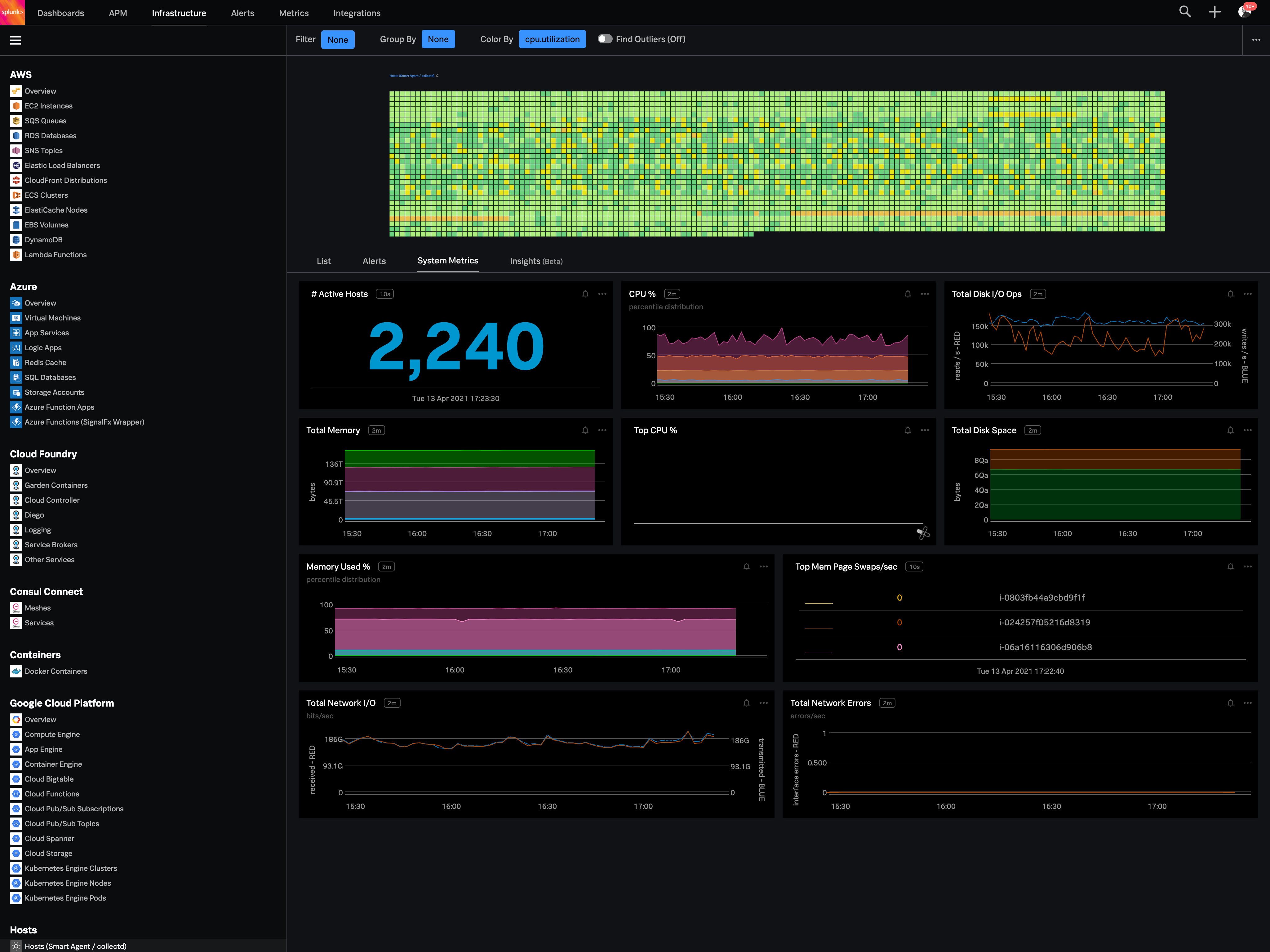
Splunk Observability Cloud aims to enable operational agility and better customer experience through real-time AI-driven streaming analytics allowing accurate alerts in seconds. It is designed to shorten MTTD and MTTR by providing real-time visibility into cloud infrastructure and services.
Netscout’s TruView monitoring system gives your IT department the perfect view of your network landscape. With the pulse hardware app, you can perform VoIP or HTTP network monitoring tests from specific remote locations and it will populate the analysis results into your console. This will give you perspective on how your sites are performing and detect any out of Service Level Agreement (SLA) performance even before users report it.
Its great if you need real-time visibility across complex or regulated environments. Also strong for hybrid or multi-cloud setups where uptime, observability and fast IR are required. It’s probably overkill for smaller teams or environments that don’t have constant changes or compliance reporting needs. It's expensive and has a steep learning curve. Also, in my opinion, do not get yourself into a consumption based model. Costs can certainly get out of control quickly.
The app monitoring gives you the details to set different filters and do a quick identification of the root cause of the problem.
Remarkable ability to store details of performance to analyze baselining, run advance troubleshooting, error detection and catalog by trends.
The ability to sync with a device/interface whether is physical or virtual gives me the standpoint to set analysis upon network traffic across LAN or WAN and also get the insight of Cloud segments, setting the triggers to find out where the behavior changes to non-production traffic.
The first one is its Kubernetes container monitoring.
I really like this features because as we know how much K8s is vast and to manually monitor each part of the Kubernetes it takes so much time but Splunk Observability Cloud makes it easier. And even once we integrate K8s with Splunk Observability Cloud it gives us some prebuilt dashboards which gives holistic view of our Cluster and its nodes, pods, etc.
The dashbaord feature of Splunk Observability Cloud, it gives us full flexibility to customize our dashboard with a wide range of predefined chart types.
Now it also supports OTEL, which is a plus point for observability. As now everyone is moving towards Otel and in current market there are only few tools who supports OTEL based integrations, Splunk Observability Cloud is one out of them.
Product features are sometimes overwhelming if the IT team is not used to this technology. For a small and mid-size company, the number of settings and work that is needed to implement the solution could be a long and exhausting process.
A "lite" version of Visual TruView could help a lot to small sized environments looking to develop the solution.
I would like to add some mitigation tools for simple/common problems that could be easily managed by a monitoring tool like Netscout TruView.
You can use table-like functionality to generate dashboards, but these queries are heavy on the system.
It could be easier to give insight into what type of line parsing is used for specific documents in a company-managed environment and/or show ways to gain the insights needed.
I would like to see ways to anonymize specific data for shared reports without pre-formatting this in a dashboard on which reports could be based.
Good: Stable system with low error rate Easy to use for simple use cases Bad: UI is not very clear for complex usage Mobile view (when logged in from phone) is bad No library for .net
When there is an issue, it’s a win if one can easily identify the root cause. To do the same, it should allow the user to dig deep with multiple data points and compare the data and identify the anomaly. In this use case, it’s good to drive from Splunk 011y.
As mentioned before, our deployment success depended on their expertise. Recommendations and overall response from their support engineers was out of this world. We, as supporters ourselves, are very critical in regards to the response times and knowledge of support services representatives. Often they just want to resolve your ticket not caring about the result, or focus only on the performance review we could give them. That's a standard behavior in most overseas support centers. The TruView engineers and management cared about us, our needs, and how they delivered the help we needed.
Visual TruView is a solid competitor with solutions such as SolarWinds NPM, Nagios, PRTG, or SolarWinds NTA. Why we chose TruView was because it goes straight to what we were looking for, no hidden modules or subscriptions to secondaries licensing terms, to get the results that we were expecting. TruView takes it to another level.
Splunk Infrastructure Monitoring provides far superior options for anybody using a complex hybrid multi-cloud environment and allows both your SOC and NOC to work together on the same data while driving their own insights. We found other products are still in the old world view of servers and agents residing together within a single data centre, but modern apps are no longer like this.
Tool consolidation, an amazing GUI that shows the most from the very beginning helping the IT Teams to set their own dashboards according to their needs.
When they meant one price tag, that's it! You won't get a headache after the purchase process is done.
Better be ready to set the scales your organization requires because if you miss something in the design you could get an application size that overrides your initial budget.