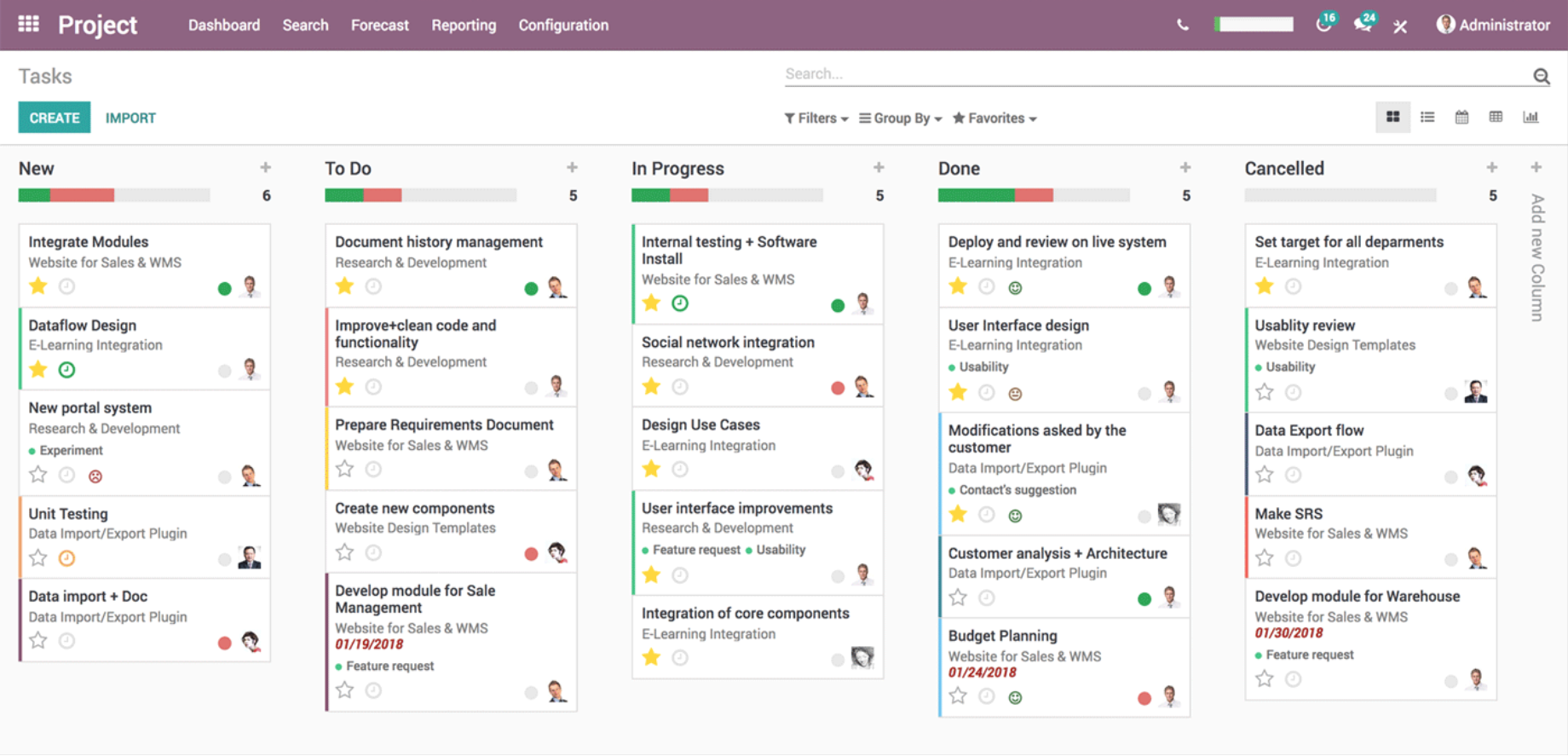
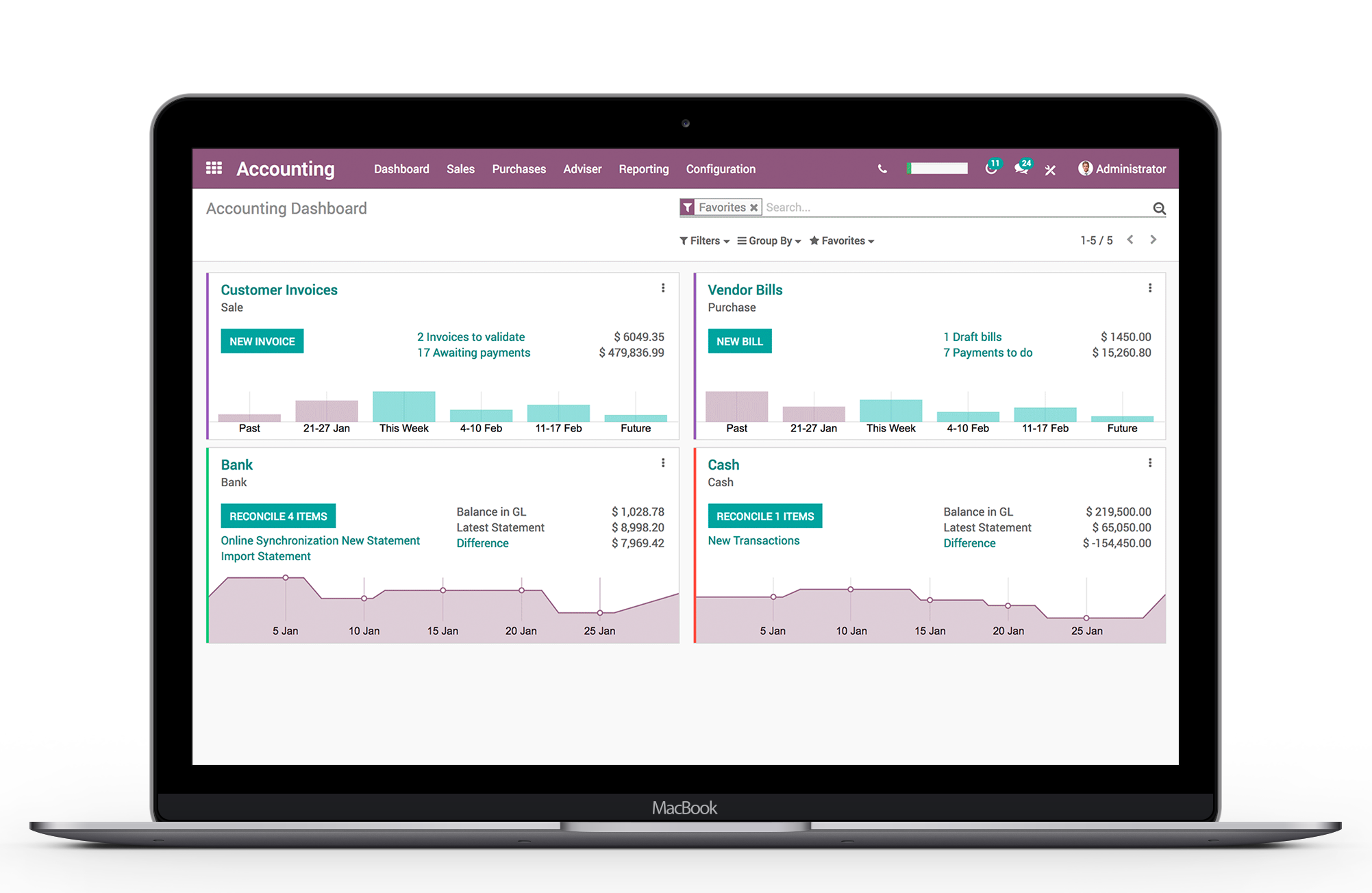
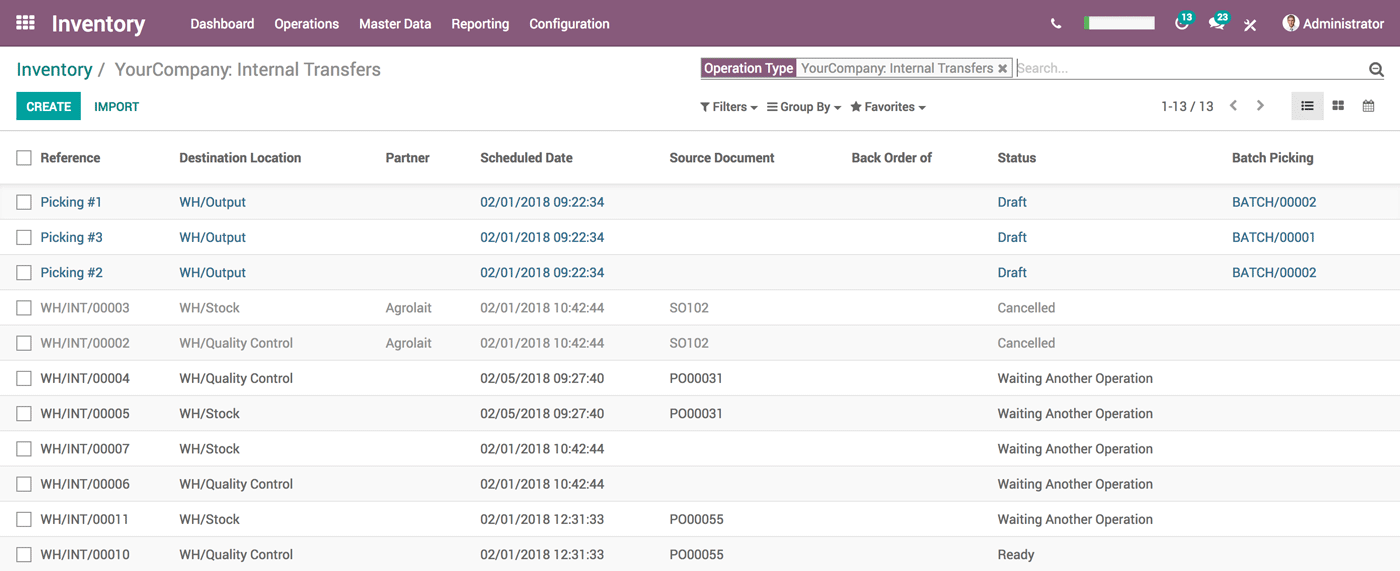
Odoo, from the Belgium-headquartered multinational company of the same name, is a suite of business applications for managing the sales pipeline. It also comprises a PoS and inventory management modules, scaling to a warehouse or retail management solution.
$31.10
per month per user
Sage 500
Score 6.3 out of 10
N/A
Sage 500 ERP includes accounting and finance, distribution and supply chain, and manufacturing operations support modules. The latest Sage 500 release includes accounts payable enhancements, credit card processing, and general updates, as well as updates to the solution's modules.
N/A
Pricing
Odoo
Sage 500 ERP
Editions & Modules
Standard
$31.10
per month per user
Custom
$46.70
per month per user
No answers on this topic
Offerings
Pricing Offerings
Odoo
Sage 500
Free Trial
Yes
No
Free/Freemium Version
Yes
No
Premium Consulting/Integration Services
Yes
No
Entry-level Setup Fee
-$49,321,250 per app/ per user/ per month
No setup fee
Additional Details
A discount is offered for new users for the first 12 months of use for the initial users purchased. ($24.90 instead of $31.10 for Standard)
—
More Pricing Information
Community Pulse
Odoo
Sage 500 ERP
Features
Odoo
Sage 500 ERP
Payroll Management
Comparison of Payroll Management features of Product A and Product B
Odoo
5.7
10 Ratings
28% below category average
Sage 500 ERP
7.0
2 Ratings
7% below category average
Pay calculation
8.69 Ratings
9.01 Ratings
Benefit plan administration
8.78 Ratings
6.01 Ratings
Direct deposit files
9.29 Ratings
7.02 Ratings
Customization
Comparison of Customization features of Product A and Product B
Odoo
8.4
13 Ratings
11% above category average
Sage 500 ERP
8.5
3 Ratings
12% above category average
API for custom integration
8.511 Ratings
9.03 Ratings
Plug-ins
8.313 Ratings
8.03 Ratings
Security
Comparison of Security features of Product A and Product B
Odoo
8.8
14 Ratings
4% above category average
Sage 500 ERP
8.5
3 Ratings
1% above category average
Single sign-on capability
9.510 Ratings
7.03 Ratings
Role-based user permissions
8.114 Ratings
10.03 Ratings
Reporting & Analytics
Comparison of Reporting & Analytics features of Product A and Product B
Odoo
7.0
16 Ratings
7% below category average
Sage 500 ERP
8.0
3 Ratings
6% above category average
Dashboards
6.416 Ratings
6.03 Ratings
Standard reports
6.916 Ratings
8.03 Ratings
Custom reports
7.716 Ratings
10.03 Ratings
General Ledger and Configurable Accounting
Comparison of General Ledger and Configurable Accounting features of Product A and Product B
Odoo
5.1
13 Ratings
41% below category average
Sage 500 ERP
8.0
3 Ratings
4% above category average
Accounts payable
7.613 Ratings
10.03 Ratings
Accounts receivable
7.613 Ratings
10.03 Ratings
Global Financial Support
7.012 Ratings
10.02 Ratings
Primary and Secondary Ledgers
7.112 Ratings
8.01 Ratings
Journals and Reconciliations
7.013 Ratings
10.02 Ratings
Configurable Accounting
7.913 Ratings
10.02 Ratings
Standardized Processes
6.912 Ratings
10.02 Ratings
Inventory Management
Comparison of Inventory Management features of Product A and Product B
Odoo
6.7
18 Ratings
17% below category average
Sage 500 ERP
8.0
3 Ratings
0% above category average
Inventory tracking
8.118 Ratings
6.03 Ratings
Automatic reordering
8.816 Ratings
10.03 Ratings
Location management
8.915 Ratings
10.03 Ratings
Order Management
Comparison of Order Management features of Product A and Product B
Odoo
6.2
16 Ratings
25% below category average
Sage 500 ERP
8.8
2 Ratings
10% above category average
Pricing
8.816 Ratings
8.02 Ratings
Order entry
8.516 Ratings
9.02 Ratings
Credit card processing
7.413 Ratings
9.02 Ratings
Cost of goods sold
8.614 Ratings
10.02 Ratings
Order Orchestration
8.412 Ratings
8.01 Ratings
Subledger and Financial Process
Comparison of Subledger and Financial Process features of Product A and Product B
Odoo
3.2
12 Ratings
81% below category average
Sage 500 ERP
5.9
2 Ratings
25% below category average
Billing Management
7.812 Ratings
10.02 Ratings
Cash and Asset Management
7.311 Ratings
8.02 Ratings
Travel & Expense Management
6.811 Ratings
8.01 Ratings
Budgetary Control & Encumbrance Accounting
6.310 Ratings
2.01 Ratings
Period Close
8.010 Ratings
8.02 Ratings
Project Financial Management
Comparison of Project Financial Management features of Product A and Product B
Odoo
1.0
6 Ratings
153% below category average
Sage 500 ERP
6.9
1 Ratings
9% below category average
Budgeting and Forecasting
1.06 Ratings
1.01 Ratings
Project Costing
1.05 Ratings
3.01 Ratings
Cost Capture
1.05 Ratings
8.01 Ratings
Capital Project Management
1.05 Ratings
9.01 Ratings
Customer Contract Compliance
1.05 Ratings
9.01 Ratings
Project Revenue Recognition
1.05 Ratings
9.01 Ratings
Project Execution Management
Comparison of Project Execution Management features of Product A and Product B
Odoo
3.3
8 Ratings
74% below category average
Sage 500 ERP
4.5
1 Ratings
45% below category average
Project Planning and Scheduling
9.88 Ratings
00 Ratings
Task Insight for Project Managers
9.87 Ratings
7.01 Ratings
Project Mobile Functionality
9.87 Ratings
5.01 Ratings
Definable Resource Pools
8.97 Ratings
00 Ratings
Grants Management
Comparison of Grants Management features of Product A and Product B
Odoo
3.2
8 Ratings
80% below category average
Sage 500 ERP
7.5
1 Ratings
1% above category average
Award Lifecycle Management
10.07 Ratings
6.01 Ratings
Procurement
Comparison of Procurement features of Product A and Product B
Odoo
7.8
11 Ratings
9% above category average
Sage 500 ERP
6.0
1 Ratings
17% below category average
Bids Analyzed and Compared
8.67 Ratings
00 Ratings
Contract Authoring
6.57 Ratings
8.01 Ratings
Contract Repository
7.57 Ratings
10.01 Ratings
Requisitions-to-Purchase Orders Integrated
8.410 Ratings
8.01 Ratings
Supplier Management
7.98 Ratings
4.01 Ratings
Risk Management
Comparison of Risk Management features of Product A and Product B
Odoo
9.8
5 Ratings
36% above category average
Sage 500 ERP
4.3
1 Ratings
45% below category average
Risk Repository
10.02 Ratings
3.01 Ratings
Control Management
10.05 Ratings
7.01 Ratings
Control Efficiency Assessments
10.04 Ratings
4.01 Ratings
Issue Detection
10.03 Ratings
00 Ratings
Remediation and Certification
10.02 Ratings
3.01 Ratings
Logistics
Comparison of Logistics features of Product A and Product B
Odoo
6.8
7 Ratings
3% below category average
Sage 500 ERP
-
Ratings
Transportation Planning and Optimization
9.05 Ratings
00 Ratings
Transportation Execution Management
10.05 Ratings
00 Ratings
Trade and Customs Management
9.44 Ratings
00 Ratings
Fulfillment Management
8.96 Ratings
00 Ratings
Warehouse Workforce Management
10.05 Ratings
00 Ratings
Manufacturing
Comparison of Manufacturing features of Product A and Product B
Odoo
8.0
9 Ratings
7% above category average
Sage 500 ERP
-
Ratings
Production Process Design
6.36 Ratings
00 Ratings
Production Management
6.17 Ratings
00 Ratings
Configuration Management
8.36 Ratings
00 Ratings
Work Execution
8.57 Ratings
00 Ratings
Manufacturing Costs
8.67 Ratings
00 Ratings
Supply Chain
Comparison of Supply Chain features of Product A and Product B
Odoo
8.6
11 Ratings
16% above category average
Sage 500 ERP
1.3
1 Ratings
140% below category average
Forecasting
8.611 Ratings
1.01 Ratings
Inventory Planning
8.811 Ratings
2.01 Ratings
Performance Monitoring
7.810 Ratings
1.01 Ratings
Product Lifecycle Management
Comparison of Product Lifecycle Management features of Product A and Product B
It is well suited for inventory tracking, shipping and sales work flows. While some customization is needed to make it functional, if done correctly Odoo can serves as a powerful one stop shop for all of a businesses needs. The ease of customization for email templates, both for sales communications and marketing outreach leaves something to be desired. Perhaps our team hasn't explored this fully enough. I have personally found it intimidating in trying to construct a news letter using the email marketing module
Sage 500 ERP is great for companies with core accounting needs, distributors, and discrete manufacturers. Some areas, such as process manufacturing, would require a companion product from an ISV for the software to be truly functional. Some areas, such as construction or retail apparel, may simply not be well-served.
The creation of products is extremely simple, I like that it does not complicate you to put a lot of detail, of course if you want to put more detailed information later it allows you to do it without problems
The fact that I can manage my inventory of my warehouse is very convenient, I only generate my stock report of the products we have in stock and taking inventory is easier
The management of opportunities in the CRM is also great, because the guys from the sales department generate their opportunity, place what their client is requiring and we, the logisticians, can automatically generate the quote for what they are requesting, and from there they can only download their quote and send it to their clients.
Sage is the one-stop-shop for all of our needs. We're able to control contracts, subcontracts, and field reports from the program.
Another strength is the ability to database all the information and export it to excel. This makes data-based investigations a breeze.
The ability for Timberscan to be imported to Sage is a huge help with invoice management. Prior to this it all had to be done manually and slowed the process to an essential halt as there are thousands of invoices per month.
Customer service is nonexistent. You will need a 3rd party to assist you.
The system has an open app for integrating with other programs. These are developed by third parties and can be hit or miss in functionality.
The system offers great flexibility; however, it is too much and requires coding. For example, changing a Sales order PDF requires coding to modify the document.
Initial implementation is clunky and seems to require a 3rd party just for setup.
Once you complete the training with Odoo, you have a great grasp of how the system works, and most every feature is intuitive- There is rarely a task within Odoo that I get frustrated trying to figure out- I can typically look through the system and find what I need to do, and if I ever do need support, the Odoo Support team is excellent
I have been using Intacct for almost 10 years in 2 different companies and I just simply love it. I tried SAP (GUI) and Netsuite and they dont come close to what Ive seen.
Easy - there is NO SUPPORT (like in ABSOLUTELY NOTHING!!!!!!!). Even for legally mandatory requirements where the system MUST work, they will gladly take a month to get back to you with a NON-answer. We couldn't even get our bank statements correctly into Odoo for 2 months - leading to no reconciliation and the company accounts were a mess (still are!!) as a result - Completely irresponsible. Have not EVEN had an apology from Odoo - they couldn't care less !!
Keep your database and application in different servers. Install Microsoft Office on your application server so you can use some of the data analysis tools in Sage.
We decided to go with Odoo over Netsuite due to a few factors. Price was a big reason why, Netsuite is the most expensive ERP we vetted. I also did not have a great experience with Netsuite at my last job. I was on the roll out team and it did not work as promised for POS, inventory managing or reporting, it crashed constantly in the middle of using it. Just over all very poor. Considering it is owned by Oracle and the most expensive, you would think it would be able to function on some sort of base level. That company ended up terminating their contract with Netsuite early and going with a different company.
We don't have crashing or error issues. I can complete receives, cycle counts etc and all of my information saves. Visually, Odoo is more satisfying also.
500 seems much smoother at handling some of the basic accounting tasks, for example both issuing and later reconciling checks in Dynamics AX seems a little tedious.
Positive: The program allows for a lot of data entry and splitting of information. It has the capability of replacing multiple programs and therefore saving cost.
Negative: The modules are cumbersome and not user friendly at all. As a result not many user are comfortable using it. This means that the program is not being used to its capacity.
Negative: Although the program has the capacity to be great, the user interface destroys that potential. Sage needs to seriously work on their program to simplify it. It's as if it still uses Command-line entries from 1995. Needs to be updated ASAP.