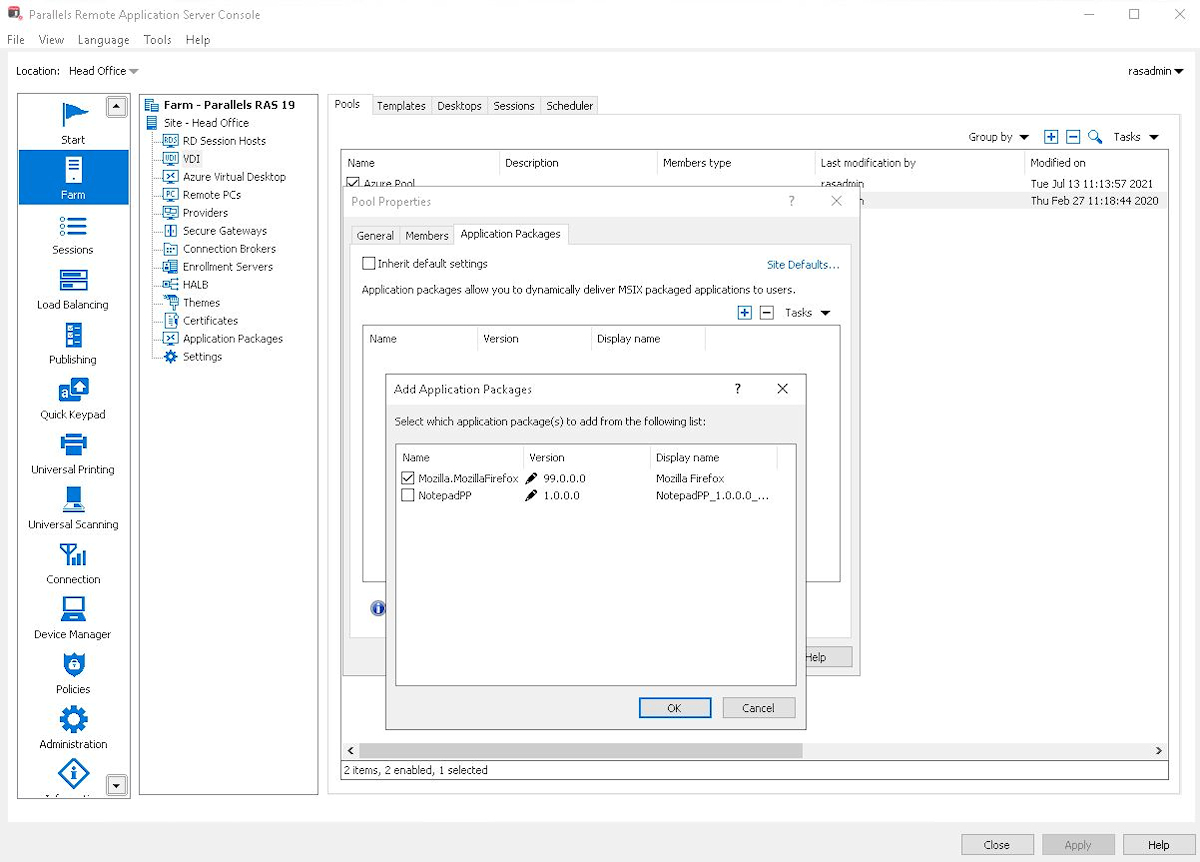
Parallels Remote Application Server (Parallels RAS, formerly 2X RAS), is application virtualization technology, billed as a solution to extend the life of legacy OS (like Windows XP) with its virtual desktop for any device.
Maltese company 2X Software developed the technology, but was acquired by Parallels (in Seattle, WA) in February, 2015 to extend their cross-platform support solutions.
$120
per year per user
VMware ESXi
Score 7.1 out of 10
N/A
A bare-metal hypervisor that installs directly onto a physical server. With direct access to and control of underlying resources, VMware ESXi partitions hardware to consolidate applications and cut costs.
N/A
Pricing
Parallels Remote Application Server (Parallels RAS)
Chose Parallels Remote Application Server (Parallels RAS)
We love the easy integration and functionality on the client side. With Citrix Workspace we always had connectivity issues and re-logins, which we never had with Parallels RAS. Awingu was also a good choice, because of its browser-only approach, but sometimes it is too …
Chose Parallels Remote Application Server (Parallels RAS)
Parallels compared to just using Microsoft's straight built-in functionally to their Windows Server is simply a cost vs reward scenario. In other words, you can save a bunch of money not using Parallels and just using MS built-in functionally. However, it likely won't work as …
Chose Parallels Remote Application Server (Parallels RAS)
The management of Parallels Remote Application Server was much easier, the cost of licenses and yearly maintenance was lower, their support team was much more helpful then their competitors and the initial server setup was faster. We had our system up and running in as little …
Chose Parallels Remote Application Server (Parallels RAS)
Our previous Citrix environment was aging, and when we spoke with our ERP vendor, and discovered that they were using Parallels Remote Application Server as their own hosting platform for hosted clients, it made it an easier decision to deploy knowing that they were using the …
Chose Parallels Remote Application Server (Parallels RAS)
Parallels is less expensive to both purchase and maintain, easier to implement, easier to support, and easier to comprehend overall. Also, the product name doesn't change every week.
Unfortunately I haven't had the opportunity to use much of any of the alternatives to ESXi. Just Hyper-V for a bit, but not enough to give a definitive answer on.
Parallels Remote Application Server (Parallels RAS)
VMware ESXi
Likelihood to Recommend
Parallels
Scenarios where time is a factor in having a solution in place and up and running safely and securely. Where there are older devices that ordinarily wouldn't be up to the task of running modern apps and services. Where users need to work away from the network, and security is a concern.
If you're looking for the industry standard in server virtualization, I would recommend ESXi. After decades of expertise in the field, VMware continues to provide a strong product, production-ready, with an easy-to-learn interface that allows for quick management along with less costly upfront onboarding and training. Grab the free personal-use license and install in your homelab to start!
The printing driver is quite excellent, both in the Parallels Client and on the HTML5 client.
Setup is incredibly easy; the default setup is very functional, and adding features is a breeze.
Speed is very acceptable in general for end-users, the clients adapt quite well to the amount of bandwidth available, and features are available to adjust further.
Resource management. The automatic load balancing works very well to ensure no host is taxed disproportionately compared to the others.
Templates and cloning. It is very easy to set up a template and spin up new servers based on a specific setup. This makes server management very streamlined.
VM management. The vSphere interface is very easy to use and navigate. Everything is responsive and it works when you need it to. The options are also robust while also being arranged in a straightforward manner.
Parallels Remote Application Server (Parallels RAS) continually improves the product but has broken some features recently. For example the web management portal lost the ability to manage user sessions after a major update. That issue was fixed in a later release
Multi-monitor support beyond 4 monitors (It does handle up to 4 -1080 monitors well)
More options around connection security and MFA. current options are sufficient but limited
We've noticed some performance issues with Windows Server 2019 and 2022. I'd like to see more robust support for remote applications running from those platforms.
VMware ESXi can improve on the UI that is installed on the bare metal machine. The menus can be hard to navigate when looking for simple configuration items.
VMware ESXi can improve on the stability of their overall hypervisor. There have been a few times we had to reinstall due to corruption of VMware ESXi.
I would like to see VMware ESXi do better at adding more standard free features in their consumer version of VMware ESXi. For example, having the ability to back up virtual machines is good practice and something that would be very nice if offered in their free version.
We have been using Parallels since it was called 2X - it is a major part of how we do business. It is fairly simple to use and maintain - staff like it, we like it. It is a product that makes a promise - and it keeps it. As Parallels evolves, and clean bandwidth becomes more readily available everywhere - it just makes sense to continue to use Parallels in our environment
It is critical to our business, what started out as a way to do certain functions, it has now become core to ensuring our product is available to our customers and reducing our costs to operate and reduce our recovery time and provisioning servers. Their support is great and the costs to renew is reasonable.
Parallels RAS was easy to setup, with great admin guides and resources. We especially liked the included Visio templates which made diagramming much easier. The reference deployment diagrams also simplified our deployment process. Our end users love Parallels RAS. Apps launch faster than Citrix, and the Parallels RAS client is far more reliable than Workspace.
The interface is fairly intuitive for most things, and the areas that are a little less obvious usually have fantastic documentation in the online knowledgebase. In 3-4 years of managing our ESXi hosts, I think that I have only opened 4-5 support cases for things that I could not figure out myself or find answers to on the website.
If there are any issues with Parallels - they are usually more about the server operating systems than Parallels itself. It would be rare for us to have any reason to take Parallels offline - we schedule a reboot on the servers at 3am to keep the O/S itself fresh, but again - it is not a Parallels issue. If individual users have any issues we ask them to completely log out of parallels - which ends their session - and then back in - and that typically resolves the issue right away.
Without the need to patch the servers with bug fixes and enhancements we whave not experienced any downtime with VMware issues. Even the bug fixes and updates do not cause of downtime as we just migrate the servers to the opposite node and update the one and then move servers back. Very simple and painless.
I am giving Parallels 9/10 on this one because the only application that sometimes seems slow or has issues - is Microsoft Outlook. It is sometimes the result of a pop-up that may not show up in the published application (vs full desktop). Other than that - pages load very quickly - and it does not seem to slow down other applications that are running at the same time. Most of our users run Outlook, softphone and Teams locally - and published applications for everything else. When they do that - it is very solid.
We do not notice any difference between a physical and virtual server running the same workload. In fact we can scale quicker with the virtual server than we can with the physical.
Good support in place if required, very helpful when it comes to upgrades or any issues faced. The support team is knowledgeable, friendly, and quick to respond to issues The company also provides a range of online resources, including a knowledge base, documentation, and forums, which can be helpful before raising a ticket
I can't say enough good about VMware's support team. To an individual they take ownership of the case, provide thorough answers, and follow up regularly. On one occasion, a problem we experienced with NSX Endpoint was escalated to development for a permanent resolution after a workaround was found. In my experience, most companies would have tried to find a way to close a case like that instead of taking it all the way. Most importantly, when production is down and every second counts, they VMware teams understand that urgency and treat your issue as if it were the only one they had to deal with. You can't ask for better.
Overall, it was pretty simple compared to most other projects. Again, we had a strong familarity with the product so there was not much of a learning curve. Our 'biggest' issue is the end-user understanding of a 'local' application and a published application. For example - Online meetings need to run locally for camera/video to work smoothly so opening a link to a meeting from a published application continues to be an occasional issue.
Jsut read and follow anything your storage provider may require to allow the integration of VMware with storage operations, outside of that VMware jsut works.
Parallels Remote Application Server (Parallels RAS) provides the finest end user experience while being cost-effective and reducing administrative and support man hours. Parallels Remote Application Server (Parallels RAS) is platform agnostic; it works with various kinds of devices (computers, phones, tablets) and several operating systems (Windows, Linux, Apple, etc.), allowing users to access it on gadgets of their choice.
As long as you're using Nutanix AOS on Nutanix hardware and are paying their software support fees, AOS is a valid competitor to VMware and can save money due to not needing a license and having their server management system built into the base host management system. If you aren't using Nutanix hardware, however, VMWare is in most cases the best way to go. I cannot comment on HyperV, but most IT people I know either use it because they have to (most) or they like it better (not many).
it has been fair and easy to understand. I know VMware is looking at wanting to change from CPU to core pricing so we will see what that looks like when it happens.
We added our Integrated Services Staff to parallels, with filtered, published applications - in a single afternoon. We added licensing and installed the desktop client software on multiple platforms both in the office and at remote sites all on the same day - and got remote users that had never used the product up and running - very quickly.
We started out with a two-server cluster and adding a third or fourth is very straightforward and simple with no issues. You just need to be aware of the size of your Vcenter Server to handle the workload, but still the resources needed is very minimal
Our customers have had dramatic cost decreases due to no longer needing IT departments to work with our software.
We've been able to charge more for our hosting services due to our customers saving money in the long run. Parallels Remote Application Server has more than paid for itself, and the increased income has gone right back into the business.
Both our customers and our company have benefited from this transition.
VMWare ESXi licensing is affordable for our business - and the licensing model is simplistic. Not like that of Microsoft with having to keep track of server licenses and CAL licenses for users.
VMWare ESXi also has hardware-monitoring built-in, so that further saves us money from having to be spent with another vendor.
As much as I hate the saying "a single pane of glass" does fit for this product. You can manage your servers, monitor hardware status, create and export backup snapshots, manage virtual NICs, connect to various storage devices. We're very happy with this product.