Salesforce Agentforce Commerce (formerly Commerce Cloud, and Demandware before that) is a cloud-based eCommerce solution for enterprises with merchandising tools, such as sorting, filtering, and image zooming, allowing customers to browse products.
$4
per month
Springbot
Score 6.0 out of 10
N/A
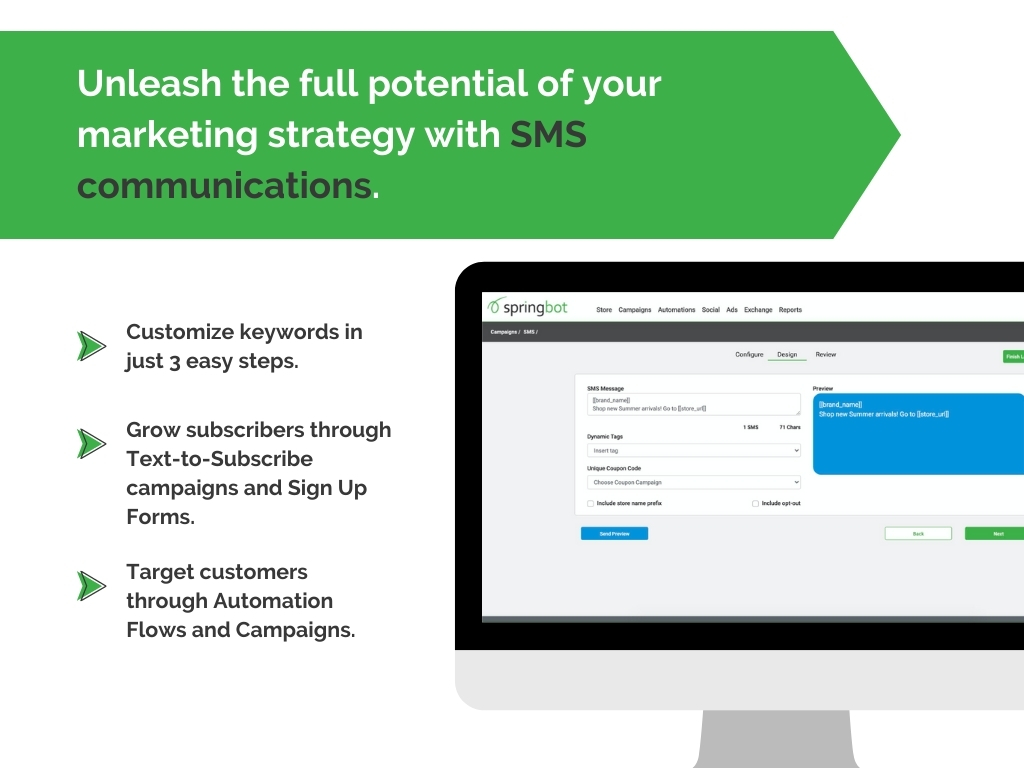
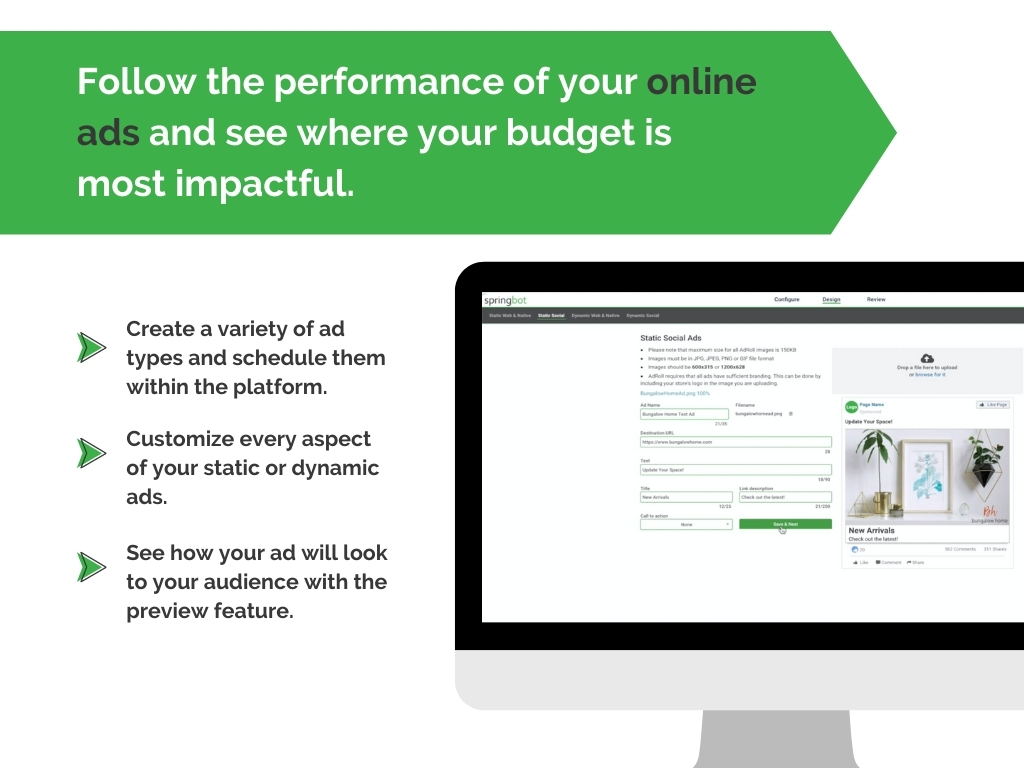
Springbot aims to bring all the marketing capabilities large retailers have to small businesses at a fraction of the cost. Through Springbot, online stores will be able to leverage automated marketing on channels such as email, SMS, social and online ads. Business owners and marketers who find themselves wearing many hats can still send the right message at the right time with confidence. With an all-in-one marketing automation platform designed with ease of use in mind, business…
$199
for up to 5,000 subscribers (includes email marketing, social hub, reporting and dashboards, signup forms, automations, account management, support and onboarding. See website for additional package options.
Pricing
Salesforce Agentforce Commerce
Springbot
Editions & Modules
No answers on this topic
Platform Base Package
$199/month
for up to 5,000 subscribers (includes email marketing, social hub, reporting and dashboards, signup forms, automations, account management, support and onboarding. See website for additional package options.
Offerings
Pricing Offerings
Agentforce Commerce
Springbot
Free Trial
No
Yes
Free/Freemium Version
No
No
Premium Consulting/Integration Services
No
No
Entry-level Setup Fee
No setup fee
No setup fee
Additional Details
B2B Commerce:
Starter - $4 price/order
Growth - $6 price/order
Plus - $8 price/order
B2C Commerce:
Starter - 1% Gross Merchandise Value
Growth - 2% Gross Merchandise Value
Plus - 3% Gross Merchandise Value
B2B2C Commerce:
1% Gross Merchandise Value
See website for pricing calculator for additional pricing options.
More Pricing Information
Community Pulse
Salesforce Agentforce Commerce
Springbot
Features
Salesforce Agentforce Commerce
Springbot
Online Storefront
Comparison of Online Storefront features of Product A and Product B
Salesforce Agentforce Commerce
8.9
44 Ratings
13% above category average
Springbot
-
Ratings
Product catalog & listings
9.339 Ratings
00 Ratings
Product management
9.339 Ratings
00 Ratings
Bulk product upload
8.138 Ratings
00 Ratings
Branding
9.139 Ratings
00 Ratings
Mobile storefront
9.235 Ratings
00 Ratings
Product variations
9.241 Ratings
00 Ratings
Website integration
8.639 Ratings
00 Ratings
Visual customization
7.940 Ratings
00 Ratings
CMS
9.337 Ratings
00 Ratings
Online Shopping Cart
Comparison of Online Shopping Cart features of Product A and Product B
Salesforce Agentforce Commerce
9.0
34 Ratings
16% above category average
Springbot
-
Ratings
Abandoned cart recovery
8.828 Ratings
00 Ratings
Checkout user experience
9.234 Ratings
00 Ratings
Online Payment System
Comparison of Online Payment System features of Product A and Product B
Salesforce Agentforce Commerce
9.4
33 Ratings
12% above category average
Springbot
-
Ratings
eCommerce security
9.433 Ratings
00 Ratings
eCommerce Marketing
Comparison of eCommerce Marketing features of Product A and Product B
Salesforce Agentforce Commerce
8.2
38 Ratings
6% above category average
Springbot
-
Ratings
Promotions & discounts
8.636 Ratings
00 Ratings
Personalized recommendations
8.038 Ratings
00 Ratings
SEO
8.133 Ratings
00 Ratings
eCommerce Business Management
Comparison of eCommerce Business Management features of Product A and Product B
Salesforce Agentforce Commerce
9.2
41 Ratings
13% above category average
Springbot
-
Ratings
Multi-site management
9.135 Ratings
00 Ratings
Order processing
8.938 Ratings
00 Ratings
Inventory management
9.237 Ratings
00 Ratings
Shipping
9.430 Ratings
00 Ratings
Custom functionality
9.338 Ratings
00 Ratings
Email & Online Marketing
Comparison of Email & Online Marketing features of Product A and Product B
Salesforce Agentforce Commerce
-
Ratings
Springbot
4.4
3 Ratings
54% below category average
WYSIWYG email editor
00 Ratings
4.03 Ratings
Dynamic content
00 Ratings
4.23 Ratings
Ability to test dynamic content
00 Ratings
2.72 Ratings
Landing pages
00 Ratings
8.21 Ratings
A/B testing
00 Ratings
4.23 Ratings
Mobile optimization
00 Ratings
4.03 Ratings
Email deliverability reporting
00 Ratings
4.03 Ratings
List management
00 Ratings
4.23 Ratings
Triggered drip sequences
00 Ratings
4.03 Ratings
Lead Management
Comparison of Lead Management features of Product A and Product B
Salesforce Agentforce Commerce
-
Ratings
Springbot
6.6
3 Ratings
17% below category average
Lead nurturing automation
00 Ratings
4.03 Ratings
Lead scoring and grading
00 Ratings
9.11 Ratings
Data quality management
00 Ratings
4.03 Ratings
Automated sales alerts and tasks
00 Ratings
9.11 Ratings
Campaign Management
Comparison of Campaign Management features of Product A and Product B
Salesforce Agentforce Commerce
-
Ratings
Springbot
5.2
3 Ratings
35% below category average
Calendaring
00 Ratings
4.03 Ratings
Event/webinar marketing
00 Ratings
6.41 Ratings
Social Media Marketing
Comparison of Social Media Marketing features of Product A and Product B
Salesforce Agentforce Commerce
-
Ratings
Springbot
2.7
2 Ratings
94% below category average
Social sharing and campaigns
00 Ratings
2.52 Ratings
Social profile integration
00 Ratings
3.02 Ratings
Reporting & Analytics
Comparison of Reporting & Analytics features of Product A and Product B
Salesforce Agentforce Commerce
-
Ratings
Springbot
4.2
3 Ratings
55% below category average
Dashboards
00 Ratings
4.23 Ratings
Standard reports
00 Ratings
4.23 Ratings
Custom reports
00 Ratings
4.23 Ratings
Platform & Infrastructure
Comparison of Platform & Infrastructure features of Product A and Product B
Global Sites; larger commerce organizations but not too large where the % rev-share would affect its feasibility in a feature comparison. Salesforce is rock solid in infrastructure and rarely has outages or issues; it scaled appropriately for holiday peak and was able to accomplish anything we put our minds to as long as we staffed development appropriately. The latter, however, is not to be overlooked. Developers are necessary and expensive.
Traffic - When we have sales, our traffic will increase exponentially and their cloud can handle the huge uptick in traffic we receive without overloading our servers.
Site updates - it continually monitors in the background for any upgrades or updates needed so we don't have to go in and do it ourselves. A real time saver!
Integration - outside plugins and add-ons are easy to install with Salesforce commerce cloud as it allows a seamless integration of extra plug ins onto our site.
The demographic data was great. I could see how many males vs. females, ages, income, married, with or without children. It gave me a good idea of who my customers were.
Using their tracking URLs in all of our campaigns allowed us to get a better idea of what exactly was driving revenue.
Not only could I see top performing products, which I can do within Magento, I could also see top selling categories and colors.
I can pull a Coupon Usage report our of Magento, but Springbot gave me additional info like AOV and ROI on those codes.
Springbot also gave me a lot of info about our abandoned carts. It shows us which products are most abandoned along with views, conversion rates, etc.
Springbot gave us an Instagram Shop page that allowed us to curate social shares and then tie them to products on our site.
The UX within the Business Manager portion of Demandware, the primary interface for marketers, is generally a confusing, inconsistent mess. Particularly infuriating are the lack of consistency for search and sort behavior within the tool.
A number of useful features, such as the ability to set schedules or tie features to unique customer segments, have seemingly arbitrary limitations imposed.
Demandware's idea of leveraging the community to be a learning resource and a sounding board for new ideas and features is a nice theory, but in practice it doesn't work for businesses with a lot of customization. I'm left with the impression that individual support is not a priority.
After our purchase, I let spring or know that I was currently too busy to implement the system and to put things on hold. They ignored this request and kept charging us a monthly fee without using any of their systems. I have only logged in once. Nothing has been set up. They can see that from their side.
After multiple emails back and forth their out was in the user agreement. I never asked for my money back only credit so I can regroup and when I have time get on to implant the systems. They tell me they don't do that.
They don't care about any of the customer's needs. They only care about charging you that monthly fee. Terrible bus plan. With enough bad feedback, they will suffer from such a narrow plan.
I wish we had actual information about the cons using the system. Unfortunately I was not given the opportunity to do unless I wanted to keep paying while not using the system.
A huge factor influencing our decision to remain on the Demandware platform is that our new parent company is standardizing all its luxury brands in the US on it. We are fortunate. However, even if we had remained an independent company, I believe we would continue on the Demandware platform for all the reasons outlined in this review. I appreciate the stability the platform has provided to our eCommerce site in the last three years as well as the continuous improvements and technological advances being rolled out that will allow us to keep the site fresh, engaging, modern and stable. I've heard many horror stories from colleagues on other platforms who struggle with the expense and complexity involved with making what should be minor and simple changes and updates to their sites.
The overall ease of using the system. Consolidation in location for our team members. Mobile application for on the go research, as many of our team members are constantly traveling to job sites or to meet clients. No more duplicate calls to current customers, since we have 12 different divisions that span the company. Mostly the ability to look at the database when our team members begin cultivating a new lead/prospect with a potential customer to see if anyone within the team has a relationship with that person or the company they work for.
They are very responsive and a support technician will be assigned quickly. Even if there is further clarification needed for the ticket, or a solution is not immediately available, you feel that someone is there and staying on top of the issue. Most common issues are resolved quickly and satisfactorily.
We have raved about Springbot's support because they always get back with us so quickly. Our rep, Jared has been phenomenal in helping us, always being available to chat with us and explaining some of the metrics with us so we can better understand. He completely handles our ads, checks on them, and lets us know when to update and why.
When I think of Salesforce products, I sometimes think of them interchangeably as one big lump. It's hard not to be incredibly immersed in the ecosystem day in and day out and taking advantage of resources like Trailhead. While Microsoft Dynamics compares in quality and offerings, it doesn't offer the same engagement and resources as Salesforce in its communications, social, and marketing, which makes a difference in terms of relevance and help. Commerce Cloud comes with the support you need to succeed and the tools you need to grow. In a high demand consumer world, we need products like this to keep up and get ahead. The minute we catch up, we're behind. Salesforce helps you stay on pace and create the unique and personalized experiences customers everywhere expect.
Springbot gave us a better idea of who our customer was. We just launched in January 2015 having been B2B previously. So we weren't really sure who we were marketing to.
I only paid $200/month for the service so I didn't waste a ton of money trying it out. They have a 30 day cancellation policy so I wasn't stuck in a year long contract.
It was a let down because I had such high hopes of everything it would allow me to do and see with one platform. Give them a couple more years and I think they will work out the kinks.