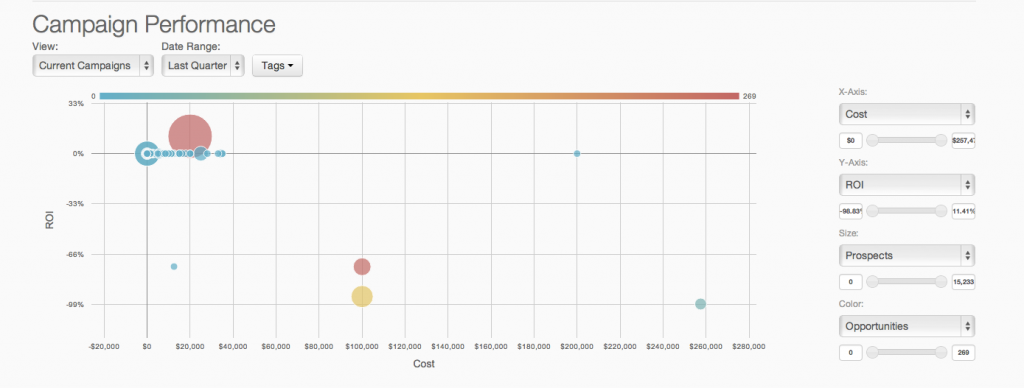
Marketing Cloud is a cloud-based digital marketing platform, used by marketers can segment their audience, deliver personalized messages, track campaign performance, engage leads and accounts, and optimize strategies based on real-time insights.
$1,250
per month
Workday Adaptive Planning
Score 8.0 out of 10
Mid-Size Companies (51-1,000 employees)
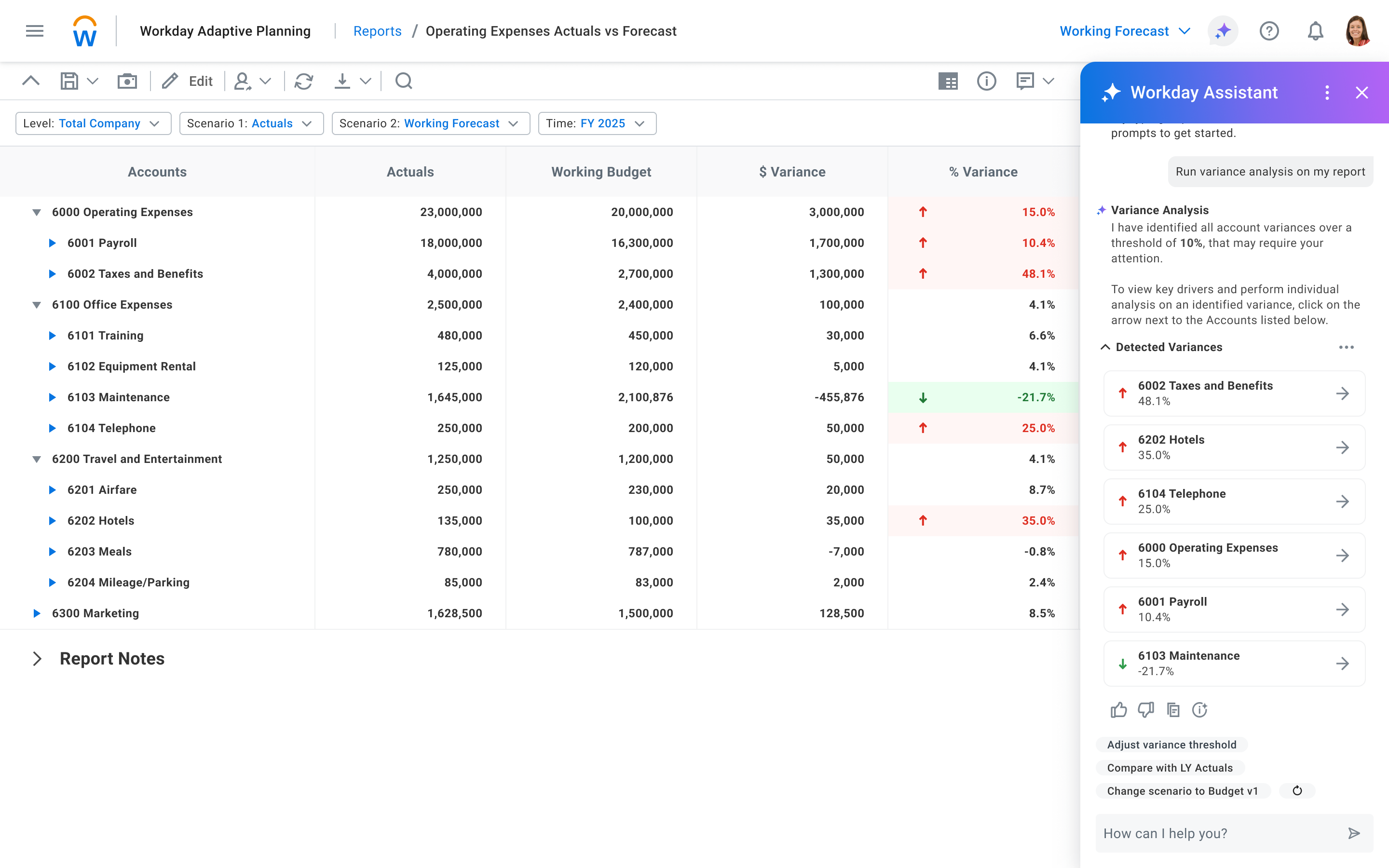
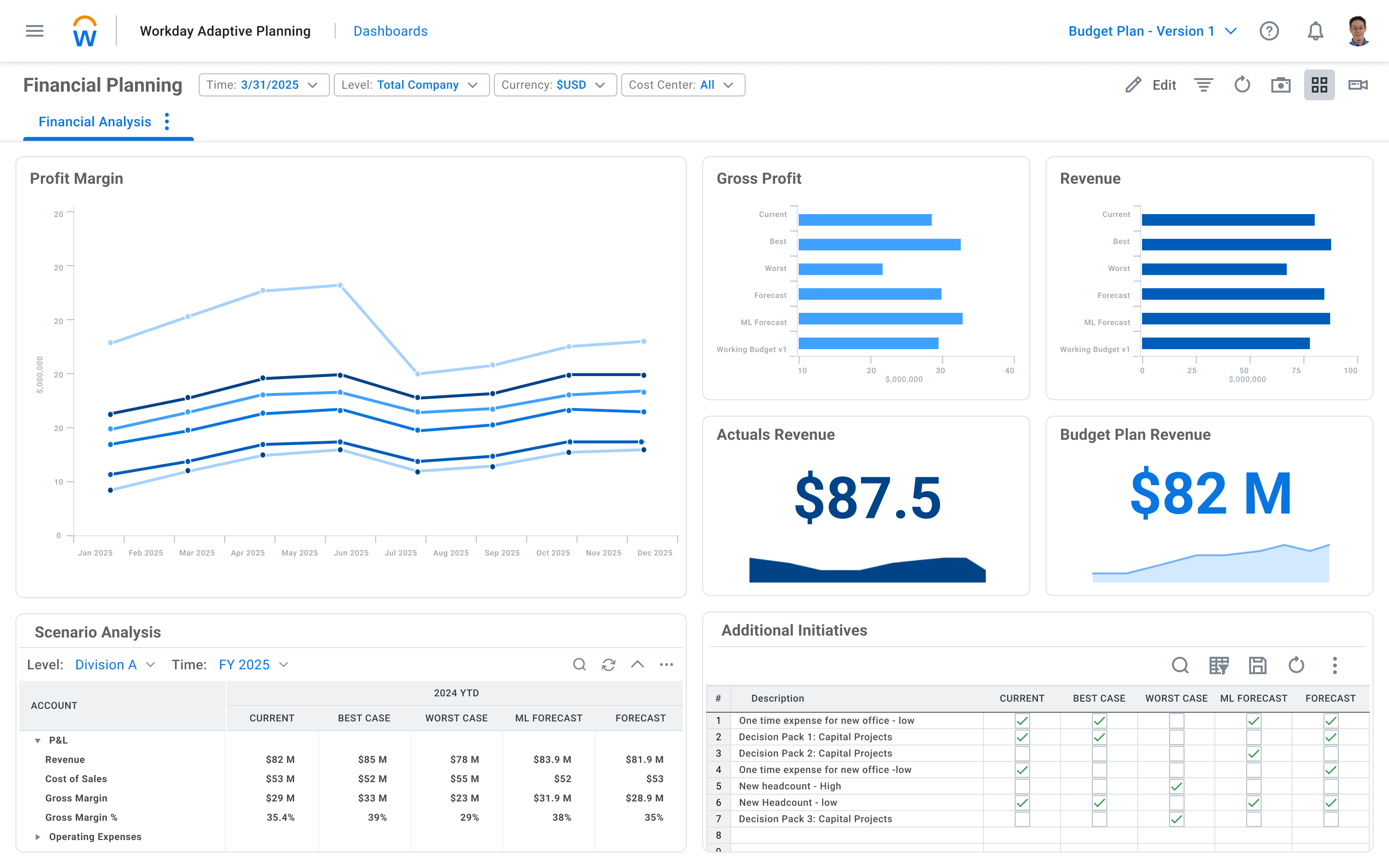
Workday Adaptive Planning streamlines planning workflows, using AI and real-time data integration to improve collaboration and provide predictive forecasts for better strategic analysis.
N/A
Pricing
Salesforce Agentforce Marketing
Workday Adaptive Planning
Editions & Modules
Account Engagement
$1,250
per month
Engagement
$1,250
per month
Intelligence
$3,000
per month
Loyalty Management
$20,000
per month
Personalization
$100,000
per year
Data Cloud for Marketing
$108,000
per year
No answers on this topic
Offerings
Pricing Offerings
Agentforce Marketing
Workday Adaptive Planning
Free Trial
Yes
Yes
Free/Freemium Version
No
No
Premium Consulting/Integration Services
No
No
Entry-level Setup Fee
No setup fee
Optional
Additional Details
—
—
More Pricing Information
Community Pulse
Salesforce Agentforce Marketing
Workday Adaptive Planning
Considered Both Products
Agentforce Marketing
Verified User
Anonymous
Chose Agentforce Marketing
Zoho CRM Plus, Twilio SendGrid and Email Marketing by Hemsmail
The only other product we’re currently evaluating is on the Veeva side — Veeva Campaign. It’s a relatively new product that Veeva has released; it’s only been about six or seven months since it went into general availability. So time will tell whether it can compete with …
Apart from Marketing Cloud we have one reach that we have used and to tell you the good stuff is like now we are getting rid of One Reach and we are moving all our text stuff as well to the marketing cloud. So that much we have confidence in Marketing Cloud and that much we are …
I have worked with all three providers across different businesses and seen the benefit of each one in different ways. It is good that Salesforce Marketing Cloud connects well with salesforce as a sales management CRM. Hubspot is a lot. more user friendly of an interface and …
I find the data stored in the database is very much cleansed and hence the overall decision making process improves. Also the customised emails, digital marketing features stacks the Salesforce Marketing Cloud way above others
We use Salesforce Marketing Cloud for lead management, generating reports, tracking customer and dealer information, inputting orders, and more. I prefer HubSpot for email marketing and automation because it is easier to use and the emails are designed much better. We …
I used Marketo for years and found it to be robust yet also fairly intuitive to navigate. When I joined my current role, they had just implemented Salesforce Marketing Cloud. I was initially not a fan, but since using the tool and navigating some complexities, I see the true …
I think that all of the marketing platforms I have evaluated and used in the past serve different markets and purposes. Salesforce Marketing Cloud was more palatable to our team because of our existing tech stack where we had Salesforce CRM already deployed and in use. Compared …
Hubspot is more user friendly, more intuitive, and has functionality built in from the start that allows you to get things off the ground faster than SFMC. I use SFMC because that is the current platform at my employer.
Mailchimp is great for simple email use. It's straightforward and great for beginners in the email space. It does not offer nearly as much in the way of complexity as Salesforce Marketing Cloud does, so is limited with what it can do. Salesforce Marketing Cloud is much more …
It has more features and a fuller capacity for all things marketing. Pardot was clunky and lacked a good email builder. It wasn't my choice to select this software, but I see its value, and the team has benefitted from it. We hope they continue to improve functionality and …
Salesforce Marketing Cloud is a more comprehensive product than HubSpot Marketing Cloud. It integrates better with multiple channels, is a powerful audience builder, and is an efficient AI. However, Salesforce Marketing Cloud is also more expensive and requires Salesforce.com …
Salesforce Marketing Cloud stands out for its comprehensive features, scalability, and seamless integration capabilities. Compared to other platforms, its unified suite of tools for email, social media, mobile, and advertising enables streamlined cross-channel campaign …
Not to sound like I am completely against Salesforce Marketing Cloud, I believe HubSpot has worked alot on their marketing platform to simplify the interface along with keeping the rich functions a marketing platform would want. Campaign monitor is a bit more basic, but perfect …
My previous organization used Pardot and also Mailchimp. Salesforce Marketing Cloud is more powerful than both of those tools and integrates more deeply with Salesforce CRM.
Overall, 80 percent of the features and boiler plate and standard across all these tools. Salesforce leads in integrations and global scalability. But lacks in User interface and ease of use.
Salesforce Marketing Cloud offers many opportunities for personalization and supports big data integration. It features powerful tools like SQL for data and AMPscript for email creation. If someone wants to master the platform, it might require some initial learning, which I …
We use these both in conjunction together now rather than rivals as the data that can be held in both does differ slightly and one platform email maker is slightly better so we do a lot of the creative in one platform and then have it link in and have all the data flow into the …
Compared to Vena, Adaptive Planning appeared to be better at scaling with us as a business. Vena uses Microsoft Dynamics as its platform and are somewhat limited in its roadmap due to what's available from Microsoft. Vena is much more linked to an Excel solution than Adaptive …
While we have looked at various other platforms and even tried them out in the past, we eventually selected Workday Adaptive Planning to help with our headcount planning as we have a lot of entities especially international ones and we felt that Workday was the best suited for …
For best-in-class capabilities, you'll very likely need to split the various HR and financial systems into separate systems rather than using a consolidated platform like Workday. However, a consolidated platform provides benefits by being a single location for employees and a …
Workday Adaptive Planning is similar to payroll and workforce management by implementing constant and new changes to finances, workplace changes and the people changing in rolls and employment. Both tools are very useful and practical in a company setting and mainly in …
Like I said in a previous question, the fact that there was downtime that was needed to update all the data that was entered in a day was not ideal. This caused for hours lost on the data update and didn't allow our leaders to see the affects immediately like Workday Adaptive …
Overall being familiar with the Workday Adaptive Planning tool's flexibility and ease of use our finance and ops team saw this as the easiest and most robust tool that they could admin and maintain without outside IT resources.
In my opinion, Spreadsheet Server is not even in the same game as Workday Adaptive Planning. While it is flexible in Excel, it still requires a lot of back and forth for analysis.
Our previous platform was patchwork tools and unintegrated. We were clunky and poorly organized. The system was slow and
difficult to use, and it was either overhaul it or start over. We evaluated our
options holistically and went with Workday. It works better and faster, and …
Workday provides adaptive and intuitive planning that does not has disruptions when there is any change in system or migrations of servers, users or systems. Workday integrates with CRM, ERP and other database engines to source data and provides insights that can be exported to …
It doesn't have the same standard fulfillment modeling as the true workforce planning products, it equals the other core HCM systems and beats them on ease of use.
Workday Adaptive Planning is not as robust as SAP Ariba, but it is certainly better than BadgePass. The trouble with BadgePass is that it can be a but clunky in some modules that seem like clear bolt ons to the main product UI. Whereas, Ariba was clearly built to satisfy …
Workday became our choice because it is fully web-based and easily integrates with other systems. The learning curve for Workday was shorter than that of Dynamics. The reporting tools in Workday are more user-friendly than that of Dynamics. However Workday did not have Check …
From our initial findings, Workday Adaptive seemed like it was going to be easier to get up and running out of the box and fit the needs of our company more.
I rated this a seven because I love Salesforce, and it is excellent on the sales side. However, the marketing side has some pros and cons. It is terrific for keeping track of lead, customer, and dealer information, but it is not easy to automate workflows, integrate other software, or create well-designed emails. It is also straightforward to generate reports, which is very helpful in keeping track of lead progression to better market those leads and turn them into customers.
If your company requires headcount and enterprise initiative planning across departments, it really helps to see the impacts at the company level. It is well-suited for conducting what-if scenarios and beneficial if you already have Workday HCM with position management. It may not be well-suited to companies that require custom dashboards.
Version Management. Adaptive lets us manage many versions/scenarios all in one platform with the robust ability to compare them to each other.
Processing Performance. With the Elastic Hypercube technology that was implemented a few years back, we can watch changes flow through a complex web of formulas and arrive at an answer within seconds.
Audit Trail. Our administrators love the ability to see and report on who made what changes when, which leads to real accountability within the organization.
Expense reporting aspects are repetitive and hard to fully optimize.
Finance tracking is limited to basic reports with multiple levels or drill-down...hard to fully grasp without exporting data and massaging in something else (like Excel).
We are happy with Pardot. It has made our jobs easier and installed some reporting functions that have increased our ROI with the company. We have worked hard to set-up the functions in Pardot and it has taken time, but paid off.
For one we're in way too deep to not move forward with Adaptive. We're integrated with Workday, we do a ton of reporting with Adaptive, and it's working very well for planning and forecasting. No reason to look back or change course.
You won't find another solution that has as many features as Salesforce Marketing Cloud Interaction Studio. We all know Salesforce, we all know how big they are and it's not for nothing... Their tools do most of the things you want, need and even imagine. Using it is complicated, but the usability is infinite.
Love, love, love, love the OfficeConnect interface as well as the Planning tab within Excel. OfficeConnect is so flexible, gets immediate updated data (after integrations are run). No need to recreate workbooks every month, just refresh the data. This really is the lifeblood for my CFO and leadership team. The Planning tab in Excel allows us to look at a Sheet with many, many rows and perform analysis, even sending it back to Workday Adaptive Planning.
Upgrades and timing of the upgrades were communicated well and planned during off hours for our work. If we did have a campaign scheduled during that time, it would kick-off after the system was back active. There were a few unplanned system down times, but it was a rare occurrence and those times were also short in duration.
There haven't been any lately. The only one issue I can think of is when there was an update in Adaptive that altered our reports. Before I realized there was an issue, Adaptive reached out to let me know, so that it could be fixed.
Though the make up of MA apps is not built this way today, it would be nice to see them become more real-time. The integration between Salesforce and Pardot is not a true real-time integration. If I modify something in Salesforce, those changes are not automatically reflected in Pardot immediately. There is a delay of about 15 minutes before the systems sync. This delay, although not long, is less than ideal We would love the systems to be integrated real time such that changes are propagated from one system to the other immediately.
All aspects of Adaptive Insights perform well. One area that I wish was quicker was integration. When importing data from Intacct our accounting ERP platform, it can sometimes take 4 hours for the import to process. The earlier imports are done, the quicker they complete. My estimate for a quick upload is about two hours.
They are really responsive and more than not solve the problem or give you insight to how you can manage the solution yourself. I do find however sometimes a long delay on the more complex issues when they need to loop in other departments. but overall a good experience with support
Whenever we have had any questions, issues, or concerns, the support has been quick and thorough. [This] allow[s] us to be able to fully resolve any issues, or be connected with the right group quickly to attain the result we were after; be it from simple formatting to adding new detailed reporting.
Training program is not very well established. There is very little documentations. More often than not it's in-person training. I wish there were more video tutorials so that somebody can learn the system quickly. Their documentation is very much like an RFP. Long and very technichal. They should definitly improve on this area.
This was extremely helpful so that they could walk you through the model and teach you more about the complexity of various areas. It is most helpful when it is specific to your organization's model. The larger in-person trainings were helpful but they tended to be more generic and entry level. The trainings that are more tailored to your specific needs are the most helpful.
Pardot's online training touches on all topics briefly and vaguely without much indepth exploration into how a final outcome could look, such as Nurturing Campaigns, Email templates, landing page templates, etc... The only true way to uncover Pardot's full capabilities is to have Front End design and coding experience. Without this key skill set, I would not recommend Pardot to another business.
They often times tended to be way too generic or entry level. They would also become sales pitches to upgrade or get new Adaptive Planning products. The questions in the training would be very niche and specific to other organizations. They were rarely helpful to the group at large.
From an IT perspective, once you set up the Javascript beacon and start collecting data there is a waiting game. During this time you can start labeling your site actions which can be labor intensive for a single person, but you don't really have the final end-users on the platform yet. We did a lot of training so users were experienced, but it wasn't until they had their first tasks to accomplish that they started using the system and had questions. I'd recommend setting up some immediate goals for an end-user to start segmenting for the purpose of displaying message campaigns so you can jump start end-user action.
Trust the expertise of very strong 3rd party implementers. Having deployed Adaptive at a separate company before, I thought I knew it all (hubris, I know). Fortunately, I began to (very quickly) trust the judgment of our Carlson implementation team, and they provided invaluable insights and best-in-class processes that have benefitted me and my team greatly.
The only other product we’re currently evaluating is on the Veeva side — Veeva Campaign. It’s a relatively new product that Veeva has released; it’s only been about six or seven months since it went into general availability. So time will tell whether it can compete with Salesforce Marketing Cloud or not.
Compared to Vena, Adaptive Planning appeared to be better at scaling with us as a business. Vena uses Microsoft Dynamics as its platform and are somewhat limited in its roadmap due to what's available from Microsoft. Vena is much more linked to an Excel solution than Adaptive Planning and we felt getting our Commercial Finance Business Partners out of Excel would be beneficial to move the mindset away from being analysts to being advisors to the business. OneStream's key selling point was its ability to merge together multiple ERPs into one single platform. This looked powerful but since we were on a single ERP, we wouldn't have benefited from that key feature. The OneStream user interface also looked very dated, as did their reporting outputs. Adaptive Planning had a much more modern and appealing reporting environment.
Prior to this, we had no solution and literally were doing things on paper in a world where technology is outpacing paper. Having this process optimized has made it easier for the sales and marketing people to change information. From the training perspective, it has allowed us to see holes in where we could create additional support training, so the ROI here has been a lot more than just the optimization of a process.
We went from 2 users to 70+ users over a 2 year period of time. The application scaled wonderfully. 65 of those users were non-finance users so they were able to quickly learn the software and prepare budgets quickly and efficiently. That is the power of Adaptive and its ability to scale