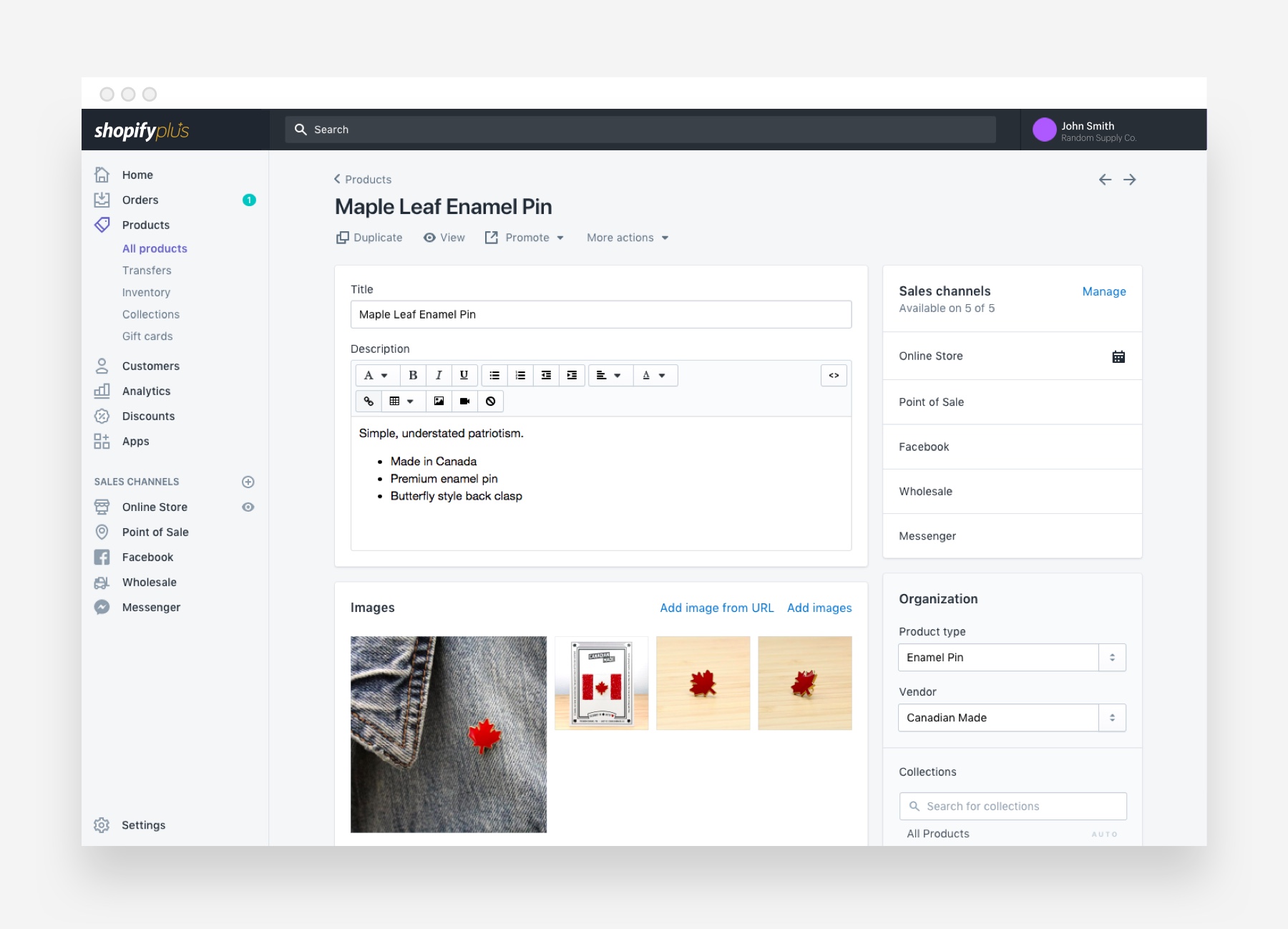
Shopify Plus is an eCommerce solution built for enterprise-level companies that enables them to sell online and offline across social channels like Facebook , Pinterest, and marketplaces like Amazon and eBay.
$2,300
per month
WooCommerce
Score 8.6 out of 10
N/A
WooCommerce is an eCommerce plugin for WordPress, developed by WooThemes (recently acquired by Automattic). Like WordPress, it is designed to be an extendable, adaptable, open-sourced platform. WooCommerce allows merchants to sell physical products, downloadables, or services.
N/A
Pricing
Sellvia
Shopify Plus
WooCommerce
Editions & Modules
Basic
$39
per month
3-year term
$2300
per month
1-year term
$2500
per month
Woo Enterprise
Contact Sales
Offerings
Pricing Offerings
Sellvia
Shopify Plus
WooCommerce
Free Trial
Yes
No
Yes
Free/Freemium Version
No
No
Yes
Premium Consulting/Integration Services
No
No
No
Entry-level Setup Fee
No setup fee
No setup fee
No setup fee
Additional Details
—
—
WooCommerce is a free and open-source plugin for WordPress. Merchants can host their WooCommerce store on any private hosting service, or with Automattic directly via WordPress.com. Some added features or services from the WooCommerce Official Marketplace may have one time or subscription pricing.
Shopify Plus offers a lot more scalable technical foundations. Magento and Woocommerce sites can be difficult to innvoate on top of and not have the security that Shopify Plus offers. Often Woocommerce sites are cobbled together with third party tools and plugins that can …
A direct connection to our ERP sets Shopify Plus apart for other platforms we've evaluated. The integration with our ERP eliminates manual data entry, reduces fulfillment errors, and ensures accurate stock visibility company-wide.
Shopify Plus is better than both due to how the platform is build and how easy it is to interact and do stuff in there. It seems more modern than both of the other platforms stated above. It is also not as heavily code based as the other two platforms. It's easier to find what …
Shopify is more robust and has more functionalities than its competitors like BigCommerce and Kibo. It offers the best UI in the business and the most exhaustive app marketplace ecosystem. It is more cost effective than big system and doe snot require large teams of developers …
Shopify Plus is far more scalable and stable. It is much easier to implement, and the time to value is much shorter. Development resources are plentiful and skilled, and the product's user base is so massive that significant testing has been done prior to releasing any updates …
Significant improvement. Magento did not have a B2B setting, so you needed to remember and alter the prices manually, and you could not create draft orders, so if you sent a customer a quote and they called up to pay, you then had to quickly create the order whilst the customer …
Shopify Plus, once existing data imported awkwardly, handles so much of the basics of running an online shop in way that you know you can rely upon. It still requires many more third party tools to be able to use best-in-class analytics and AB testing.
Shopify Plus is the best choice for DTC-oriented brands, especially if you are a leaner team and want more hands-on customization vs relying on an agency to manage your website backend.
Shopify Plus is the most advanced and most widely accepted "DIY" website tool. While WordPress has some capabilities and is certainly cheaper, it is still a blogging platform with e-commerce capabilities added later, and you can tell that's what it is when you use it. …
Shopify Plus's ease of use compared to Sticky.io was the biggest reason we had switched, and just the sheer customization and available apps allow you to adjust your store without needing to spend weeks custom developing tools.
A far more professional approach to e-commerce in general. Servers and the core SSL are taken care of and you're left with a whole host of tools to sell, sell and sell.
Shopify is a much easier and more intuitive platform to use.
The mobile focus is outstanding from the other competitors and the capability to modify the store without previous code or experience makes them the best e-commerce platform.
Shopify Plus is better supported, more powerful, and has much more ability for customization. Shopify as a platform is also much more stable than others and offers excellent customer support. New features are constantly being rolled out and it has a very large community.
Shopify Plus is an all in one service. You are able to keep track of invoices and payments. Shopify Plus also offers options for shipping and connects your tracking number to you order which allows for easy tracking. Your tracking number is also a link which makes it even easier.
Shopify Plus is the least expensive option. Apps/plug ins are vast, inexpensive, and relatively easiest to integrate Least amount of customization, but good for teams with small dev support
Shopify had the quickest go-to-market and most robust API among the products we compared. CommerceCloud required a VERY LONG integration phase that we just didn't have time for. BigCommerce fell short on the number of features and API coverage that we needed. Overall Shopify …
Netsuite SuiteCommerce, which has a very high cost of ownership, and Magento, which although powerful can be expensive and is too complex for the average eComm requirements. Too flexible can be bad in some cases.
Shopify Plus offers a more robust solution than Woo commerce and is easier to train on than Big Commerce. Woo commerce is freeware with no support. Big Commerce offers more SEO features and is a more powerful solution, but harder to remote train users on - lots more …
Shopify Plus is WAYYYYYY better than anything else that we have used, and it's not even close. The websites are faster and more reliable, both of which are critical to running an online business. The cost to run is way less. We are running five websites on Shopify Plus for less …
I selected Shopify Plus because the clients found it easy to use to manage their website, whenever they needed an update of their website. Shopify Plus is great when it comes to e-commerce websites and should only be used for e-commerce.
Our experience with SFCC was fairly poor. SFCC was very expensive, and the ecosystem of partners is very expensive. SFCC is a bit more mature but the time to execute is significantly slower.
Shopify Olus is more of a SAAS than the self-managed Magento solution. With this comes a host of benefits such as hosting, security, updates, and new technology that you no longer have to worry about. Specifically, with Shopify Plus, scripts can be very powerful and when …
WooCommerce has been here through many successes and failures for rivals but shopify has a ton of new features that, in my opinion, the WooCommerce team should take a look at. A modern facelift and a complete review of the systems and I think it'll get to where it needs to be.
WooCommerce is cheaper and more customizable, making it easy to create a great-looking product and a polished purchasing and checkout experience. Our BigCommerce site required significant custom coding to get the desired functionality. That said, BigCommerce has been a very …
They both are great in terms of usability, Adobe Commerce (Magento) is powerful but provides limited customization than the WooCommerce whereas shopify is not free and same it doesn't support the customization as much as other platforms do. WooCommerce is free and customizable …
In my opinion, Shopify is a much better option overall but perhaps more expensive then WooCommerce. I'd recommend Shopify for users with a higher budget as it will deliver a better website in the end
Initially due to budget i have selected the woo commerce but the they dont have customisation as we are need when our customer base is increasing thats why i shifted to big platform like shopify that give us alot of customisation but it comes with a price...but woo commerce is …
WooCommerce is great for customization and for customers whose needs grow with their business. With its add-ons, it works for customers of all sizes with a variety of e-commerce needs. It does need more technical development skills to set up compared to Wix or Shopify, which …
From a functional perspective this can do everything that the others can do and for many developers it is the preferred platform for online stores that require a high level of customisation. It is an open source platform with a strong community of developers behind it who have …
The level of customization and ease of integration with an existing WordPress website makes it a good choice. Snipcart is better for developers or small sites and Shopify is an amazing e-commerce-optimized platform but if you have an existing website on Wordpress, it is much …
We love the functionality of Wordpress itself, so that's why we ended up using WooCommerce to do checkout instead of going over to the Shopify platform. Wordpress allows us to do so much more with the backend code and customization of our website. We were not impressed with the …
They're very similar to be honest, but from our experience and what I've seen online, WooCommerce seems to have better performance and pricing. I think they probably match in quality for most other features
Since I don't use the e-commerce options constantly for my photography business, I didn't want to pay a monthly subscription and waste that budget during the months when I don't need any online booking options. WooCommerce allows me to install and uninstall plugins as needed to …
Woocommerce is a free option and since I work with mostly small businesses who do not have the budget to subscribe to an expensive product on a monthly basis, it makes it really easy to help these companies get set up with their e-commerce store. Plus, it offers all the …
We were pretty sure we wanted a WordPress site so that we had more control over the site itself, having been burned by third-party vendor sites before. The fact that WooCommerce integrates so well with WordPress was a big selling point for us. Magento would have been too heavy …
While I haven't tried other e-commerce plug-ins, WooCommerce satiates and satisfies all areas one could hope for and look to when shopping around. And in cross-referencing other reviews there is certainly enough to show that WooCommerce is an immensely powerful program that can …
WooCommerce is a good free version that's very customisable, but is not a smooth or polished platform. If you look at both dashboards between Shopify and WooCommerce you can see the difference is huge.
WooCommerce seems to be built for websites that aren't focused entirely on …
I have used WooCommerce longer than other products that I have tried. WooCommerce fits my requirements mainly for the value it offers based on the features available for the cost.
Platforms like Shopify are easier to set up and running and come with better default functionality. But if your business is successful you’ll quickly run into structural limitations: 1) can’t tweak the checkout flow 2) can’t make the site much faster or better for SEO 3) any …
Especialista en Marketing Digital y Comercio Electrónico
Chose WooCommerce
I like WooCommerce because it can be optimized, customized and adapted to every business needs. That's because it's WordPress core, it helps us customize stores in ways we can only imagine and also we can implement Google AMP and PWA easier and faster than with other platforms. …
Shopify is a premium e commerce platform tailored just for online shops. While WooCommerce is a plugin which has main platform as WordPress. Shopify is costly to have. Most of the basic shop functions that are offered in shopify can be achieved using WordPress + WooCommerce …
Shopify Plus makes order management simple and less error prone. Connecting our ERP allows us to seamlessly manage our product listings, fulfill orders, and sync customer data. Limitations to the number of product variants requires attention from our staff to make sure our products sync without issue. Other than being arbitrary, there's really no need to limit the number of product variants.
WooCommerce is best suited to customers whose website is built on the WordPress platform, and whose development team has a good understanding of plug-in implementation. If your website is not built on WordPress, but on Laravel or React (or any other non WordPress technology), then WooCommerce is not for you. WooCommerce is also great for customers who just need a simple online shopping experience. If your needs involve more complex or immersive features such as timed discounts, pick up locations, delivery reminders, or post shopping feedback surveys, know that you will need to purchase additional add-ons to make to get these features using WooCommerce set up on WordPress.
Scales incredibly well. Forget about hardware concerns, load balancing, downtime, etc. and focus on eCommerce. We've seen merchants go from a few thousand dollars per month to having million dollar days, all on Shopify without having to worry about performance or scaling systems.
Great new features consistently being added, ahead of the curve on almost everything
Solid API to build on and work with, a few annoying quirks here and there for super complex use cases but overall very well documented and works well
Most Merchant Success Managers are good and genuinely want to be helpful
A fantastic user interface, very logical and easy to use
Tons and tons and tons of out of the box integrations. Easily the best integration marketplace of the e-commerce platforms. There's an app for that.
The Account Managers/Reps have become more scripted and seem like they are busier and handling more clients than before. It doesn't seem as personal and special anymore like when we first upgraded to Plus.
Shopify still has missing features in their software that might not have an app in their app marketplace available that fills this void.
The 24/7 support doesn't seem as dedicated as they once were.
Does not provide everything out of the box, for certain features you will have to install additional plugins.
Their own addon plugins are costly.
The Order table uses wp posts meta table, For those who have good amount of orders coming in, the table will keep getting larger by time that it might hog the server.
Despite very rare glitches, more connected to an excessive number of plugins, that affect the speed of the site, we are extremely satisfied with the platform, the ability to import and export products, even though we just export them, as we have our proprietary system for updating inventories. We love the ease of upgrading, enhancing, innovating, and the freedom we have to do whatever we want, which is a plus, when you consider Shopify can take down your whole store as they please, if they think you aren't abiding to their TOS or their ever changing set of rules.
It is extremely easy for merchants to get to know how Shopify Plus works. Comparitive to other platforms such as Magento and WooCommerce it is extremely lean and easy to operate, meaning clients who migrate over to it find it very intuitive to use. There is also a lot of guides and up to date information online
WooCommerce is highly customizable, feature rich, matured, ever evolving, and regularly updated plugin for WordPress. Since it is already extremely popular, you can find online tutorials to help you get started. Even if you face a problem, you can quickly get a solution from a helpful online community. You can use most of the popular payment gateways with WooCommerce. Besides that you have a full control over your website/shop.
Shopify Plus is an all in one service. You are able to keep track of invoices and payments. Shopify Plus also offers options for shipping and connects your tracking number to you order which allows for easy tracking. Your tracking number is also a link which makes it even easier.
WooCommerce is cheaper and more customizable, making it easy to create a great-looking product and a polished purchasing and checkout experience. Our BigCommerce site required significant custom coding to get the desired functionality. That said, BigCommerce has been a very stable and reliable experience, whereas our WooCommerce site has had some security and reliability issues.
Definitely makes selling on multiple platforms easy, saving us time and effort.
Keeps all of our business in one place, saving us money on other apps to manage each aspect.
Automatically flags potential fraudulent orders, preventing us from accidentally shipping to a scam.
During our busiest months, we don't see any slowdowns, which allows us to go full throttle with all ads and marketing without worrying about whether or not the software can handle it.