

What is Phano?
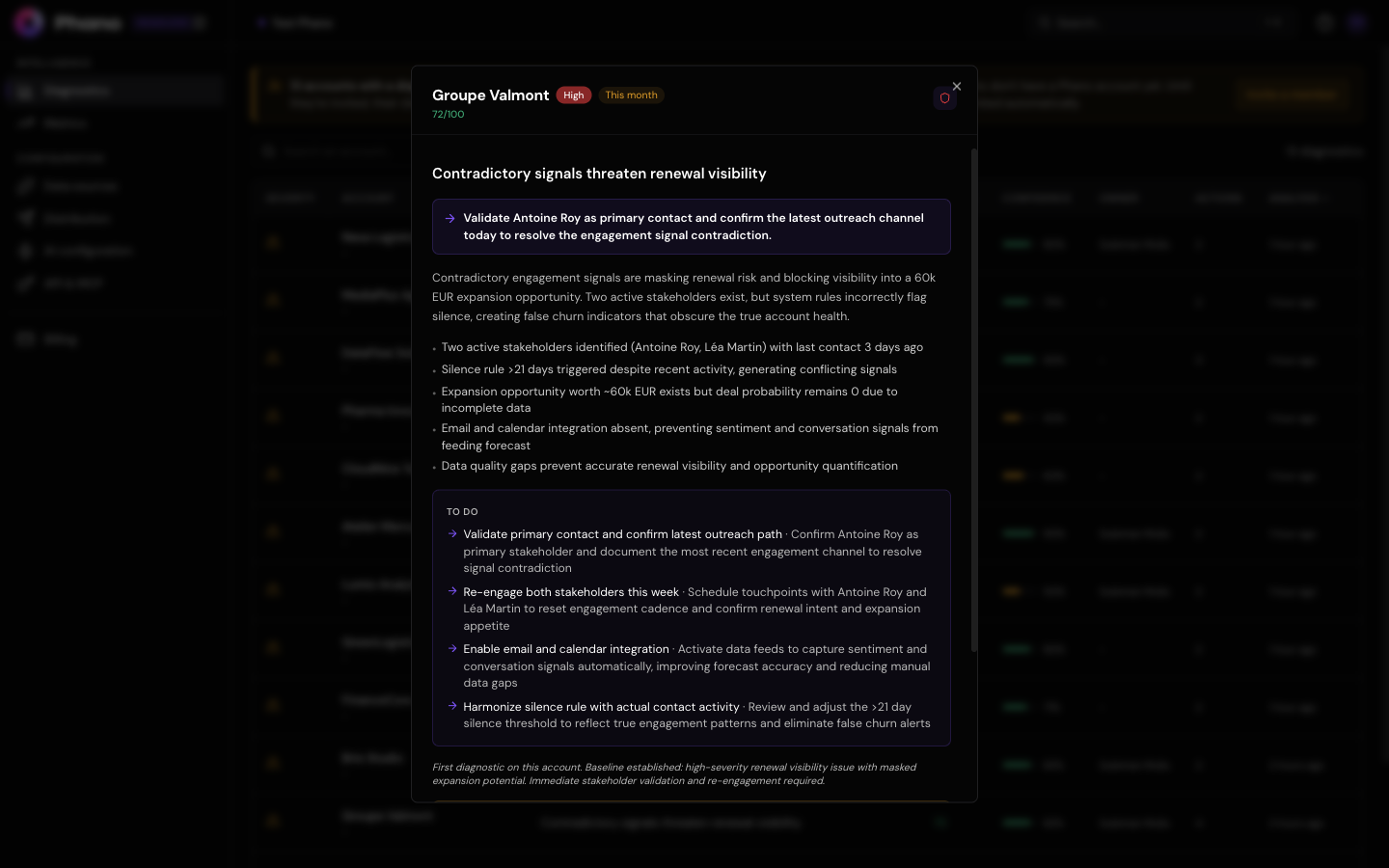
Phano is a composite AI platform for Customer Success and Account Management teams in B2B SaaS. It analyzes every account each night, cross-referencing usage, relationship, and support signals to surface churn risk and expansion opportunities before renewal, each with its likely cause and a recommended action.
Composite AI, not a single score
Rather than one predictive health score, Phano runs six analytical techniques in parallel and confronts their results, so a diagnosis is raised when independent signals converge. The six techniques are:
- Predictive scoring
- Conversation analysis
- Contact network
- Business rules
- Temporal analysis
- Cross-checking and contradictions
This convergence exposes not only the at-risk account but the underlying cause behind it.
Four agents that turn analysis into action
Four specialized agents act on each diagnosis across the entire book of business:
- Defense: portfolio protection (churn risk, renewals, disengagement)
- Expansion: revenue growth (quantified upsell and cross-sell opportunities)
- Field: relationship coverage (interaction frequency, active stakeholders)
- Strategy: long-term vision (portfolio positioning, trends, benchmarks)
Delivered where teams already work (headless)
Phano is headless: instead of another dashboard to open, intelligence is delivered into email, Slack, Microsoft Teams, the CRM (through dedicated phano_* fields), and webhooks, plus API and MCP access. The CRM remains the system of record.
Built for two roles on one diagnosis
The same nightly diagnosis serves both personas: the Customer Success Manager protects the installed base while the Account Manager develops accounts, working from shared context instead of separate tools.
Pricing
A 30-day free trial is available with no credit card. The Standard plan is 99 EUR per month for up to 100 accounts, then 1 EUR per additional account.
Categories & Use Cases
Media



1 / 5
Screenshot of Daily diagnostics feed: every account analyzed each night, ranked by churn risk and expansion opportunity, each with its likely cause.


