Adobe Audience Manager is a data management platform (DMP) that is integrated into the Adobe Marketing Cloud.
N/A
Paligo
Score 9.1 out of 10
N/A
Paligo is a component content management system (CCMS) that helps teams manage complex technical documentation through structured authoring, content reuse, and controlled publishing.
$4,800
per year per seat
Pricing
Adobe Audience Manager
Paligo
Editions & Modules
No answers on this topic
Professional
from $4800
per year
Business
Contact Sales
per year
Enterprise
Contact Sales
per year
Offerings
Pricing Offerings
Adobe Audience Manager
Paligo
Free Trial
No
No
Free/Freemium Version
No
No
Premium Consulting/Integration Services
No
Yes
Entry-level Setup Fee
No setup fee
Optional
Additional Details
—
—
More Pricing Information
Community Pulse
Adobe Audience Manager
Paligo
Features
Adobe Audience Manager
Paligo
Data Collection
Comparison of Data Collection features of Product A and Product B
Adobe Audience Manager
8.6
16 Ratings
5% above category average
Paligo
-
Ratings
Collection of first-party data
8.116 Ratings
00 Ratings
Collection of third-party data
8.116 Ratings
00 Ratings
Access to Third-party Data Providers
9.616 Ratings
00 Ratings
Data Classification
Comparison of Data Classification features of Product A and Product B
Adobe Audience Manager
7.3
16 Ratings
12% below category average
Paligo
-
Ratings
Audience taxonomy
7.916 Ratings
00 Ratings
Tag Management
6.215 Ratings
00 Ratings
Data Analysis Dashboard
7.816 Ratings
00 Ratings
Ad Network Integration
Comparison of Ad Network Integration features of Product A and Product B
Adobe Audience Manager
8.9
16 Ratings
11% above category average
Paligo
-
Ratings
Data Transfer
8.916 Ratings
00 Ratings
DSP integration
8.815 Ratings
00 Ratings
DMP Analytics
Comparison of DMP Analytics features of Product A and Product B
If you are already using multiple other pieces of the Adobe Experience Cloud stack, adobe audience manager is an easy choice. It allows for quick and easy data activation for your first and potentially brokered 2nd party data. However this product will likely be absorbed into the adobe experience platform (AEP) soon. In the end I would wait to see where adobe is truly headed with this product before investing heavily without additional heavy adobe investments.
Paligo is particularly well suited for developing similar document sets for multiple products or product lines. It is not a page layout application, so don't expect the same capabilities as popular applications for graphics-heavy documentation. With some up-front time developing good layouts, however, Paligo does manage to create very usable PDF output for customer-facing documents.
We are able to generate reports that provide valuable insights into potential customer behavior, allowing us to better focus our marketing efforts.
By allowing us to understand who are key audiences are and how they overlap with other brands and products, AAM allows us to get a fuller picture of how we should target our audience.
Reporting in AAM is wonderful in that it is easy to understand and exportable. The use of graphics and updates make it easier to share insights with various team members--even those with minimum experience in marketing and analytics.
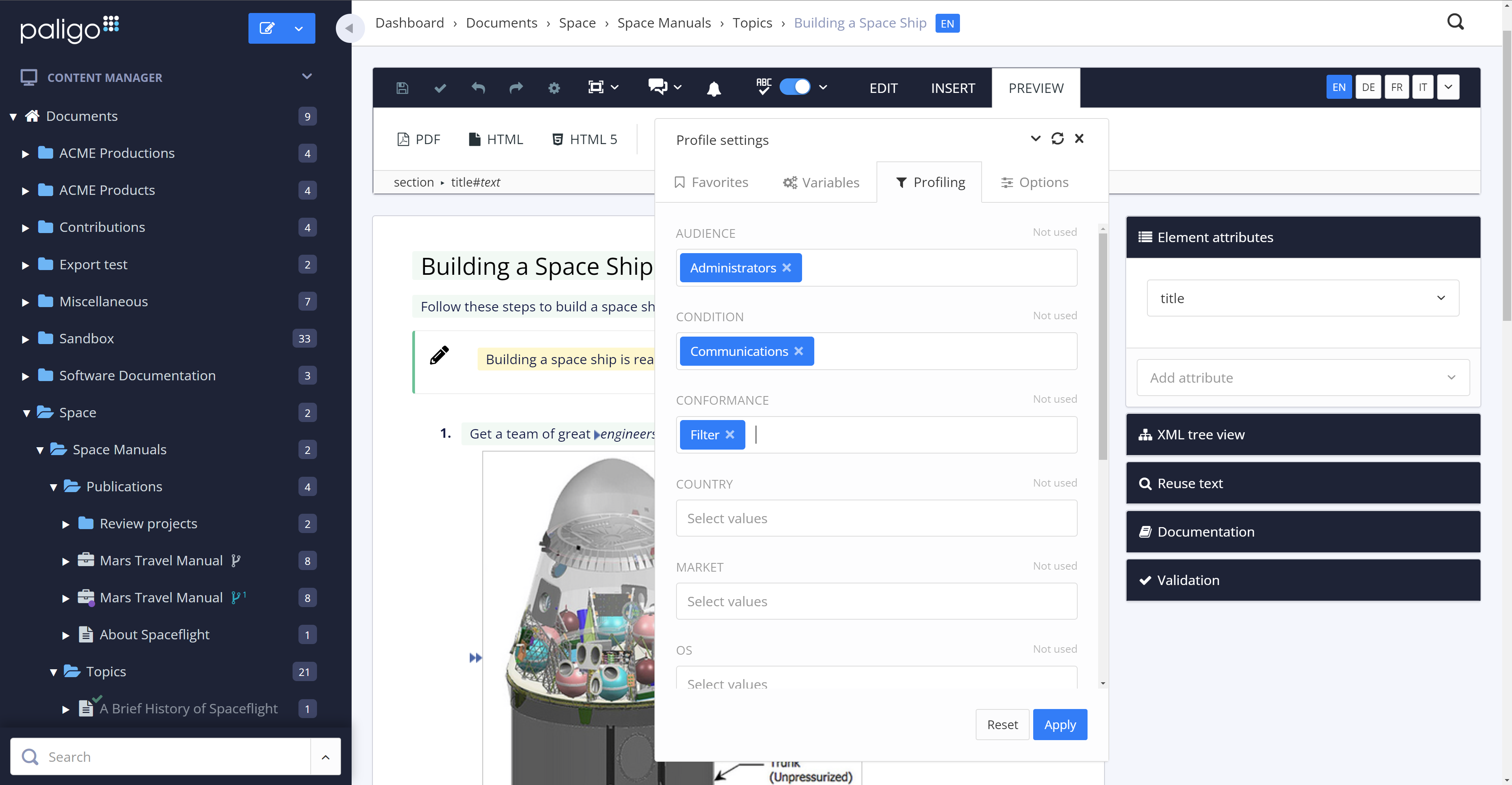
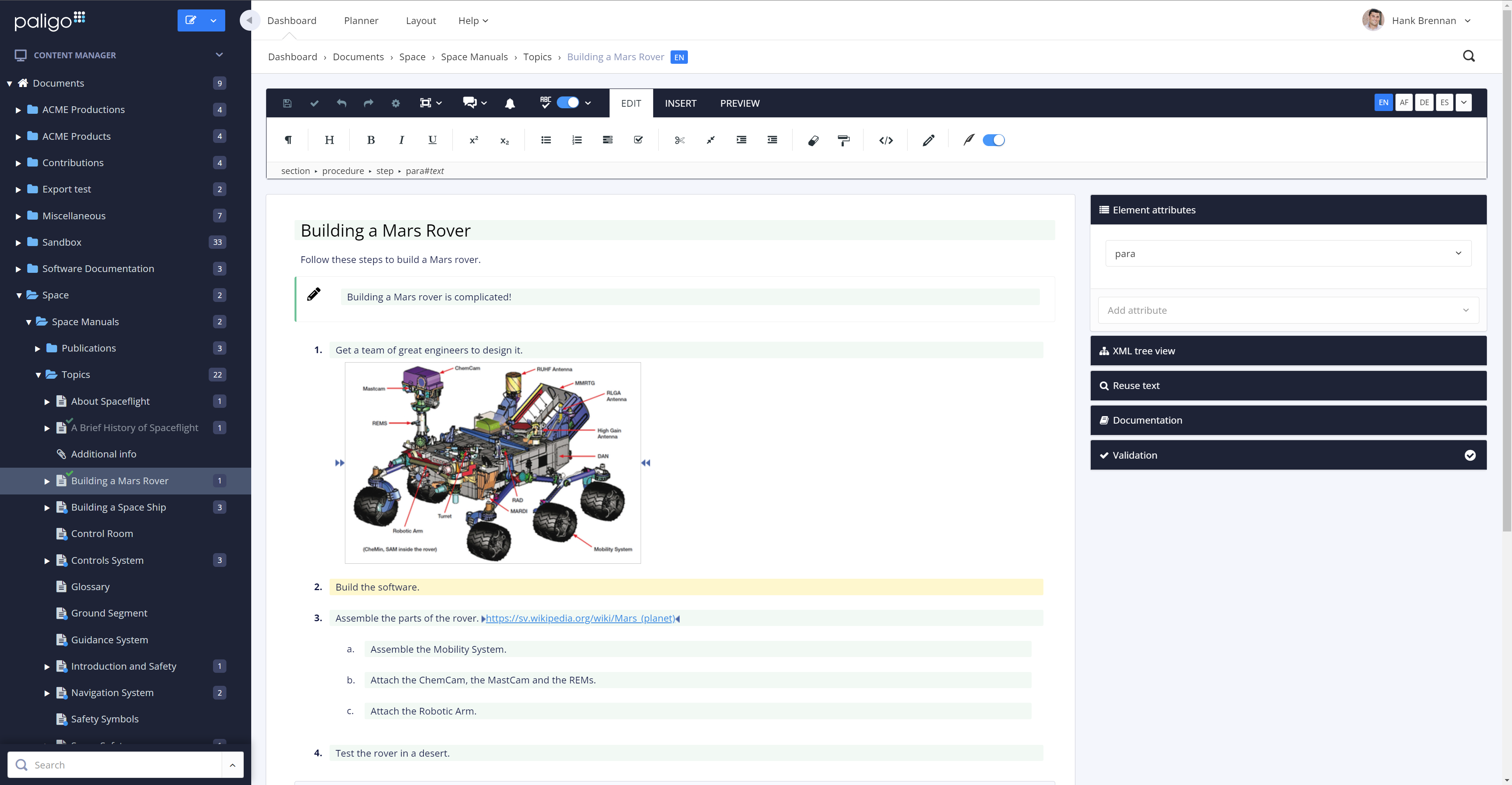
The review mode is super convenient. Comparing a snapshot of the previous versions with the current one clearly outlines the respective changes and reduces the necessary content to review tremendously.
The option to reuse text fragments is another handy feature. Text fragments will be updated whenever the original text fragment is altered is also extremely helpful.
Managing a content's structure was never easier. An intuitive drag & drop functionality allows you to design your document's structure however you like.
You can also fork content, in addition to reuse text fragments. This is another helpful option that no longer requires you to create repetetive chapters over and over.
The amount of CSS/JS required to customize a site's appearance can be cumbersome
Product documentation can be lacking, specifically with integrations; in some cases, support offered no real help when trying to solve a problem with an integrated service
Some features require extensive development experience to use, which can sometimes be an obstacle to less-experienced team members
Overall usability is great, as are most of Adobe's software. Maybe a UI refresh could make it a bit easier to do advanced functions or reporting but, overall, it works very well. This is something you take for granted with Adobe solutions because when you try another vendor you realize how bad it can be.
Generally, I'm very happy with Paligo and the productivity gains that I get from using it. There are a few arbitrary limitations on structure, and when applying conditional formatting, that I don't really understand. Unlinking / editing reused text uses this broadly inscrutible colour-coding that I just hate. It would be nice to double-click a component, make edits, then respond to a popup asking if I want to confirm the edit for all linked content, or unlink this instance. Likewise converting from an informal topic insertion to duplicates of its raw contents.
AAM has good support, but the support is not as available, due to waiting time and queue. The instructions presented are available, but it navigation is not easy between pages. However, instructions are usually direct and straightforward, but any underlying thoughts or questions won’t be easily answered without support from their service.
All the support requests I've submitted have been resolved in one way or another. Sometimes it takes some back and forth, which is to be expected. This is where being on a different continent becomes a drawback. Since we became Enterprise users, we've also had an additional level of help and support from a dedicated account manager in the US, and the resolutions seem to come more quickly
I personally like the Adobe Audience Manager interface and it's easier to use for beginners. It also has some features that Google does not, nor do its other competitors. It is worth the money and time spent, overall. I feel like it gives a bigger and more in-depth picture to our company's audience than other programs.
We moved from Flare to Paligo. One of the main reasons was the fact that Paligo is a cloud product. Collaboration with anyone outside of our team was more difficult with Flare. Also, maintaining a server for Flare content was going to become an issue, and overall I felt the Flare desktop product was prone to errors and issues. The flexibility of assigning Paligo licenses was a huge factor, as was the stability of the cloud platform.
I am not involved in the financial decisions for my company regarding Paligo; the decision to migrate our content to this environment predates my hiring. However, I know that the migration effort from WordPress to Paligo was an initially heavy lift, but any content migration effort would be. I believe that ultimately, getting our content out of WordPress was a positive move, and I look forward to seeing what Paligo will help us accomplish in the future. Sorry, no hard numbers from me. :)