Adobe acquired Neolane in July 2013 and later re-named the product Adobe Campaign. Adobe Campaign provides both marketing automation and marketing resource management functionality such as spend & financial management, workflow, and asset management.
N/A
Rudderstack
Score 2.0 out of 10
N/A
Rudderstack is an open source Customer Data Platform (CDP) that provides data pipelines making it easy to collect data from every application, website and SaaS platform.
$600
per month
Agentforce Marketing
Score 7.7 out of 10
N/A
Marketing Cloud is a cloud-based digital marketing platform, used by marketers can segment their audience, deliver personalized messages, track campaign performance, engage leads and accounts, and optimize strategies based on real-time insights.
We adore the fact that we can run numerous automated campaigns concurrently and that we can make changes to them without stopping and starting a new campaign. Adobe Campaign makes it possible for the process to go on.
Sender also offers multi-channel marketing capabilities, allowing users to engage with their audience through different channels. However, the range and depth of multi-channel capabilities in Adobe Campaign are generally more extensive. So after using both the platforms I …
In the end we didn’t go with Adobe Campaign. Although it offers great a great tool set that is very flexible. You do need someone on staff that know Adobe products to get the full utilisation out of it. Ultimately what it came down to for us was that because we had a small team, …
Adobe Campaign Standard has a lot of segmentation options out of the box and a lot better analytics. Pardot is a lot more listbased, where with Adobe Campaign, you can do complete customized segmentation, such as all permissions in base A who are currently customers of this …
Especially in its ease of use, especially considering its price and the great possibilities that this tool has given our company. Definitely a great competitor in this sector and the best option in terms of campaign creation, without any doubt, even having things that could be …
Adobe Campaign has all the features and tools that develop the whole marketing and sales channels. It has been able to integrate with our systems in all departments in development of our planning structure. While Salesforce CMS works effectively in the management of our …
Compared to other websites, Adobe Campaign stacks up with its various uses. You can create with its other platforms and follow through. Other platforms, you have to use adobe to create then go somewhere else to schedule and post. Adobe Campaign allows you to use all within one …
Adobe Campaign is good in terms of features, offerings, it's customization options, and extensive possibilities to make a powerful email campaign or offer landing page. It's very reliable and stable too. But in terms of its dashboard UI, it is not as simple or quick to learn as …
All these applications are very similar, adobe has a differential for the company's expertise, for the way cloud services and their specialists are treated. I believe that it also has a differential in the metrics and management of flows where it is possible to have a broader …
The platform is much more complex and much more suited for complicated applications. While Mailchimp is an easier all rounded solution for starters it doesn’t allow the system integrator to do customization of the workflows and more complicated tasks. I would say that in my …
Adobe Campaign is different from these products in that is much more all-encompassing and is able to manage more aspects of a campaign than these more singular-tracked platforms.
As we tried to centralise the marketing automation platform within the enterprise, Adobe Campaign can plug into several instances of Salesforce.com for lead management queues. All other marketing automation platforms can only plug into one instance of Salesforce.com.
For B2C campaign, [I] still prefer to go with Marketo. However, for all other transactional/Nontransactional, promotional, Welcome email campaigns, while it is required to handle [the] global market with [a] number of brands, [I would] [prefer to] go with Adobe Campaign …
Adobe Campaign has a lot more features as compared to Mailchimp. While Mailchimp allows you to send a lot of communication to a lot of recipients, Adobe Campaign lets you set variables in the workflow, and send email at different times with a lot more customization. Adobe …
Adobe is far ahead of what I used previously. Adobe has all the details of the customer which is required to increase the sales of the company and the customer also gets relevant information. Mailchimp is just an email tool where we can send mails to multiple users.
Rudderstack offers a similar core product as Segment but differentiates itself with better reverse ETL and data warehouse integrations. They are also significantly less expensive than Segment. While Segment has more downstream destinations than Rudderstack this didn't …
The only other product we’re currently evaluating is on the Veeva side — Veeva Campaign. It’s a relatively new product that Veeva has released; it’s only been about six or seven months since it went into general availability. So time will tell whether it can compete with …
Apart from Marketing Cloud we have one reach that we have used and to tell you the good stuff is like now we are getting rid of One Reach and we are moving all our text stuff as well to the marketing cloud. So that much we have confidence in Marketing Cloud and that much we are …
I have worked with all three providers across different businesses and seen the benefit of each one in different ways. It is good that Salesforce Marketing Cloud connects well with salesforce as a sales management CRM. Hubspot is a lot. more user friendly of an interface and …
I find the data stored in the database is very much cleansed and hence the overall decision making process improves. Also the customised emails, digital marketing features stacks the Salesforce Marketing Cloud way above others
We use Salesforce Marketing Cloud for lead management, generating reports, tracking customer and dealer information, inputting orders, and more. I prefer HubSpot for email marketing and automation because it is easier to use and the emails are designed much better. We …
I used Marketo for years and found it to be robust yet also fairly intuitive to navigate. When I joined my current role, they had just implemented Salesforce Marketing Cloud. I was initially not a fan, but since using the tool and navigating some complexities, I see the true …
I think that all of the marketing platforms I have evaluated and used in the past serve different markets and purposes. Salesforce Marketing Cloud was more palatable to our team because of our existing tech stack where we had Salesforce CRM already deployed and in use. Compared …
Hubspot is more user friendly, more intuitive, and has functionality built in from the start that allows you to get things off the ground faster than SFMC. I use SFMC because that is the current platform at my employer.
Mailchimp is great for simple email use. It's straightforward and great for beginners in the email space. It does not offer nearly as much in the way of complexity as Salesforce Marketing Cloud does, so is limited with what it can do. Salesforce Marketing Cloud is much more …
It has more features and a fuller capacity for all things marketing. Pardot was clunky and lacked a good email builder. It wasn't my choice to select this software, but I see its value, and the team has benefitted from it. We hope they continue to improve functionality and …
Salesforce Marketing Cloud is a more comprehensive product than HubSpot Marketing Cloud. It integrates better with multiple channels, is a powerful audience builder, and is an efficient AI. However, Salesforce Marketing Cloud is also more expensive and requires Salesforce.com …
Salesforce Marketing Cloud stands out for its comprehensive features, scalability, and seamless integration capabilities. Compared to other platforms, its unified suite of tools for email, social media, mobile, and advertising enables streamlined cross-channel campaign …
Not to sound like I am completely against Salesforce Marketing Cloud, I believe HubSpot has worked alot on their marketing platform to simplify the interface along with keeping the rich functions a marketing platform would want. Campaign monitor is a bit more basic, but perfect …
My previous organization used Pardot and also Mailchimp. Salesforce Marketing Cloud is more powerful than both of those tools and integrates more deeply with Salesforce CRM.
Overall, 80 percent of the features and boiler plate and standard across all these tools. Salesforce leads in integrations and global scalability. But lacks in User interface and ease of use.
Salesforce Marketing Cloud offers many opportunities for personalization and supports big data integration. It features powerful tools like SQL for data and AMPscript for email creation. If someone wants to master the platform, it might require some initial learning, which I …
We use these both in conjunction together now rather than rivals as the data that can be held in both does differ slightly and one platform email maker is slightly better so we do a lot of the creative in one platform and then have it link in and have all the data flow into the …
Multi-Channel Campaign Management: I have found Adobe Campaign to be excellent for managing campaigns across multiple channels, including email, mobile, social media, and web. Its centralized platform allows me to plan, execute, and track campaigns effectively, making it ideal for organizations with diverse marketing channels. For example, when I was running a campaign to promote a new product launch across email, SMS, and social media channels, Adobe Campaign provided me with the tools to orchestrate and track the campaign seamlessly. I could ensure consistent messaging and a cohesive customer experience across different channels.
Rudderstack is a great platform for capturing events from various systems and tying them all together in once place. This allows you to have a holistic view of your customer and reach them through various downstream platforms. It also enables the activation of data from your data warehouse into other platforms.
I rated this a seven because I love Salesforce, and it is excellent on the sales side. However, the marketing side has some pros and cons. It is terrific for keeping track of lead, customer, and dealer information, but it is not easy to automate workflows, integrate other software, or create well-designed emails. It is also straightforward to generate reports, which is very helpful in keeping track of lead progression to better market those leads and turn them into customers.
What we like most about this application is that it provides us with the creation of ads to generate presence and impact on different channels at minimum cost.
It has a section where [it] [helps] us determine our preferences in terms of marketing by private messaging and offer a report of actions.
It also provides analysis with percentages to determine how many customers actually received our e-mail advertising.
Despite the shortcomings of user interface and basic troubleshooting difficulty, Neolane is much more robust and delivers better capabilities to our sales and marketing staffs than any other product we have used here or any product our staff members have used at other locations.
We are happy with Pardot. It has made our jobs easier and installed some reporting functions that have increased our ROI with the company. We have worked hard to set-up the functions in Pardot and it has taken time, but paid off.
Thanks to this tool we are taking more internal control of the creation and deployment of campaigns with less dependency on an ESP. We can pre-program marketing publications, being able to concentrate on the target audience. It helps me manage email campaigns with real-time tracking.
You won't find another solution that has as many features as Salesforce Marketing Cloud Interaction Studio. We all know Salesforce, we all know how big they are and it's not for nothing... Their tools do most of the things you want, need and even imagine. Using it is complicated, but the usability is infinite.
Upgrades and timing of the upgrades were communicated well and planned during off hours for our work. If we did have a campaign scheduled during that time, it would kick-off after the system was back active. There were a few unplanned system down times, but it was a rare occurrence and those times were also short in duration.
Though the make up of MA apps is not built this way today, it would be nice to see them become more real-time. The integration between Salesforce and Pardot is not a true real-time integration. If I modify something in Salesforce, those changes are not automatically reflected in Pardot immediately. There is a delay of about 15 minutes before the systems sync. This delay, although not long, is less than ideal We would love the systems to be integrated real time such that changes are propagated from one system to the other immediately.
Although there is a lot of material available on the internet to answer questions, I still feel a lack of commitment and delay in the responses of the support, but as a whole, it leaves nothing to be desired. I believe that, in the great majority, companies sin in the desired support, but we cannot generalize. But this one, in particular, has a wide range of specialists and well-qualified management, but I believe that it is not so bad.
They are really responsive and more than not solve the problem or give you insight to how you can manage the solution yourself. I do find however sometimes a long delay on the more complex issues when they need to loop in other departments. but overall a good experience with support
Training program is not very well established. There is very little documentations. More often than not it's in-person training. I wish there were more video tutorials so that somebody can learn the system quickly. Their documentation is very much like an RFP. Long and very technichal. They should definitly improve on this area.
Pardot's online training touches on all topics briefly and vaguely without much indepth exploration into how a final outcome could look, such as Nurturing Campaigns, Email templates, landing page templates, etc... The only true way to uncover Pardot's full capabilities is to have Front End design and coding experience. Without this key skill set, I would not recommend Pardot to another business.
From an IT perspective, once you set up the Javascript beacon and start collecting data there is a waiting game. During this time you can start labeling your site actions which can be labor intensive for a single person, but you don't really have the final end-users on the platform yet. We did a lot of training so users were experienced, but it wasn't until they had their first tasks to accomplish that they started using the system and had questions. I'd recommend setting up some immediate goals for an end-user to start segmenting for the purpose of displaying message campaigns so you can jump start end-user action.
Sender also offers multi-channel marketing capabilities, allowing users to engage with their audience through different channels. However, the range and depth of multi-channel capabilities in Adobe Campaign are generally more extensive. So after using both the platforms I selected Adobe Campaign for my email marketing purpose.
Rudderstack offers a similar core product as Segment but differentiates itself with better reverse ETL and data warehouse integrations. They are also significantly less expensive than Segment. While Segment has more downstream destinations than Rudderstack this didn't negatively impact our use case
The only other product we’re currently evaluating is on the Veeva side — Veeva Campaign. It’s a relatively new product that Veeva has released; it’s only been about six or seven months since it went into general availability. So time will tell whether it can compete with Salesforce Marketing Cloud or not.
Prior to this, we had no solution and literally were doing things on paper in a world where technology is outpacing paper. Having this process optimized has made it easier for the sales and marketing people to change information. From the training perspective, it has allowed us to see holes in where we could create additional support training, so the ROI here has been a lot more than just the optimization of a process.
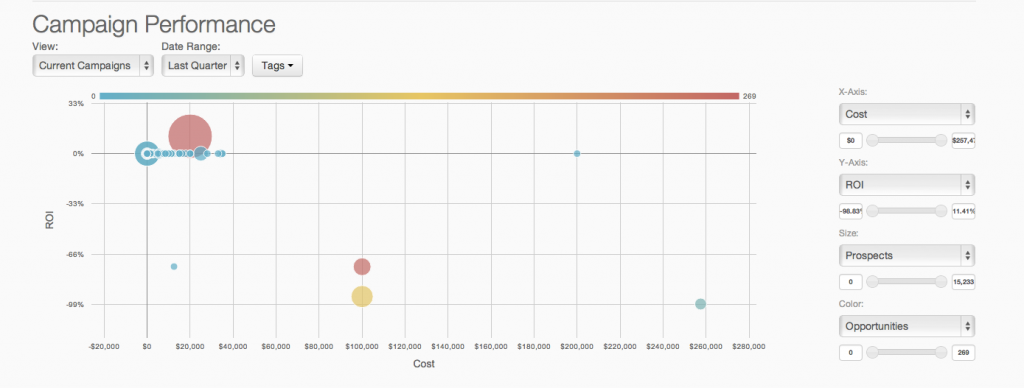
Adobe Campaign has boosted our ROI, with a 700% increase in the last month of using the service. These results are very favorable, and we will continue to use the service.
Adobe Campaign makes it easy to calculate the proposed ROI on a monthly basis, as it constantly lets us evaluate and compare the growth of our earnings in relation to previous ones.