Algolia offers AI-powered solutions to improve online search and discovery experiences, with tools for business teams and APIs for developers that help to improve user engagement and conversions across websites, apps, and e-commerce platforms.
$0
per month 10k search requests + 100k records
Shopify
Score 8.6 out of 10
N/A
Shopify is a commerce platform designed for both online stores and retail locations. Shopify offers a professional online storefront, a payment solution to accept credit cards, and the Shopify POS application to power retail sales.
$39
per month
Pricing
Algolia
Shopify
Editions & Modules
Build
Free
per month Up to 10,000 search requests + 1 Million records
Grow Plus
Free / Pay as you go
per month 10K searches/month & 100K records included; $1.75 per extra 1K searches, $0.40 per extra 1K records
Grow
Free / Pay as you go
per month 10K search requests & 100K records included; $0.50 per extra 1K searches, $0.40 per extra 1K records
Elevate
custom
per year
Elevate
Custom
per year Custom search requests and records — volume-based discounts available
Basic Shopify
$39
per month
Grow
$105
per month
Advanced
$399
per month
Shopify Plus
2,000
per month
Shopify Plus
2,300
per month
Offerings
Pricing Offerings
Algolia
Shopify
Free Trial
Yes
Yes
Free/Freemium Version
Yes
No
Premium Consulting/Integration Services
Yes
No
Entry-level Setup Fee
Optional
No setup fee
Additional Details
Pay as you go, scale instantly, or upgrade anytime for advanced features and capabilities.
Elasticsearch is its direct competitor, but I would say that it is more focused on performance and less focused on aesthetics and recommendations. If you are thinking of getting Algolia, I would recommend that you also compare it at least to Elasticsearch. Either one is a good …
Algolia works well in tandem with Magento and provides a large number of tools and features that provide greater control and adaptability as compared to other solutions we reviewed. Algolia has demonstrated its commitment to continual innovation, providing access to next-gen …
We selected Algolia because it was ridiculously fast and we liked the direction the company was going. We also did not want to deal with a self hosted solution like Solr.
Shopify out of the box had more features and did what we were looking to do that BigCommerce could not do without extensive customizations using a third-party vendor. That made it a very easy choice to switch to Shopify. Most of the customizations needed in Shopify we were able …
Algolia is both well-suited to replace Shopify's out-of-the-box search and to very large sites with millions of products in their catalog. Algolia provides a specialized solution that benefits from very large R&D budgets and ongoing investment. Algolia offers a more retail- and open-design solution than competitors such as Amazon or Google search, which offer fewer options and fewer features.
Shopify allowed us to handle matrix items and combined listings. Both of which we could not do on our previous platform. There was some customization involved but overall, it did what we needed it to. The one downside was that if we want to change anything we would have to reload the entire set of matrix items manually.
Users get instant feedback as they type, even with complex filters like brand, model, price range, and financing eligibility. This speed significantly improves engagement and reduces bounce.
A user searching for “Camry 2020” or even “Camary 20” still sees relevant Toyota Camry listings from 2020. This reduces friction, especially on mobile where spelling errors are common.
Algolia handles multi-faceted filters efficiently. For example, a user can filter by location, transmission type, color, or inspection status without any lag.
We fine-tune the ranking of search results based on what matters to our business—like prioritizing cars with higher margins or better availability in key cities.
We can experiment with different ranking formulas or UI variations to improve KPIs like lead conversion or time-to-first-interaction.
It's base security and integration with trusted security partners (such as NoFraud) is a game-changer when it comes to reliability and a "hands off approach" for our IT department. The up-time is also very good.
It offers a wide range of verified plugins that are (for the most part) easy to install and use for any specific scenario you're looking for.
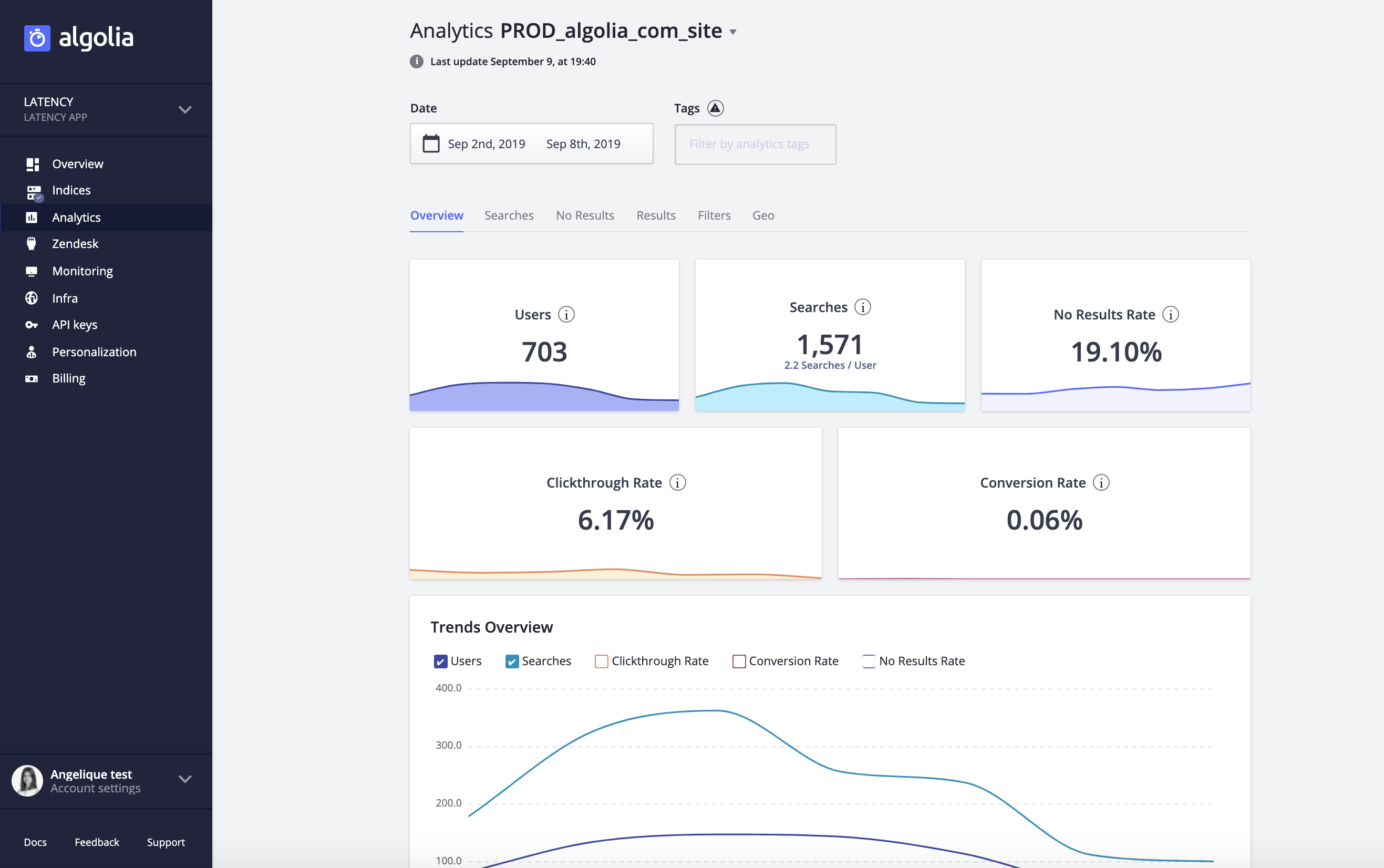
It's Analytics area in the admin is actually nice and offers a wide variety of reports that you can run.
Better integration of features (ex. synonyms feature is great but isn't respected by their re-ranking product)
Tooling to reduce spam search queries being triaged by system/logged to analytics panels
More automated summaries of analytics (ie. recommend synonyms to add, trends noticed in search volume in specific areas of site, easier ways to leverage API vs using website UI)
I would love it if Shopify built an in house app which helped us post UGCs and social proof from platforms such as Instagram, Youtube etc. more seamlessly on our website. Right now, we are able to do it through third party apps but the look and feel is just okay.
Algolia is a great tool, we didn't have to build a custom search platform (using Elasticsearch for example) for a while. It has great flexibility and the set of libraries and SDKs make using it really easy. However, there are two major blockers for our future: - Their pricing it's still a bit hard to predict (when you are used to other kind of metrics for usage) so I really recommend to take a look at it first. - Integrating it within a CI/CD pipeline is difficult to replicate staging/development environments based on Production.
Nothing we have used in the past or have seen thus far even comes close to offering what we get with Shopify Plus, especially for the price. You cannot even come close to getting what we are getting at the price we pay. We are beyond thrilled and Shopify Plus meets and exceeds all of our needs and expectations. We love it!
Personally I find the Algolia integration not very complicated and the service super reactive. In terms of configuration, it's quite complete, at the end what matters is what we are able to index on Algolia. With rich data, the tool is amazing and a lot of things are possible.
It is fairly easy to use Shopify regardless of what task you are attempting to perform. Most things are customizable to a degree without requiring coding ability. I have very limited coding experience and have still been able to navigate my way around changing features of the website that require edits to the code with the use of AI and trial-and-error. This previously wasn't possible with the WooCommerce platform.
Performance is always a major concern when integrating services with our client's websites. Our tests and real-world experience show that Algolia is highly performant. We have more extremely satisfied with the speed of both the search service APIs and the backend administrative and analytic interface.
It’s non existent. No tech support and no customer service… my application was blocked and is currently inactive causing huge business disruption, and I’m still waiting days later for a response to an issue which could be resolved very very quickly if only they would respond. Very poor from a company of that size
In terms of support I give Shopify a 9 out of 10 because they're always very friendly and thorough, and they personally can't solve my problem for me they always point me in the proper direction with the proper information I need to move forward
Shopify offered us several trainings to setup a Shopify store, how to build a brand, SEO, product photography etc. All this content have been super helpful in our journey.
Algolia gives way more control for a non-developer than AWS Elasticsearch Service. Previously we'd have to have our developers make adjustments to site search relevancy, typos, prioritizing certain attributes over others, etc. but now the marketing and website team can do that themselves in the Algolia dashboard
Big Commerce and SAP Hybris are two other platforms we've investigated and Shopify is by far easiest to use and customize. While it doesn't do everything out of the box, the apps do fill in many gaps. The cost however, is probably the biggest selling point against these other two options.
Overall is a scalable tool as the environment and the backend functions are the same and many things are done directly on the tool so without the need of further specific developments. However some things could be improved such as documentation for integration that could help in doing whitelabel solutions
Users who had abandoned our product (attributing slow search speeds as the reason) returned to us thanks to Algolia
We used Algolia as our product's backbone to relaunch it, making it the center of all search on our platform which paid off massively.
Considering we relaunched our product, with Aloglia functioning as its engine, we got a lot of press coverage for our highly improved search speeds.
One negative would be how important it is to read the fine print when it comes to the technical documentation. As pricing is done on the basis of records and indexes, it is not made apparent that there is a size limit for your records or how quickly these numbers can increase for any particular use case. Be very wary of these as they can quite easily exceed your allotted budget for the product.
It got the store up quickly so the client could start selling. She was previously selling products on Etsy and Facebook and wanted to consolidate everything onto one website, so the main thing Shopify solved was to reduce the store owner's time in managing all her products on multiple sites. Also, we had previously built a website on Wix with all the custom functionality and branding she needed - a truly great, high-end website - but it performed so slowly that it was unusable. So the speed at which Shopify can be set up and then works on the page is appreciable.
The website was manageable by the client - she could figure the system out herself after a while so she saved money on costs for hiring developers. She did have to hire developers to customize some of the plug-ins but costs are all relative; it wasn't a high investment compared to building a full e-commerce website. With the complexity and size of her product base and the functionality and branding she wanted to have in a website, and the potential of her business, she would have needed to invest well over $10,000 to get to where she really needs to be. In the end she kept the budget under $5000.00.
Costs kept climbing with plug-ins having to be added with everything. My client became more involved in building the website and began to try multiple plugins, and she did not have the skill base to evaluate the plugins functionalities so she chose plugins that did not do everything she needed, and then ended up paying the plugin developers to customize the plugins. So on one hand, it's pretty amazing to be able to bring up an e-commerce website as quickly as a week or so, but on the other hand if you need anything customized or deeper functionality in regards to product searching and filtering on the web page, and management on the backend, it quickly goes beyond the skills of the average person to manage, and above their expected budget as well. In the end my client really did not get anything close to the functionality for the website we had originally envisioned.
Shopify was the easiest way we could find to bring the client's products to a global market. We evaluated several other platforms and the functionality simple did not seem to be adequate, so Shopify seemed like the only solution that could do enough of what we needed and still stay within this client's budget. Really the problem in this project was not platform per se but that the budget wasn't large enough. Shopify managed to provide a solution for an ecommerce store with thousands of products on a tiny budget, so in the sense of pure functionality it provided the best value of all the platforms we evaluated. The solution still isn't big enough for this client's business though so, without having insights into this client's post-build sales results, my guess is that because her new website did not make her products easier to sort through, and she likely didn't have much more budget left to invest in SEO and other marketing of the website, her sales probably didn't increase substantially as a result of having built the website. So I think this project all in all did not likely have a high ROI.