Main advantage of DynamoDB is Amazon's offering as SaaS. This removes the need for managing the database. DynamoDB is well suited for querying simple and flat JSON objects.
Compared to PostgresSQL, I would pick Postgres over Dynamo considering that Postgres is very mature and …
I've used SQL and NoSQL solutions, such as MongoDB and MySQL. I would not choose Dynamo to be a primary datastore and one of the others is likely a better option. Dynamo is good as almost viewed as a large cache. If you want something that is more supported and easier to work …
DynamoDB is a natural fit for anyone using the AWS environment for their code. If we were using Google or not tied to anything then Firebase might have been a better choice as it supports pub / sub among other things. It doesn't really act as a cache like redis does, but it can …
Other all SQL Databases are based on the traditional Schema Structure and Amazon DynamoDB is NoSQL so you don't need to generate the SQL Schemas. You can store the data whatever you want, whenever you want. You can store data in structured or non-structured any way you want. If …
Amazon DynamoDB supports larger throughput, with better SLA, also, we are considering unstructured data, so Amazon DynamoDB has become the final decision
Comparing RDS and Dynamo is not fully Apples to Apples comparison. RDS is a more flexible cloud-native solution that supports a wide range of engines that are relational. It is great for running older DB types like Oracle in the Cloud. Because it supports multiple engines, it …
DynamoDB is slightly different than both the above-stated DBs, with RDS being a relational database and Redshift being a data warehouse used for heavier jobs and analytics and vast data. DynamoDB lies in between both, with it being a no SQL base that can relatively store …
Mongo services are outside of our Vpc and are on a different network. Since most of our infra is on AWS, dynamo by AWS was a natural choice. Most of our engineers are familiar with AWS sdk and the console so that brought in a much smaller learning curve for our engineering team
DynamoDB provided an easy to use, schema-less, out of the box solution that can be used to spin up a full working implementation very easily. It doesn't require extra knowledge such as MongoDB query functions
When you compare database systems it's easy to have an apples to apples comparison. However, when comparing two No-SQL systems it isn't as easy because they are built with different purposes in mind. DynamoDB has been easier to implement because it comes as a Service from …
I wish I could speak more towards this, but I did not take the time to evaluate any other options. As I've mentioned earlier in this review, our entire infrastructure is already inside of AWS - we use dozens of their services - so it was a no brainer for us to keep with that …
DynamoDB is more flexible than key-value stores like Redis-flavored Elasticache. They both offer high-availability. Elasticache requires a little more management, and lacks on-demand scaling and pricing. DynamoDB is not a relational database, but can replace RDS for simple …
As a fully managed NoSQL service, DynamoDB provides a lot of functionality for relatively low cost. Scaling, sharding, throughput performance is managed for you, and you only pay for the bandwidth you provision.
9/10 times I would recommend using MongoDB over DynamoDB. The only real benefit of DynamoDB over MongoDB is that it's already deeply nested in the Amazon ecosystem with tight integration with other AWS tools. Working with Amazons sdks is clunky compared to Mongo, it lacks a …
When compared to SQL and many other No SQL databases out in the market, I guess DynamoDB is a perfect stack for developing quick websites. More than that it's highly scalable which is offered by DynamoDB
While evaluating Cassandra, PostgreSQL, MongoDB and DynamoDB we found Cassandra and DynamoDB being well suited for us. At the same time we didn't have the luxury of large team or devops so it came down to Amazon DynamoDB. As a small team we are glad to go forward with this …
We've evaluated using [Amazon Relational Database Service (RDS)] against same-capability configurations with MySQL/MariaDB, PostgreSQL, and even Amazon Redshift (though, we haven't evaluated redshift in quite some time). Assuming RDS checks all the boxes for the requirements of …
We used to have On-Premises servers with Microsoft SQL Server and MySQL databases. We used that for years, and we had a hard time and a lot of work involved in securing and updating the server. And not no mention that growth involves a lot of calculations and extra costs. …
At first GCP was considered, but it not very intuitive to use and maintain. We then wanted to run MySQL instances on EC2, which would have been a little cost effective but having limited man power and hassle of patching, scaling and backup led us to select more managed service.
These tools are not necessarily competing products. They integrate seamlessly once identity access is established and used to easily manage and support our MySQL RDS instances.
Running MySQL RDS was a simpler solution than running standalone MySQL servers as the semi-managed nature of RDS saved us the need to install, maintain, secure, and backup our database servers. Using MySQL RDS was in addition to running MongoDB Atlas workloads and allowed us to …
Because we have our whole architecure on AWS cloud so to provide close connectivity we have choose AWS RDS and also due to Features offered by AWS RDS.
With the latest serverless technology Amazon Relational Database Service (RDS) has an edge over all its competitors, it works really fast with high log retention.
MongoDB is nosql database and some clients prefer it. In our presentation we try to persuade them to use RDS with its pros and cons. The type of selection depends upon the actual need.
We have a strong preference for AWS managed services, and we find that RDS offers excellent integration with various AWS services, making it a seamless choice for our infrastructure. Furthermore, RDS supports integration with automation tools such as Terraform, enhancing our …
1: If your company is already deeply involved in the AWS ecosystem, such as AWS Lambda, Amazon S3, or Amazon Redshift, leveraging Amazon RDS might result in a more seamless integration of services. AWS offers a broad set of cloud services, which makes it easier to design and …
Every traditional rational Database requires server installation & accessing needs to be monitored periodically manually. But Amazon provides easy-to-access and monitor health and scale-up and scale-down option just by clicks without adding any additional hardware.
We prefer RDS to spin up our own MySQL instances via traditional servers, EC2 instances, or containers, and RDS provides all of our DB needs compared to other database products AWS offers. As mentioned, the manageable, operational, security, and reliability features of RDS that …
Oracle Autonomous Database is designed for Oracle Database workloads, making it suitable for organizations with existing Oracle investments. RDS supports various database engines. Autonomy and Automation: Oracle Autonomous Database places a strong emphasis on automation for …
I've used on-site MSSQL, Oracle, and IBM DB2 as well as MSSQL and postgresql in Azure, and RDS is much easier to setup than any of those aforementioned engines/setups. This includes initial setup, maintenance, security, and configurations. RDS also makes it easy to get …
People use both RDS and Redshift and both allow you to use your traditional database over cloud. But both RDS and Redshift have their own different usages. RDS is particularly suit[ed] for Online Transaction processing systems ( OLTP) whereas, Redshift is used for analytics and …
Actually you can have most of these tools through AWS Relational Database Service as they are basically those technologies provided as a service. It is way better to have those products provided as a service through a huge and reliable infrastructure like AWS.
MS-SQL Server in Azure costs more and/or is slower...but even if you were in a position where the costs were close, you'd still have the fact that Amazon Relational Database Service is more mature and resilient in the Cloud Managed Database environment to tip the scales toward …
It's hard to identify how Amazon RDS stacks up against the databases they support, because to install and use a relational database in a production environment you need a Database Administrator to help install, configure and manage. Amazon RDS keeps the details simple enough …
RDS implements the databases we were interested in and allows us to focus on the application and not the management. AWS handles setting up the server and the database as well as upgrading the software when necessary. Security is simple, using security groups to allow or deny …
MySQL provides the option to reduce support and maintenance cost when P0 Level 1 support is not really needed for databases used for noncritical use cases and workloads. Other versions that include Microsoft SQL, Amazon RDS, etc don't provide such options and are overkill. …
I've been using MySQL for so long that it's my go-to RDBMS. I really like MySQL Workbench in conjunction with MySQL. I've experimented with Amazon DynamoDB in my personal time.
We chose MySQL because of its open-source nature and its compatibility with various systems, languages, and databases. It is easy to use and fast. Additionally, it has been in the market for more than 30 years now which makes it a reliable option when compared to its …
Verified User
Engineer
Chose MySQL
After Oracle bought MySQL, I have pivoted some projects to use MariaDB instead, which is a fork of MySQL and maintained by the community and original developers of MySQL. This is free under the GNU GPL, and is not impacted by decisions Oracle makes for MySQL. RDS has the …
MySQL has it's pros / cons. The best things about MySQL are that it is open-source/free and has such a vast community of users. If you want a free database MySQL is the quickest to use, but if you're trying to build a strong foundation for your company, I prefer Postgres. If …
MySQL is a standard across many industries and is familiar to most developers as a result. When comparing to something like MongoDB, most developers are more familiar and comfortable with MySQL. When comparing to something like Oracle, MySQL clearly wins in the expense …
MySQL stands in better place when it comes to cost. It is also an inexpensive database. We selected this database due to the cost as first reason. Secondly we do not have complex database manipulation requirements separately. Occasionally we need to generate reports which we do …
There are so many SQL solutions, it's difficult to compare them all. MySQL has a huge community and suite of tools to help it. However, it doesn't have quite the upside as the paid solutions. It's comparable to something like Postgres and all depends on the tools and support …
It’s great for server less and real-time applications. It would be great for gaming and mobile apps. However, if you need relational database and have fixed budget, do not use it. While budget can be managed, you need to be careful. Also this is not a tool for storing big data, there are other wide-column database types you could use for it ins the ad
If your application needs a relational data store and uses other AWS services, AWS RDS is a no-brainer. It offers all the traditional database features, makes it a snap to set up, creates cross-region replication, has advanced security, built-in monitoring, and much more at a very good price. You can also set up streaming to a data lake using various other AWS services on your RDS.
MySQL is best suited for applications on platform like high-traffic content-driven websites, small-scale web apps, data warehouses which regards light analytical workloads. However its less suited for areas like enterprise data warehouse, OLAP cubes, large-scale reporting, applications requiring flexible or semi-structured data like event logging systems, product configurations, dynamic forms.
Automated Database Management: We use it for streamlining routine tasks like software patching and database backups.
Scalability on Demand: we use it to handle traffic spikes, scaling both vertically and horizontally.
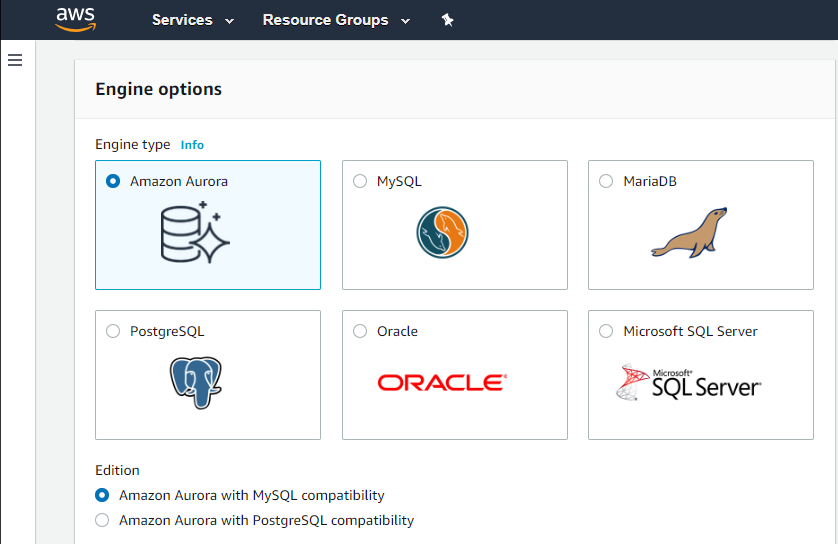
Database Engine Compatibility: It works amazingly with multiple database engines used by different departments within our organization including MySQL, PostgreSQL, SQL Server, and Oracle.
Monitoring: It covers our extensive monitoring and logging, and also has great compatibility with Amazon CloudWatch
It is a little difficult to configure and connect to an RDS instance. The integration with ECS can be made more seamless.
Exploring features within RDS is not very easy and intuitive. Either a human friendly documentation should be added or the User Interface be made intuitive so that people can explore and find features on their own.
There should be tools to analyze cost and minimize it according to the usage.
Learning curve: is big. Newbies will face problems in understanding the platform initially. However, with plenty of online resources, one can easily find solutions to problems and learn on the go.
Backup and restore: MySQL is not very seamless. Although the data is never ruptured or missed, the process involved is not very much user-friendly. Maybe, a new command-line interface for only the backup-restore functionality shall be set up again to make this very important step much easier to perform and maintain.
It's core to our business, we couldn't survive without it. We use it to drive everything from FTP logins to processing stories and delivering them to clients. It's reliable and easy to query from all of our pipeline services. Integration with things like AWS Lambda makes it easy to trigger events and run code whenever something changes in the database.
We do renew our use of Amazon Relational Database Service. We don't have any problems faced with RDS in place. RDS has taken away lot of overhead of hosting database, managing the database and keeping a team just to manage database. Even the backup, security and recovery another overhead that has been taken away by RDS. So, we will keep on using RDS.
For teaching Databases and SQL, I would definitely continue to use MySQL. It provides a good, solid foundation to learn about databases. Also to learn about the SQL language and how it works with the creation, insertion, deletion, updating, and manipulation of data, tables, and databases. This SQL language is a foundation and can be used to learn many other database related concepts.
Functionally, DynamoDB has the features needed to use it. The interface is not as easy to use, which impacts its usability. Being familiar with AWS in general is helpful in understanding the interface, however it would be better if the interface more closely aligned with traditional tools for managing datastores.
I've been using AWS Relational Database Services in several projects in different environments and from the AWS products, maybe this one together to EC2 are my favourite. They deliver what they promise. Reliable, fast, easy and with a fair price (in comparison to commercial products which have obscure license agreements).
I give MySQL a 9/10 overall because I really like it but I feel like there are a lot of tech people who would hate it if I gave it a 10/10. I've never had any problems with it or reached any of its limitations but I know a few people who have so I can't give it a 10/10 based on those complaints.
It works very well across all the regions and response time is also very quick due to AWS's internal data transfer. Plus if your product requires HIPPA or some other regulations needs to be followed, you can easily replicate the DB into multiple regions and they manage all by it's own.
I have only had good experiences in working with AWS support. I will admit that my experience comes from the benefit of having a premium tier of support but even working with free-tier accounts I have not had problems getting help with AWS products when needed. And most often, the docs do a pretty good job of explaining how to operate a service so a quick spin through the docs has been useful in solving problems.
We have never contacted MySQL enterprise support team for any issues related to MySQL. This is because we have been using primarily the MySQL Server community edition and have been using the MySQL support forums for any questions and practical guidance that we needed before and during the technical implementations. Overall, the support community has been very helpful and allowed us to make the most out of the community edition.
The only thing that can be compared to DynamoDB from the selected services can be Aurora. It is just that we use Aurora for High-Performance requirements as it can be 6 times faster than normal RDS DB. Both of them have served as well in the required scenario and we are very happy with most of the AWS services.
Amazon Relational Database Service (RDS) stands out among similar products due to its seamless integration with other AWS services, automated backups, and multi-AZ deployments for high availability. Its support for various database engines, such as MySQL, PostgreSQL, and Oracle, provides flexibility. Additionally, RDS offers managed security features, including encryption and IAM integration, enhancing data protection. The pay-as-you-go pricing model makes it cost-effective. Overall, Amazon RDS excels in ease of use, scalability, and a comprehensive feature set, making it a top choice for organizations seeking a reliable and scalable managed relational database service in the cloud.
MongoDB has a dynamic schema for how data is stored in 'documents' whereas MySQL is more structured with tables, columns, and rows. MongoDB was built for high availability whereas MySQL can be a challenge when it comes to replication of the data and making everything redundant in the event of a DR or outage.
I have taken one point away due to its size limits. In case the application requires queries, it becomes really complicated to read and write data. When it comes to extremely large data sets such as the case in my company, a third-party logistics company, where huge amount of data is generated on a daily basis, even though the scalability is good, it becomes difficult to manage all the data due to limits.
Some developers see DynamoDB and try to fit problems to it, instead of picking the best solution for a given problem. This is true of any newer tool that people are trying to adopt.
It has allowed us to add more scalability to some of our systems.
As with any new technology there was a ramp up/rework phase as we learned best practices.