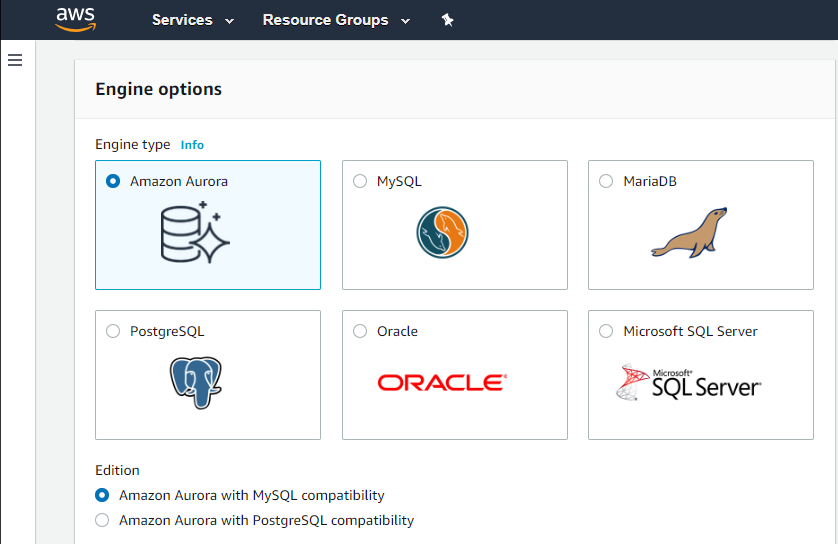
Amazon Relational Database Service (Amazon RDS) is a database-as-a-service (DBaaS) from Amazon Web Services.
N/A
Oracle Database
Score 8.4 out of 10
N/A
Oracle Database, currently in edition 23ai, is a converged, multimodel database management system. It is designed to simplify development for AI, microservices, graph, document, spatial, and relational applications.
$0.05
per hour
SAP Datasphere
Score 8.5 out of 10
N/A
SAP Datasphere, the next generation of SAP Data Warehouse Cloud, is a comprehensive data service that enables data professionals to deliver seamless and scalable access to mission-critical business data. It provides a unified experience for data integration, data cataloging, semantic modeling, data warehousing, data federation, and data virtualization. SAP Datasphere enables users to distribute mission-critical business data — with business context and logic preserved — across the data…
N/A
Pricing
Amazon Relational Database Service (RDS)
Oracle Database
SAP Datasphere
Editions & Modules
Amazon RDS for PostgreSQL
$0.24 ($0.48)
per hour, R5 Large (R5 Extra Large)
Amazon RDS for MariaDB
$0.25 ($0.50)
per hour, R5 Large (R5 Extra Large)
Amazon RDS for MySQL
$0.29 ($0.58)
per hour, R5 Large (R5 Extra Large)
Amazon RDS for Oracle
$0.482 ($0.964)
per hour, R5 Large (R5 Extra Large)
Amazon RDS for SQL Server
$1.02 ($1.52)
per hour, R5 Large (R5 Extra Large)
Oracle Base Database Service - Standard
$0.0538
per hour
Oracle Base Database Service - Enterprise
$0.1075
per hour
Oracle Base Database Service - High Performance
$0.2218
per hour
Standard Edition
Contact Sales
Enterprise Edition
Contact Sales
Personal Edition
Contact Sales
No answers on this topic
Offerings
Pricing Offerings
Amazon RDS
Oracle Database
SAP Datasphere
Free Trial
No
Yes
Yes
Free/Freemium Version
No
Yes
No
Premium Consulting/Integration Services
No
No
No
Entry-level Setup Fee
Optional
No setup fee
No setup fee
Additional Details
—
—
SAP Datasphere is available as a subscription or consumption-based model. The SAP Datasphere capacity unit (CU) offers an adaptable approach to pricing that enables any workload on any hyperscaler. The number of CUs required is determined by the unique workload, with the ability to tailor the combination of required services within SAP Datasphere utilizing a flexible tenant configuration. The services that contribute to CU consumption are the core application (compute and storage), data lake, BW bridge, data integration, and data catalog (crawling and storage).
Oracle Database can be more expensive in comparison to Amazon RDS. This may be because of licensing fees. Installation can be a bit messy and take longer than necessary. The user interface could also use some work when compared to Amazon RDS. Some companies will need a DBA to …
Oracle Autonomous Database is designed for Oracle Database workloads, making it suitable for organizations with existing Oracle investments. RDS supports various database engines. Autonomy and Automation: Oracle Autonomous Database places a strong emphasis on automation for …
Installing, configuring, and managing Oracle Database can be challenging, especially for people who are new to Oracle products. Longer learning curves and higher operational overhead can be caused by this complexity. Amazon Relational Database Service is easy to understand and …
In a few words, we are just to confortable working with oracle and sql server. Using RDS add another layer of distributed database in order to backup everything we have in case of a disaster and also complies with authorities locally and internacionally. All database we use, …
Earlier we were using the Azure Ecosystem but we faced some issues in DevOps side so we decided to migrate towards some other reliable infra so we migrated all our engines, RDS and other services to Amazon Relational Database Service (RDS) and from that time we are using this. …
Every traditional rational Database requires server installation & accessing needs to be monitored periodically manually. But Amazon provides easy-to-access and monitor health and scale-up and scale-down option just by clicks without adding any additional hardware.
amazon provides wide range of support for multiple database engines so we dont have to look for any other providers integration with aws ecosystem so we can seemlessly use other aws services connected to database aws have data points globally so it if data needs to be in …
[Amazon Relational Database Service (RDS)] is much better to have everything in the cloud instead of having it on-premise once you can get all the benefits from Cloud. Of course, it can be a bit expensive if your company it's not growing anymore but if you check it in detail, …
Although Oracle Database is a great tool as well but considering the product features of SAP Data Warehouse Cloud, it was clear SAP is the future and provides the on point features required for a growing company and a ever scaling business with real time capabilities of …
Each of these listed software has its own unique strength and capacity that scales well. SAP Datasphere on its end up against them with more suitability for large establishments with complex data ecosystems with scalability support. Also, it avails a pay-as-you-go pricing for …
If your application needs a relational data store and uses other AWS services, AWS RDS is a no-brainer. It offers all the traditional database features, makes it a snap to set up, creates cross-region replication, has advanced security, built-in monitoring, and much more at a very good price. You can also set up streaming to a data lake using various other AWS services on your RDS.
We migrated from NoSQL to an Oracle database. One of the reasons was robust backup and recovery options available in the Oracle database, which provide zero data loss. A transactional database like Oracle is a better fit for our use case than NoSQL. On a large scale, deployment was evaluated as a cheaper option than the NoSQL engine. This conclusion came even after considering Oracle license is expensive.
SAP Datasphere is well suited for scalable cloud based data integration scenarios which also opens up the doors for AI driven insights which are much harder to achieve with on-prem data warehouses. Considering the licensing model of SAP Datasphere being based on consumption driven capacity units cost can be a big consideration for organizations with large volumes of data that can be a pre-requisite for data mining and AI use cases. So this can be a bottleneck or not so well adopted scenario for SAP Datasphere.
Automated Database Management: We use it for streamlining routine tasks like software patching and database backups.
Scalability on Demand: we use it to handle traffic spikes, scaling both vertically and horizontally.
Database Engine Compatibility: It works amazingly with multiple database engines used by different departments within our organization including MySQL, PostgreSQL, SQL Server, and Oracle.
Monitoring: It covers our extensive monitoring and logging, and also has great compatibility with Amazon CloudWatch
SAP Data Warehouse Cloud offers free trial for 90 days with free 128 GB of storage and 64 GB memory.
Availability of self-service data modeling and analytics on SAP Data Warehouse Cloud enables users to access and analyze data without getting support from the IT team.
Without zero coding while collecting, connecting, analyzing and modeling data, it saves us time and operational costs of partnering with external IT support experts.
It is a little difficult to configure and connect to an RDS instance. The integration with ECS can be made more seamless.
Exploring features within RDS is not very easy and intuitive. Either a human friendly documentation should be added or the User Interface be made intuitive so that people can explore and find features on their own.
There should be tools to analyze cost and minimize it according to the usage.
We do renew our use of Amazon Relational Database Service. We don't have any problems faced with RDS in place. RDS has taken away lot of overhead of hosting database, managing the database and keeping a team just to manage database. Even the backup, security and recovery another overhead that has been taken away by RDS. So, we will keep on using RDS.
There is a lot of sunk cost in a product like Oracle 12c. It is doing a great job, it would not provide us much benefit to switch to another product even if it did the same thing due to the work involved in making such a switch. It would not be cost effective.
We are moving into using SAP datasphere heavily and replacing all of the SAP HANA native calc view logic to the sap datasphere graphical view which will reduce the legacy SAP BW data warehouse. Also need some more features such as debugging, sql preview and prompts enhancements so that we can generate the reports.
I've been using AWS Relational Database Services in several projects in different environments and from the AWS products, maybe this one together to EC2 are my favourite. They deliver what they promise. Reliable, fast, easy and with a fair price (in comparison to commercial products which have obscure license agreements).
Many of the powerful options can be auto-configured but there are still many things to take into account at the moment of installing and configuring an Oracle Database, compared with SQL Server or other databases. At the same time, that extra complexity allows for detailed configuration and guarantees performance, scalability, availability and security.
It is one of the best tools and a boon to Logistics teams across the globe. One tends to actually process warehousing data so smoothly and the way demonstration is made while in programs it makes it user friendly. The Inventory touch points that one identify is simply awesome and is best part.
I have only had good experiences in working with AWS support. I will admit that my experience comes from the benefit of having a premium tier of support but even working with free-tier accounts I have not had problems getting help with AWS products when needed. And most often, the docs do a pretty good job of explaining how to operate a service so a quick spin through the docs has been useful in solving problems.
1. I have very good experience with Oracle Database support team. Oracle support team has pool of talented Oracle Analyst resources in different regions. To name a few regions - EMEA, Asia, USA(EST, MST, PST), Australia. Their support staffs are very supportive, well trained, and customer focused. Whenever I open Oracle Sev1 SR(service request), I always get prompt update on my case timely. 2. Oracle has zoom call and chat session option linked to Oracle SR. Whenever you are in Oracle portal - you can chat with the Oracle Analyst who is working on your case. You can request for Oracle zoom call thru which you can share the your problem server screen in no time. This is very nice as it saves lot of time and energy in case you have to follow up with oracle support for your case. 3.Oracle has excellent knowledge base in which all the customer databases critical problems and their solutions are well documented. It is very easy to follow without consulting to support team at first.
I would greatly acknowledge the services of Sap Data [warehouse Cloud] because we were struggling before its arrival where we used to get manual data connections and this used to consume a lot of time but after its use, we now are able to connect data easily saving a lot of time and finances.
Overall the implementation went very well and after that everything came out as expected - in terms of performance and scalability. People should always install and upgrade a stable version for production with the latest patch set updates, test properly as much as possible, and should have a backup plan if anything unexpected happens
Amazon Relational Database Service (RDS) stands out among similar products due to its seamless integration with other AWS services, automated backups, and multi-AZ deployments for high availability. Its support for various database engines, such as MySQL, PostgreSQL, and Oracle, provides flexibility. Additionally, RDS offers managed security features, including encryption and IAM integration, enhancing data protection. The pay-as-you-go pricing model makes it cost-effective. Overall, Amazon RDS excels in ease of use, scalability, and a comprehensive feature set, making it a top choice for organizations seeking a reliable and scalable managed relational database service in the cloud.
Because of a rich user base and support for any critical issue, this is one of the best options to choose. In case the project has a TCO issue, it can compromise and choose Postgres as the best alternative. SQL server is also good and easy to code and maintain but performance is not as good as the Oracle
Each of these listed software has its own unique strength and capacity that scales well. SAP Datasphere on its end up against them with more suitability for large establishments with complex data ecosystems with scalability support. Also, it avails a pay-as-you-go pricing for users, and it is widely up for data quality, data governance, and data discovery.
Despite the pricing model being expensive for small businesses, it provides decent features and capabilities for organizations of different sizes and it's an appropriate investment in today's business environment where there is constant pressure to build a scalable and flexible analytics service
Ever since we implemented SAP Data Warehouse Cloud, we have been able to reduce the additional costs of hiring third-party service providers by incorporating professional services offered by the vendor.
Preserving data quality has enhanced governance on data by having a single source that is accessible to every business user via self-service capabilities.
Operational cost is lowered by connecting data in one integrated solution hence making it easy to access information without having to keeping logging to other applications. Additionally, no external IT support is needed since SAP Data Warehouse Cloud has no-coding modeling tools.
SAP Data Warehouse Cloud has enabled every business user to understand different data by transforming data to real insights.