Amazon S3 is a cloud-based object storage service from Amazon Web Services. It's key features are storage management and monitoring, access management and security, data querying, and data transfer.
N/A
Microsoft Azure
Score 8.4 out of 10
N/A
Microsoft Azure is a cloud computing platform and infrastructure for building, deploying, and managing applications and services through a global network of Microsoft-managed datacenters.
$29
per month
Splunk Observability Cloud
Score 8.4 out of 10
N/A
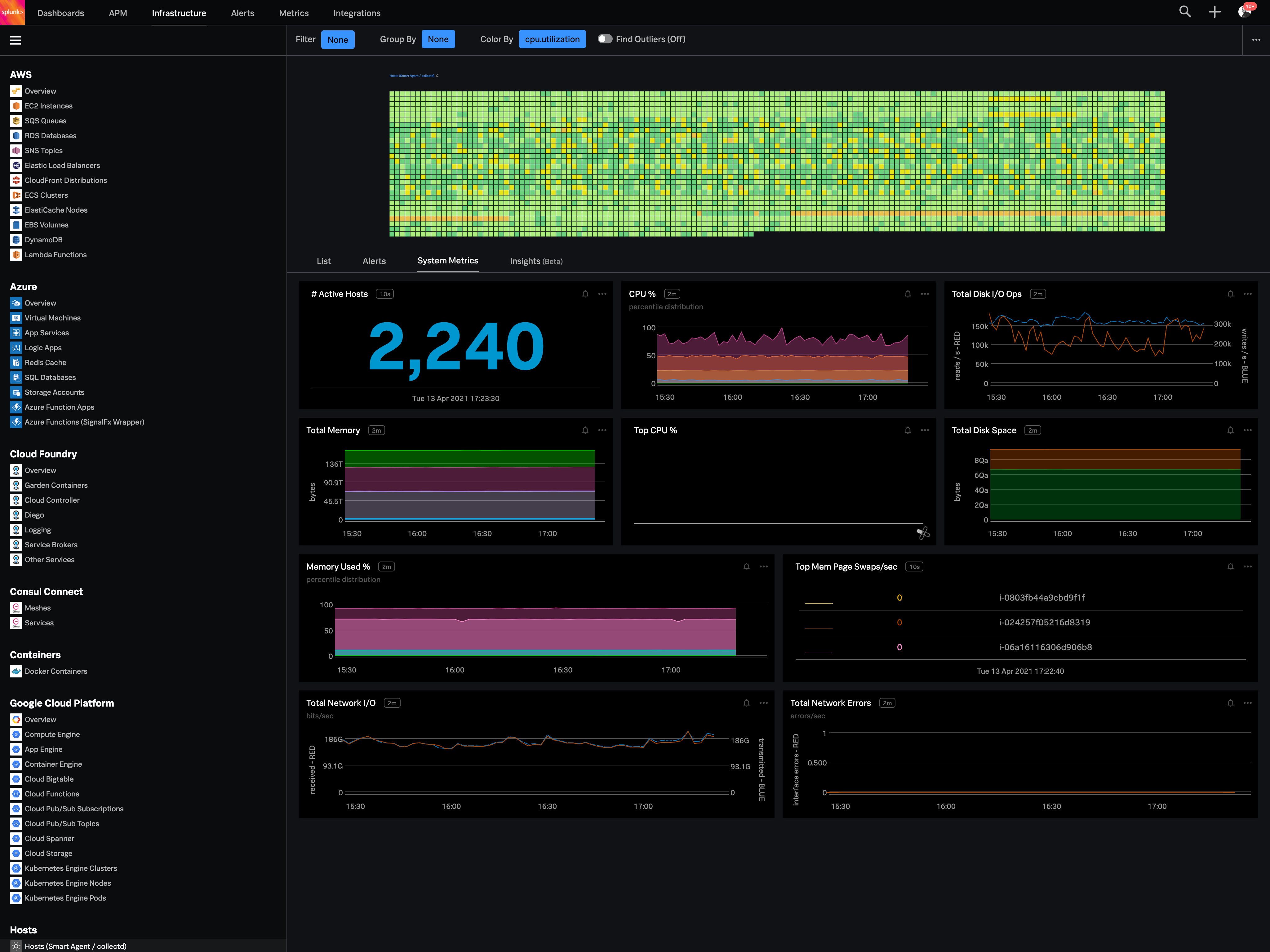
Splunk Observability Cloud aims to enable operational agility and better customer experience through real-time AI-driven streaming analytics allowing accurate alerts in seconds. It is designed to shorten MTTD and MTTR by providing real-time visibility into cloud infrastructure and services.
$180
per year per host
Pricing
Amazon S3 (Simple Storage Service)
Microsoft Azure
Splunk Observability Cloud
Editions & Modules
No answers on this topic
Developer
$29
per month
Standard
$100
per month
Professional Direct
$1000
per month
Basic
Free
per month
Infrastructure
$15
per month (billed annually) per host
App & Infra
$60
per month (billed annually) per host
End-to-End
$75
per month (billed annually) per host
Offerings
Pricing Offerings
Amazon S3
Microsoft Azure
Splunk Observability Cloud
Free Trial
No
Yes
Yes
Free/Freemium Version
No
Yes
No
Premium Consulting/Integration Services
No
No
No
Entry-level Setup Fee
No setup fee
No setup fee
No setup fee
Additional Details
—
The free tier lets users have access to a variety of services free for 12 months with limited usage after making an Azure account.
When we were implementation the solution of our issue then we find Azure and Google Cloud Storage platforms but we were unable to find the proper documentation for the platform as compared to S3, So we moved to S3 and discarded the other options. Cost wise there are only some …
S3 provides an on-demand usage model for storage. You only pay for what you use. Nutanix is an on-premises solution and does not allow for usage-based pricing. Azure was less integrated with our current AWS workloads which helped drive our decision to use s3 with the Amazon …
Amazon S3 comes with all other services of AWS, all other services are very quick and secure with S3 storage, which is the best option for any application. Again, compared to other services like Azure or GCP, AWS provides more configuration and functions to host multi nature …
Some obvious ones are Google storage services like Drive, and their whole arsenal of services. Another could be the Office line where SharePoint and other programs can be used synchronously. I have seen other people use Windows Azure for storage needs similar to ours. We chose …
Amazon has had years of development in building their cloud solution. A few other vendors are playing catch up but that's always the case when you have the key to success. The saying goes " if you built it, they will come". :)
Azure provides an environment that while at time is more pricey, the tight integration with our existing Microsoft-based infrastructure makes it difficult to beat.
AWS is competitor and it's leading in cloud space with his wide sprawl of offerings and services. AWS is a ocean once you login you get everything on one console. AWS leads this space with all his offerings and capabilities. But Azure is not behind, it is competing and is …
Amazon S3 is a great service to safely backup your data where redundancy is guaranteed and the cost is fair. We use Amazon S3 for data that we backup and hope we never need to access but in the case of a catastrophic or even small slip of the finger with the delete command we know our data and our client's data is safely backed up by Amazon S3. Transferring data into Amazon S3 is free but transferring data out has an associated, albeit low, cost per GB. This needs to be kept in mind if you plan on transferring out a lot of data frequently. There may be other cost effective options although Amazon S3 prices are really low per GB. Transferring 150TB would cost approximately $50 per month.
Azure is particularly well suited for enterprise environments with existing Microsoft investments, those that require robust compliance features, and organizations that need hybrid cloud capabilities that bridge on-premises and cloud infrastructure. In my opinion, Azure is less appropriate for cost-sensitive startups or small businesses without dedicated cloud expertise and scenarios requiring edge computing use cases with limited connectivity. Azure offers comprehensive solutions for most business needs but can feel like there is a higher learning curve than other cloud-based providers, depending on the product and use case.
Its great if you need real-time visibility across complex or regulated environments. Also strong for hybrid or multi-cloud setups where uptime, observability and fast IR are required. It’s probably overkill for smaller teams or environments that don’t have constant changes or compliance reporting needs. It's expensive and has a steep learning curve. Also, in my opinion, do not get yourself into a consumption based model. Costs can certainly get out of control quickly.
Fantastic developer API, including AWS command line and library utilities.
Strong integration with the AWS ecosystem, especially with regards to access permissions.
It's astoundingly stable- you can trust it'll stay online and available for anywhere in the world.
Its static website hosting feature is a hidden gem-- it provides perhaps the cheapest, most stable, most high-performing static web hosting available in PaaS.
Microsoft Azure is highly scalable and flexible. You can quickly scale up or down additional resources and computing power.
You have no longer upfront investments for hardware. You only pay for the use of your computing power, storage space, or services.
The uptime that can be achieved and guaranteed is very important for our company. This includes the rapid maintenance for security updates that are mostly carried out by Microsoft.
The wide range of capabilities of services that are possible in Microsoft Azure. You can practically put or create anything in Microsoft Azure.
The first one is its Kubernetes container monitoring.
I really like this features because as we know how much K8s is vast and to manually monitor each part of the Kubernetes it takes so much time but Splunk Observability Cloud makes it easier. And even once we integrate K8s with Splunk Observability Cloud it gives us some prebuilt dashboards which gives holistic view of our Cluster and its nodes, pods, etc.
The dashbaord feature of Splunk Observability Cloud, it gives us full flexibility to customize our dashboard with a wide range of predefined chart types.
Now it also supports OTEL, which is a plus point for observability. As now everyone is moving towards Otel and in current market there are only few tools who supports OTEL based integrations, Splunk Observability Cloud is one out of them.
Web console can be very confusing and challenging to use, especially for new users
Bucket policies are very flexible, but the composability of the security rules can be very confusing to get right, often leading to security rules in use on buckets other than what you believe they are
The cost of resources is difficult to determine, technical documentation is frequently out of date, and documentation and mapping capabilities are lacking.
The documentation needs to be improved, and some advanced configuration options require research and experimentation.
Microsoft's licensing scheme is too complex for the average user, and Azure SQL syntax is too different from traditional SQL.
You can use table-like functionality to generate dashboards, but these queries are heavy on the system.
It could be easier to give insight into what type of line parsing is used for specific documents in a company-managed environment and/or show ways to gain the insights needed.
I would like to see ways to anonymize specific data for shared reports without pre-formatting this in a dashboard on which reports could be based.
Moving to Azure was and still is an organizational strategy and not simply changing vendors. Our product roadmap revolved around Azure as we are in the business of humanitarian relief and Azure and Microsoft play an important part in quickly and efficiently serving all of the world. Migration and investment in Azure should be considered as an overall strategy of an organization and communicated companywide.
Good: Stable system with low error rate Easy to use for simple use cases Bad: UI is not very clear for complex usage Mobile view (when logged in from phone) is bad No library for .net
It is tricky to get it all set up correctly with policies and getting the IAM settings right. There is also a lot of lifecycle config you can do in terms of moving data to cold/glacier storage. It is also not to be confused with being a OneDrive or SharePoint replacement, they each have their own place in our environment, and S3 is used more by the IT team and accessed by our PHP applications. It is not necessarily used by an average everyday user for storing their pictures or documents, etc.
As Microsoft Azure is [doing a] really good with PaaS. The need of a market is to have [a] combo of PaaS and IaaS. While AWS is making [an] exceptionally well blend of both of them, Azure needs to work more on DevOps and Automation stuff. Apart from that, I would recommend Azure as a great platform for cloud services as scale.
When there is an issue, it’s a win if one can easily identify the root cause. To do the same, it should allow the user to dig deep with multiple data points and compare the data and identify the anomaly. In this use case, it’s good to drive from Splunk 011y.
AWS has always been quick to resolve any support ticket raised. S3 is no exception. We have only ever used it once to get a clarification regarding the costs involved when data is transferred between S3 and other AWS services or the public internet. We got a response from AWS support team within a day.
We were running Windows Server and Active Directory, so [Microsoft] Azure was a seamless transition. We ran into a few, if any support issues, however, the availability of Microsoft Azure's support team was more than willing and able to guide us through the process. They even proposed solutions to issues we had not even thought of!
As I have mentioned before the issue with my Oracle Mismatch Version issues that have put a delay on moving one of my platforms will justify my 7 rating.
Overall, we found that Amazon S3 provided a lot of backend features Google Cloud Storage (GCS) simply couldn't compare to. GCS was way more expensive and really did not live up to it. In terms of setup, Google Cloud Storage may have Amazon S3 beat, however, as it is more of a pseudo advanced version of Google Drive, that was not a hard feat for it to achieve. Overall, evaluating GCS, in comparison to S3, was an utter disappointment.
As I continue to evaluate the "big three" cloud providers for our clients, I make the following distinctions, though this gap continues to close. AWS is more granular, and inherently powerful in the configuration options compared to [Microsoft] Azure. It is a "developer" platform for cloud. However, Azure PowerShell is helping close this gap. Google Cloud is the leading containerization platform, largely thanks to it building kubernetes from the ground up. Azure containerization is getting better at having the same storage/deployment options.
Splunk Infrastructure Monitoring provides far superior options for anybody using a complex hybrid multi-cloud environment and allows both your SOC and NOC to work together on the same data while driving their own insights. We found other products are still in the old world view of servers and agents residing together within a single data centre, but modern apps are no longer like this.
It practically eliminated some real heavy storage servers from our premises and reduced maintenance cost.
The excellent durability and reliability make sure the return of money you invested in.
If the objects which are not active or stale, one needs to remove them. Those objects keep adding cost to each billing cycle. If you are handling a really big infrastructure, sometimes this creates quite a huge bill for preserving un-necessary objects/documents.
For about 2 years we didn't have to do anything with our production VMs, the system ran without a hitch, which meant our engineers could focus on features rather than infrastructure.
DNS management was very easy in Azure, which made it easy to upgrade our cluster with zero downtime.
Azure Web UI was easy to work with and navigate, which meant our senior engineers and DevOps team could work with Azure without formal training.