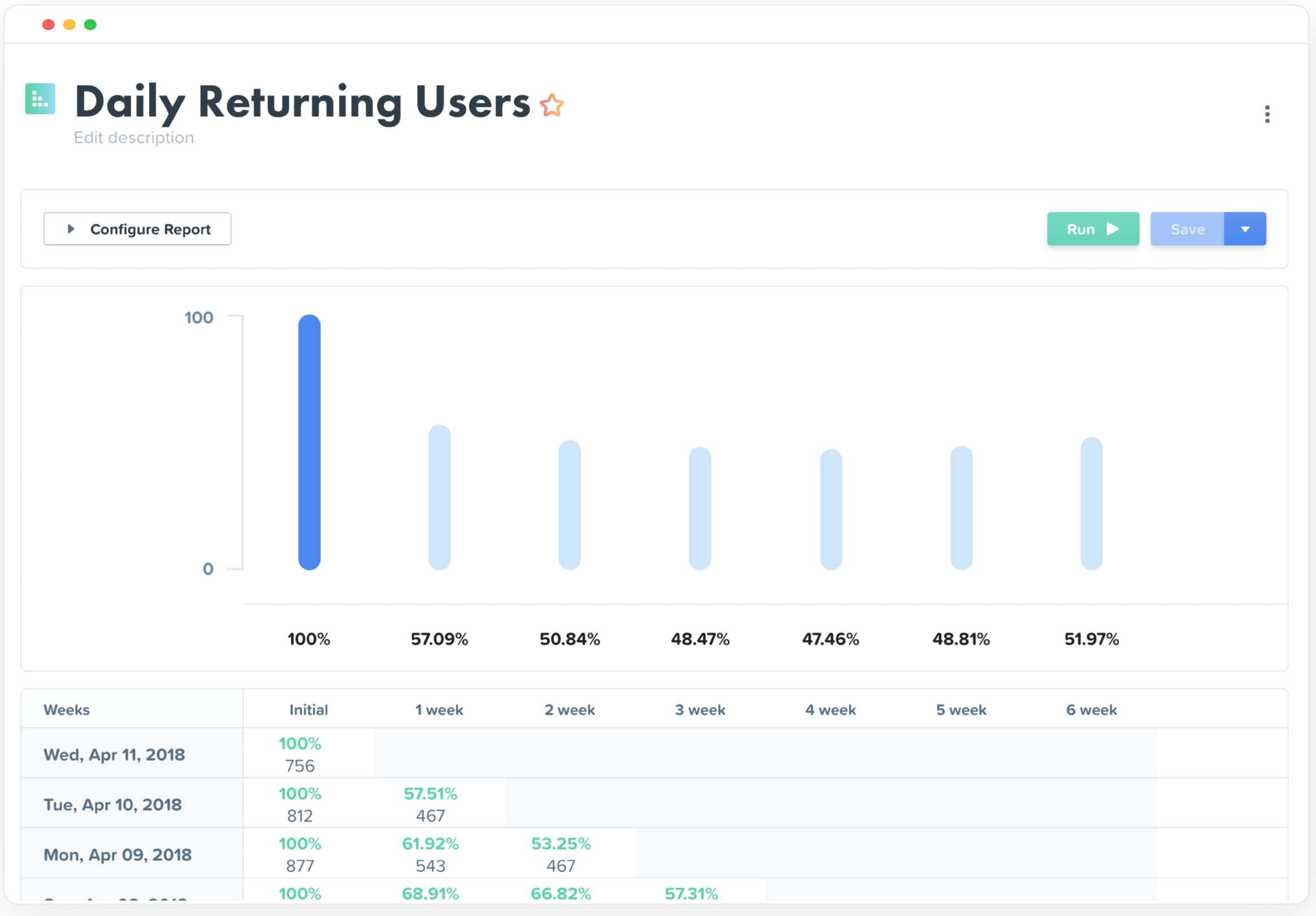
Amplitude Analytics is an analytics platform for mobile and web. It is designed to help organizations segment users and analyze funnels, retention and revenue. Amplitude Analytics helps product marketers to achieve actionable insights from customer digital journeys and uses behavioral graphs to build customer-focused products. Amplitude also optimizes digital products for increased quality engagements, increased conversion rates, and long-term customer loyalty.
$61
per month
Woopra
Score 3.0 out of 10
Enterprise companies (1,001+ employees)
Woopra provides real-time customer analytics. It begins by tracking users across digital touch points (website, mobile app, help desk, marketing automation, etc.) and building a comprehensive behavioral profile for each user. These Customer Profiles are Woopra's building blocks, which are used to generate custom analytics reports, funnel analytics, retention analytics, and more.
Amplitude Analytics is an excellent solution for anyone with a mobile app and you want to track what users are doing, are they completing conversion steps, and are they coming back more often. This all helps you visual your customer bases engagement and help project future engagement and create goals. This also helps with prioritizing products to address drop-off points in the product to increase conversions.
My rating of Woopra is the absolute best possible. I would recommend them to anyone looking for an analytics website that prefers a visual interface and a beautiful design. I have not encountered any problems using their app -- ZERO! Their integration with other marketing software, such as MailChimp, helps our company zero in on our marketing campaigns and gives us the information we need to make better choices. I LOVE Woopra and think they are the best out there! I have used other websites and there is no comparison!
Woopra tracks *individual users and customer accounts*. It cannot be understated how important this is. Google Analytics and other low cost solutions only sample users and provide aggregate data. For enterprise sales, this is critical. Likewise, for product managers trying to segment product usage by types of accounts, this is incredibly useful.
Woopra updates user analytics in real time. This is critical in a sales context as you want to be able to follow up quickly on opportunities. Likewise, it is useful for customer success as they can see usage in real time for an individual they are supporting.
Woopra has the most turnkey integrations of any web analytics solution on the market. By far the most useful are Marketo, SalesForce, and Slack, but there are several more we didn't tap into. While any solution worth its salt has an API, Woopra's integrations usually require a login and/or API key, and you are good to go. Here is the current list: https://www.woopra.com/appconnect/.
Woopra enables B2B product managers to track product and feature usage by revenue, not just clicks. Again, in a B2B context, this is critical, as there are high-value users and low-value users. Knowing the difference is critical.
Woopra's implementation is super simple. We were able to set it up with a couple of hours of one frontend developer and some help from our product intern.
Some offerings seem duplicative, like dashboards and notebooks, which only seem to differ in that one can subscribe to dashboards
The messaging on valid vs invalid property types could be better explained to clarify which types (string, Boolean, integer, etc) are expected in particular scenarios. Though the type is usually set during event creation, we've often seen examples where the data received in production is different, leading to 'invalid type' errors
Great product Good value for the cost/initiate Support docs and FAQs are great - they limit the necessity of reaching out to in-person support. So when you do call them ... it is for a legit question/issue, no just a "where is it" or a "how to I do xyz123?"
We just really like the tool. There are lots of us using it internally... from Product, to marketing, to customer service, to optimization team, to traffic acquisition, to Executives. Really helps us answer questions about how well things are going, and what is not going well.
It's a fairly straightforward platform that's beginner friendly. The biggest usability hurdle is most often created by your own team, as it's imperative to know what event sources are being sent to Amplitude and what those event names are. Within being properly onboarded by a team member it can be hard to get started using Amplitude. It takes time to understand what data your company may be sending to the product, the naming conventions of events (especially if there are old or deprecated events names
The UI and reports are great overall. Creating reports just requires a few too many screens and clicks. Also dashboard tiles can't be resized. Both of these are easy items that are being addressed
Alway up and running, or if there is a problem we can get back in the game right away. The reliability was a big selling point for me, and it was true when this company got it. Rollouts can be tough, but this was pretty seamless. Good support throughout the process, good documentation to handle questions/tips
No issues, problems, or negative remarks from us!! We had a plan, vendor support was rock solid, our data folks have experience, OCM supported as needed, and we got the rollout done on time, on budget, and with only minor hiccups. SInce the rollout, most of us have already forgotten the hiccups and generally speak highly of the product
I haven't used the Amplitude support other than their training docs so I can't speak too much to the in-person support but the docs are serviceable. Nothing too crazy but between the user tips, email notifications, and the decent number of docs I was able to get the support I needed to ramp up on the tool.
Virtual Not bad considering the timeframe and turnaround. The biggest benefit was for my end-users to hear a voice (other than mine/ours! LOL) telling them about the new features and capabilities. The in-person training was really good for having an expert that knows the answers and could refer to past experiences, problems, solutions. THey were a great resource to ease the transition ... basically a "you are gonna be okay with this change ... you got this etc.!" kinda vibe
Good enough to get strong baseline. I always make sure our our users go to and/or focus on the vebndor-provided support docs rather than any formal training. Our instructors come and go, but written policy and how-to docs live much longer in a corporate setting. That said, the online training is sufficient. I like that the training curric is stacked and progressive.
My team members all have background as data analysts, so Amp was pretty easy to for them. There was sufficient online training available. We also used the available support documents. The actual rollout went well. We did significant testing beforehand. We did a phased rollout, with partial silent rollout (part of OCM's plan) for the smallest line of business. THe silent one was "silent" b/c it was done without fanfare or public notices ... it was just a "we're doing some things, it wont impact your work or workday
Compared to other products, the support was a small effort. We only had part time contributions from a product management intern and front end developer.
Amplitude Analytics provides much more granular data than Google Analytics and gives you much more flexibility in how you can segment and splice the data. It also provides the ability to create closed funnels, which I have yet to find out how to do in Google Analytics. Amplitude has a very similar interface to Mixpanel, with a few handy additions, like the ability to name and categorize your events.
Woopra is much easier to setup and use than Google Analytics. I've spent hours trying to create custom reports in Google Analytics. Woopra does not take this much time to get solid reporting for our site. If you need something that tracks marketing efforts then Google Analytics will likely be a better fit.
Like all the other grades, it was mostly an easy implementation ... we have experience people, the rollout in general is well planned, and the vendor was very supportive
Really helped us begin to segment our users based on their engagement and retention.
Helped increase retention by about 1.5% after about 5 months of implementation (don't shoot the messenger if your team can't implement that quickly).
I felt like it had great potential to create a pipeline between sales and the CSM, but I had trouble getting the sales team to implement it properly as they had their noses deep in calls and emails (they struggle entering notes in SalesForces as well, so it's more a company specific problem).