Apache Spark is a multi-language engine for executing data engineering, data science, and machine learning on single-node machines or clusters.
N/A
Matillion
Score 8.5 out of 10
N/A
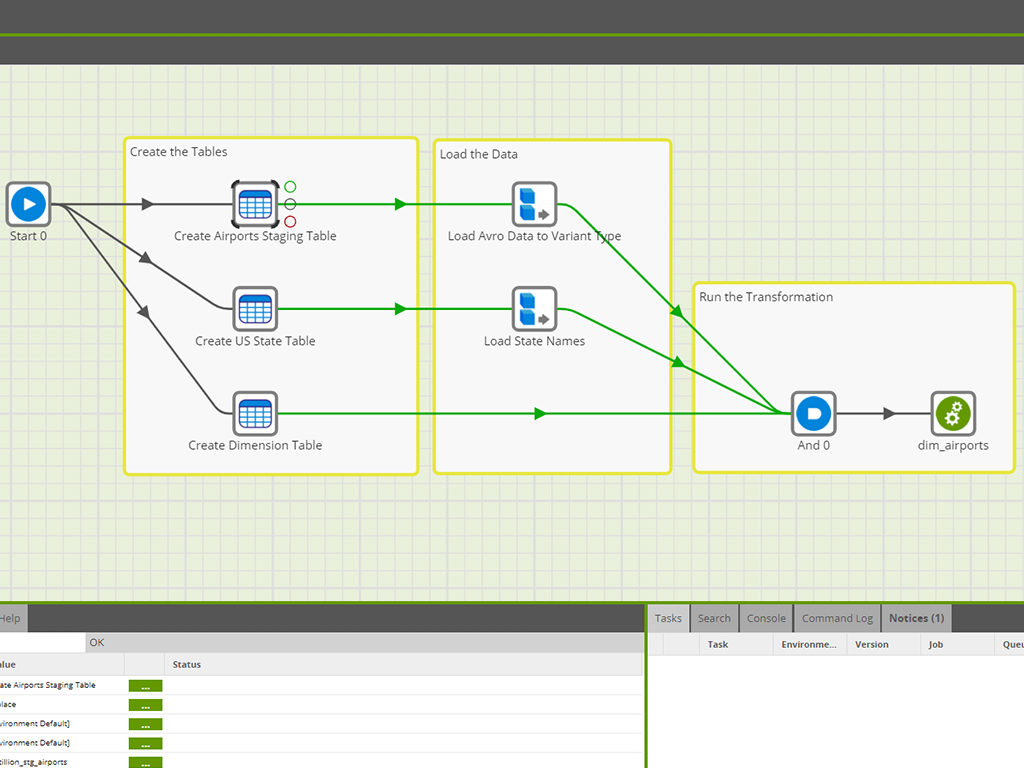
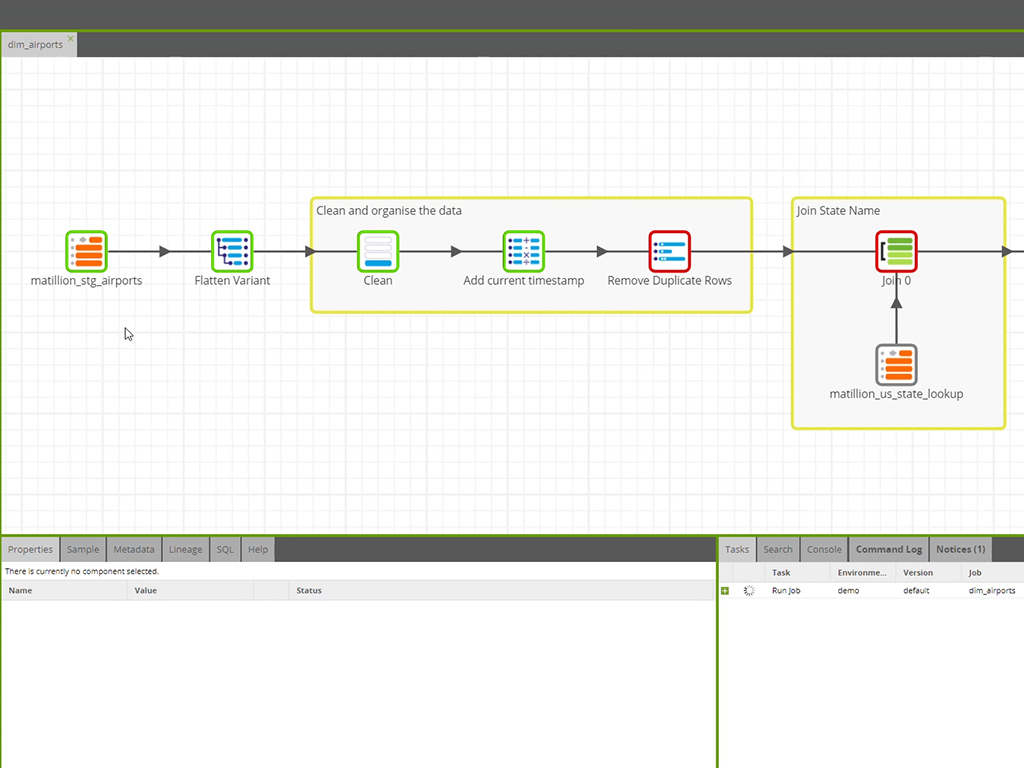
Matillion is a data pipeline platform used to build and manage pipelines. Matillion empowers data teams with no-code and AI capabilities to be more productive, integrating data wherever it lives and delivering data that’s ready for AI and analytics.
$2.50
Pay as you go per user
Snowflake
Score 8.7 out of 10
N/A
The Snowflake Cloud Data Platform is the eponymous data warehouse with, from the company in San Mateo, a cloud and SQL based DW that aims to allow users to unify, integrate, analyze, and share previously siloed data in secure, governed, and compliant ways. With it, users can securely access the Data Cloud to share live data with customers and business partners, and connect with other organizations doing business as data consumers, data providers, and data service providers.
N/A
Pricing
Apache Spark
Matillion
Snowflake
Editions & Modules
No answers on this topic
Developer: For Individuals
$2.50/credit
Pay as you go per user
Basic
$1000
per month 500 prepaid credits (additional credits: $2.18/credit)
Advanced
$2000
per month 750 prepaid credits (additional credits: $2.73/credit)
Enterprise
Request a Quote
No answers on this topic
Offerings
Pricing Offerings
Apache Spark
Matillion
Snowflake
Free Trial
No
Yes
Yes
Free/Freemium Version
No
No
No
Premium Consulting/Integration Services
No
Yes
No
Entry-level Setup Fee
No setup fee
No setup fee
No setup fee
Additional Details
—
Billed directly via cloud marketplace on an hourly basis, with annual subscriptions available depending on the customer's cloud data warehouse provider.
Databricks uses Spark as a foundation, and is also a great platform. It does bring several add-ons, which we did not feel needed by the time we evaluated - and haven't needed since then. One interesting plus in our opinion was the engineering support, which is great depending …
Matillion was chosen by Schibsted due to the seamless integration with Snowflake. The ease of use and fast workflow have made it an essential tool in our setup, and with the option to integrate nearly every data source there is, plus the ease of use, it really gives a lot of …
The only other ETL tool I've used was SSIS. At first I thought Matillion seemed "kiddish" after using the polished Microsoft tool but now I think Matillion is easier and can do much more as it has so many built-in connectors etc. We selected Matillion at our job because of …
Matillion has better capabilities and better built-in elements that saves your time and efforts. also the connectivity across multiple data warehousing tool is better in Matillion. even the performance of the pipeline and the time required to create a particular pipeline is …
n/a -- joined the team after they already were established in Matillion. Have had brief looks at other ETL products but found nothing compelling enough to suggest a change.
Matillion provided much more flexibility than the other products we tested, at a much lower price point. Other products, in my view, had a cleaner/simpler UI but I also felt that they offered much less functionality. A key design pattern we had to deliver was to perform delta …
Fivetran offers a managed service and pre-configured schemas/models for data loading, which means much less administrative work for initial setup and ongoing maintenance. But it comes at a much higher price tag. So, knowing where your sweet spot is in the build vs. buy spectrum …
Cost and ease of use were better for our purposes. Matillion distinguishes itself from Fivetran and SnapLogic through its user-friendly design, no-code interface, in-depth transformation capabilities, allowing for complex data manipulations directly within the platform, …
We decided to move forward with Matillion because it was the best tool among tools that support both ingesting data from a source system to a target database and running transformation workflows on it afterwards. Fivetran and Airbyte only support data ingestion and we had our …
Removes most of the complexity around setting up and preparing things. If you could describe with words what needs to be done to move data from A to B, the implementation in Matillion would probably be the most similar in terms of simplicity of understanding what you are doing …
dbt is great for engineers and those comfortable with coding. Matillion is the low-code alternative with a huge emphasis on collaboration with ease. You don't need to checkout a branch, clone, pull, merge etc. in order to help your colleague with a data pipeline. The simple …
Matillion is much easier to set up and easier to work for the team. Offers a lot more connections which are easier to set up. Environment variables make it easy to set up once and job creation is easy. We use Metadata tables to just loop through the list of tables that need to …
Matillion ran circles around Stitch and Striim both in functionality, setup, and performance. There was no real comparison. Fivetran massively outperforms Matillion in pretty much every facet of the production from setup, maintenance, visibility, and usability. It already …
I tried to use several opensource tools before Matillion. They were not bad, but I spent a ton of time maintaining the system, and debugging why things wouldn't work. It also seemed like everything needed a hack to get it working properly. With Matillion, it just works outside …
When compared with other technologies , Matillion was cost effective , more scalable and flexible in terms of complexity and components. The licensing cost of Matillion was also less and the flexibility with components helps in implementing complex business logics. The training …
Snowflake fits perfectly into our BI stack, with Matillion delivering the data on a daily schedule, and feeding into Tableau for analysis and further manipulating.
Snowflake provides various features, such as integration with Python using Snowpark. The reporting feature that caters to your small reporting needs is Snowsight. The Snowflake data marketplace is where you can get multiple data for free and even some of the data which you can …
In my experience running the data management practice at InterWorks, we believe that cloud data warehouse products will eventually serve the majority of data warehousing use cases and power data analytics at most companies. Of this cohort, we believe that Snowflake is the best …
Redshift compute and storage can be scaled up/down together (though they added some features recently, they don't quite add up). I haven't tried Avalanche or Firebolt but would love to in the near future, due to their pedigree or revolutionary billing methods.
The average percentage of time that a data warehouse is actually doing something is around 20%. Given this, the price by query estimate becomes an important pricing consideration.
For this, Snowflake crucially decouples of storage and compute. With Snowflake you pay for 1) …
Well suited: To most of the local run of datasets and non-prod systems - scalability is not a problem at all. Including data from multiple types of data sources is an added advantage. MLlib is a decently nice built-in library that can be used for most of the ML tasks. Less appropriate: We had to work on a RecSys where the music dataset that we used was around 300+Gb in size. We faced memory-based issues. Few times we also got memory errors. Also the MLlib library does not have support for advanced analytics and deep-learning frameworks support. Understanding the internals of the working of Apache Spark for beginners is highly not possible.
Great: Need to query simpler APIs, or utilize well known services such as GSheets etc.? Matillion has got some of the best and easiest to use connectors out there. Not so great: Do you need have a competent CI/CD flow that you will be able to update / compare from Matillion as well as other sources at the same time? Good luck, you will need to be extra careful, as you might have to have a deeper dive into your servers Terminal each time you have a git conflict.
Snowflake is well suited when you have to store your data and you want easy scalability and increase or decrease the storage per your requirement. You can also control the computing cost, and if your computing cost is less than or equal to 10% of your storage cost, then you don't have to pay for computing, which makes it cost-effective as well.
Snowflake scales appropriately allowing you to manage expense for peak and off peak times for pulling and data retrieval and data centric processing jobs
Snowflake offers a marketplace solution that allows you to sell and subscribe to different data sources
Snowflake manages concurrency better in our trials than other premium competitors
Snowflake has little to no setup and ramp up time
Snowflake offers online training for various employee types
Matillion is brilliant at importing data -- it would be amazing to have more ways to export data, from emailed exports to API pushes.
Any Python that takes more than a few lines of code requires an external server to run it. It would be great to have more integration (perhaps in a connected virtual environment) to easily integrate customized code.
Troubleshooting server logs requires quite a bit of technical expertise. More human readable detailed error handling would be greatly appreciated.
Do not force customers to renew for same or higher amount to avoid loosing unused credits. Already paid credits should not expire (at least within a reasonable time frame), independent of renewal deal size.
With the current experience of Matillion, we are likely to renew with the current feature option but will also look for improvement in various areas including scalability and dependability. 1. Connectors: It offers various connectors option but isn't full proof which we will be looking forward as we grow. 2. Scalability: As usage increase, we want Matillion system to be more stable.
SnowFlake is very cost effective and we also like the fact we can stop, start and spin up additional processing engines as we need to. We also like the fact that it's easy to connect our SQL IDEs to Snowflake and write our queries in the environment that we are used to
If the team looking to use Apache Spark is not used to debug and tweak settings for jobs to ensure maximum optimizations, it can be frustrating. However, the documentation and the support of the community on the internet can help resolve most issues. Moreover, it is highly configurable and it integrates with different tools (eg: it can be used by dbt core), which increase the scenarios where it can be used
We are able to bring on new resources and teach them how to use Matillion without having to invest a significant amount of time. We prefer looking for resources with any type of ETL skill-set and feel that they can learn Matillion without problem. In addition, the prebuilt objects cover more than 95% of our use cases and we do not have to build much from scratch.
Because the fact that you can query tons of data in a few seconds is incredible, it also gives you a lot of functions to format and transform data right in your query, which is ideal when building data models in BI tools like Power BI, it is available as a connector in the most used BI tools worldwide.
1. It integrates very well with scala or python. 2. It's very easy to understand SQL interoperability. 3. Apache is way faster than the other competitive technologies. 4. The support from the Apache community is very huge for Spark. 5. Execution times are faster as compared to others. 6. There are a large number of forums available for Apache Spark. 7. The code availability for Apache Spark is simpler and easy to gain access to. 8. Many organizations use Apache Spark, so many solutions are available for existing applications.
Overall, I've found Matillion to be responsive and considerate. I feel like they value us as a customer even when I know they have customers who spend more on the product than we do. That speaks to a motive higher than money. They want to make a good product and a good experience for their customers. If I have any complaint, it's that support sometimes feels community-oriented. It isn't always immediately clear to me that my support requests are going to a support engineer and not to the community at large. Usually, though, after a bit of conversation, it's clear that Matillion is watching and responding. And responses are generally quick in coming.
We have had terrific experiences with Snowflake support. They have drilled into queries and given us tremendous detail and helpful answers. In one case they even figured out how a particular product was interacting with Snowflake, via its queries, and gave us detail to go back to that product's vendor because the Snowflake support team identified a fault in its operation. We got it solved without lots of back-and-forth or finger-pointing because the Snowflake team gave such detailed information.
Spark in comparison to similar technologies ends up being a one stop shop. You can achieve so much with this one framework instead of having to stitch and weave multiple technologies from the Hadoop stack, all while getting incredibility performance, minimal boilerplate, and getting the ability to write your application in the language of your choosing.
Fivetran offers a managed service and pre-configured schemas/models for data loading, which means much less administrative work for initial setup and ongoing maintenance. But it comes at a much higher price tag. So, knowing where your sweet spot is in the build vs. buy spectrum is essential to deciding which tool fits better. For the transformation part, dbt is purely (SQL-) code-based. So, it is mainly whether your developers prefer a GUI or code-based approach.
I have had the experience of using one more database management system at my previous workplace. What Snowflake provides is better user-friendly consoles, suggestions while writing a query, ease of access to connect to various BI platforms to analyze, [and a] more robust system to store a large amount of data. All these functionalities give the better edge to Snowflake.
We're using Matillion on EC2 instances, and we have about 20 projects for our clients in the same instance. Sometimes, we're struggling to manage schedules for all projects because thread management is not visible, and we can't see the process at the instance level.