Apollo is a sales platform that helps revenue teams find and engage leads, automate outreach, manage deals, and enrich data.
$59
per month per user
Bookafy
Score 9.0 out of 10
Small Businesses (1-50 employees)
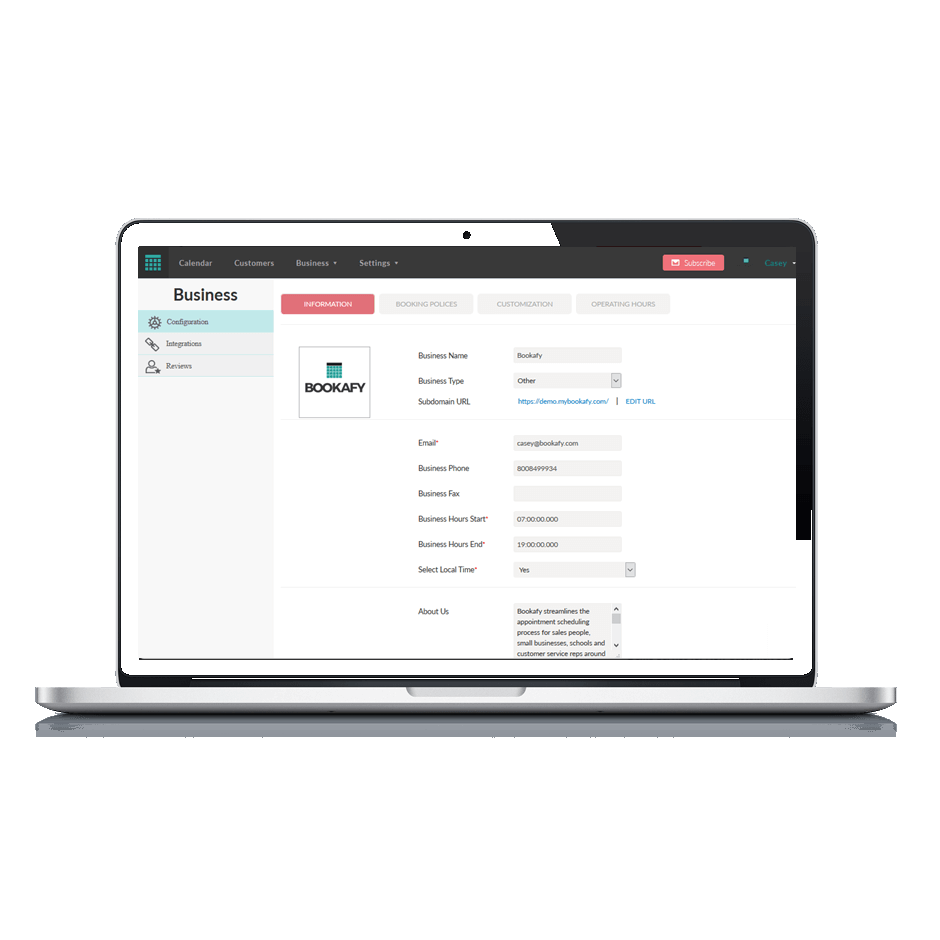
Bookafy is an online appointment scheduling solution targeted at a variety of industries. The vendor’s value proposition is that their solution is simple to use, fully customizable, has an elegant user interface and can be embedded into the business user’s website. Support is available via phone, email or chat.
$9
per month
Pricing
Apollo.io
Bookafy
Editions & Modules
Basic
$59
per month per user
Professional
$99
per month per user
Organization
$1,188
per year per user
Pro
$9
per month
Pro+
$13
per month
Enterprise
Contact sales team
Offerings
Pricing Offerings
Apollo.io
Bookafy
Free Trial
Yes
Yes
Free/Freemium Version
Yes
Yes
Premium Consulting/Integration Services
Yes
Yes
Entry-level Setup Fee
Optional
No setup fee
Additional Details
20% discount for annual billing on the Basic and Professional plans.
If a company is looking to do higher volume email and phone outreach, Apollo.io is a good tool. I would recommend first verifying if this type of outreach works with your offering. If it does, this tool will be very helpful for you.
In my experience, Bookafy has pretty much the same features as the other well-known scheduling apps. In terms of functionality, the two obstacles I experience were setting up a hidden (not shown on the main booking page) meeting for special bonus calls you don't want anyone to have access to. Yes, you can set up a paid meeting and give someone a coupon to access it free but that seems like an extra unnecessary step. The other limitation was how ugly it looks to embed meetings on a website. The scheduler looks fine inside Bookafy, but when embedded, it doesn't flow as well. For everything else, it works well. If you want to sync the scheduler with email marketing systems, most of the integrations work through Zapier so that can be an additional cost. Bookafy focuses on the meeting schedules.
Firstly, finding the details of the potential customers that is there name, designation email and phone number since these are the most important cases most of the times I can get this data in Apollo.io
I can pull the bulk data of the targeted organization, or I can pull the emails based on the location and job titles
Apart from the email capture, the thing which helpful is that the email sequence can find emails and send emails in Apollo.io itself and also the report and the dashboard are so clean
Friendly UI and UX Apollo.io was the first tool which I used. Since then I'm still using Apollo.io for easy understanding
I gave it a 7 because it doesn't help you out if you're an organization that's call-heavy, because a lot of times the numbers aren't the best. It's not accurate. If you're somebody who's email and outbound and your goal is to find that, then that's cool. It works well for it. Some of the features, the AI tools, and some additional features they have are just too complex. Sometimes it's easy to use, but at the same time, there are tools that are not efficient, and it's like, "Where is this coming from?"Especially if you're looking for your niche, whatever industry you're in, and the target word, sometimes it can't find it. You can see what people are searching for, and it just doesn't add up. If you're trying to get very, very detailed, it's not the best. Sometimes it's going to depend on your industry, of course.
The team wants to solve probelms, but we are finding that they don't know how to solve the more technical issues quickly. I suspect that they don't have a mature process for escalations, and they don't have a usable knowledge base article repository. They seems to push emails around to let us know that people are working on the issues to find solutions, but this takes weeks and oftentimes still leaves us without a resolution.
In terms of Apollo.io, the easiest part is its integration and versatility in handling data. LinkedIn NAVIGATOR, on the other hand, is also a decent tool, but it’s significantly more expensive than Apollo.io and Lusha, especially when considering a decent set of data. However, it’s somewhat incomplete when compared to Apollo.io.
Bookafy is more advanced and has more features that I need comparing to these other brands. Calendly is very basic while Bookfy offers more robust features.
We sign our new clients based on the list of accounts in the industry that Apollo.io provides. This gives us a clear picture to identify which industry to target.