Ardexus Customer Relationship Management (CRM) is built as a marketing, sales, service, and mobile CRM solution.
N/A
Fin by Intercom
Score 8.7 out of 10
N/A
Fin is Intercom’s AI Agent for customer service, designed to deliver high-quality answers, even for complex queries. It works with any helpdesk, or it can be paired with Intercom’s next-generation Helpdesk to get the full Intercom Customer Service Suite.
$0.99
one-time fee per outcome
Kustomer
Score 8.7 out of 10
N/A
Kustomer is a customer service CRM platform built for managing high support volume by optimizing experiences throughout the customer service journey. Kustomer was acquired by Facebook in late 2020, but spun out in 2023 and re-launched as an independent entity, Kustomer, LLC.
$89
per month per user
Pricing
Ardexus CRM
Fin by Intercom
Kustomer
Editions & Modules
No answers on this topic
Fin with your current helpdesk
$0.99
one-time fee per outcome
Copilot add-on
$35
per month per user
Pro
$99
per month For analysis of 1,000 conversations
Fin with Intercom’s Helpdesk
from $39 + $0.99 per Fin outcome
per month per seat
Enterprise
$89
per month, per user
Ultimate
$139
per month, per user
Offerings
Pricing Offerings
Ardexus CRM
Fin by Intercom
Kustomer
Free Trial
No
Yes
No
Free/Freemium Version
No
No
No
Premium Consulting/Integration Services
No
No
No
Entry-level Setup Fee
No setup fee
No setup fee
No setup fee
Additional Details
—
Fin comes with a 90-day money-back guarantee. Here's how it works:
Intercom states that users who sign up for the Fin Guarantee Success Program and do not achieve at least a resolution rate of 65% will be paid $1M. This program is designed for high volume customers.
Eligibility criteria:
High volume customers (over 250k monthly conversions) in North America and Europe. Intercom states that phase one of this program will admit customers on Intercom Helpdesk or Zendesk.
All plans require an annual subscription and 8 users minimum.
It is well-suited for mid-sized companies. And the pricing is relatively better. I don't think it will work well well with companies handling bleeding-edge tech. But if u are looking for a typical CRM which does what it's supposed to do, then go for it. And it works well with your ERP software too.
It's excellent when users often have trouble understanding certain aspects of your product, so you don't have to manually share the same information every time. It's less appropriate if your user problems are user-specific, as then you probably don't have every expected case covered in your documentation, which then requires Fin to have access to your codebase, at which point you might want to consider building your own agent.
I would say the greatest strength of Kustomer is its flexibility. In the hands of a skilled admin, it can be adapted to tons and tons of different use cases. I've been able to make custom displays for different groups of agents, produce complex cross sections of users, draw interesting data relationships combining marketing contacts and customer-initiated contacts. For example, there's really no other data source in our company which could tell you which users received a specific promo code and checked out with it, received their delivery within 14 days and then can related that to the number of times they contacted us about using our product. At the intersection of communication, marketing, data, and relationship-management, Kustomer shines at the center. I would say it falls short when you are trying to coordinate multiple "side conversations" with multiple sources to resolve an issue. This is a tough task for any type of platform, but if you're maintaining 3 different email chains with a 3PL partner, the customer, and a separate internal conversation, it would be confusing anyway!
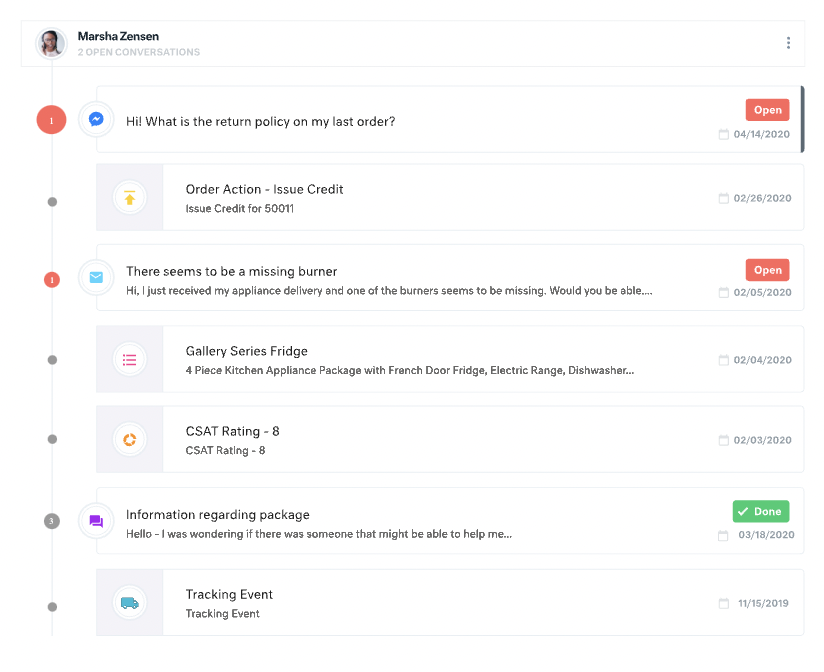
All customer data (past orders, communication with customer service, rewards account data) is in one place. This helps agents avoid confusion and reduces the number of tabs they need to open.
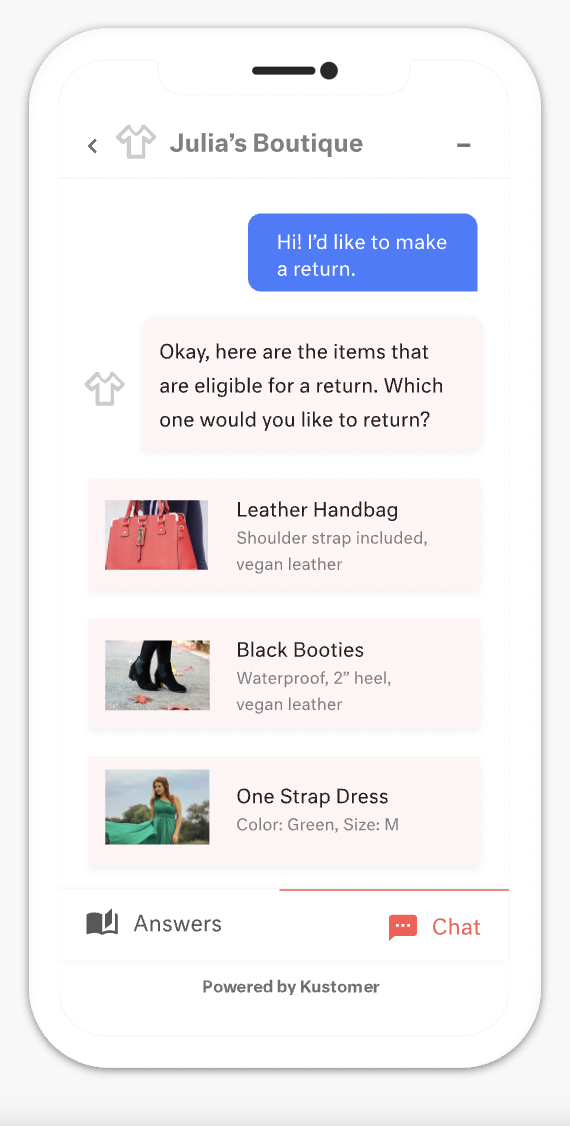
The Knowledge Base (or K Base) is very helpful. Any time we roll out a new policy or have a limited-time promotion, we can add all the relevant information and worksheets there for the convenience of the agents. That way they can stay in a chat while looking up the answer to a question.
We can seamlessly move from chat into email if the customer leaves or the queue times are too long. All the interactions will stay on the customer profile page, so they are kept up to date.
It seems some users really struggle to figure out how to escalate to a human (especially through email).
Not excited about how "soft" resolutions still count as resolutions and are paid for. Though some abandoned cases appear to be able to be concluded as "the user got the answer they needed", there are others where they clearly didn't, because they just open up another chat (or even more), trying to get more info. This pads the resolution stats and makes it seem more effective than it actually is.
Cost -- Fin is quite expensive. It helps us with scaling coverage, but we're not really saving money.
For our team, the feature that defaults all notes to begin in "done" status is difficult. Throughout each day we need to have notes open and assigned back and forth to different teams, and we have to remember to manually "open" each note. There is too much room for human error with this setting, and it is easy for important notes to be missed if a user forgets to open the note.
Similarly, it can be hard to remember to assign emails/notes to a particular team in addition to a user. We almost exclusively work out of team inboxes, and if someone on Care writes an email to a customer, the email will automatically be "done" when it is created, and it will be assigned to the user who wrote it, but not also to the user's team. There are instances where an email needs to be snoozed for several days/hours with further action needed, and unless the user remembers to assign the email to their team it may "awake" from the snooze and not be visible to anyone except the user who created it. Similarly to my first comment, this leaves a lot of room for human error and is not very intuitive.
Personally, I do not love that all tickets/emails/notes are jumbled together in the same inbox. While this gives visibility to everything on the "to do" list at the same time, it can be visually overwhelming. We have created unique folders for certain types of projects or categories of work, but have experienced tech glitches or just the awkwardness of another step to manually read the note, determine what type of category it is, and then manually assign it to another folder. Would love to have things auto-sort and take out this manual lift.
I love the idea of the autopilot setting, but we have not been able to use this for our work because it sorts items based on time, and not based on priority. In our line of work, we may have an urgent situation arise that needs attention before an email that was sent in 60 minutes ago. The autopilot feature would push the email to my associates sooner than it would the urgent situation from 5 minutes ago. Due to this, we manually monitor inboxes and assign work to ourselves and others.
We have been and will be continuing our journey with Intercom and nothing too concerning has happened that I have experienced or heard of that has us on the edge yet. If it ever happens it will be something along the lines of "Outgrowing" the use of need of the platform.
Firstly, it's relatively cheaper than the other products in this segment but offers more features. For mid-Sized companies, this CRM is the best choice. If the company is already using Lotus Notes, the integration becomes easier. And finally, this is IBM-based.
FIN is easy to set up and pretty quick to get everything the way you need (some things could be handled better), and you can preview how it's going to work before it's available to everyone. Since you can use FIN on multiple channels, you can save a lot of time by not having your team work on multiple chat platforms as well.
There is a learning curve, but it is more than worth it, especially to have a dedicated resource pointed at Kustomer and any other software it interacts with. The basic implementation is useful, and powerful - certainly a MASSIVE upgrade over taking care of your customers in an email inbox or shuffling between multiple windows and applications! It is also set up really well to grow and reconfigure with your business. I'm a big fan.
I can get help by asking Fin questions about itself. It answers accurately, citing its own Help Center resources with visuals. It can reason and dialogue well. But when it comes to getting human support for Fin, it is not as quick. It can sometimes take a few days. They are polite and well-meaning. Some things aren't their fault (product limitations), but there was one occasion where something took a long time to resolve with lots of back and forth but it was I who found out the error in the end that they missed, so they didn't really help resolve it.
I did not reach out to Kustomer support when we had an issue. Still, whenever we provide feedback to our manager regarding what can improve based on our experience using Kustomer, our manager always comments that Kustomer support always replies with some positive feedback based on our suggestions.
Oracle CRM on-demand is better for a huge company; it doesn't offer the level of customization this CRM offers. It provides less scope for 3rd party integrations. The analytics are far better with Ardexus CRM. Oracle CRM has not changed in 10 years, whereas Ardexus CRM gets constant Updates.
There are so many AI platforms available, and you could theoretically build a system using the available AI API's from any of the big platforms. However, I dont think it's as easy as this. Intercom is deliberately built for customer service, the features they are releasing a based on providing the best customer experience. If we were to build this ourselves or to use another platform we would be taking on the upkeep, using Fin is just much simpler as it's also our chosen ticketing platform so anything that Fin is not able to answer yet and escalated directly to our team with no extra effort required from our side.
Apps like Intercom, Zendesk, and Gorgios all treat customer inquiries as tickets, just tracking that one issue or interaction with a customer. Kustomer treats each customer as an individual, which allows us to provide top-notch customer service. Customers love that we're able to be more conversational and informal, while still solving their issues quickly. It also helps us build relationships with customers and increases repeat orders.
New role opportunities — Using the “Fin-first” approach has reduced the workload for our Tier 1 team, giving them more time to focus on their own career growth. It’s also opened the door to a dedicated, AI-focused role, where a team member regularly reviews Fin’s answers and makes updates to help it perform even better.
Enabling Fin has also reduced our response time and allowed us to meet SLA's.
We’re getting so much positive feedback — which is not something you traditionally associate with a customer care team — because we’re making it effortless for customers to deliver both positive and negative feedback, and we can now resolve the bad feedback really really quickly.
Primarily from our increased efficiency with Kustomer, we’ve seen a significant reduction of $3 to $4 for every cost per contact.