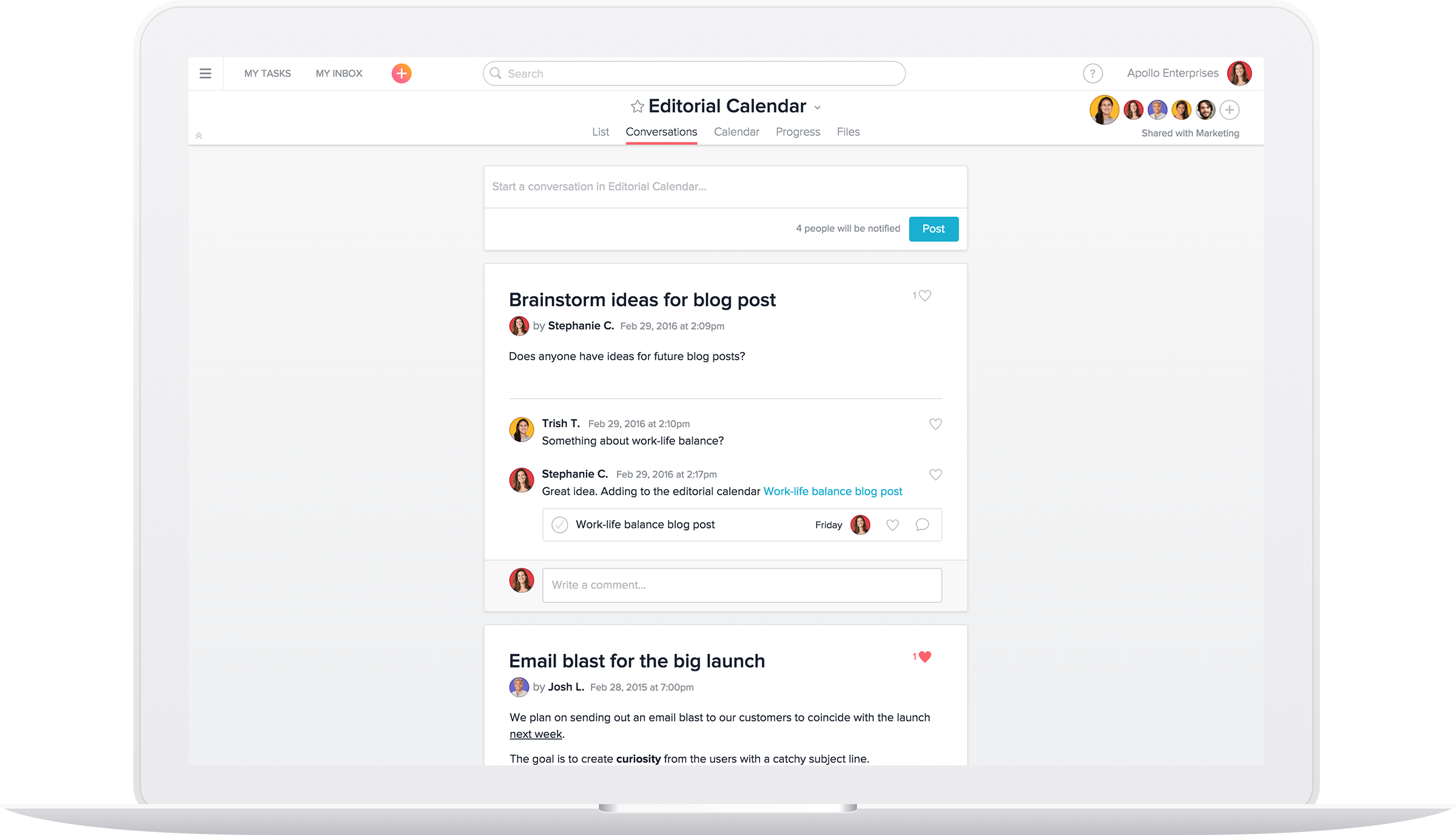
Asana is a web and mobile project management app. With tasks, projects, conversations, and dashboards, Asana lets an entire team know who's doing what by when, enabling workload balancing. Users can also add integrations for GANTT charts, time tracking and more.
$13.49
per month per user
Microsoft To Do
Score 8.1 out of 10
N/A
Microsoft To Do replaces the former Wunderlist task management tool.
Asana is a highly effective instrument for managing teams and projects. The paid edition provides a multitude of features that can be tailored and used in accordance with the organisation's specific requirements.
Email integration facilitates notifications that remind team …
Overall for the money Asana brings a lot of value for organizations who want to do more with less and need a task and project management solution as a small company is growing and scaling to get to the next level. In the space when we evaluated didn't find a lot of other …
Against Jira it offers a more modern experience with less complex user interfaces. The admin and setup experience is also way faster with less (or no) legacy complexity.
Against other modern players like Linear and Basecamp it offers way more integrations so we can pull in data …
Asana is a top-tier project management software that helps us organize and track projects from start to finish. It allows us to apply tasks/to-dos to multiple projects without duplication, divide complex projects into smaller tasks, and track project progress. It also helps us …
Asana provides a mix of features between notion and Jira. Unlike Notion, it helps ease up the collaboration on vast projects and between multiple teams. Jira proved to be a little expensive with similar set of features if not more and which is why we thought of going with Asana.
I believe that Asana is more professional than Trello. I used Trello a long time ago, but it looked more suitable for a student project rather than for a professional team or business environment. I believe it has great features to help companies in different stages and of …
Since I have tried the two applications and saw their advantages and disadvantages, I see that Asana is much better in terms of dealing with files, ease of use, and the many features and characteristics that it has. Also, I noticed that it does not consume much space on my …
Side by side with the other two Asana by far beats Monday.com and is comparable and slightly better than ClickUp. Monday is completely browser-based and is hard to navigate and figure out how to set up. Asana and ClickUp are the exact opposite. Both are easy to set up and …
I like how extensive the capabilities are for Asana. With other softwares it seems there are many things lacking. I feel like Asana is also a very user friendly platform and aesthetically pleasing which is important in a modern office. We have many young people entering our …
Asana compared to Jira is certainly better in terms of user experience, since most of the people can start using it basically without having any kind of training or previous explanation, which makes it really useful not only for people already used to project management but …
Asana is amazing for a remote team, that we are currently as its accessible seamlessly to all our team member no matter where they are in the world. Its very easy to onboard new members to this platform as its very intuitive and easy for new people to get a hang of it. It has …
Basecamp was a great tool, but it was paid and things like recurring tasks and opening new projects was a pain. Asana, as a free tool, has been better for our organization as it serves the basic functions very well and is not complicated otherwise. I really like the …
Wrike and monday.com are the big siblings of Microsoft To Do. Even the free versions allow you so much more customization than Microsoft To Do. Miro is an infinite whiteboard style workspace that can be used for project management if your work style is more visual. Again, the …
No comparison. Microsoft To Do is far better, simply because of the easy integration with Outlook email, allowing me to simply flag an email in Outlook, then recognize it as a task in Microsoft To Do. iCloud does not integrate well, even though it claims to. iCloud also …
I choose Microsoft to do because is easier and is on the job email, but Clickup is more handful and Google Tasks its in my personal email, so its more convenient.
Microsoft To-Do simply put just does to-do lists very well. I don't want the visual components of software like Trello or ClickUp, and I had used Asana in previous roles and just found it to have too much going on. I also didn't like the notification system of Asana, constantly …
I am a fan of to-do lists. Previously they were all pen and paper though, which is fine for chores but not so much when you consistently receive emails and chat messages with various tasks mentioned in there. To Do helps keeping track of them.
The main alternative that I've used is Todoist. Todoist is better at auto-detecting dates and tags, and I found it easier to assign items to other people using Todoist. I think the big benefit that Microsoft To Do has is that it is more integrated into existing Microsoft …
The biggest selling point of Microsoft To Do is that it's free. We were able to jump in and start learning it without having to worry about making up for the cost of the software. We liked the idea of using all Microsoft products in hopes of some of our older employees being …
I selected MS To-Do because is easy to use, has a pretty UI and in my organization is free to use. Amazing to schedule your work, meetings, to-do list, prioritize task, etc, but is not like other software like Evernote that have more functionalities like a diagram, …
To be honest, I loved Wunderlist, and so just moved over to Microsoft To Do out of inertia. Also Trello is more Kanban than a to-do list, so not exactly what we needed. Todoist might be more what we need, but we were already using Wunderlist, so we didn't want to take the time …
I prefer Microsoft To Do because of it's amazing app. It seamlessly integrates with mobile so if you're on the go or need to set a reminder, you can very easily take care of it.
Compared to in-built apps from Microsoft or Apple, Wunderlist is far better. It is incredibly hard to collaborate on both Outlook, Gmail, or Apple calendar/reminders. I wouldn't suggest any of those for team projects. Additionally, Wunderlist allows me to separate your work and …
Wunderlist is overly simplistic and a bit outdated compared to competing tools. Trello and Microsoft To-Dos and Planner accomplish the same things better.
I started using Wunderlist purely to keep track of my to-dos and organize my time around the general tasks I have to complete. Attempts I have made to extend Wunderlist into project management or other broader tasks have been largely unsuccessful because it feels like there …
Both Trello and Remember the Milk offer their own value in managing tasks and projects. Wunderlist is the best simple task manager I've come across in that it focuses on the critical features you'd want in a task manager - great interface, ease of use, and accessible anywhere. …
Wunderlist was a good starting point, but we now use Todoist, and I definitely wouldn't look back. It is more complicated, but with that comes much more control than you get in Wunderlist - rather than simple search tags you have filters that can run across projects, human …
I have tried numerous programs in the past, this one, in particular, has an easy interface and almost anyone can use it. One of the most recent programs we have tried is Microsoft To-Do and it does not even compare. We have created access databases specific to do this type of …
While I have tried a number of other to-do lists, Wunderlist is easy to use and free. Most other to-do lists that I have tried I have used for a day or two and the have deleted and returned to Wunderlist. Part of it is that I am used to this tool, but I think it is also just …
The usability of Asana is broad since it's available in a variety of platforms that are widely used nowadays. I think that it would be great for people who are constantly on the move and switching devices, since it has allowed me to work from my phone, too. I also think that Asana has proven itself to handle a large quantity of work
Great to capture flagged emails for reminders later. Great for quick entry tasks. Would love it if you could set a checklist so that you could more easily assign a task to a category, that is currently a little more tedious than what it should be. The lack of integration with Google is also a little disappointing.
Wunderlist is what you need for your to do lists. It's really simple to use.
Allows you to set due date to your lists, share them with your team and/or create a folder to divide and organize all your list set
Also, Wunderlist is compatible with all platform and devices. So you can always be updated on your list or work on them from wherever you are and with all the devices you have.
I just can't see us getting it off of Asana any time soon, despite the many headaches it has caused us. We have too much data in there, too much time & training invested into it, too much at stake to move. If we were just starting out today, fresh, I don't know for certain that I would absolutely go the same direction, but I *think* I still would. I just haven't seen anything better yet. Maybe if Podio's support staff hadn't treated me like a worthless nuisance to them, I might feel differently, but the fact is that their task management is simply inferior to Asana's. That can't be denied, and in fact Podio said it themselves: "Tasks are a simple function. They cannot be customized. Tasks in Podio can be used for quick to-do's for you and your team members." In our operation, however, prompt task completion is a big deal; one task can't be completed until another one is done first, and closing the gaps between those tasks is critical in meeting deadlines and servicing our customers. Asana gets us there, the others don't.
It is very user-friendly. Takes a new employee an hour to start figuring out how the system works. That's an important factor. You don't want to encounter the issue where employees need a week to understand how the system works. For example, JIRA, I tried using it for a week and I still don't understand the complicated layout. Asana has a simple interface. Once you see it, you get it type of program.
The actual user interface and the way to navigate around the app is very intuitive and easy to learn/use which would make me give it a high ranking, but the syncing issues drop down my rating because there are times where you add an item to the list and then it just disappears. Then when you add it again the sync will happen and now you have duplicates. The other negative with the usability is adding extra information to an item, such as files or comments or assignments. You can do it but it's difficult to tell which items have this information from the main screen. You have to click on them individually.
I haven't had to use their support so I can't rate it. The fact that I haven't needed them reflects the ease of use of the product. I would recommend that any new users schedule a complete demo of the product to ensure that they are using it to it's fullest (there's a lot of useful features).
I have not had an issue where I needed to reach out to Wunderlist, but I know their contact and online chat is easy to access and feel confident that they would be helpful. My only worry is Wunderlist is becoming Microsoft to-do in May 2020, and I believe the app will become worse after that.
Asana is a top-tier project management software that helps us organize and track projects from start to finish. It allows us to apply tasks/to-dos to multiple projects without duplication, divide complex projects into smaller tasks, and track project progress. It also helps us organize work on Kanban boards or linear lists. It stands out from the crowd in a big way compared to the competition.
Wrike and monday.com are the big siblings of Microsoft To Do. Even the free versions allow you so much more customization than Microsoft To Do. Miro is an infinite whiteboard style workspace that can be used for project management if your work style is more visual. Again, the free version is still so much more customizable and usable than Microsoft To Do. On a team of people of multiple generations, Microsoft To Do might be a good option if you have to work collaboratively on a simple project. Otherwise, I would recommend any of the other three software options above Microsoft To Do.
It helps our team complete tasks on time, securing better ROIs.
No tasks are being forgotten, leading to better client retention.
The team is getting serious momentum from being able to see and finish the tasks. We even applaud every time we hear the little "ding!" when the task is completed. :)