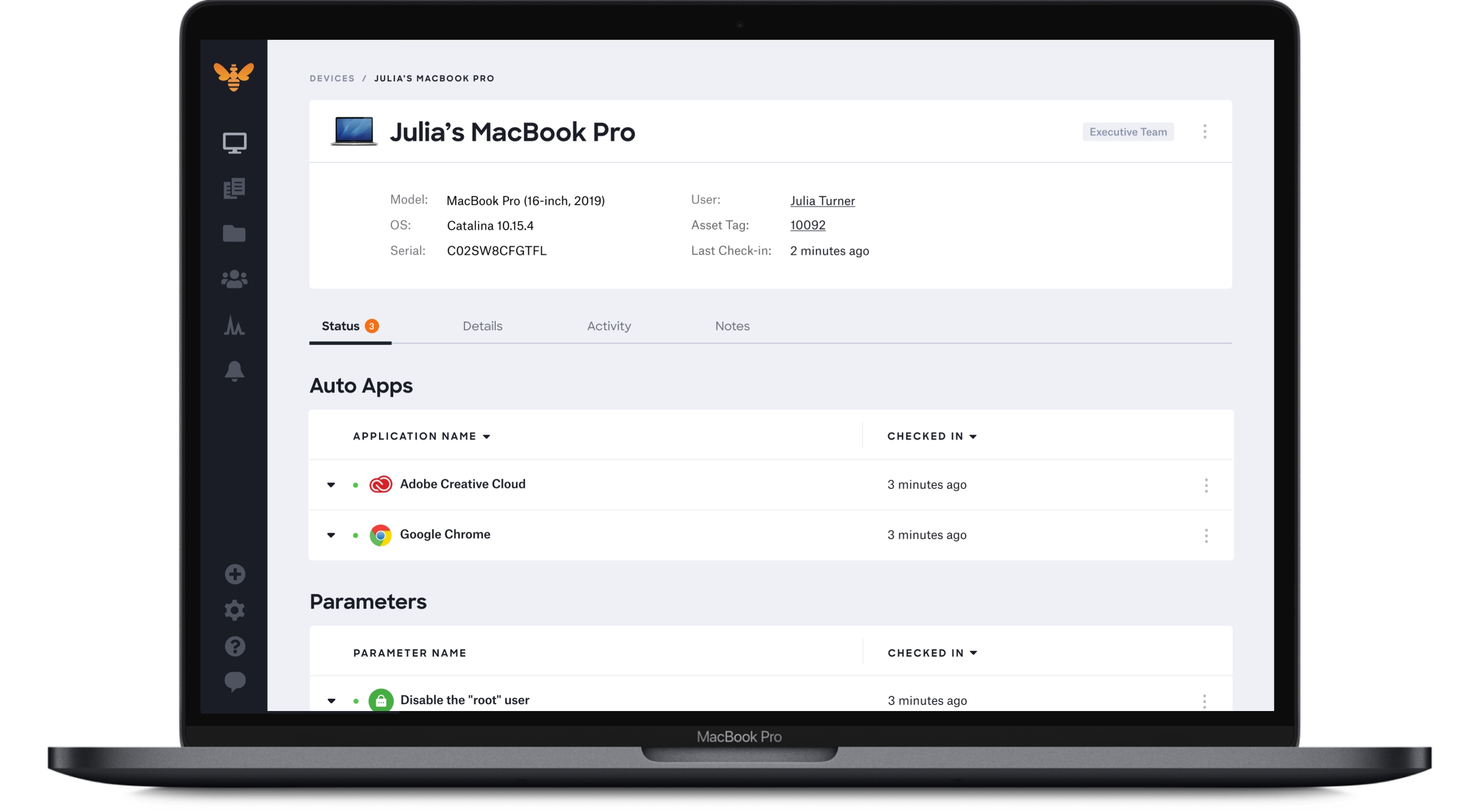
Automox is an endpoint management platform built for the era of autonomous operations. It provides a cloud-native foundation that unifies automation, speed, visibility, and trust.
$1
per month per endpoint
Kandji
Score 8.7 out of 10
Mid-Size Companies (51-1,000 employees)
Kandji is an Apple device management software solution for macOS, iOS, iPadOS, and tvOS, from the company of the same name in San Diego.
N/A
Pricing
Automox
Kandji
Editions & Modules
No answers on this topic
No answers on this topic
Offerings
Pricing Offerings
Automox
Kandji
Free Trial
Yes
Yes
Free/Freemium Version
No
No
Premium Consulting/Integration Services
No
No
Entry-level Setup Fee
No setup fee
No setup fee
Additional Details
Automox can patch macOS, Windows, and Linux endpoints with PatchOS, an offering at $1 per endpoint/ month with an annual commitment.
The Automate Essentials or Automate Enterprise packages are for scaling IT automation, endpoint configuration, and software updates.
Modules are available with Automox Assist, a one-on-one remote endpoint control and assistance for helpdesk technicians.
I have used Tenable Patch Management, but the reason I did not go with it is because it uses on prem servers that we have to host instead of using Agent and cloud platform like Automox.
I feel like that is dated as most solutions are now changing into the cloud solutions.
Automox lets us control so much more and makes it incredibly easy to target very specific devices for very specific actions. it is also incredibly reliable and I know it will patch as expected with very minimal monitoring. Automox has been the most stable of all the tools I …
Automox blows Intune out of the water in terms of app patching. I don't know why Microsoft doesn't spend money on making pushing patches easy with Intune, but that creates an opportunity for others I guess? If you've ever worked with Intune you know what I'm talking about. If …
I was able to update browsera like edge and chrome which have updates every few days, automatically. No more emails to ask people to update edge or chrome. Display drivers and dell drivers are not visible for users, having Automox update them make it much easier for users as not all of the users are technical.
Kandji is well-suited for the following: - Onboarding remote employees (we are a remote company). Kandji offers zero-touch deployment via Apple Business Manager, making it incredibly easy to configure our Macs. -Maintaining security and compliance for Apple devices -Managing a fleet of iOS devices in the field. Where it's less appropriate: -When there is a mixed OS environment -If you have a highly custom or script-heavy environment.
Server patching orchestration. There is no way to patch and reboot systems in order of importance, such as database servers before application servers.
Worklets for patching .net core and similar.
Worklets for removing unwanted Java installs or other unwanted software.
Integration with Tenable Vulnerability Management.
AI script development should be included at no additional cost; GPT or Gemini can be used instead for free and pasted into Automox. Why charge when others are free?
Official worklets are slow to be added or updated.
Problem after problem after problem with employees getting locked out of their laptops, (which was the whole reason we switched to Kandji - to prevent that from happening), employees ultimately having to factory reset their laptops to get back in, pop-ups that never go away, and continuous password sync issues.
This is a software that just works. Once configured its a set and forget kind of tool that keeps things up to date and alerts me if something is wrong. I was able to work through an expansion project to deploy an additional 500 devices in almost no time and create a robust self-patching environment.
It's great at what it does. We're able to veiw endpoints that are online in real time, and run scans on them to ensure they're still compliant. The software itself is very easy to use and set up on end points, with the main admin portal having a clean and very easy to understand set up
I gave it an 8/10 because overall, it offers a spotless and intuitive interface that makes routine device management easy. Features such as onboarding, app deployment, and compliance enforcement are handy, thanks to the various blueprints we can set up. The only reason I didn't give it a 10 is that it lacks some advanced configurations, and the reporting aspect is not as customizable.
I did not need to reach out to support often but when I did the answers were relatively correct and they were answered quickly. The only thing I might "ding" their support on was their lack of understanding of OS's different from Windows and especially Linux. Other than that I was satisfied
Implementing Automox successfully starts with a clear strategy for organizing and grouping devices based on operating systems, environments, or business criticality. This ensures that patching and configuration policies can be applied with precision. A phased rollout approach is essential—beginning with a pilot group allows teams to test patching schedules, reboot behaviors, and custom Worklets before scaling across the organization. Leveraging Worklets from the start can significantly boost automation by enforcing security baselines and performing routine system tasks. Integration with existing SOC tools, such as SIEMs, enhances visibility and response time by correlating patch compliance with threat intelligence. Additionally, aligning patching schedules with operational downtimes minimizes disruptions, and consistent monitoring and reporting helps maintain compliance and prepare for audits. Overall, Automox offers a streamlined and effective solution, but its true value is unlocked through thoughtful planning, testing, and integration with existing IT and security workflows.
We felt that Automox provided us with the functionality our MSP offered, including OS and device patching, as well as remote control capabilities, but in a better and more manageable way. We also felt the usability of the tool gave us the ability to be effective in our way of working, as well as integrating with Rapid7 was a massive benefit for us.
With Intune, they aren’t friendly with Macs. We had to add each app individually and constantly update the packages for updates. Even when we do everything right, it still doesn’t work all the time
Being a start up, we have pivoted our strategies a number of times. The pay as you go model has worked very well for us, and has prevented us from overprovisioning
The time saved pulling reports to provide to auditors has been well worth our small spend on the solution
We have no need to maintain a scanning tool or invest in hardware thanks to the SaaS nature of Automox
They promised us we could add devices as needed. I even had that written in an email. However, they rescinded that promise and required us to add devices in buckets of 50. That means, since we had 55 users, we had to pay for 100 licenses.
Password issues were made much worse by using Kandji instead of our old MDM (Hexnode).
Overall, Kandji created major headaches with laptop instead of improving.