IT Desktop Support Manager in Information Technology at Essex Property Trust (Real Estate, 1001-5000 employees)
Chose ManageEngine ServiceDesk Plus
No contest. Remedyforce required a full time investment to understand the use of cryptically named variables, so all changes needed to be made by a specially trained administrator. Remedy had terrible problem handing capability. ServiceDesk Plus is a polar opposite - most …
A de minimis incentive was given to thank the reviewer for their time. The incentive was not used to bias or drive a particular response, nor was the incentive contingent on a positive endorsement. More Info
[BMC Helix Remedyforce] is probably best suited for an MSP who needs to keep multiple clients separated. If you were an internal IT department I think the additional features it has would be lost. When dealing with an MSP who needs to know what software and what issues have effected specific clients it is very well suited to do that.
A de minimis incentive was given to thank the reviewer for their time. The incentive was not used to bias or drive a particular response, nor was the incentive contingent on a positive endorsement. More Info
We use the free version, it allows up to 10 technicians to be added to the system, but that has never been an issue, as we are a small team. The functionality and usability of MESDP are great and can work with larger teams too. It is well suited to be used as a main Ticketing system, and this is not limited to IT only, I am sure other teams that need to keep track and log issues will be able to utilize MESDP without any issues. There is a self-service portal as an option, however, we do not use it as of yet, as there has not been the need for it. If you would need to use the same instance within multiple departments, this may be a bit tricky to achieve, as there is no easy way to limit visibility to tickets from other departments, however, I am sure there is a way around it.
A de minimis incentive was given to thank the reviewer for their time. The incentive was not used to bias or drive a particular response, nor was the incentive contingent on a positive endorsement. More Info
An admin user is able to quickly create a request definition with all of its components from one screen. We use to have to go to the 7 or 8 different screens to create each piece of the request definition.
Ability to update multiple Incidents/Service Requests at once with the update button. This allows essentially an inline edit functionality within Remedyforce.
Change management schedule is a great feature as well to be able to see how changes align and what there expected start dates/times are.
It is very easy to create business rules that automatically route email tickets to the correct department and apply templates to correctly categorize the incident.
The technician auto-assign function allows email tickets to be fairly apportioned using a round robin technique. We do not cuurently use the load balancing technique which is also available.
It is very easy to bulk edit requests to correct miscatergorization by Analysts. (i.e. Incidents vs. Service Requests)
Coordinating communications and notifying ticket holders when a network or application event is resolved is very simple.
A de minimis incentive was given to thank the reviewer for their time. The incentive was not used to bias or drive a particular response, nor was the incentive contingent on a positive endorsement. More Info
The ability to monitor/regulate the volume of tickets when you integrate with your monitoring software. We have so many items that trigger alerts, creating a ticket for each is somewhat overwhelming. Would like to be able to better control when an incident should be created.
Being able to report on Service requests and tasks together would be nice. Right now I have to do it separately as they are in different buckets, so to speak.
Remedy console is an improvement from where it started but can still be a cleaner interface for a tech to be able to work out of for their day to day work.
Reporting tools; the report features can be a little limited, it can be quite tricky to get the information you want displayed in detail
You can set required fields within the ticket template, which should mean the user has to complete them before they can submit the ticket, however this often doesn't enforce correctly
A de minimis incentive was given to thank the reviewer for their time. The incentive was not used to bias or drive a particular response, nor was the incentive contingent on a positive endorsement. More Info
The total amount of time spent from installation to configuration for a minimal ticketing system was 2 hours. Maintenance and customization for the application can be completed with a great amount of ease. In addition having a customer portal is an added benefit that pays for itself
A de minimis incentive was given to thank the reviewer for their time. The incentive was not used to bias or drive a particular response, nor was the incentive contingent on a positive endorsement. More Info
Because this is the best tool, we have given ManageEngine ServiceDesk Plus a rating of 9 out of 10 because it provides a good overall IT service management experience, especially for ticketing, asset management, automation, and reporting. It has helped us organize IT support processes and improve visibility. For ticketing.
A de minimis incentive was given to thank the reviewer for their time. The incentive was not used to bias or drive a particular response, nor was the incentive contingent on a positive endorsement. TR verified that a representative sample of customers was invited. More Info
As any other feature-rich software package, starting out with ManageEngine ServiceDesk Plus has a little bit of a learning curve, but it usually doesn't take very long until you can use the basic features. Training new technicians on the use of the software does not take very long, and for users to submit tickets it is as easy as sending an email.
A de minimis incentive was given to thank the reviewer for their time. The incentive was not used to bias or drive a particular response, nor was the incentive contingent on a positive endorsement. More Info
A de minimis incentive was given to thank the reviewer for their time. The incentive was not used to bias or drive a particular response, nor was the incentive contingent on a positive endorsement. More Info
I have a few issues with MESDP and even though we use the free version, the support staff was very quick to respond and extremely competent and helpful. Luckily, I have only had to use them a couple of times over the 2.5 years I have been using their product, but they strike me as very competent, friendly and helpful, regardless of the version of their product you use.
A de minimis incentive was given to thank the reviewer for their time. The incentive was not used to bias or drive a particular response, nor was the incentive contingent on a positive endorsement. More Info
Learning industry best practices or gaining insight on them from either BMC or an implementation partner would have saved some headaches we faced after roll-out.
A de minimis incentive was given to thank the reviewer for their time. The incentive was not used to bias or drive a particular response, nor was the incentive contingent on a positive endorsement. More Info
I previously worked with tools like Service Manager which were difficult to configure, administer and maintain. The support options were very limited. Remedyforce has local US support, dedicated reps, and a more developed infrastructure to work from to support an organization. This runs on the Salesforce platform so worrying about server failures and unscheduled outages was no longer going to be an issue for us. Self service, knowledge base, and change control were just a few highly utilized features that helped employees support themselves and automate very manual processes.
Spiceworks was free, which obviously had both benefits and limitations - I will say that the community around Spiceworks has always been great. If we could replicate that experience with the ME user base, it would be terrific.
A de minimis incentive was given to thank the reviewer for their time. The incentive was not used to bias or drive a particular response, nor was the incentive contingent on a positive endorsement. More Info
Remedyforce has allowed us to eliminate other solutions that provided similar features. By now using one true ITSM we have been able to save money which in higher education is always a concern.
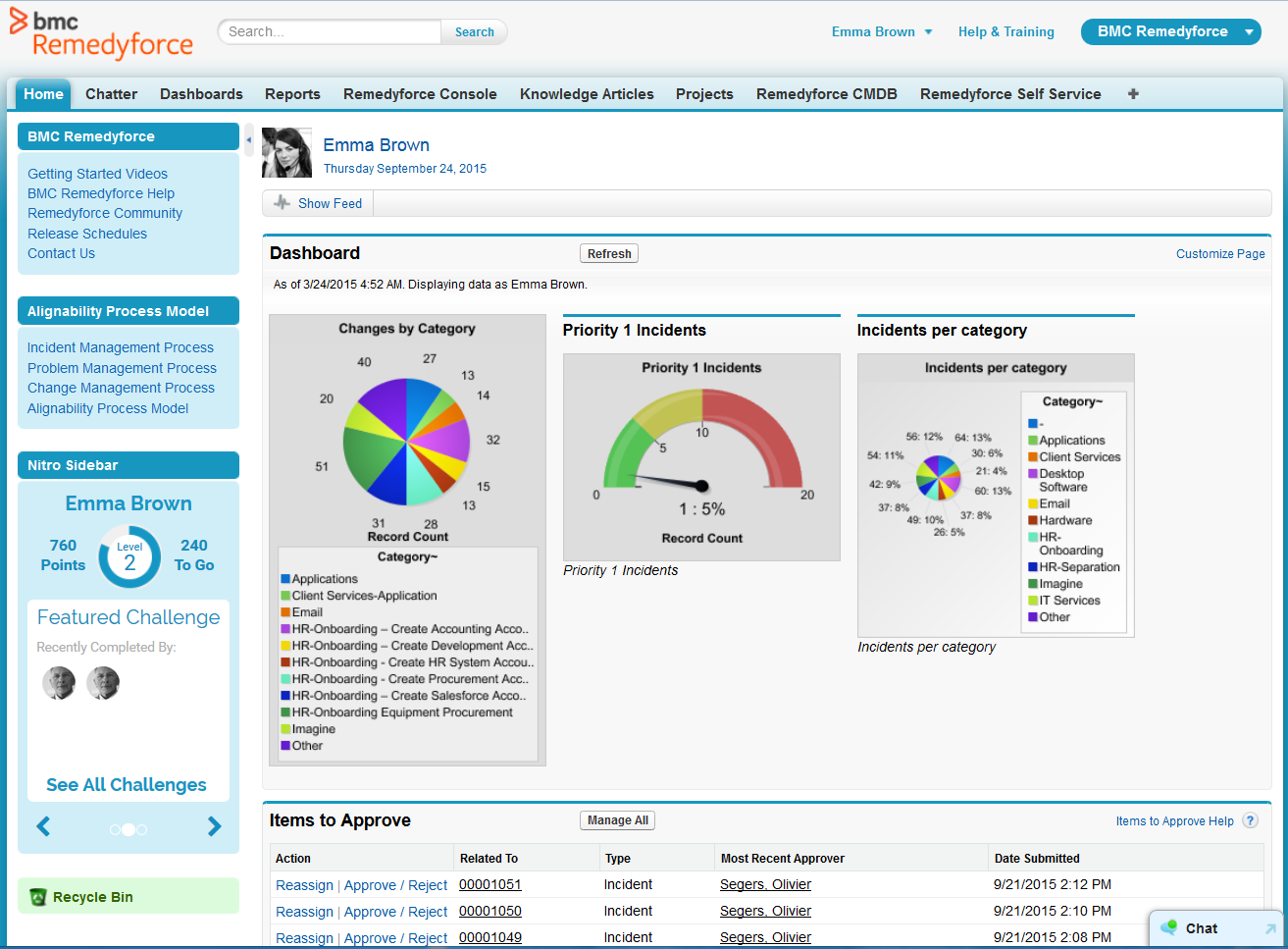
The reports and dashboards allow for a birds-eye view of our daily operations and provide managers and executives the information they need to make important cost saving decisions.
The tool does not scale well from an ROI perspective. As you add a customer, you must add a new instance, hence a new license.
The tool is probably on the expensive side (34,000 USD per 130 technicians per year).
There is no usage beyond incident, change, and problem management. The CMDB feature is extremely limited and cannot generate additional ROI. There is no knowledge-base or integration with other software (other than ME Desktop Central).
A de minimis incentive was given to thank the reviewer for their time. The incentive was not used to bias or drive a particular response, nor was the incentive contingent on a positive endorsement. More Info