Bonita is an open-source business process and workflow management platform created by the French National Institute for Research in Computer Science. It is available as a free community edition or as a commercial subscription product.
N/A
Alfresco
Score 9.2 out of 10
N/A
The Alfresco platform, from Hyland, delivers comprehensive cloud-native content services. It is used to intelligently activate processes and content to accelerate the flow of business.
N/A
Pricing
Bonita Platform
Alfresco
Editions & Modules
No answers on this topic
No answers on this topic
Offerings
Pricing Offerings
Bonita Platform
Alfresco
Free Trial
No
Yes
Free/Freemium Version
Yes
Yes
Premium Consulting/Integration Services
Yes
No
Entry-level Setup Fee
No setup fee
No setup fee
Additional Details
—
—
More Pricing Information
Community Pulse
Bonita Platform
Alfresco
Considered Both Products
Bonita Platform
Verified User
General Manager
Chose Bonita Platform
One of the best support for BPMN Ability to extend platforms with reusable components to offer common functionality/connectivity Based on Java, used throughout our company
Bonita has a community version, open-source, so it´s easy to test the benefits of process automation for any enterprise. Bonita Platform is also very near to Java architecture, so the learning curve for developers is not difficult, and they only need to understand how processes …
The Bonita platform is by far the most complete and flexible solution as a BPM suite with the added advantage that the Community edition is usable for production deployment. From a cost perspective, Bonitasoft licenses the subscription edition per server with no limitations as …
Bonita BPM has much more connectors than SAP NetWeaver BPM. It's easier and cheaper to develop processes with Bonita and also the consultants are less expensive on that technology.
Well suited for low code/no code applications centered around approval flows. It has built-in task management for users to see their pending actions, comments, statuses, etc. It has a very nice design for process flows. Less appropriate may be for generic type applications with complex screens and logic within those screens that need a lot of data to process.
Easy integration with the external APIs Workflows can be invoked via REST call Wonderful swagger documentation for process REST APIs REST, MULE, CAMEL, Google Drive, and Box features are available with Alfresco Process Services The micro-service version deployment should be well documented and needs improvement
Bonita seems particularly suited for processes requiring a great deal of human interaction. Its user model allows you to control access to business processes in a fine-grained way. This allows for business processes to move smoothly between users and services as the process advances.
The definition and usage of custom forms from the latest version of Bonita seems particularly powerful. It allows for a thorough customization of the look-and-feel and does not require complex developments.
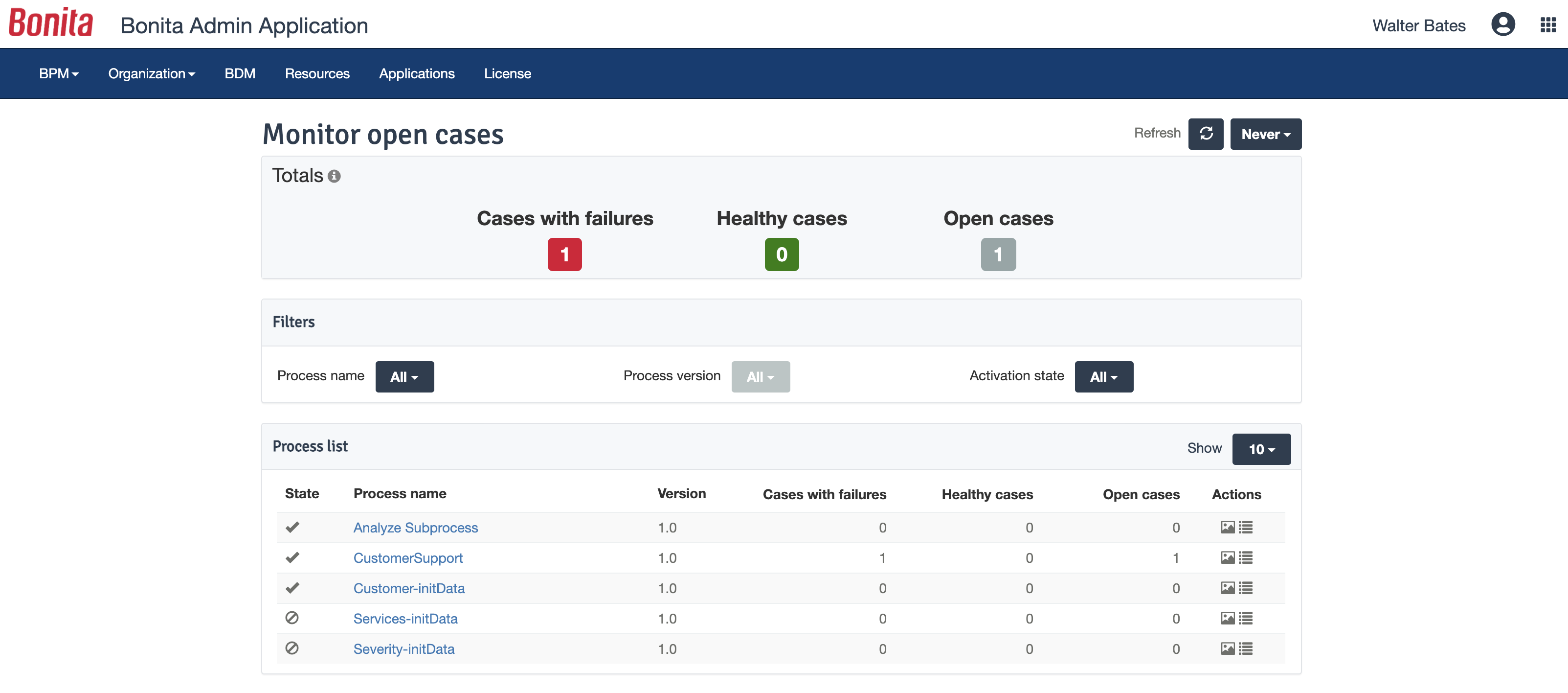
The web interface and administration section have greatly improved in the latest versions. Installation and configuration of processes has become more flexible and more structured. The administration section gives a good view on failed processes, allowing to analyse problems in an efficient way.
There is a learning curve beyond the boot camps that needs to be addressed with more structured curriculum.
The full stack technologies are industry standard, but these [are] challenging to learn and could use a learning path and orientation. There's probably opportunity for third-parties here to help with learning and adoption.
Alfresco Process Services and Alfresco Application Development Framework integration makes for best functionality/application of ECM.
Use case alignment - Marketing content and documentation of specific business requirements and user stories being available as reference material/documentation.
As per the current market and the line of products that are available for content and document management system, Alfresco is a very good option compared to other systems in terms of features and cost. Plus the community support is great. Also since the product is open source, it can be extended or understood in a better way.
Bonita Platform has allowed us to develop GUI relatively fast using its UI Designer while being able to seamlessly integrate our business logic in Java in a BPMN2 process diagram. It gives a nice productivity boost but still requires programming know-how to be able to deliver the final solution to your business problems.
Engine itself is efficient enough for most cases I dealt with. It can also be extended by clustering. I have done performance tests with JMeter and only managed to induce the crash of... JMeter. If there are efficiency issues they usually concern bad design/implementation of created apps or bottlenecks in integrated systems. Although I have met two cases with efficiency loss.
1. Java 7 related PermGen saturation caused by big number of installed apps (there is no jar dependency reusal between apps option).
2. Big number of waiting event handlers in processes stresses the database.
I am not big fan of Alfresco Content Services' support; it works on its own speed and sometimes it becomes challenging to achieve business needs. However, I appreciate regular delivery of security patches and updates
Process was relatively smooth and overall, downtime minimal. MSI was very responsive to our needs and made the transition easier than it otherwise might have been.
All software has some pros and some cons. Alfresco has some good pluses, and suits our environment very well. It fit perfectly in the place that we are working on. That is why we decided to go with this software. Overall, the kind of content management that needs to be done in an organization is what would determine which software to use.
Respect of BPMN standard over the long term. Good enhancements by Bonitasoft for new use cases, for example the introduction of a real form editor even if it has been technically difficult to manage. Once done though, we have far greater possibility of human interaction.