Coremetrics / IBM Digital Analytics (discontinued)
Score 8.9 out of 10
N/A
Based on the former Coremetrics, IBM Digital Analytics is a discontinued analytics product. IBM acquired Coremetrics in 2010, and re-branded the platform to the IBM Digital Marketing Optimization Solution. Product support was ultimately provided by Acoustic, but the product is not a part of the company's plans going forward.
N/A
Splunk Observability Cloud
Score 8.4 out of 10
N/A
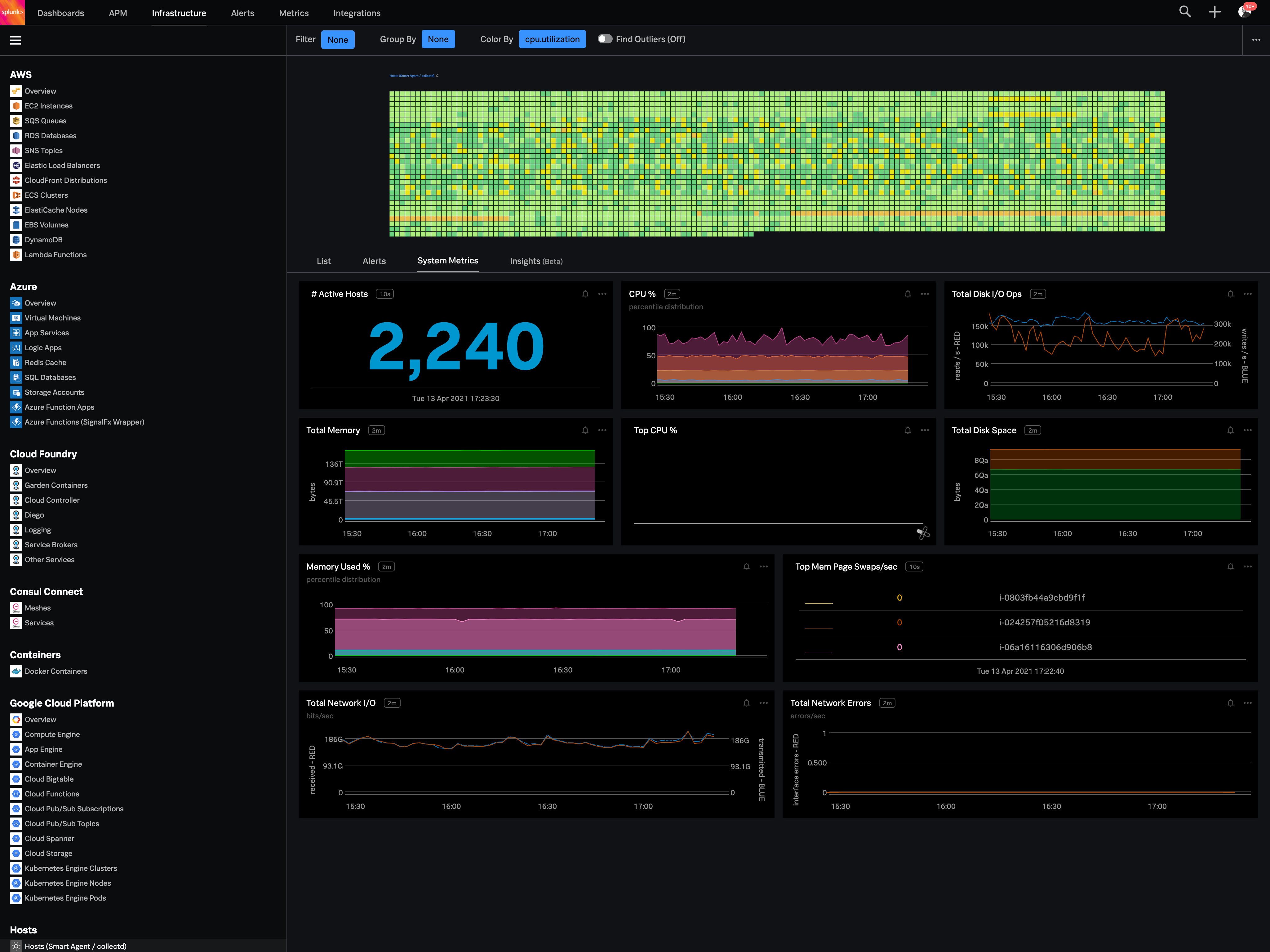
Splunk Observability Cloud aims to enable operational agility and better customer experience through real-time AI-driven streaming analytics allowing accurate alerts in seconds. It is designed to shorten MTTD and MTTR by providing real-time visibility into cloud infrastructure and services.
$180
per year per host
Pricing
Coremetrics / IBM Digital Analytics (discontinued)
Splunk Observability Cloud
Editions & Modules
No answers on this topic
Infrastructure
$15
per month (billed annually) per host
App & Infra
$60
per month (billed annually) per host
End-to-End
$75
per month (billed annually) per host
Offerings
Pricing Offerings
Coremetrics / IBM Digital Analytics (discontinued)
Coremetrics / IBM Digital Analytics (discontinued)
Splunk Observability Cloud
Likelihood to Recommend
Discontinued Products
IBM analytics has continued to improve upon the days of being the original core metrics. After using the updated version for quite some time, it has been great at providing the needed analytics to measure ROI and goal performance for our quarterly KPI's. It has resulted in a great increase in web engagements although we are a midsize company, smaller outfits may not need such an expensive option.
Its great if you need real-time visibility across complex or regulated environments. Also strong for hybrid or multi-cloud setups where uptime, observability and fast IR are required. It’s probably overkill for smaller teams or environments that don’t have constant changes or compliance reporting needs. It's expensive and has a steep learning curve. Also, in my opinion, do not get yourself into a consumption based model. Costs can certainly get out of control quickly.
IBM CXA comprises an acquisition called Tealeaf. This tool has deep heritage and this is evident in its present-day capabilities.
The Universal Behaviour Exchange or UBX puts the concept of personalisation at the forefront. The ability to combine physical (analog) and digital transactions to create the complete picture of a customer journey, is a stand out benefit.
The solution does not have to involve the purchase of software. IBM CXA can be sold as a service bundled with analytics as a service. This not only lowers the cost of ownership, it gets around one of the principal issues. Strong staff with design and analytical capability to drive the solution and deliver tangible benefits.
The seamless integration of Watson AI services to help with the heavy lifiting. Watson reinforces the analytical focus this solution has and can learn to recognise situations specific to a company.
The first one is its Kubernetes container monitoring.
I really like this features because as we know how much K8s is vast and to manually monitor each part of the Kubernetes it takes so much time but Splunk Observability Cloud makes it easier. And even once we integrate K8s with Splunk Observability Cloud it gives us some prebuilt dashboards which gives holistic view of our Cluster and its nodes, pods, etc.
The dashbaord feature of Splunk Observability Cloud, it gives us full flexibility to customize our dashboard with a wide range of predefined chart types.
Now it also supports OTEL, which is a plus point for observability. As now everyone is moving towards Otel and in current market there are only few tools who supports OTEL based integrations, Splunk Observability Cloud is one out of them.
The user interface is in Flash, which can be very frustrating and slow at times. Apparently, this is to be transitioned in a future release.
Can only segment the last 93 days of data. Any historical segmentation beyond the 93 days must be run in Explore (which is credit based, and has its own limitations with the number of credits per month, based on the initial contract with IBM).
Reports can only display 93 days of data at a given time for custom date ranges. There are pre-programmed date ranges setup with IBM during implementation (last week, last month, last quarter etc.), but are not flexible enough to answer more specific questions.
Certain reports cannot have segments applied, making answering some simple questions a bit more tricky. For example, I can create a segment around mobile devices and apply it to the marketing channels report, but I can't create a marketing channel segment and apply it to the mobile reports.
Built in API calls allows for nice report design and automation.
You can use table-like functionality to generate dashboards, but these queries are heavy on the system.
It could be easier to give insight into what type of line parsing is used for specific documents in a company-managed environment and/or show ways to gain the insights needed.
I would like to see ways to anonymize specific data for shared reports without pre-formatting this in a dashboard on which reports could be based.
IBM Digital Analytics is a great solution for our clients and I believe they offer the best solution for the retail space. We have access to IBM support via email or live chat and they can answer many of the reporting questions that come up. IBM is receptive to our feedback of the product so I am confident they will continue making improvements
Good: Stable system with low error rate Easy to use for simple use cases Bad: UI is not very clear for complex usage Mobile view (when logged in from phone) is bad No library for .net
When there is an issue, it’s a win if one can easily identify the root cause. To do the same, it should allow the user to dig deep with multiple data points and compare the data and identify the anomaly. In this use case, it’s good to drive from Splunk 011y.
As reports are templated, the system is pretty quick. Sometimes you have to wait a bit for a report to render. Or you might have to re-load the page. But there is no real issue here and the system is on par with other similar systems.
Overall, the level of support is very good and I would say it is a strong asset of the solution. However, you can sometimes feel that there is a difference of level among the support team.
Online training is really great. One of the best assets that they have. Lots of great videos, pop quizzes at the end of each module. Fantastic. Other tools have similar features, but not as good.
Much of the work we did in IBM Digital Analytics could have been answered through Google Analytics, a much simpler, agile and FREE solution set. Not mention, given the vast number of Google Analytics USERS, free and actionable support is simply a click away ... this compared to IBM Digital Analytics fractured and often absent support service.
Splunk Infrastructure Monitoring provides far superior options for anybody using a complex hybrid multi-cloud environment and allows both your SOC and NOC to work together on the same data while driving their own insights. We found other products are still in the old world view of servers and agents residing together within a single data centre, but modern apps are no longer like this.
This solution can support large amount of data and transaction. The way that user management features are built, it shows it is meant for large organizations.
We spend too much time trying to work around bugs on the new UI.
We spend too much time trying to figure out how to make certain segments work because support and the knowledge center are lackluster.
Our sales rep is very unresponsive and leaves us searching for a lot of answers on our own, including what other products we may benefit from that IBM offers.