Crownpeak CMS is a composable, enterprise-ready content management system that empowers global teams to seamlessly orchestrate personalized digital experiences across all content channels. Marketing teams can create, manage, and monitor inclusive, accessible, and transactional experiences fast without compromising on functionality, security, or service.
N/A
Drupal
Score 7.0 out of 10
N/A
Drupal is a free, open-source content management system written in PHP that competes primarily with Joomla and Plone. The standard release of Drupal, known as Drupal core, contains basic features such as account and menu management, RSS feeds, page layout customization, and system administration.
N/A
Paligo
Score 9.1 out of 10
N/A
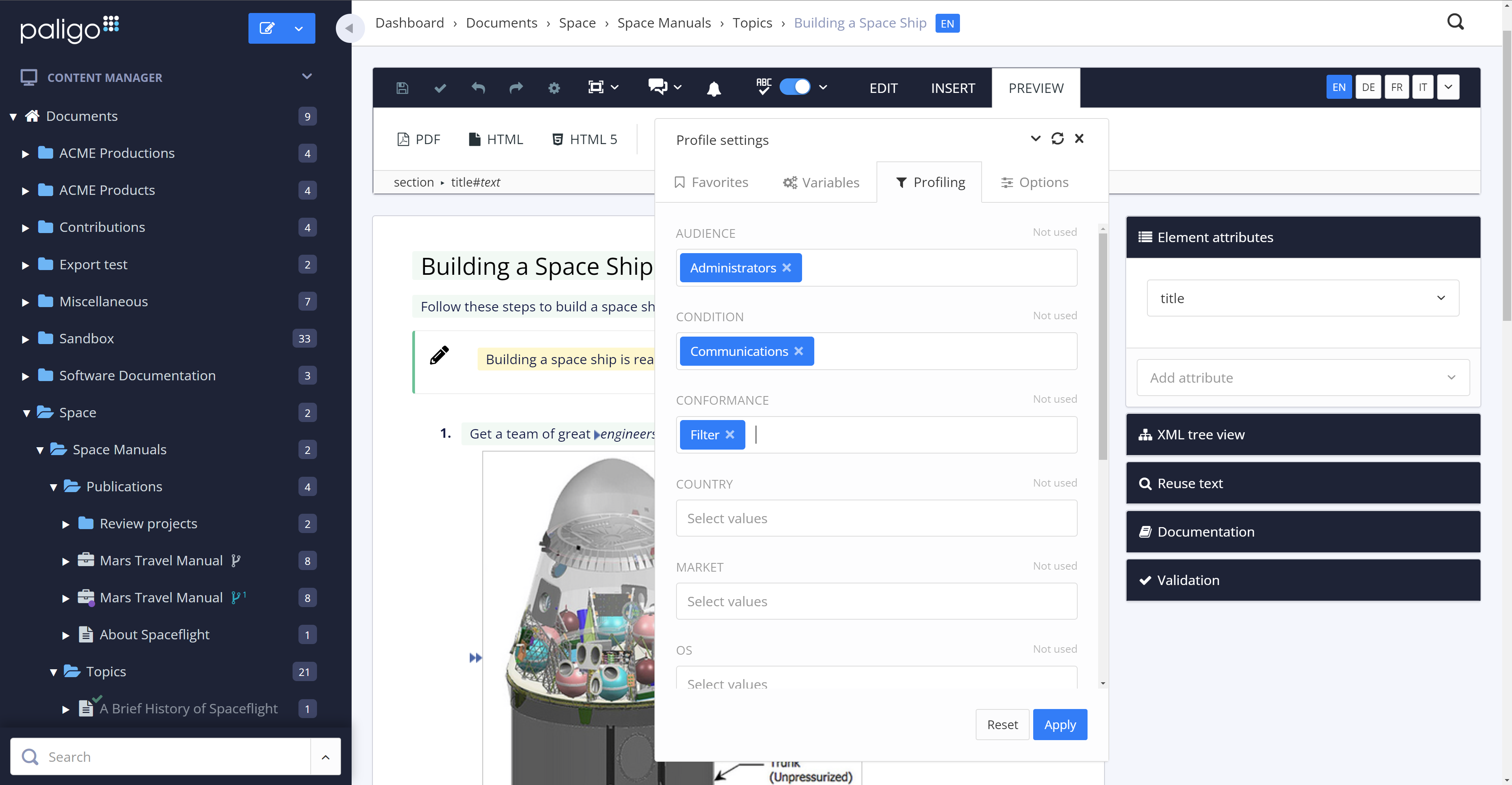
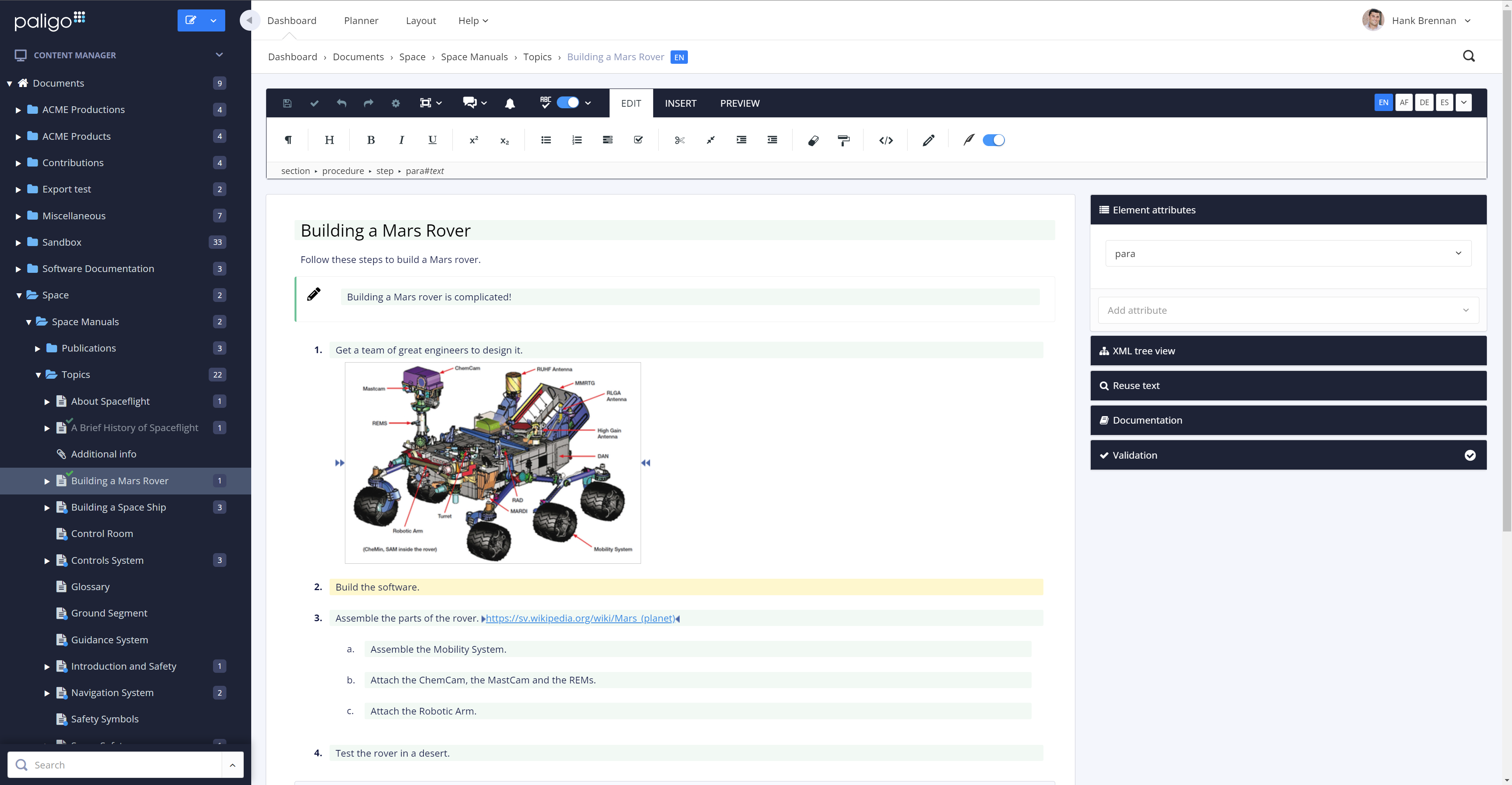
Paligo is a component content management system (CCMS) that helps teams manage complex technical documentation through structured authoring, content reuse, and controlled publishing.
$4,800
per year per seat
Pricing
Crownpeak CMS
Drupal
Paligo
Editions & Modules
No answers on this topic
No answers on this topic
Professional
from $4800
per year
Business
Contact Sales
per year
Enterprise
Contact Sales
per year
Offerings
Pricing Offerings
Crownpeak CMS
Drupal
Paligo
Free Trial
No
No
No
Free/Freemium Version
No
No
No
Premium Consulting/Integration Services
Yes
No
Yes
Entry-level Setup Fee
No setup fee
No setup fee
Optional
Additional Details
—
—
—
More Pricing Information
Community Pulse
Crownpeak CMS
Drupal
Paligo
Considered Multiple Products
Crownpeak CMS
Verified User
Director
Chose Crownpeak CMS
Crownpeak is the only true SAAS CMS on the market. All the others are either not/partially SAAS or providing it through other 3rd party vendors.
CrownPeak’s DQM gives the entire CrownPeak suite a slight advantage because it’s so helpful in tracking functionality issues, typos and areas for SEO improvements.
The other competitive products I used had not had these features in such a robust way the last time I used them …
Crownpeak DXM is a great solution if you are looking for a flexible platform that allows engineers to quickly develop while also making it easy for content authors to work especially in scenarios where you need multi-language support. It is also good for scenarios where you want a cloud-based solution and are looking for just one vendor to handle hosting and offer the CMS.
If you want to set up a basic Not For Profit (NFP) Membership system and content base, Word Press is easier than Drupal. However, if you have specific needs that require a fair bit of customisation then Drupal is the best CRM available. If the webmaster is confident with PHP and SQL, Drupal allows a lot of creativity.
Paligo is particularly well suited for developing similar document sets for multiple products or product lines. It is not a page layout application, so don't expect the same capabilities as popular applications for graphics-heavy documentation. With some up-front time developing good layouts, however, Paligo does manage to create very usable PDF output for customer-facing documents.
Build & manage digital experiences without dependency on your IT team
Built-in Digital Quality tool (DQM) tool allows you to check the quality of content and any accessibility issues and immediately flag any issues before publishing.
Build websites with the component-based technology and spend less effort in creating the best user experience for the end-user
The review mode is super convenient. Comparing a snapshot of the previous versions with the current one clearly outlines the respective changes and reduces the necessary content to review tremendously.
The option to reuse text fragments is another handy feature. Text fragments will be updated whenever the original text fragment is altered is also extremely helpful.
Managing a content's structure was never easier. An intuitive drag & drop functionality allows you to design your document's structure however you like.
You can also fork content, in addition to reuse text fragments. This is another helpful option that no longer requires you to create repetetive chapters over and over.
Crownpeak moved to a web browser admin tool in 2018, which has made the admin experience much better, but there are still a couple of features missing from the browser version that won't arrive until later in 2019.
Integration with 3rd party digital asset management tools would be great.
Smoother integration with source control would be nice.
This is not an easy CMS to work with if you don't have a good understanding of website development. It isn't "plug-and-play" like Wordpress or Shopify.
Over time, doing major updates to the system can be taxing, especially if you aren't well-versed enough in doing system updates in line with your "child" theme and code.
The CMS can become somewhat cumbersome with server resources if not carefully optimized while you build and customize it to your liking.
The amount of CSS/JS required to customize a site's appearance can be cumbersome
Product documentation can be lacking, specifically with integrations; in some cases, support offered no real help when trying to solve a problem with an integrated service
Some features require extensive development experience to use, which can sometimes be an obstacle to less-experienced team members
The time and money invested into this platform were too great to discontinue it at this point. I'm sure it will be in use for a while. We have also spent time training many employees how to use it. All of these things add up to quite an investment in the product. Lastly, it basically fulfills what we need our intranet site to do.
Crownpeak DXM is a flexible easy to use CMS platform speaking to the most challenging localization scenarios. Crownpeak users have the freedom to integrate DXM platform with their existing technology at no cost. Moving from legacy systems to the Saas platform is painless and cost-effective. Extensive targeting and personalization options are something that users will benefit from.
As a team, we found Drupal to be highly customizable and flexible, allowing our development team to go to great lengths to develop desired functionalities. It can be used as a solution for all types of web projects. It comes with a robust admin interface that provides greater flexibility once the user gets acquainted with the system.
Generally, I'm very happy with Paligo and the productivity gains that I get from using it. There are a few arbitrary limitations on structure, and when applying conditional formatting, that I don't really understand. Unlinking / editing reused text uses this broadly inscrutible colour-coding that I just hate. It would be nice to double-click a component, make edits, then respond to a popup asking if I want to confirm the edit for all linked content, or unlink this instance. Likewise converting from an informal topic insertion to duplicates of its raw contents.
Drupal itself does not tend to have bugs that cause sporadic outages. When deployed on a well-configured LAMP stack, deployment and maintenance problems are minimal, and in general no exotic tuning or configuration is required. For highest uptime, putting a caching proxy like Varnish in front of Drupal (or a CDN that supports dynamic applications).
Pages load very fast on production (assuming you develop with basic SEO practices in place) due to Crownpeak's publishing architecture. The slide downside is that publishing can be a bit slow at times.
Drupal page loads can be slow, as a great many database calls may be required to generate a page. It is highly recommended to use caching systems, both built-in and external to lessen such database loads and improve performance. I haven't had any problems with behind-the-scenes integrations with external systems.
Crownpeak DXM's service and support are outstanding. We have immediate access to both the tech support team and the software engineering team. We can get a support person on the phone whenever needed, and we can schedule impromptu training sessions at any time. Best support I have ever received from a platform provider in 20 years of software and application development.
As noted earlier, the support of the community can be rather variable, with some modules attracting more attraction and action in their issue queues, but overall, the development community for Drupal is second to none. It probably the single greatest aspect of being involved in this open-source project.
All the support requests I've submitted have been resolved in one way or another. Sometimes it takes some back and forth, which is to be expected. This is where being on a different continent becomes a drawback. Since we became Enterprise users, we've also had an additional level of help and support from a dedicated account manager in the US, and the resolutions seem to come more quickly
We received on-site training from Crownpeak, the trainer had touched upon every possible scenario and provided great insights about the product & ease of implementation.
I was part of the team that conducted the training. Our training was fine, but we could have been better informed on Drupal before we started providing it. If we did not have answers to tough questions, we had more technical staff we could consult with. We did provide hands-on practice time for the learners, which I would always recommend. That is where the best learning occurred.
My team left training with a solid understanding of how to use the product and the developer training ended with a test to ensure the ability to properly develop was learned properly. Recently, Crownpeak has added a self-paced training option which makes it extremely flexible to on-board new developers.
The on-line training was not as ideal as the face-to-face training. It was done remotely and only allowed for the trainers to present information to the learners and demonstrate the platform online. There was not a good way to allow for the learners to practice, ask questions and have them answered all in the same session.
SaaS model is perfect for us to avoid slow and costly version updates to get access to new features and functions. Crownpeak is a true SaaS model, so we get all the good new stuff without the need to invest in effort, time or money. this frees our teams to focus on content creation and deployment, which is pretty fast because the DXM publishes straight to html through the headless model.
Plan ahead as much you can. You really need to know how to build what you want with the modules available to you, or that you might need to code yourself, in order to make the best use of Drupal. I recommend you analyze the most technically difficult workflows and other aspects of your implementation, and try building some test versions of those first. Get feedback from stakeholders early and often, because you can easily find yourself in a situation where your implementation does 90% of what you want, but, due to something you didn't plan for, foresee, or know about, there's no feasible way to get past the last 10%
I was not at this team within my organization during the evaluation period of Crownpeak. However, my previous team used Sitecore. Crownpeak is a bit easier to use from a UI perspective and has more creative options within the tool. Sitecore's clunky UI also was a reason I found out later why we ended up using Crownpeak as our DXM.
Drupal can be more complex to learn, but it offers a much wider range of applications. Drupal’s front and backend can be customized from design to functionality to allow for a wide range of uses. If someone wants to create something more complex than a simple site or blog, Drupal can be an amazing asset to have at hand.
We moved from Flare to Paligo. One of the main reasons was the fact that Paligo is a cloud product. Collaboration with anyone outside of our team was more difficult with Flare. Also, maintaining a server for Flare content was going to become an issue, and overall I felt the Flare desktop product was prone to errors and issues. The flexibility of assigning Paligo licenses was a huge factor, as was the stability of the cloud platform.
In some recent projects we have delivered to our clients, we were able to roll out sites in shorter time period due the scalability of the Crownpeak's DXM solution.
Drupal is well known to be scalable, although it requires solid knowledge of MySQL best practices, caching mechanisms, and other server-level best practices. I have never personally dealt with an especially large site, so I can speak well to the issues associated with Drupal scaling.
I'm pretty sure it raises our back-end development costs by making the development process (of creating input forms and producing outputs from the content) more complicated and painful than it needs to be.
It helps lock our clients in to us because not a whole lot of agencies have Crownpeak expertise.
It helps our clients not have to deal with their own IT teams, which they tend to dislike working with.
I am not involved in the financial decisions for my company regarding Paligo; the decision to migrate our content to this environment predates my hiring. However, I know that the migration effort from WordPress to Paligo was an initially heavy lift, but any content migration effort would be. I believe that ultimately, getting our content out of WordPress was a positive move, and I look forward to seeing what Paligo will help us accomplish in the future. Sorry, no hard numbers from me. :)