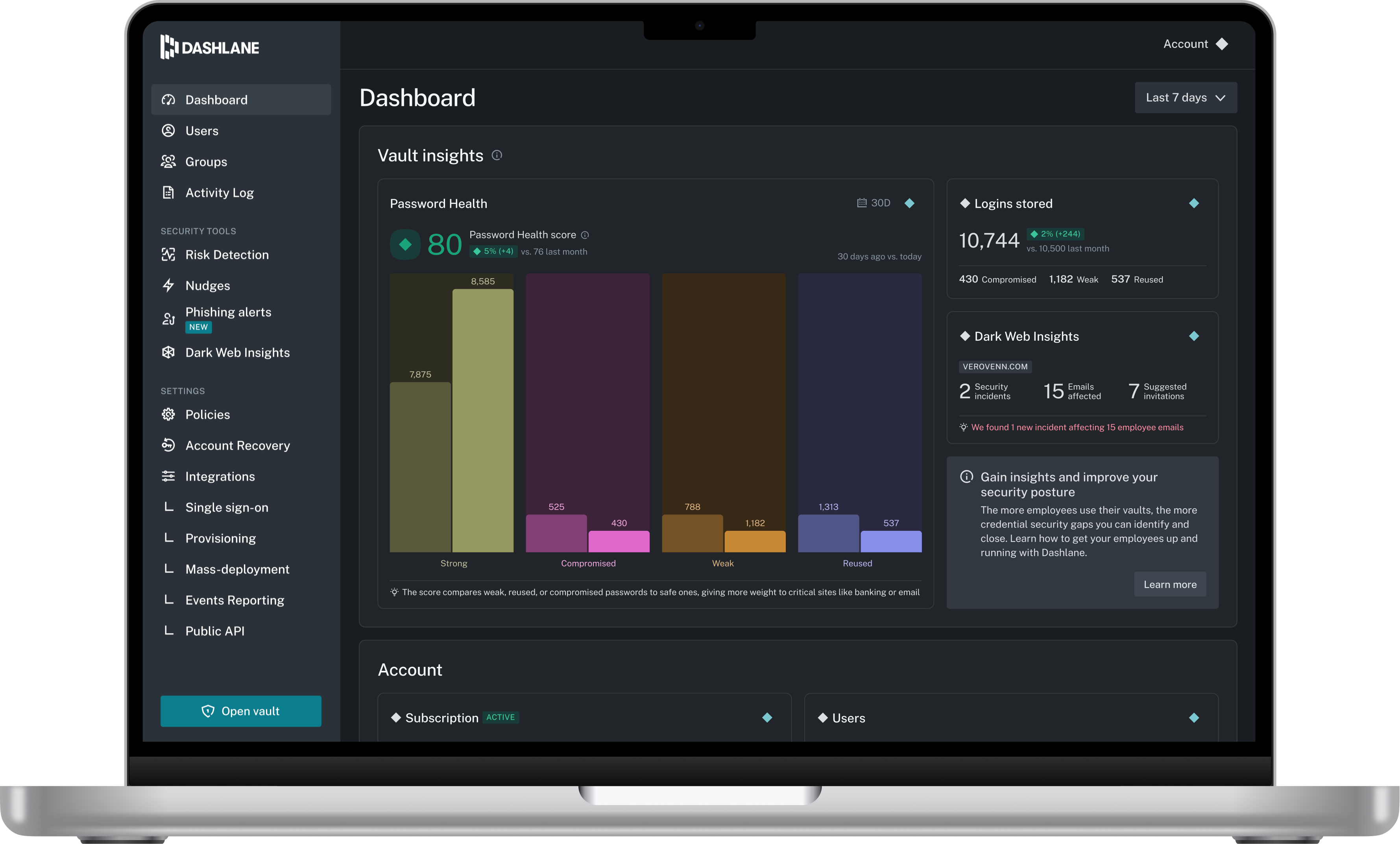
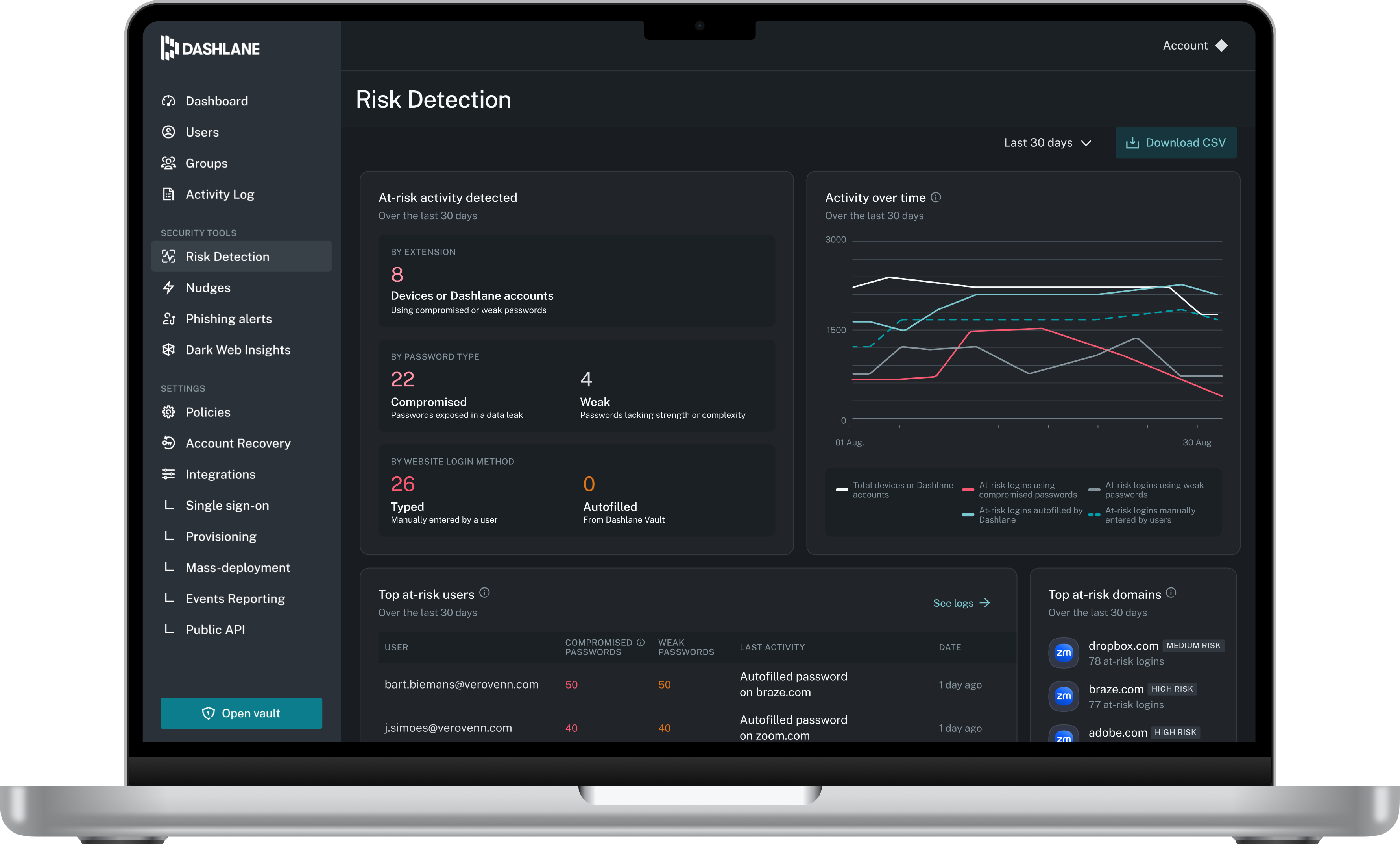
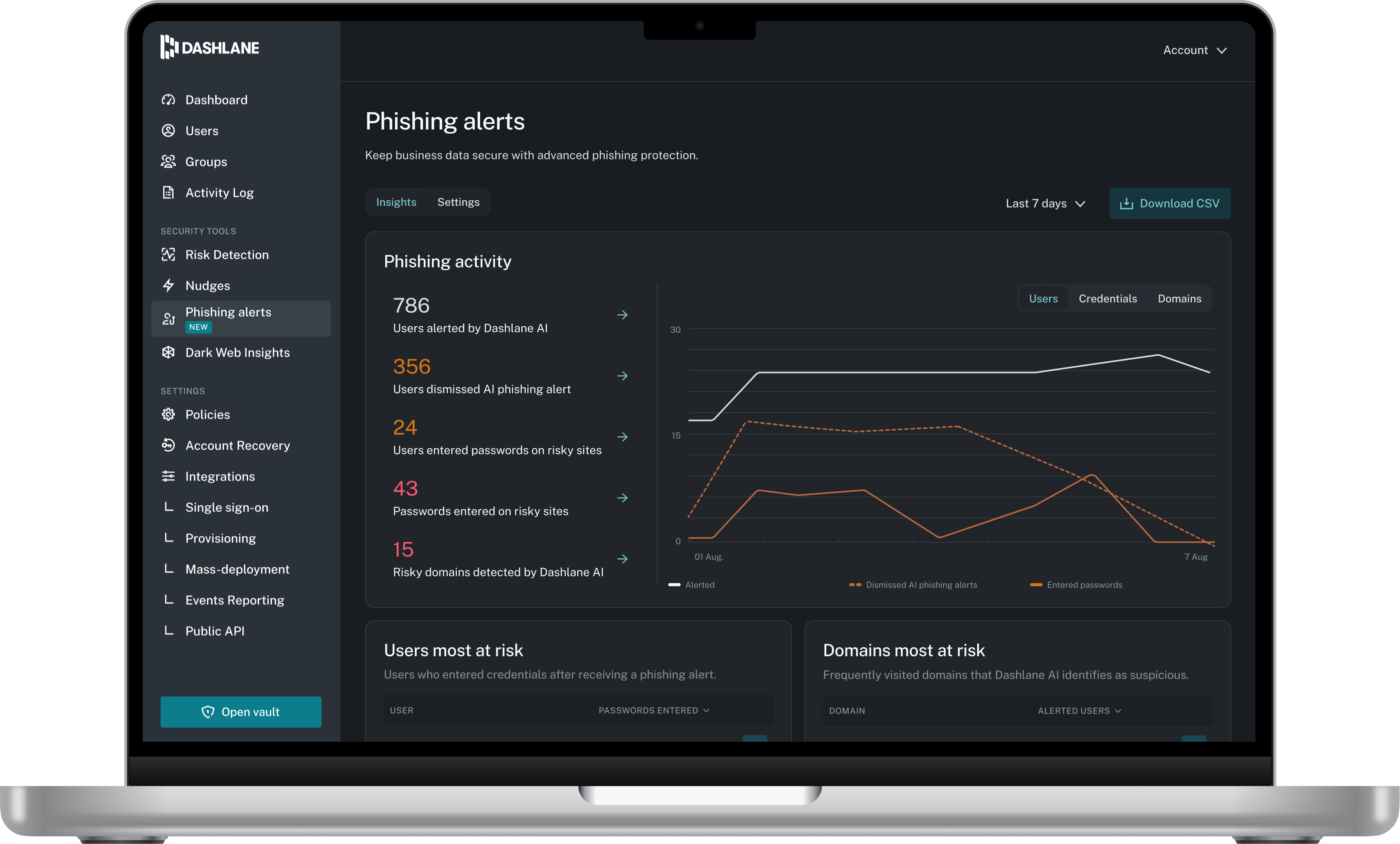
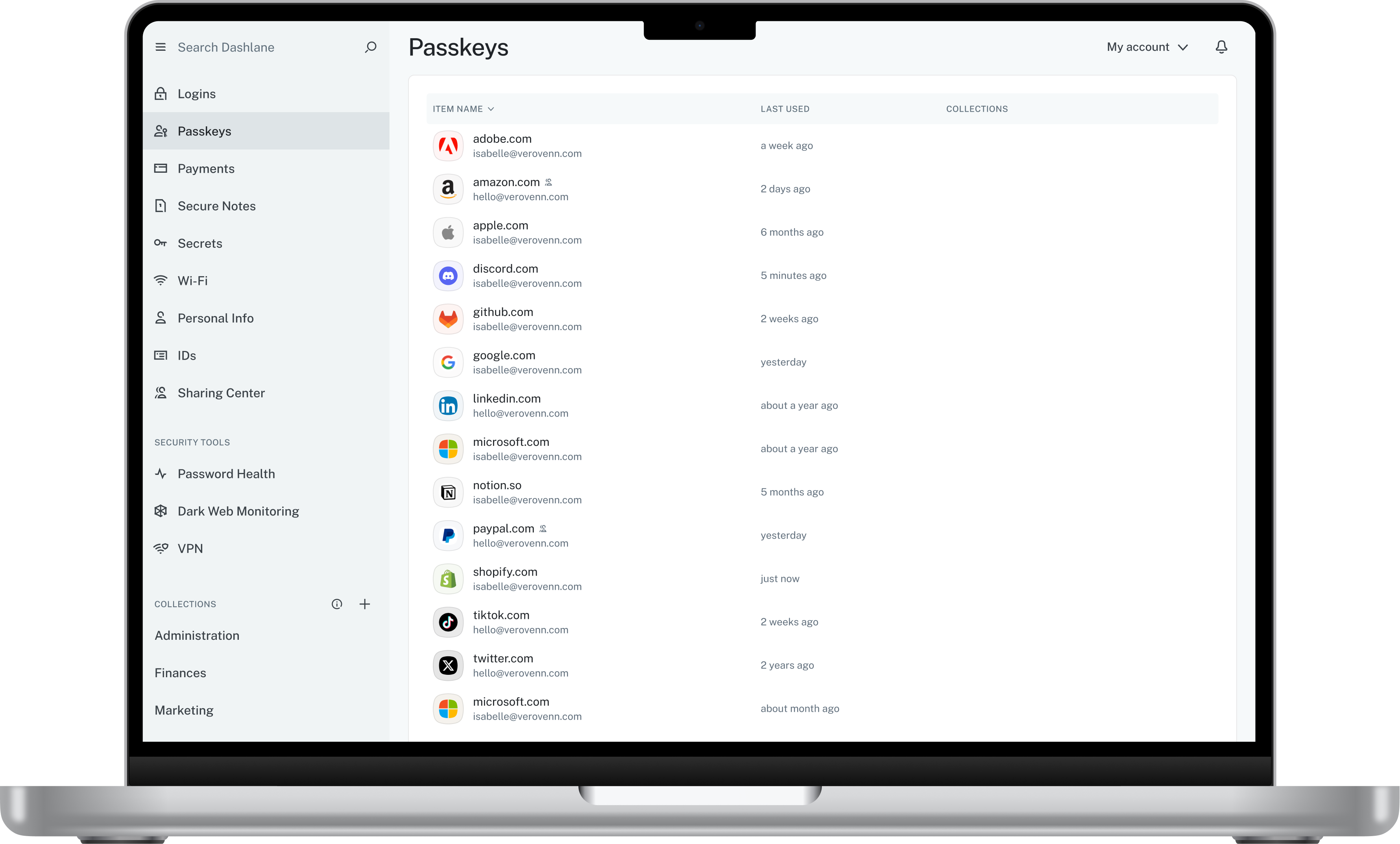
Dashlane is a credential manager that secures every credential, every user, and every employee device to proactively protect against breaches. Brands worldwide can use Dashlane to stay ahead of evolving threats.
$240
per year 10 employees
OneLogin by One Identity
Score9.4 out of 10
N/A
OneLogin is an identity and access management (IAM) product from One Identity since the October 2021 acquisition, featuring single sign-on (SSO), multi-factor authentication, provisioning, cloud directory, and more.
$4
per month per user
Pricing
Dashlane Password Manager
OneLogin by One Identity
Editions & Modules
Business
$8
per month (billed annually) per seat
Omnix™
Contact Sales
per year for organizations of 100+
Advanced (bundle)
$4
per month per user
Professional (bundle)
$8
per month per user
Offerings
Pricing Offerings
Dashlane Password Manager
OneLogin by One Identity
Free Trial
Yes
Yes
Free/Freemium Version
Yes
No
Premium Consulting/Integration Services
No
No
Entry-level Setup Fee
No setup fee
No setup fee
Additional Details
—
Aside from the bundle options, OneLogin offers its services a la carte, and therefore these prices can vary depending on your business's needs.
I think Dashlane is a great service for anyone who uses the internet. We need to create accounts on almost every website, and Dashlane helps generate secure passwords and store them safely, but easily accessible through its seamless browser extension. Any business or personal lifestyle can benefit from Dashlane when you go online
A de minimis incentive was given to thank the reviewer for their time. The incentive was not used to bias or drive a particular response, nor was the incentive contingent on a positive endorsement. More Info
OneLogin is very convenient. Users can register their own iPhone or Android to act as their authorization device, meaning they will likely always have access to the OneLogin security code. The OneLogin application then allows the users to hit a button instead of inputting the security code to validate their two-factor authorization. OneLogin is great for businesses who need to enforce secure access into their various systems and tools. By consolidating the security into a single login with security device two-factor authorization, it makes it safe and easy to manage.
A de minimis incentive was given to thank the reviewer for their time. The incentive was not used to bias or drive a particular response, nor was the incentive contingent on a positive endorsement. More Info
A de minimis incentive was given to thank the reviewer for their time. The incentive was not used to bias or drive a particular response, nor was the incentive contingent on a positive endorsement. More Info
Connects with a lot of different vendors, tools, and sites. It is also customizable to where you can add almost any site you are logging into. This makes it especially useful for team members who may use a tool that other team members within the company do not use.
It works. I've used a few keychain apps that work for a little while, or never work, and this app works 99.99% of the time. Only on one experience have I experienced issue access sites and that was due to user error.
It's easy to update passwords and usernames within the app. It allows password resets to be an easy process and lowers the time in updating items everywhere.
A de minimis incentive was given to thank the reviewer for their time. The incentive was not used to bias or drive a particular response, nor was the incentive contingent on a positive endorsement. More Info
The mobile app works fine for quick access, but autofill across different apps can be inconsistent. Sometimes it doesn’t recognize the login field, which slows people down when they’re on the go.
Occasionally the browser extension logs users out or doesn’t sync immediately with the desktop app, which causes frustration if someone just updated a password.
A de minimis incentive was given to thank the reviewer for their time. The incentive was not used to bias or drive a particular response, nor was the incentive contingent on a positive endorsement. More Info
Lack of administrative APIs for creating or setting up new connectors: This prevents the automated integration to federations and requires manual setup rather than discovery-based automated setup.
Customization of the interface: The potential configuration of the interface are still limited at the moment (logo, primary and secondary colors, background). This prevents the usage of the platform as a communication medium or to organize the space in a more standard fashion (for our institution)
There are some limitations with using the apps provisioning APIs that can lead to some termination or provisioning actions not being completed
A de minimis incentive was given to thank the reviewer for their time. The incentive was not used to bias or drive a particular response, nor was the incentive contingent on a positive endorsement. More Info
A de minimis incentive was given to thank the reviewer for their time. The incentive was not used to bias or drive a particular response, nor was the incentive contingent on a positive endorsement. More Info
Dashlane is usable, but there are 2 key issues that annoy me. 1. The mobile app and the browser extension are not synced and i cannot find passwords in the app that are clearly in the extension. 2. The system doe snot make it easy to assign a password to a specific subdomain. I get hundreds of passwords that i have to go through any time i go to any subdomain on my main site because of the nature of my business. I need the option back to assign a password to only work with a specific subdomain (and all related paged on that subdomain) note: The search features have been annoying in the past. I just went to test them to verify my issues and found that notes inside of a password are finally searchable. This helps
A de minimis incentive was given to thank the reviewer for their time. The incentive was not used to bias or drive a particular response, nor was the incentive contingent on a positive endorsement. More Info
OneLogin is very easy to use. The most complicated part is the user setup and even that is not difficult. After everything is working, using it day to day is trivial. All you have to do is have the application ready on your phone and you can use a single set of login credentials to access all of your tools securely.
A de minimis incentive was given to thank the reviewer for their time. The incentive was not used to bias or drive a particular response, nor was the incentive contingent on a positive endorsement. More Info
We've had no issues with Dashlane. I can't speak to their customer service because I have not personally needed to contact them. I guess that speaks about their product if we've not had any issues to reach out about. Great for supporting data/information on multiple platforms that are shared among team members.
A de minimis incentive was given to thank the reviewer for their time. The incentive was not used to bias or drive a particular response, nor was the incentive contingent on a positive endorsement. More Info
There has never been an issue where I have needed to use the OneLogin support so it would be unfair to rate them anything other than a 10 on their ability to provide support. Like I said its a very basic platform that we use it for with no issues.
A de minimis incentive was given to thank the reviewer for their time. The incentive was not used to bias or drive a particular response, nor was the incentive contingent on a positive endorsement. More Info
Dashlane’s customer support is often rated higher, providing more responsive and helpful assistance. LastPass has a slightly steeper learning curve than Dashlane, but it offers more flexibility with user permissions, which can benefit teams. Dashlane includes unlimited passkey support and a clean breach history, while LastPass is more accommodating for smaller teams.
A de minimis incentive was given to thank the reviewer for their time. The incentive was not used to bias or drive a particular response, nor was the incentive contingent on a positive endorsement. More Info
OneLogin has a lesser cost as compared to other solutions. It also has a successful POC, partner expertise, integration with in-house and cloud-based apps, and provides restriction of access from unauthorized devices. It is a secure solution with industry-standard encryption, a good dashboard, and a cloud-based solution. In my opinion, there is not too much effort involved in the integration and it provides good OEM support.
A de minimis incentive was given to thank the reviewer for their time. The incentive was not used to bias or drive a particular response, nor was the incentive contingent on a positive endorsement. More Info
A de minimis incentive was given to thank the reviewer for their time. The incentive was not used to bias or drive a particular response, nor was the incentive contingent on a positive endorsement. More Info
A de minimis incentive was given to thank the reviewer for their time. The incentive was not used to bias or drive a particular response, nor was the incentive contingent on a positive endorsement. More Info