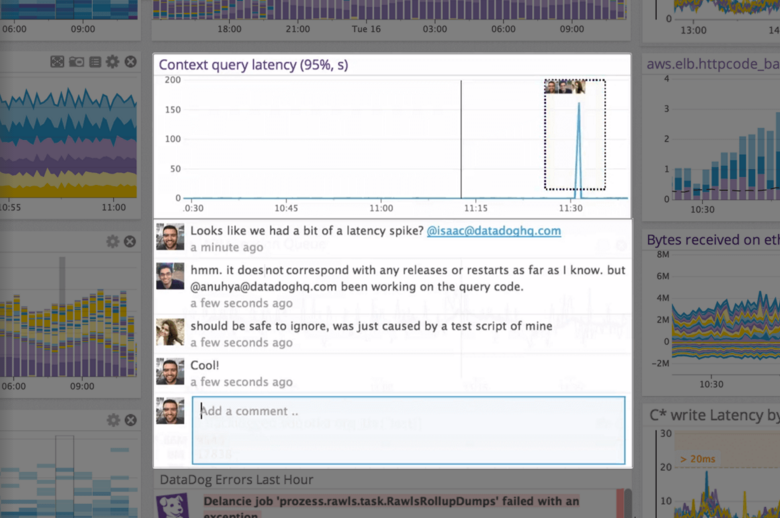
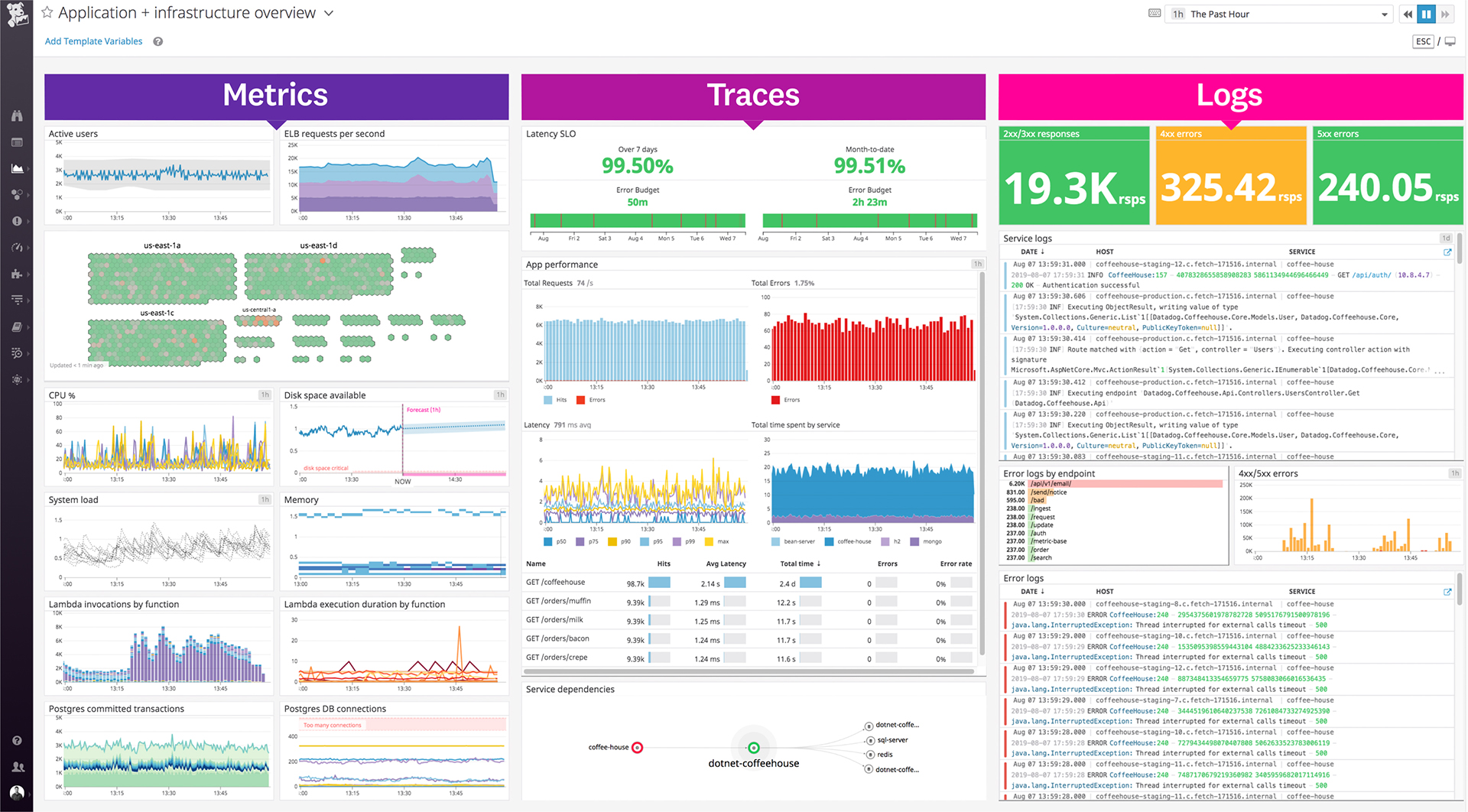
Datadog is a monitoring service for IT, Dev and Ops teams who write and run applications at scale, and want to turn the massive amounts of data produced by their apps, tools and services into actionable insight.
$18
per month per host
LevelBlue USM Anywhere
Score 7.6 out of 10
N/A
The LevelBlue USM Anywhere XDR platform (replacing the former AlienVault USM) delivers threat detection, incident response, and compliance management.
$1,075
per month
Sumo Logic
Score 8.8 out of 10
N/A
Sumo Logic is a log management offering from the San Francisco based company of the same name.
$3
Per GB Logs
Pricing
Datadog
LevelBlue USM Anywhere
Sumo Logic
Editions & Modules
Log Management
$1.27
per month (billed annually) per host
Infrastructure
$15.00
per month (billed annually) per host
Standard
$18
per month per host
Enterprise
$27
per month per host
DevSecOps Pro
$27
per month per host
APM
$31.00
per month (billed annually) per host
DevSecOps Enterprise
$41
per month per host
Essentials
$1,075
per month
Standard
$1,695
per month
Premium
$2,595
per month
Essentials
$3.00
Per GB Logs
Enterprise
$4.00
Per GB Logs
Enterprise Security
$4.25
Per GB Logs
Enterprise Suite
$4.75
Per GB Logs
Offerings
Pricing Offerings
Datadog
LevelBlue USM Anywhere
Sumo Logic
Free Trial
Yes
Yes
No
Free/Freemium Version
Yes
Yes
No
Premium Consulting/Integration Services
No
Yes
No
Entry-level Setup Fee
Optional
Optional
No setup fee
Additional Details
Discount available for annual pricing. Multi-Year/Volume discounts available (500+ hosts/mo).
Datadog visually is up there with the rest of these products. For some projects I use datadog and others I use different open source tools. For our production environment we use datadog and with Puppet the installation on each of our servers makes it quick and easy to install. …
All of the other products have their strengths and weaknesses. In trying to keep the platform focused on security while keeping the spend contained, we chose AlienVault. Both LogRhythm and Splunk had great solutions, but AlienVault just checked off more of our organizational …
Datadog may be better suited for teams that have a more out-of-the-box infrastructure, on the primary platforms Datadog supports. You may also have better results if you have a bigger team dedicated to devops and/or a bigger budget. We found that trying to adapt it to our use case (small team, .NET on AWS Fargate) wasn't feasible. We continually ran into roadblocks that required us to dig through documentation (and at times, having to figure out some documentation was wrong), go back and forth with support, and in my opinion, waste money on excessive and unintended usages due to opaque pricing models and inaccurate usage reports, as well as broken/non-functional rate sampling controls.
At this point I'm saying a 4. While the marketing material make it appear to be easy to use and it was relatively easy to set up, as previously mentioned, each event description is based upon the individual asset making it nearly impossible for the administrator to be a SME for each asset. For example, if one of the assets reporting is a router, the administrator monitoring alerts would need to know what the various events are that can be triggered as an event for the particular router; however, if the asset is a workstation, the administrator would need to know the various events that are triggered for workstations.
SumoLogic is a fantastic log aggregator and analysis tool, a fine alternative to Splunk. Searching is powerful and mostly intuitive and results come fast. If you have application logs in clusters or Kubernetes pods that lose their logs every time they're restarted, Sumo is the solution for you
The thing which Datadog does really well, one of them are its broad range of services integrations and features which makes it one step observability solution for all. We can monitor all types of our application, infrastructure, hosts, databases etc with Datadog.
Its custom dashboard feature which helps us to visualize the data in a better way . It supports different types of charts through those charts we can create our dashboard more attractive.
Its AI powered alerting capability though that we can easily identify the root cause and also it has a low noise alerting capability which means it correlated the similar type of issues.
AlienVault USM is simple and easy to deploy. Sensors can be deployed in as little as 15 minutes through the setup wizard.
The USM UI is easy to understand. I've trained multiple analysts who are able to perform their duties on their first day, in part because of USM Anywhere's ease of use.
Top-notch built-in compliance templates and reporting features.
Sumo Logic allowed for our InfoSec team to ingest logs from our CDN directly, in real-time, instead of massive compressed archives that were sent every two-hours (the only alternative at the time). Sumo Logic had an app for these logs, that allowed us to easily get an immediate payoff from the data, with canned dashboard and saved searches.
Sumo Logic has a fairly extensive REST API when it comes to log sources, source configurations, dashboard data, searches, etc. Their wiki for the API is usually kept up to date.
Sumo Logic, during the period of time I had used their product, had added the ability to configure agents via configuration files. This allowed customers to configure their endpoints, and modify the endpoints, with configuration management tools like Chef / Puppet / Salt. Beforehand, the only option was to always make changes either via the web portal or REST API.
The solutions engineers were extremely helpful, and easily reachable when issues would occur.
Users at our company found it easy to get started, working on new dashboards, scheduled searches, and alerting. The alerting worked well with our third-party paging tool.
Alert windows cause lag in notifications (e.g. if the alert window is X errors in 1 hour, we won't get alerted until the end of the 1 hour range)
I would appreciate more supportive examples for how to filter and view metrics in the explorer
I would like a more clear interface for metrics that are missing in a time frame, rather than only showing tags/etc. for metrics that were collected within the currently viewed time frame
Personally, I've wished I could purchase a service that would configure AV for my environment. I get a lot of traffic on a daily basis and I almost need to hire an analyst that just works on AV.
Some of the filters when looking for a specific alert aren't that easy to use.
The centralized logging and retention for PCI compliance was our main driver, and it is meeting that need. Otherwise there has been enough frustration with the lack of documentation and the need to customize through the CLI that I would be open to alternatives.
There are so many features that it can be hard to figure out where you need to go for your own use case. For example, RUM monitoring us buried in a "Digital Experience" sidebar setting when this is one of our key use cases that I sometimes struggle to find in the application. It appears that ECS + Fargate monitoring was recently released which is great because we had to build a lambda reporting solution for ephemeral task monitoring. But this new feature was never on my radar until I starting clicking around the application.
Once you are able to navigate the different panels, finding what you need is quite easily. Before getting used it it can be a bit of challenge . Each panel is quite well laid out and the filtering search capabilities are quite strong.
Sumo Logic is very powerful but definitely requires some configuration work to get the most out of it. You can get a certification related to this, but it is definitely not something you can just throw together.
We do have issues with maintenance on the AlienVault USM as the disk fills up from time to time with other data sources. Sources for scanning logs and net flow data isn't calculated in regular disk maintenance and can easily fill up our disk if we do not keep an eye on it with some custom Nagios plugins. The system does properly trim logging data from logging sources properly.
With the latest release of AlienVault USM overall performance has not been an issue. We have noticed single source events per second does not scale well with the overall system. 2,000eps on a vmware system with a single source produces delays of up to an hour for us. Pages, reporting and even raw log searches are rather quick though.
The support team usually gets it right. We did have a rather complicate issue setting up monitoring on a domain controller. However, they are usually responsive and helpful over chat. The downside would be I don’t think they have any phone support. If that is important to you this might not be a good fit.
The support we received from alienvault was excellent. They went above and beyond in making sure everything was working as it needed to be. They REALLY want their product implementation to be a success and our security goals be achieved. They are like a member of our security team.
I would give this rating because I attended a free Sumo Logic training at a WeWork in Chicago. I found the training very useful, and I learned a lot of features that I was not aware of before I went to the training. I like the idea that SumoLogic provides free training seminars. I am certified in level1, and I plan on certifying to level2.
I did not have any experience with "in person" training directly. The free online classes offered for a half a day are based on the actual training offered. These little teasers are very good and well worth your time to learn a few quick and dirty ways of getting more information from your SIEM
It was very well organized and helpful in using the product to the fullest extent. The instructor allowed time for folks who were involved with managed services to receive tuning tips in order to better support their customers. In addition, the course materials were automatically updated when the new version came out.
AlienVault USM was a very simple to implement and get up and running. We started with a trial version and had that up and going within an hour of receiving email instructions from the sales engineer. We never had to contact support to get the system up and going. It was extremely easy to convert over to a full license once we started with a paid version.
I was satisfied with the implementation, as at the time, it was the best way to implement the product with the available feature sets in Sumo Logic. User creation and management became more of an issue during continued use, instead of it being an issue related to deploying the product in our environment.
Our logs are very important, and Datadog manages them exceptionally well. We frequently use Datadog services for our investigations. Use case: Monitor your apps, infrastructure, APIs, and user experience.
Key features:
Logs, metrics, and APM (Application Performance Monitoring)
Real-time alerting and dashboards
Supports Kubernetes, AWS, GCP, and other integrations
RUM (Real User Monitoring) and Synthetics
✅ Best for backend, server, and distributed systems monitoring.
Splunk's ES is a paid add-on on top of an already pricey product. Finding a MSSP that supports Splunk and isn't a 6 figure annual commitment seems unlikely. LogRhythm did not have a cloud-based solution when we were considering SIEMs. Fantastic product though and have a good MSSP base. Devo did not have a MSSP partner base when we looked. Their product is fantastic too. AlienVault USM has good partners to choose from as well as an affordable cloud model, that's why we chose it.
Sumo Logic works very well out of the gate. For a small business it has given us what we need. I worked at a larger company previously, and we produced so many logs we had to create a custom logging service to handle them all. Cost and availability are big issues when deciding between the different services, whether self maintained and hosted, or provided by another company.
The AlienVault USM is not very scalable. Some scalability can be achieved by installing additional sensors, but this only offers 500eps per sensor and is still overall limited by the installation type of VM or physical. We have also noticed the EPS (events per second) is rated overall and not towards a single source. A single source on a very healthy VMware partition tops out at 2,000eps for us, no matter how we configure it. Maybe this is a problem of the 5.2 release?
Once you hit the 150 asset mark, you have to jump to their unlimited license. There is no middle ground. We were only 10 or so assets above the 150 so we had to chose to either not monitor those assets or pay the price of the upgrade.
AlienVault brings all the information to one place which makes it much quicker to track down problems.