Overview
ProductRatingMost Used ByProduct SummaryStarting Price
Astra DB, now part of IBM watsonx.data
Score 8.7 out of 10
N/A
Astra DB is a vector database for developers. In 2025 Datastax, the developer and supporter of Astra DB, was acquired. Astra DB is now available as a component of the IBM watsonx.data Multicloud offering.N/A
MongoDB
Score 8.9 out of 10
N/A
MongoDB is an open source document-oriented database system. It is part of the NoSQL family of database systems. Instead of storing data in tables as is done in a "classical" relational database, MongoDB stores structured data as JSON-like documents with dynamic schemas (MongoDB calls the format BSON), making the integration of data in certain types of applications easier and faster.
$0.10
million reads
MySQL
Score 8.3 out of 10
N/A
MySQL is a popular open-source relational and embedded database, now owned by Oracle.N/A
Pricing
Astra DB, now part of IBM watsonx.dataMongoDBMySQL
Editions & Modules
No answers on this topic
Shared
$0
per month
Serverless
$0.10million reads
million reads
Dedicated
$57
per month
No answers on this topic
Offerings
Pricing Offerings
Astra DB, now part of IBM watsonx.dataMongoDBMySQL
Free Trial
YesYesNo
Free/Freemium Version
YesYesNo
Premium Consulting/Integration Services
YesNoNo
Entry-level Setup FeeNo setup feeNo setup feeNo setup fee
Additional DetailsFully managed, global cloud database on AWS, Azure, and GCP
More Pricing Information
Community Pulse
Astra DB, now part of IBM watsonx.dataMongoDBMySQL
Considered Multiple Products
Astra DB, now part of IBM watsonx.data
Chose Astra DB, now part of IBM watsonx.data
I have previously used and evaluated MongoDB and MySQL for various projects before choosing AstraDB for my chatbot application. While MongoDB and MySQL are both powerful and popular database solutions, AstraDB stood out for specific reasons in the context of my project.MongoDB, …
Chose Astra DB, now part of IBM watsonx.data
Astra DB, which is built on Apache Cassandra, is well-known for its smooth horizontal scalability, making it an ideal solution for applications with quickly rising data and traffic. Although MongoDB Atlas provides high availability, Astra DB's multi-region capability can …
Chose Astra DB, now part of IBM watsonx.data
The biggest competitor was Cassandra which we have been using as the self-hosted solution, so we had the option of going to hosted versions as well. The main advantage of Astra was the ability to combine managed experience with scalability, which was Datastax' strong suit. The …
Chose Astra DB, now part of IBM watsonx.data
Astra DB is at par with each one of them as it's scalability and availability is unmatched. The best thing about Astra DB is it's managed service takes care of database operations, freeing up development teams to work on application features. With its scalable architecture and …
Chose Astra DB, now part of IBM watsonx.data
Since I was familiar with CQL, choosing Astra DB was the only smart choice for me. It is equally capable as all the other cloud-based fully managed database services currently out in the market. It provides very good documentation also for people who are new to it, making it …
Chose Astra DB, now part of IBM watsonx.data
Astra Db combines the power of tools and sdk's over the use of cassandra which makes it better than most options out there.
Chose Astra DB, now part of IBM watsonx.data
Astra DB supports Cassandra which is very important and of key notice. We work on Cassandra , thus we need Astra DB. Astra DB has high availability and scalability. The customer service provided by Astra DB is really helpful and the response is always available. Astra DB has …
Chose Astra DB, now part of IBM watsonx.data
Astra DB is more optimized as compared to its rivals in many cases such as the replication provides with maximum uptime.
Chose Astra DB, now part of IBM watsonx.data
Astra DB supports apache cassandra which in itself is a plus point. It's primary database model has a wide column store. Deployment of Astra Db takes minutes in AWS, Google Cloud, Azure. Also it is schema free. It also has advanced replication for edge computing. In other …
Chose Astra DB, now part of IBM watsonx.data
The tools astra db provides are much more effective and efficient, especially the integration allowed within astra db. One can customize the choice of tools as per their requirements.
Chose Astra DB, now part of IBM watsonx.data
Astra DB allows connection and integration with multiple tools and apache products, which gives it an edge against other products in the market.
Chose Astra DB, now part of IBM watsonx.data
The integration compatibility Astra DB provides in unmatchable.
Chose Astra DB, now part of IBM watsonx.data
Astra DB has a better database system than Mongo DB and that why me and my team prefers using Astra DB over all the database tools available. The Apache Cassandra database is what attracts the user to Astra DB rather than other databases. Wide Column storing database is what we …
Chose Astra DB, now part of IBM watsonx.data
Some advantages of Cassandra by itself over the other solutions is being masterless and column oriented. About Astra DB, for us the decision-making factor was having a serverless solution and with the latest Cassandra version and features, additionally it provides a rich set …
Chose Astra DB, now part of IBM watsonx.data
Graph, search, analytics, administration, developer tooling, and monitoring are all incorporated into a single platform by Astra DB. Mongo Db is a self-managed infrastructure. Astra DB has Wide column store and Mongo DB has Document store. The best thing is that Astra DB …
Chose Astra DB, now part of IBM watsonx.data
We liked the definitive structure to schema data types and the independence from tying ourselves to a specific cloud provider. We also preferred a solution that is not a blackbox and we have sone understanding of what is happening under the hood.
Chose Astra DB, now part of IBM watsonx.data
Free plan of AstaDB was convenient for us to start development without initial cost spending. Free features comparably to DynamoDB, CosmosDB and Scylla are richer and efficient to start development.
MongoDB
Chose MongoDB
I have used KairosDB, Cassandra and MySQL and mongodb proves out to be the best of them. Mainly due to it being a document-oriented database.
Chose MongoDB
MySQL is a great for querying related data, but it's unable to store structured data and has a fixed schema. Also SQL can be non-intuitive. DynamoDB, CouchDB and Redis all make querying the data quite difficult and lack important features. The problem CouchDB tries to solve is …
Chose MongoDB
I love MySQL, but again, it's a totally different use-case. For something with so much varied data in no particular form or structure that needs to be pooled together in a "data lake," a NoSQL solution like MongoDB is an easy choice. It makes it so much easier not having to …
Chose MongoDB
MongoDB is the best NoSQL database out there. There are others, but Mongo has the largest community, is very easy to set up, and is extremely performant. Compared to a relational DB (like MySQL or Postgres) is like comparing apples and oranges. One isn't better or worse than …
Chose MongoDB
In our early development days we weighed NoSQL databases like MongoDB with RDBMS solutions like MySQL. We were more familiar with MySQL from past experience but also were wary of painful data migrations that slowed down development iterations and increased the risk of outages …
Chose MongoDB
The environment I work in is somewhat unique in that we use both MySQL and MongoDB. However, each is used for specific purposes that the other is not well suited for. MongoDB is not a relational database like MySQL, so it serves as the perfect place to dump key bits of data for …
Chose MongoDB
We have [measured] the speed in reading/write operations in high load and finally select the winner = MongoDBWe have [not] too much data but in case there will be 10 [times] more we need Cassandra. Cassandra's storage engine provides constant-time writes no matter how big your …
Chose MongoDB
MongoDB is the most reliable and fastest for storing document-based data. It has a place among the most popular DB's these days.
Chose MongoDB
The flexible structure underlying MongoDB's construction is not found in other competitors; the ability to easily change the structure without affecting other stored documents. It is very ideal for projects that you cannot predict that the structure will change this way. Of …
Chose MongoDB
It's very fast and easiest to use. Many companies are using this nowadays. It's helped to complete many software products very quickly so the year income has increased compared with last years. Many programmers are now leaning this tool as back end developers so that we changed …
Chose MongoDB
MongoDB is our go-to database solution for any project, and the more we work with it the more we love it. Some say that NoSQL is pointless... Our developers wholeheartedly disagree, because they love working with it. Though both NoSQL and SQL have their purposes, in most …
Chose MongoDB
We tend to choose MongoDB when we're faced with a particular situation: we know that we need a NoSQL database in general, and want an open-source implementation that allows us to prevent against platform lock-in. Amazon's new DocumentDB product even allows us to choose to use …
Chose MongoDB
MongoDB is very easy to use and the best advantage is the NoSQL database. No concept of the relational database.
Chose MongoDB
MongoDB is the most complete database of NoSQL type. In my opinion, it has all the tools for a good development of a database. I have not had problems when using the application.
Chose MongoDB
I only briefly looked at CouchDB after I already began using MongoDB. Naturally, I have used many relational SQL databases.

Since MongoDB did everything I needed, I saw no need to look around for alternatives.
Chose MongoDB
You can use MongoDB with the same use cases you use other relational databases, the difference is that with MongoDB you can do the same but easier and faster.
Chose MongoDB
MongoDB was the most full-featured NoSQL database we evaluated - that offered atomic transactions at a document level, built-in HA & DR, open source, robust queries, and enterprise level support.

Other platforms had specific parts of what we were looking for - MongoDB had it all.
Chose MongoDB
From the beginning, we thought we would have a large volume of data, so MongoDB was a natural choice. Next we started the project and found MongoDB is also developing new features that are more like SQL which was very nice for us. As data volume is growing with time, no need to …
Chose MongoDB
Relational DB are not efficient when storing data structure like JSON. Different data structure can be stored without defining the schema. Most relational db might store data like Json as blobs. One single entry would store the entire JSON as blob and you can't query the …
Chose MongoDB
MongoDB is my only NoSQL database that I have used. I have used SQL databases and don't find them as enjoyable. I code in full stack JavaScript and it blends perfectly with this. I know that there are competitors in this space, and I need to take time to try them all out. I …
Chose MongoDB
I selected MongoDB because it works for well with web interfaces. All of the RDBMS alternatives would have required a lot more time writing schemas and working around retrieving data and mapping it. That could have been somewhat mitigated with Entity Framework, but that again …
MySQL
Chose MySQL
Postgres, SQL Server, DB2, Oracle, DashDB, MongoDB, RedShift - all of them have their strengths and weaknesses. I will say this about MySQL though, it is generally the first database chosen by a startup. It's easy to use, easy to deploy, free, and it just works.
Chose MySQL
The main argument of this decision was by popularity. At the time (2010), MySQL was the most popular open source database. Between 2010 and today, we evaluated different databases and PostgreSQL is a great competitor. SQL Server is good for windows applications but it's not …
Chose MySQL
As MongoDB does not support relational queries we have to write all queries manually, but My Sql supports this feature through joins.
Chose MySQL
Comparing MongoDB vs MySQL performance is difficult, since both management systems are extremely useful and the core differences underly their basic operations and initial approach. However, MongoDB vs MySQL is a hot argument that has been going on for a while now: mature …
Chose MySQL
MySQL is a standard across many industries and is familiar to most developers as a result. When comparing to something like MongoDB, most developers are more familiar and comfortable with MySQL. When comparing to something like Oracle, MySQL clearly wins in the expense …
Chose MySQL
If you are looking for a relational database (depending on your app), MySQL is a good place to start. MongoDB and Cassandra are NoSQL options (very powerful). I am more inclined towards PostgreSQL as it's more scalable over time. MySQL was bought by Oracle and the community …
Chose MySQL
It would be hard to make a case for the use of Microsoft Access for any but the most simple of internal business applications at this stage, not because it is a bad product but it falls well short of the power and scalability of MySQL and almost any other databse solution out …
Chose MySQL
MongoDB is an application oriented solution with unstructured data. Percona Server for MySQL is a good solution when looking for performance peaks and the amount of data grows continuously over time. MySQL is the ideal solution when we have a data schema defined and we do not …
Chose MySQL
MongoDB has a dynamic schema for how data is stored in 'documents' whereas MySQL is more structured with tables, columns, and rows. MongoDB was built for high availability whereas MySQL can be a challenge when it comes to replication of the data and making everything redundant …
Chose MySQL
The primary reason we use MySQL instead of MongoDB is because we are in a large, legacy enterprise environment. MySQL works well and has all the necessary integrations with the various other software tools in our company's suite. Additionally, MySQL is a relational database …
Chose MySQL
Is not a drop-in replacement for any of the things listed above. MySQL has it's purpose and use-cases, same as those. It's a low-cost solution for high read/low write applications and works very well when used in the right circumstances. Support can be purchased from various …
Chose MySQL
MySQL was the first option due to the existing knowledge, and after using other databases, it also appeared to be the most predictable in terms of costs
Chose MySQL
Each of the products has its own merits and demerits. however since MySQL is a very good documentation and global community its easy to learn and apply in different stages for analytics work. compare to other data bases its simple for setup and work on it. MySQL is cost …
Chose MySQL
We let go SQL server as We don't want to use Windows server and bare the cost of Windows licensing.
Chose MySQL
Having used both PostgreSQL and Microsoft SQL Server, I can tell that MySQL performs admirably in a Linux setting. When compared to Microsoft SQL Server, the extra benefit is the minimal or nonexistent licence fee. We find that MySQL's programming interface is particularly …
Chose MySQL
A bit on the more complex side, but definitely one of the more popular solutions between our customers. As a stable alternative to the sometimes really pricy Oracle DB, it performed well for most of our not-database-heavy projects. It was a bit slower than no-SQL solutions on …
Chose MySQL
It is one of the tools that we had stopped using some time ago and in the last year we amplified its use thanks to its benefits and new functionalities.
Chose MySQL
Of course compare to no SQL databases it's slower but there is a completely different use case for them... In my opinion it is better than PostgreSQL, it's easier to configure and has the same performance, or approximately the same. Of course Oracle Database is a way bigger …
Chose MySQL
MySQL is a most generic implementation of a database of a sort that is coherent with major designs of web engines and frameworks. As it works in cross-platform environments and easy to deploy it seems to be a competitive choice and prospective solution for integration into web …
Chose MySQL
We have used Oracle as our clinical databases that stores patient records. In this project we didn't used Oracle but separately built MySQL based data infrastructure as this is an independent scientific research project. Oracle is great overall, with most of functionalities …
Chose MySQL
MySQL has it's pros / cons. The best things about MySQL are that it is open-source/free and has such a vast community of users. If you want a free database MySQL is the quickest to use, but if you're trying to build a strong foundation for your company, I prefer Postgres. If …
Chose MySQL
I have the most experience with MySQL so I feel most comfortable using and implementing it. I like it over MSSQL just because I'm not a fan of some of the features MSSQL has. My Mongo and Hadoop experience was for a very specific purpose and they better matches the project …
Chose MySQL
MySQL provides a feature to easily move to another technology. As we know, most of the users like to use MySQL in the backend because it reduces the overall business cost. No need to pay additional charges. Regularly updated.
Chose MySQL
Oracle is very mature and best in its class. However the cost is much higher. MySQL is a good alternative option.
Features
Astra DB, now part of IBM watsonx.dataMongoDBMySQL
Vector Database
Comparison of Vector Database features of Product A and Product B
Astra DB, now part of IBM watsonx.data
8.0
12 Ratings
0% below category average
MongoDB
-
Ratings
MySQL
-
Ratings
Vector Data Connection8.212 Ratings00 Ratings00 Ratings
Vector Data Editing8.56 Ratings00 Ratings00 Ratings
Attribute Management7.810 Ratings00 Ratings00 Ratings
Geospatial Analysis8.26 Ratings00 Ratings00 Ratings
Geometric Transformations8.06 Ratings00 Ratings00 Ratings
Vector Data Visualization7.87 Ratings00 Ratings00 Ratings
Coordinate Reference System Management:7.86 Ratings00 Ratings00 Ratings
Data Import/Export7.811 Ratings00 Ratings00 Ratings
Symbolization and Styling8.45 Ratings00 Ratings00 Ratings
Data Sharing and Collaboration7.69 Ratings00 Ratings00 Ratings
NoSQL Databases
Comparison of NoSQL Databases features of Product A and Product B
Astra DB, now part of IBM watsonx.data
-
Ratings
MongoDB
10.0
39 Ratings
12% above category average
MySQL
-
Ratings
Performance00 Ratings10.039 Ratings00 Ratings
Availability00 Ratings10.039 Ratings00 Ratings
Concurrency00 Ratings10.039 Ratings00 Ratings
Security00 Ratings10.039 Ratings00 Ratings
Scalability00 Ratings10.039 Ratings00 Ratings
Data model flexibility00 Ratings10.039 Ratings00 Ratings
Deployment model flexibility00 Ratings10.038 Ratings00 Ratings
Best Alternatives
Astra DB, now part of IBM watsonx.dataMongoDBMySQL
Small Businesses
Redis Software
Redis Software
Score 9.1 out of 10
IBM Cloudant
IBM Cloudant
Score 7.4 out of 10
InfluxDB
InfluxDB
Score 8.8 out of 10
Medium-sized Companies
Redis Software
Redis Software
Score 9.1 out of 10
IBM Cloudant
IBM Cloudant
Score 7.4 out of 10
SQLite
SQLite
Score 8.0 out of 10
Enterprises
Redis Software
Redis Software
Score 9.1 out of 10
IBM Cloudant
IBM Cloudant
Score 7.4 out of 10
SQLite
SQLite
Score 8.0 out of 10
All AlternativesView all alternativesView all alternativesView all alternatives
User Ratings
Astra DB, now part of IBM watsonx.dataMongoDBMySQL
Likelihood to Recommend
8.6
(46 ratings)
10.0
(79 ratings)
8.4
(145 ratings)
Likelihood to Renew
-
(0 ratings)
10.0
(67 ratings)
9.0
(5 ratings)
Usability
7.8
(4 ratings)
10.0
(15 ratings)
7.9
(18 ratings)
Availability
-
(0 ratings)
9.0
(1 ratings)
-
(0 ratings)
Support Rating
8.9
(4 ratings)
9.6
(13 ratings)
9.0
(3 ratings)
Implementation Rating
-
(0 ratings)
8.4
(2 ratings)
8.0
(1 ratings)
Product Scalability
8.5
(44 ratings)
-
(0 ratings)
-
(0 ratings)
User Testimonials
Astra DB, now part of IBM watsonx.dataMongoDBMySQL
Likelihood to Recommend
Discontinued Products
We've been super happy with Astra DB. It's been extremely well-suited for our vector search needs as described in previous responses. With Astra DB’s high-performance vector search, Maester’s AI dynamically optimizes responses in real-time, adapting to new user interactions without requiring costly retraining cycles.
Read full review
MongoDB
If asked by a colleague I would highly recommend MongoDB. MongoDB provides incredible flexibility and is quick and easy to set up. It also provides extensive documentation which is very useful for someone new to the tool. Though I've used it for years and still referenced the docs often. From my experience and the use cases I've worked on, I'd suggest using it anywhere that needs a fast, efficient storage space for non-relational data. If a relational database is needed then another tool would be more apt.
Read full review
Oracle
MySQL is best suited for applications on platform like high-traffic content-driven websites, small-scale web apps, data warehouses which regards light analytical workloads. However its less suited for areas like enterprise data warehouse, OLAP cubes, large-scale reporting, applications requiring flexible or semi-structured data like event logging systems, product configurations, dynamic forms.
Read full review
Pros
Discontinued Products
  • We need to be able to process a lot of data (our biggest clients process hundreds of milions of transactions every month). However, it is not only the amount of data, it is also an unpredictable patterns with spikes occuring at different points of time - something athat Astra is great at.
  • Our processing needs to be extremaly fast. Some of our clients use our enrichment in a synchronous way, meaning that any delay in processing is holding up the whole transaction lifecycle and can have a major impact on the client. Astra is very fast.
  • A close collaboration with GCP makes our life very easy. All of our technology sits in Google Cloud, so having Astra in there makes it a no-brainer solution for us.
Read full review
MongoDB
  • Being a JSON language optimizes the response time of a query, you can directly build a query logic from the same service
  • You can install a local, database-based environment rather than the non-relational real-time bases such a firebase does not allow, the local environment is paramount since you can work without relying on the internet.
  • Forming collections in Mango is relatively simple, you do not need to know of query to work with it, since it has a simple graphic environment that allows you to manage databases for those who are not experts in console management.
Read full review
Oracle
  • Stable - it just runs, with minimal downtime or errors
  • Fast - well-structured data is quickly written and read
  • Secure - MySQL is easy to keep data secure from people and applications that shouldn't see it
  • Easy to use - SQL is industry standard so no problems with adding, editing and reading data stored in MySQL
Read full review
Cons
Discontinued Products
  • Need better fine-grained Security options.
  • The support team sometimes requires the escalate button pressed on tickets, to get timely responses. I will say, once the ticket is escalated, action is taken.
  • They require better documentation on the migration of data. The three primary methods for migrating large data volumes are bulk, Cassandra Data Migrator, and ZDM (Zero Downtime Migration Utility). Over time I have become very familiar will all three of these methods; however, through working with the Services team and the support team, it seemed like we were breaking new ground. I feel if the utilities were better documented and included some examples and/or use cases from large data migrations; this process would have been easier. One lesson learned is you likely need to migrate your application servers to the same cloud provider you host Astra on; otherwise, the latency is too large for latency-sensitive applications.
Read full review
MongoDB
  • An aggregate pipeline can be a bit overwhelming as a newcomer.
  • There's still no real concept of joins with references/foreign keys, although the aggregate framework has a feature that is close.
  • Database management/dev ops can still be time-consuming if rolling your own deployments. (Thankfully there are plenty of providers like Compose or even MongoDB's own Atlas that helps take care of the nitty-gritty.
Read full review
Oracle
  • Learning curve: is big. Newbies will face problems in understanding the platform initially. However, with plenty of online resources, one can easily find solutions to problems and learn on the go.
  • Backup and restore: MySQL is not very seamless. Although the data is never ruptured or missed, the process involved is not very much user-friendly. Maybe, a new command-line interface for only the backup-restore functionality shall be set up again to make this very important step much easier to perform and maintain.
Read full review
Likelihood to Renew
Discontinued Products
No answers on this topic
MongoDB
I am looking forward to increasing our SaaS subscriptions such that I get to experience global replica sets, working in reads from secondaries, and what not. Can't wait to be able to exploit some of the power that the "Big Boys" use MongoDB for.
Read full review
Oracle
For teaching Databases and SQL, I would definitely continue to use MySQL. It provides a good, solid foundation to learn about databases. Also to learn about the SQL language and how it works with the creation, insertion, deletion, updating, and manipulation of data, tables, and databases. This SQL language is a foundation and can be used to learn many other database related concepts.
Read full review
Usability
Discontinued Products
It's a great product but suffers with counters. This isn't a deal breaker but lets down what is otherwise a good all round solution
Read full review
MongoDB
NoSQL database systems such as MongoDB lack graphical interfaces by default and therefore to improve usability it is necessary to install third-party applications to see more visually the schemas and stored documents. In addition, these tools also allow us to visualize the commands to be executed for each operation.
Read full review
Oracle
I give MySQL a 9/10 overall because I really like it but I feel like there are a lot of tech people who would hate it if I gave it a 10/10. I've never had any problems with it or reached any of its limitations but I know a few people who have so I can't give it a 10/10 based on those complaints.
Read full review
Support Rating
Discontinued Products
Their response time is fast, in case you do not contact them during business hours, they give a very good follow-up to your case. They also facilitate video calls if necessary for debugging.
Read full review
MongoDB
Finding support from local companies can be difficult. There were times when the local company could not find a solution and we reached a solution by getting support globally. If a good local company is found, it will overcome all your problems with its global support.
Read full review
Oracle
We have never contacted MySQL enterprise support team for any issues related to MySQL. This is because we have been using primarily the MySQL Server community edition and have been using the MySQL support forums for any questions and practical guidance that we needed before and during the technical implementations. Overall, the support community has been very helpful and allowed us to make the most out of the community edition.
Read full review
Implementation Rating
Discontinued Products
No answers on this topic
MongoDB
While the setup and configuration of MongoDB is pretty straight forward, having a vendor that performs automatic backups and scales the cluster automatically is very convenient. If you do not have a system administrator or DBA familiar with MongoDB on hand, it's a very good idea to use a 3rd party vendor that specializes in MongoDB hosting. The value is very well worth it over hosting it yourself since the cost is often reasonable among providers.
Read full review
Oracle
1. Estimate your data size. 2. Test, test, and test.
Read full review
Alternatives Considered
Discontinued Products
Graph, search, analytics, administration, developer tooling, and monitoring are all incorporated into a single platform by Astra DB. Mongo Db is a self-managed infrastructure. Astra DB has Wide column store and Mongo DB has Document store. The best thing is that Astra DB operates on Java while Mongo DB operates on C++
Read full review
MongoDB
We have [measured] the speed in reading/write operations in high load and finally select the winner = MongoDBWe have [not] too much data but in case there will be 10 [times] more we need Cassandra. Cassandra's storage engine provides constant-time writes no matter how big your data set grows. For analytics, MongoDB provides a custom map/reduce implementation; Cassandra provides native Hadoop support.
Read full review
Oracle
MongoDB has a dynamic schema for how data is stored in 'documents' whereas MySQL is more structured with tables, columns, and rows. MongoDB was built for high availability whereas MySQL can be a challenge when it comes to replication of the data and making everything redundant in the event of a DR or outage.
Read full review
Scalability
Discontinued Products
We are well aware of the Cassandra architecture and familiar with the open source tooling that Datastax provides the industry (K8sSandra / Stargate) to scale Cassandra on Kubernetes.
Having prior knowledge of Cassandra / Kubernetes means we know that under the hood Astra is built on infinitely scalable technologies. We trust that the foundations that Astra is built on will scale so we know Astra will scale.
Read full review
MongoDB
No answers on this topic
Oracle
No answers on this topic
Return on Investment
Discontinued Products
  • Better uptime due to the managed service having no outages
  • Less technical debt because we don't need to worry about upgrading our Cassandra clusters
  • Lower cost on infrastructure as a whole
  • Quick and easy to integrate vector search into our tech stack
Read full review
MongoDB
  • Open Source w/ reasonable support costs have a direct, positive impact on the ROI (we moved away from large, monolithic, locked in licensing models)
  • You do have to balance the necessary level of HA & DR with the number of servers required to scale up and scale out. Servers cost money - so DR & HR doesn't come for free (even though it's built into the architecture of MongoDB
Read full review
Oracle
  • As it is an open source solution through community solution, we can use it in a multitude of projects without cost license
  • The acquisition by Oracle makes you need to contract support for the enterprise version
  • If you have knowledge about oracle databases, you can get more out of the enterprise version
Read full review
ScreenShots

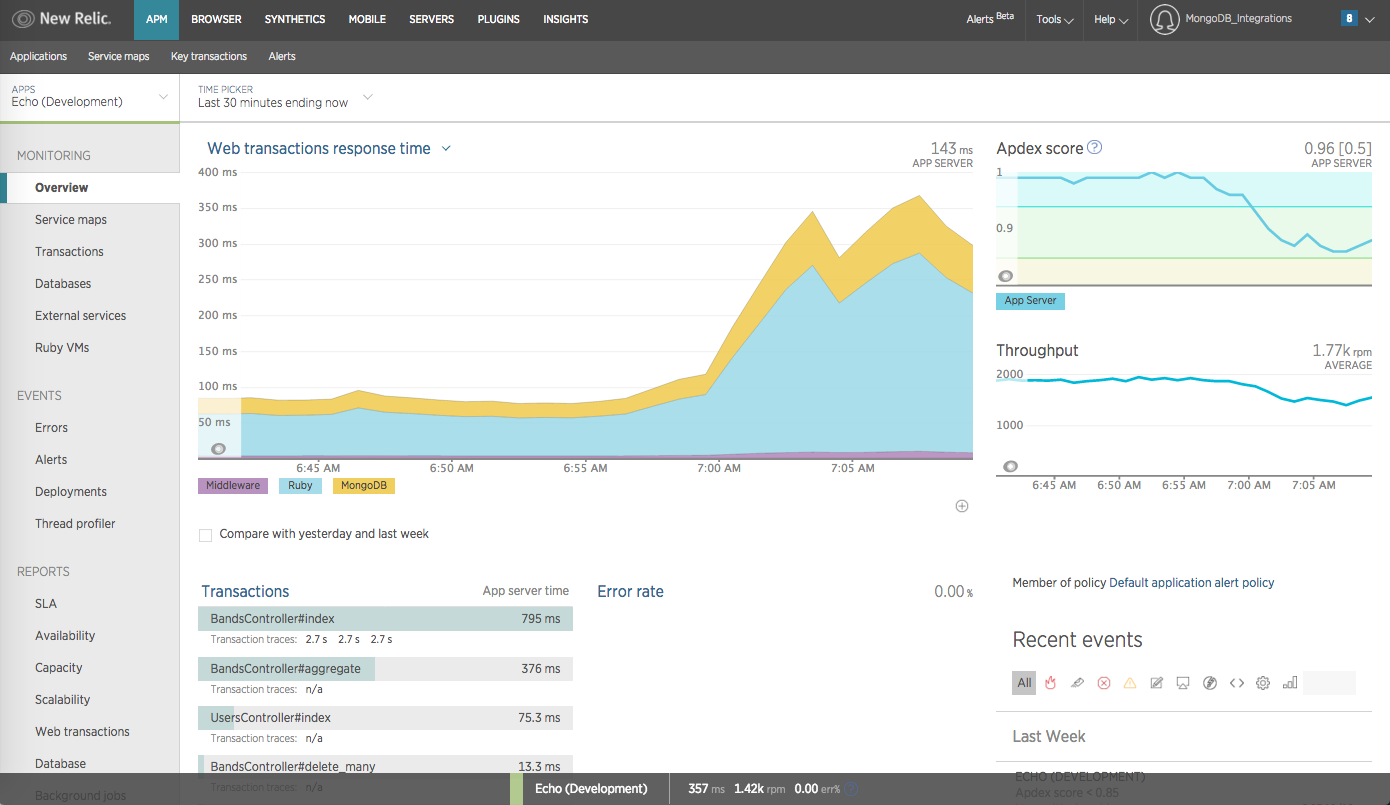
MongoDB Screenshots

Screenshot of Screenshot of Screenshot of Screenshot of Screenshot of Screenshot of