
Kyle Golembiewski
Marketing Analyst
Chose Flowdock

| Product | Rating | Most Used By | Product Summary | Starting Price |
|---|---|---|---|---|
 Flowdock | N/A | Flowdock is a collaboration tool built around a chat and team inbox interface. Flowdock is available via app or as a browser-based solution. It was originally offered by Rally Software Development, which was acquired by CA Technologies, which was acquired by Broadcom in 2018. | N/A | |
 Slack | N/A | Slack is a group messaging or team collaboration app that aims to simplify communication for businesses. Features include open discussions, private groups, and direct messaging, as well as deep contextual search and message archiving, and file sharing. Slack integrates with a number of other tools, such as MailChimp, Dropbox, and Google Drive. Slack was acquired by Salesforce in December 2020. The product is free to use, and also has paid plans with more features and greater controls. The… | $8.75 per month per user | |
 Zimbra | N/A | Zimbra is an email and collaboration platform and productivity suite that includes contacts, calendar, tasks, chat and file sharing, plus videoconferencing, document editing, and file storage. | N/A |
| Flowdock | Slack | Zimbra by Synacor | ||||||||||||||||||||||
|---|---|---|---|---|---|---|---|---|---|---|---|---|---|---|---|---|---|---|---|---|---|---|---|---|
| Editions & Modules | No answers on this topic |
| No answers on this topic | |||||||||||||||||||||
| Offerings |
| |||||||||||||||||||||||
| Entry-level Setup Fee | No setup fee | No setup fee | No setup fee | |||||||||||||||||||||
| Additional Details | — | *Per active user, per month, when paying once a year. Pro is $8.75 USD per active user when paying month to month. Business+ is $15.00 USD per active user when paying month to month. | — | |||||||||||||||||||||
| More Pricing Information | ||||||||||||||||||||||||
| Flowdock | Slack | Zimbra by Synacor | |
|---|---|---|---|
| Considered Multiple Products |  Flowdock Kyle Golembiewski Marketing Analyst Chose Flowdock  Vinicius Lima Computer Technician Chose Flowdock | Slack  Joshua Rodriguez Marketing Campaign Manager Chose Slack Slack is like an advanced version of any tool that I've ever used in the past. It's super simple and clean and makes chatting and organizing tasks, projects and content super easy. I think every company should be using Slack if they want to truly have their team be the most …  Valay Churi Product Specialist Chose Slack First, it was the pricing. Slack is much cheaper than the competitors and offers more features. We liked how there was no implementation charge involves and how easy it was implement as well. You can add interns or guest for no additional cost, managing the team seats is super … | Zimbra  Mochammad Zachri Project Manager Chose Zimbra by Synacor We chose Zimbra because Zoho Mail is too pricey with less-functionality than Zimbra. Zoho's UI is better, but we need more than just UI, we need many features that Zimbra has. G Suite is the best for team collaboration of course, but because of the price and our needs we … |
| Flowdock | Slack | Zimbra by Synacor | |||||||||||||||||||||||||||||||||||
|---|---|---|---|---|---|---|---|---|---|---|---|---|---|---|---|---|---|---|---|---|---|---|---|---|---|---|---|---|---|---|---|---|---|---|---|---|---|
| Project Management |
| ||||||||||||||||||||||||||||||||||||
| Communication |
| ||||||||||||||||||||||||||||||||||||
| File Sharing & Management |
|
| Flowdock | Slack | Zimbra by Synacor | |
|---|---|---|---|
| Small Businesses |  Stackby Score 8.9 out of 10 | Stackby Score 8.9 out of 10 | Stackby Score 8.9 out of 10 |
| Medium-sized Companies |  Troop Messenger Score 9.8 out of 10 | Troop Messenger Score 9.8 out of 10 | Troop Messenger Score 9.8 out of 10 |
| Enterprises |  HCL Connections Score 9.0 out of 10 | HCL Connections Score 9.0 out of 10 | HCL Connections Score 9.0 out of 10 |
| All Alternatives | View all alternatives | View all alternatives | View all alternatives |
| Flowdock | Slack | Zimbra by Synacor | |
|---|---|---|---|
| Likelihood to Recommend | 6.6 (2 ratings) | 9.1 (625 ratings) | 7.9 (10 ratings) |
| Likelihood to Renew | 10.0 (1 ratings) | 10.0 (25 ratings) | - (0 ratings) |
| Usability | - (0 ratings) | 9.0 (248 ratings) | 7.0 (1 ratings) |
| Availability | - (0 ratings) | 10.0 (2 ratings) | - (0 ratings) |
| Performance | - (0 ratings) | 10.0 (2 ratings) | - (0 ratings) |
| Support Rating | - (0 ratings) | 9.9 (68 ratings) | - (0 ratings) |
| Implementation Rating | - (0 ratings) | 8.7 (5 ratings) | 8.0 (1 ratings) |
| Configurability | - (0 ratings) | 10.0 (2 ratings) | - (0 ratings) |
| Contract Terms and Pricing Model | - (0 ratings) | 10.0 (1 ratings) | - (0 ratings) |
| Ease of integration | - (0 ratings) | 9.3 (2 ratings) | - (0 ratings) |
| Product Scalability | - (0 ratings) | 10.0 (1 ratings) | - (0 ratings) |
| Professional Services | - (0 ratings) | 10.0 (1 ratings) | - (0 ratings) |
| Vendor post-sale | - (0 ratings) | 10.0 (1 ratings) | - (0 ratings) |
| Vendor pre-sale | - (0 ratings) | 10.0 (1 ratings) | - (0 ratings) |
| Flowdock | Slack | Zimbra by Synacor | |
|---|---|---|---|
| Likelihood to Recommend | Broadcom
Vinicius Lima Computer Technician | Salesforce
 Jeremy Herman Security Engineer | Synacor
 Paul Chauvet Information Security Officer |
| Pros | Broadcom
Kyle Golembiewski Marketing Analyst | Salesforce
 Donavan Dunga Training Manager | Synacor
|
| Cons | Broadcom
Vinicius Lima Computer Technician | Salesforce
| Synacor
|
| Likelihood to Renew | Broadcom
Kyle Golembiewski Marketing Analyst | Salesforce
| Synacor No answers on this topic |
| Usability | Broadcom No answers on this topic | Salesforce
| Synacor
|
| Reliability and Availability | Broadcom No answers on this topic | Salesforce
 Leonardo Oliveira Quality Analyst | Synacor No answers on this topic |
| Performance | Broadcom No answers on this topic | Salesforce
Leonardo Oliveira Quality Analyst | Synacor No answers on this topic |
| Support Rating | Broadcom No answers on this topic | Salesforce
| Synacor No answers on this topic |
| Implementation Rating | Broadcom No answers on this topic | Salesforce
Leonardo Oliveira Quality Analyst | Synacor
Paul Chauvet Information Security Officer |
| Alternatives Considered | Broadcom
Vinicius Lima Computer Technician | Salesforce
| Synacor
 Eliz Marvic Melicio Carvajal Coordinador de desarrollo de software |
| Return on Investment | Broadcom
Kyle Golembiewski Marketing Analyst | Salesforce
 Michael Grey Director of Operations | Synacor
 Alexander Palma Ibarra Coordinador de Proyectos |
| ScreenShots | Zimbra Screenshots 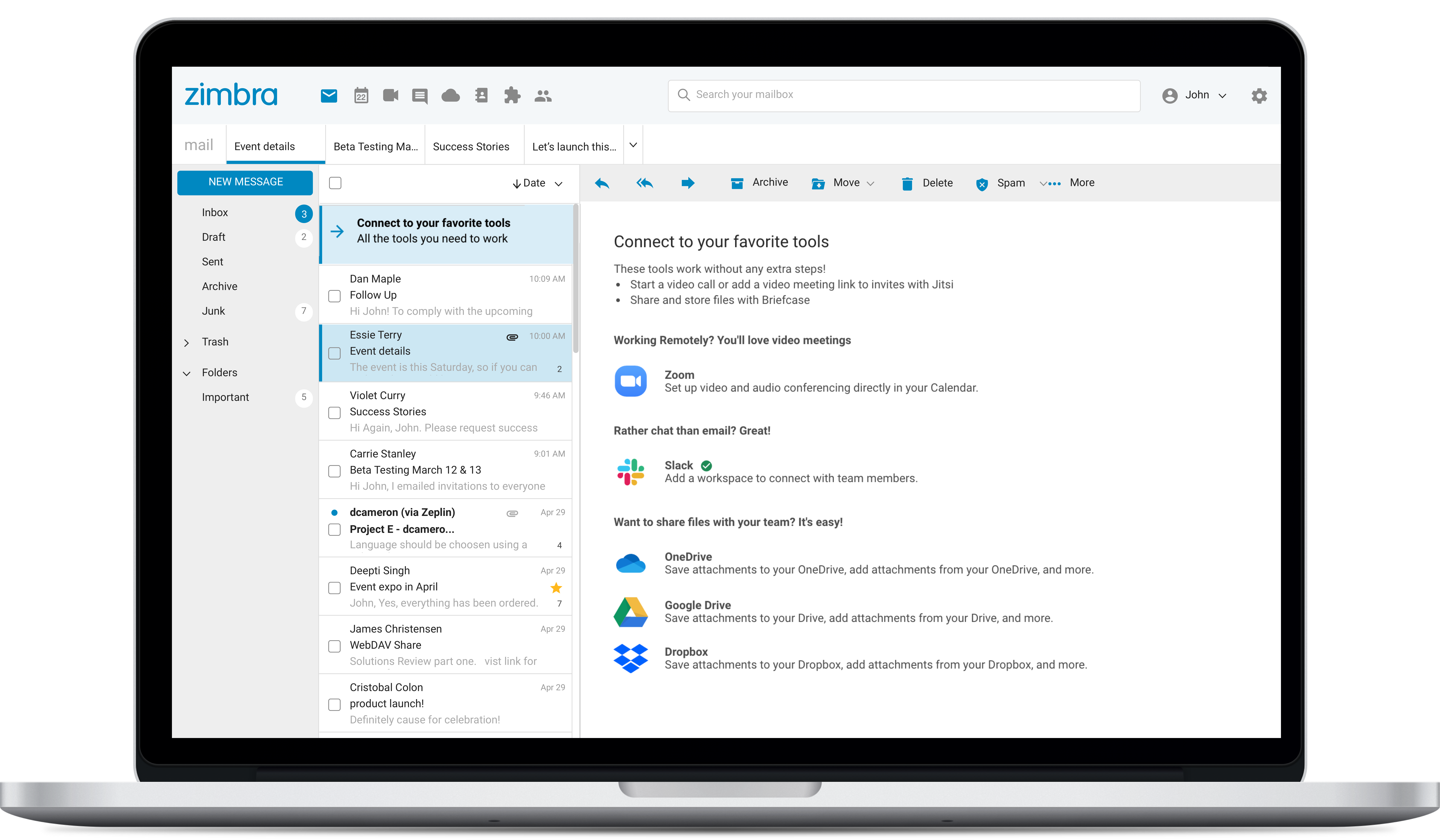  |
