Google Cloud Speech-to-Text vs. Phrase Localization Platform

Overview
ProductRatingMost Used ByProduct SummaryStarting Price
Google Cloud Speech-to-Text
Score 7.2 out of 10
N/A
Speech-to-Text on Google Cloud is a tool used to convert speech into text using an API powered by Google’s AI technologies. The vendor states users can transcribe content in real time or from stored files; deliver a better user experience in products through voice commands; and, gain insights from customer interactions to improve service.
$0.02
per min
Phrase Localization Platform
Score 4.5 out of 10
Small Businesses (1-50 employees)
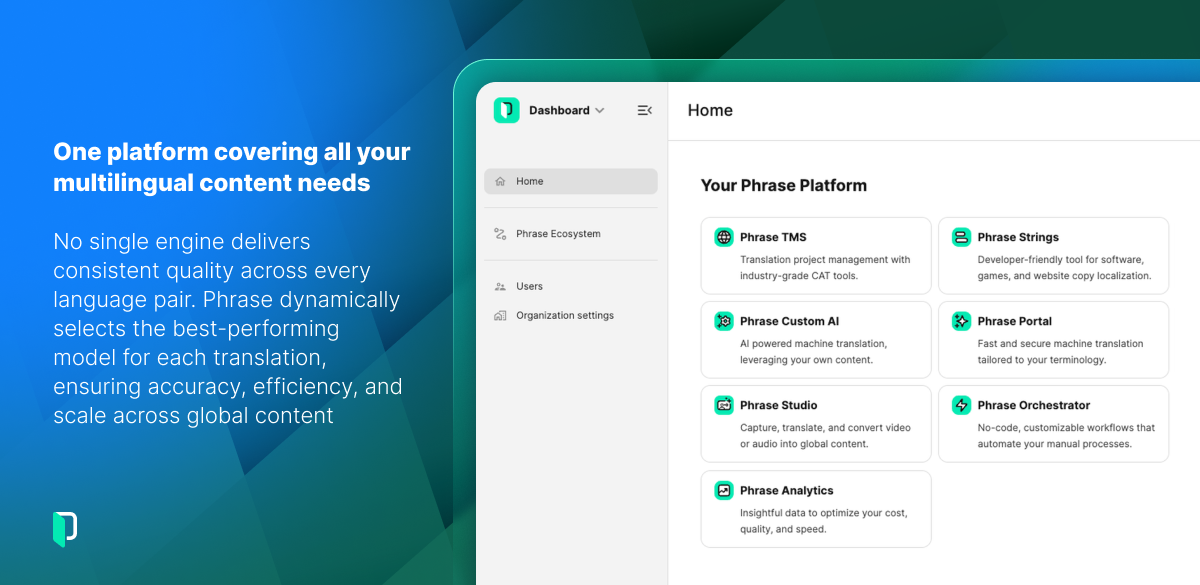
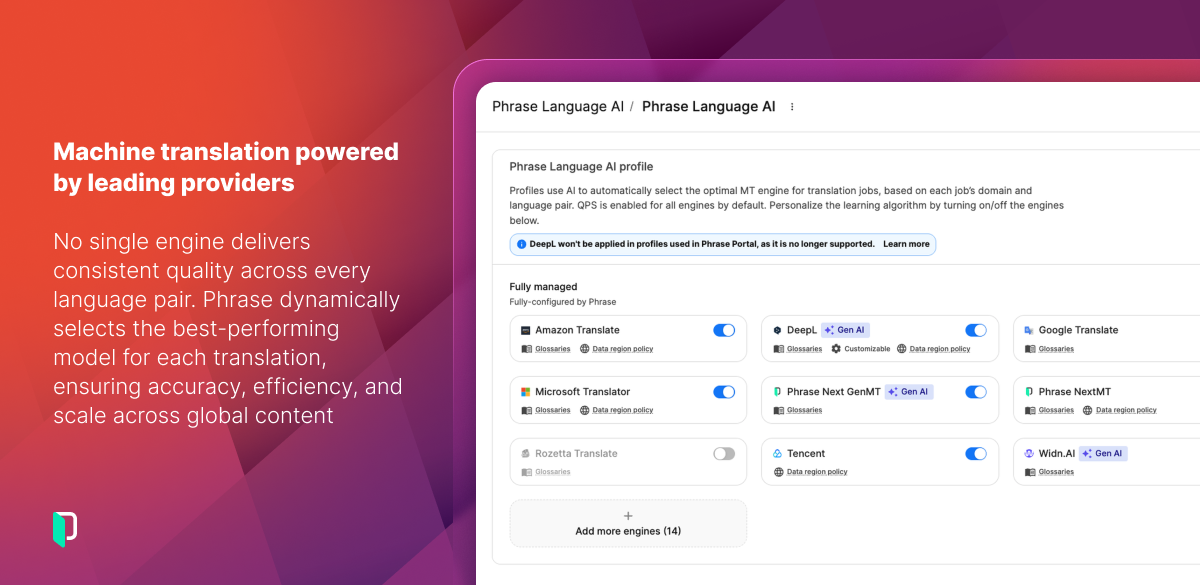
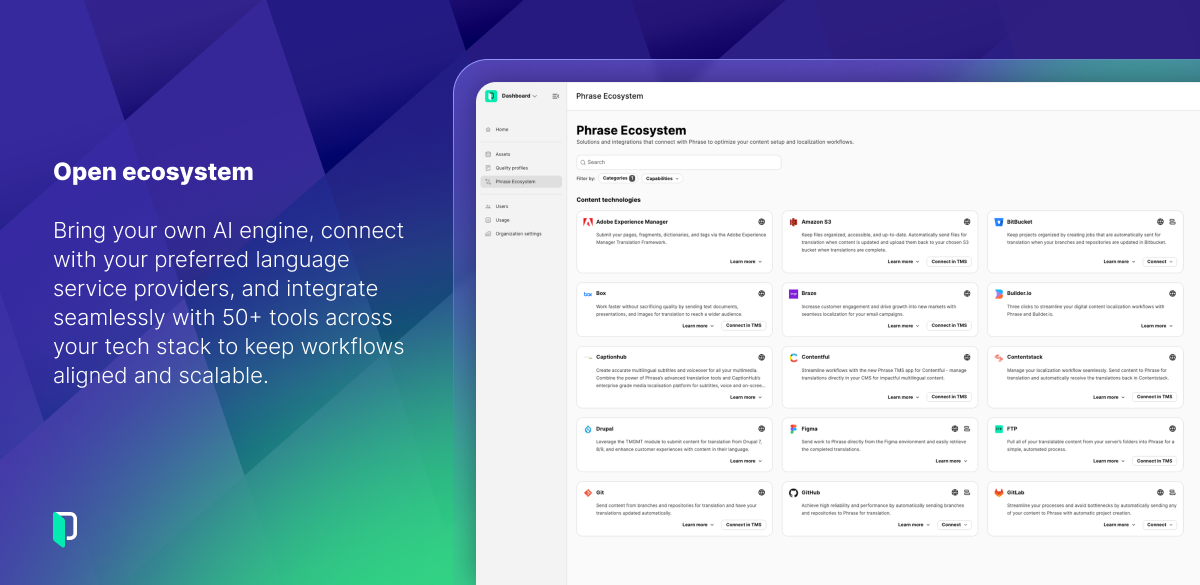
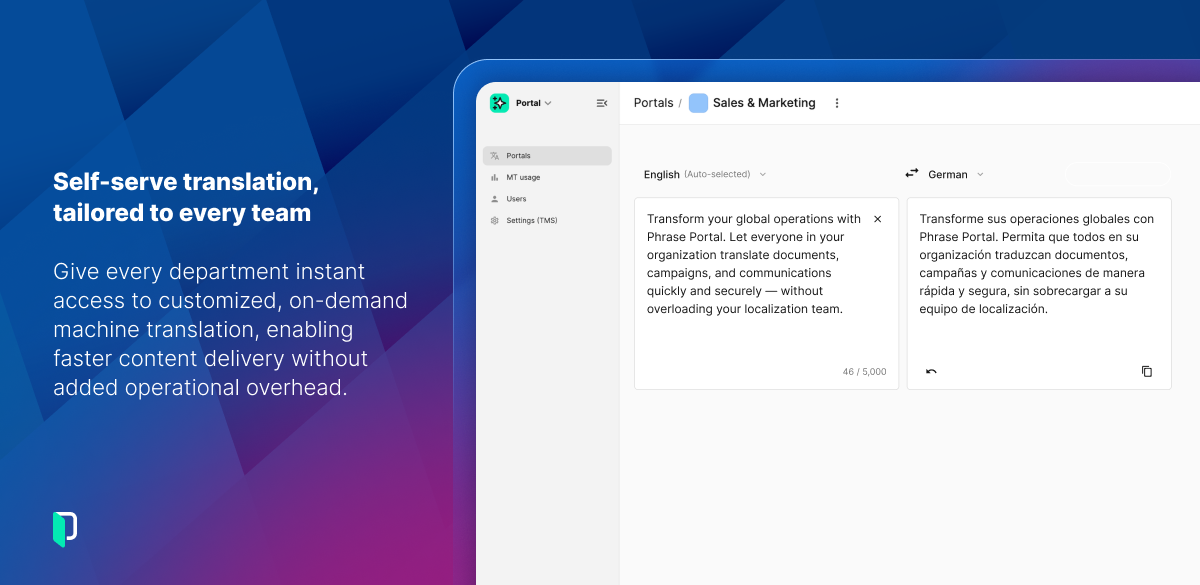
The Phrase Localization Platform is an AI-powered language platform that integrates translation, scoring, and automation tools in one place for businesses and language service providers. It offers scalability, a vendor-neutral approach, and advanced analytics for performance optimization, with single sign-on to facilitate easy setup.
$27
per month
Pricing
Google Cloud Speech-to-TextPhrase Localization Platform
Editions & Modules
Speech-to-Text V2 API
$0.016
per min
Speech-to-Text V1 API
$0.024
per min
Freelancer
$27
per month
Direct plan: Starter
$135
per month
LSP plan: Professional
$875
per month
Direct plan: Team
1,045
per month
Direct plan: Business
4,395
per month
Direct plan: Enterprise
Custom
per month
LSP plan: Business
Custom
per month
LSP plan: Enterprise
Custom
per month
Offerings
Pricing Offerings
Google Cloud Speech-to-TextPhrase Localization Platform
Free Trial
YesYes
Free/Freemium Version
YesNo
Premium Consulting/Integration Services
NoYes
Entry-level Setup FeeNo setup feeOptional
Additional DetailsSpeech-to-Text V1 API V1 offers data residency for multi region only. Models include short, long, phone call, and video. V1 does not include audit logging. New customers get $300 in free credits and 60 minutes for transcribing and analyzing audio free per month, not charged against your credits. Speech-to-Text V2 API V2 offers data residency for multi and single region. Models include short, long, telephony, video, and Chirp. V2 does include audit logging and support for customer managed encryption keys.
More Pricing Information
Community Pulse
Google Cloud Speech-to-TextPhrase Localization Platform
Best Alternatives
Google Cloud Speech-to-TextPhrase Localization Platform
Small Businesses
RingCentral Contact Center
Score 8.1 out of 10

No answers on this topic

Medium-sized Companies
Zoom Contact Center
Zoom Contact Center
Score 8.3 out of 10

No answers on this topic

Enterprises
Verint Speech and Text Analytics
Score 8.4 out of 10

No answers on this topic

All AlternativesView all alternativesView all alternatives
User Ratings
Google Cloud Speech-to-TextPhrase Localization Platform
Likelihood to Recommend
6.6
(44 ratings)
3.2
(57 ratings)
Likelihood to Renew
-
(0 ratings)
9.6
(2 ratings)
Usability
7.3
(25 ratings)
2.0
(1 ratings)
Support Rating
-
(0 ratings)
8.0
(1 ratings)
User Testimonials
Google Cloud Speech-to-TextPhrase Localization Platform
Likelihood to Recommend
Google
Real-time meeting notes for the smaller group audience. Strong language coverage of over 125+ languages. Handles mobile phone recordings and environmental noise effectively. Fast transcription turnaround also supports phrases, which improves industry-specific terminology. Generating QA/compliance audit logs. Also builds the sentences with accurate punctuation and sentence boundaries. It has vast global support centers whose primary focus in resolving customer issues and help multinational engineering in building great products
Read full review
Phrase
The system is well suited if you also run Trados or any second system. As the system is very expensive and the use of MTUs is rather complicated to understand the best thing is to run most larger projects through Trados or any other CAT tool and then to import it. Large projects are expensive in Phrase Localization Platform so I would recommend it if you have small projects and have enough capacity to carefully check the terminology as the data pulled from the term base is inconsistent. The same applies to the find replace feature which can work great.
Read full review
Pros
Google
  • So, first of all it gives the answer or translates in real time which is awesome.
  • It has speaker diarization, which detects who spoke each segment. This is a great feature because it can track the number of people as well.
  • It has an automatic punctuation system that detects each punctuation mark, such as a dot and a comma, and places it in the text.
  • Lastly, it offers a variety of language translations, providing a global platform for interaction with people from different countries.
Read full review
Phrase
  • The QA tool it provides is practical and always handy.
  • Instant QA feature can save time at the end of the process.
  • The possibility to decline a job directly from the platform instead of having to contact the client by email.
Read full review
Cons
Google
  • Integration outside of the google eco system is challenging here.
  • Google Cloud Speech-to-Text works only with active internet connection if the internet bandwidth is low it effect the transcription process and can lead to data inaccuracy.
  • In terms of the pricing also this is at higher range which all the companies cannot afford like small scale organisation if they would like to use the tool they would look over the price to make the decision. Reducing the price can increase the product usage more
Read full review
Phrase
  • In the case of EN to JA translation, we enter text and then convert it to get the correct final text (word or phrase) which uses correct Chinese character(s), as there are often multiple Chinese characters with the same reading but different meanings. When those conversion options are displayed, it is usually possible to change our selection among them by hitting the Tab key, but in Memsource, hitting the Tab key makes us leave the text conversion and move to the source segment, so we must make sure to use arrow keys to choose the right conversion option when using Memsource.
  • When there are tag elements used in the source text, the tags must exist in the target text of course, but the tag order also must be the same. The tags cannot be moved around in the segment, which causes problems in the case of the Japanese language, because the word order differs between EN and JA.
  • In the Japanese language, Italics are basically not used, so there must be no texts between the tags which specify Italic font. But then the segment cannot be confirmed and the job status cannot be changed to "Complete".
Read full review
Likelihood to Renew
Google
No answers on this topic
Phrase
I use and manage an Academic edition (approx. 15 students) and the corporate license (10 users). In both cases, the features are easy to find, set and use. My students and my translators understand the dynamics of the platform easily and get used to them quickly.
Read full review
Usability
Google
The reasoning behind my 10 is that the UI is very intuitive; I didn't require any formal training to use it. Google's speech-to-text is not just a conversion tool; it helps automate mundane tasks, saves time, and has an almost human-like understanding.
Read full review
Phrase
It is designed to be a lean system, but that means that things are clustered in weird groups and a lot of trial and error is involved getting the settings right. If something goes wrong first level support is very quick and has very fast answers which are quite typical of first level support and essentially equate to asking you if you have switched it off and on yet. Anything more involved is challenging for support to address.
Read full review
Support Rating
Google
No answers on this topic
Phrase
We rarely use support, but most questions were answered in a timely fashion, although we didn't exactly find them satisfactory. That's mostly the fault of the software and not the Support team because we asked for things that Memsource couldn't do.
Read full review
Alternatives Considered
Google
Google Cloud Speech-to-Text outperformed its competitors significantly in terms of accuracy, surpassing any other product available. Additionally, its support for multiple languages was unrivaled in the market. Moreover, for clients with robust bandwidth, Google Cloud Speech-to-Text offered real-time transcription capabilities, enabling users to transcribe live audio streams with minimal delay.
Read full review
Phrase
Memsource has a very good user interface that people can quickly learn and start using. Also, its analysis features are top class which helps me provide a detailed estimate to my client based on the file particulars. It has a QA feature that helps me do a very high-quality check before I send out my translation to the client.
Read full review
Return on Investment
Google
  • It reduced our budget for assistants who transcribed files manually
  • It speeds up the process, because we can have a transcriptions straight after the interviews
  • It increased accuracy, because AI makes the transcriptions for every second, and you can find the words which were said at specific time.
Read full review
Phrase
  • Positive impact as I have been able to recruit and reach more and new clients.
  • As it is easy to use, I provide high quality translations for my clients.
  • Using TM and Search ensures consistency and my clients appreciate my good work with the help of Memsource.
Read full review
ScreenShots

Google Cloud Speech-to-Text Screenshots

Screenshot of audio transcription creation -  Using the Speech-to-Text API from within the Cloud Console by creating an audio transcription is done in just a few steps. It can transcribe short, long, and streaming audio.Screenshot of creating subtitles for videos using AI -  Transcriptions with captions and subtitles can be added to existing content or in real time to streaming content. Google's video transcription model can be used for indexing or subtitling video and/or multispeaker content and uses similar machine learning technology as YouTube does for video captioning.Screenshot of adding Speech-to-Text to apps - The video pictures covers how to add AI to an application without extensive machine learning model experience. The pretrained Speech-to-Text API lets users enable AI for applications.Screenshot of Language, speech, text, and translation with Google Cloud API - The pictures displays a section of Google training course, where learners use the Speech-to-Text API to transcribe an audio file into a text file, translate with the Google Cloud Translation API, and create synthetic speech with Natural Language AI.

Phrase Localization Platform Screenshots

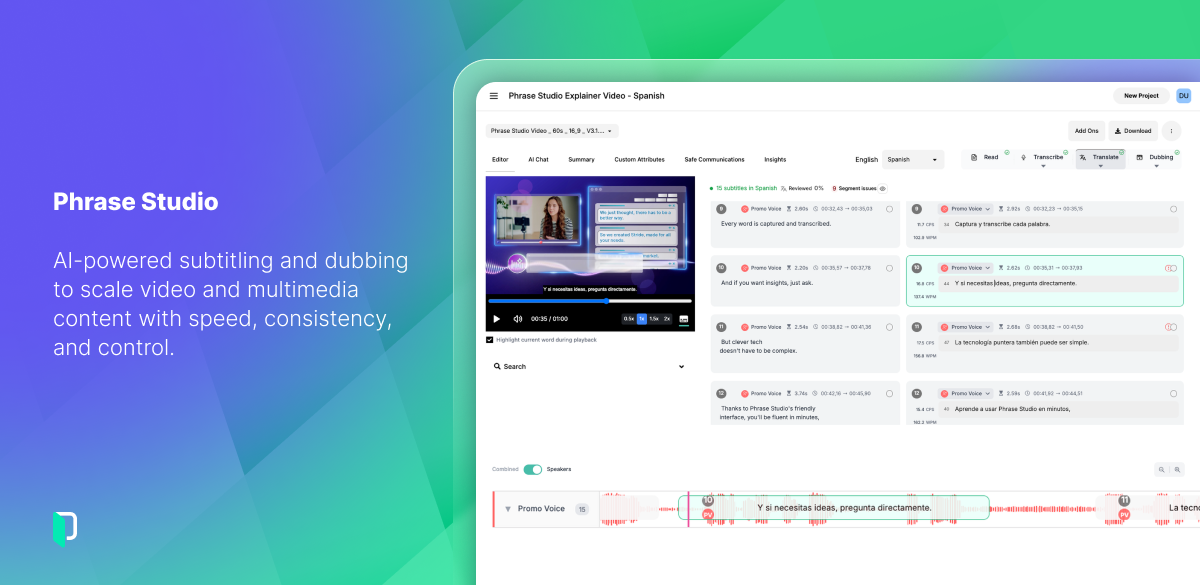
Screenshot of Phrase TMS - analyticsScreenshot of Phrase TMS - job pageScreenshot of Phrase TranslateScreenshot of Phrase Strings - project overviewScreenshot of Phrase Strings - editor