IBM Cloud Databases vs. MariaDB Platform vs. MongoDB

Overview
ProductRatingMost Used ByProduct SummaryStarting Price
IBM Cloud Databases
Score 8.1 out of 10
N/A
IBM Cloud Databases are open source data stores for enterprise application development. Built on a Kubernetes foundation, they offer a database platform for serverless applications. They are designed to scale storage and compute resources seamlessly without being constrained by the limits of a single server. Natively integrated and available in the IBM Cloud console, these databases are now available through a consistent consumption, pricing, and interaction model. They aim to provide a cohesive…N/A
MariaDB Platform
Score 9.5 out of 10
N/A
MariaDB is an open-source relational database made by the original developers of MySQL, supported by the MariaDB Foundation and a community of developers. The community states recent additional capabilities as including clustering with Galera Cluster 4, compatibility with Oracle Database, and Temporal Data Tables, allowing one to query the data as it stood at any point in the past.N/A
MongoDB
Score 8.9 out of 10
N/A
MongoDB is an open source document-oriented database system. It is part of the NoSQL family of database systems. Instead of storing data in tables as is done in a "classical" relational database, MongoDB stores structured data as JSON-like documents with dynamic schemas (MongoDB calls the format BSON), making the integration of data in certain types of applications easier and faster.
$0.10
million reads
Pricing
IBM Cloud DatabasesMariaDB PlatformMongoDB
Editions & Modules
No answers on this topic
Shared
$0
per month
Serverless
$0.10million reads
million reads
Dedicated
$57
per month
Offerings
Pricing Offerings
IBM Cloud DatabasesMariaDB PlatformMongoDB
Free Trial
NoYesYes
Free/Freemium Version
NoYesYes
Premium Consulting/Integration Services
NoYesNo
Entry-level Setup FeeNo setup feeOptionalNo setup fee
Additional DetailsFully managed, global cloud database on AWS, Azure, and GCP
More Pricing Information
Community Pulse
IBM Cloud DatabasesMariaDB PlatformMongoDB
Considered Multiple Products
IBM Cloud Databases
Chose IBM Cloud Databases
We use Amazon's RDS (MySQL database), Redislabs (Redis) and also MongoDB's Atlas. They all have their own advantages and disadvantages. For us, MongoDB's Atlas and Compose are obviously similar services. For now, we use Atlas to try new things (since they run the latest stable …
Chose IBM Cloud Databases
I tried MLab and was not a fan of how the UI worked on their control panel. It felt outdated and cumbersome. They offered less backup solutions for the price point as well. In fact, you had to contact them with a ticket if you wanted access to a daily backup. Anything over that …
Chose IBM Cloud Databases
MongoDB is the primary db we use, and Meteor is the primary application framework. Configuring MongoDB to fully support Meteor oplog tailing is a challenge - and when we started looking, Compose was those only MongoDB provider that had turnkey support for Meteor.

Since we wanted …
Chose IBM Cloud Databases
We previously hosted our own Redis and RabbitMQ cluster. Before switching to IBM Compose we evaluated Redis Lab, Scalegrid, AWS ElastiCache, CloudAMQP and others. We still host our core database (MongoDB) ourselves.
Chose IBM Cloud Databases
All our databases are hosted on Compose. We haven't seen a reason to switch providers, however, we have compared with some others and Compose seems to be the best from a cost and reliability standpoint.
Chose IBM Cloud Databases
Compose has the best interface for viewing data. Others have better pricing. Atlas has best metrics.
Chose IBM Cloud Databases
It is pretty much the same only Compose offers many more database types.
Chose IBM Cloud Databases
We evaluated several DBaaS providers, the thing that won out for Compose was its GUI which makes working with the database very easy.
Chose IBM Cloud Databases
While at the time, Amazon RDS did/does not create Mongo databases, I was able to set up many with PostgreSQL databases with the same ease as IBM Compose. However, IBM compose does seem to offer a more intuitive application control panel. Amazon RDS costs run on a server …
Chose IBM Cloud Databases
We selected Compose because we initially thought that they would provide great support, and that they would bring encryption at rest within months. That has not materialized yet.

We also thought that the cost, while far from being the lowest, was reasonable.
Chose IBM Cloud Databases
We use Amazon Aurora as our primary datastore and use IBM Compose Mongo as an alternative only when Aurora does not cover the use case well. Amazon DynamoDB looks good but doesn't have the same wealth of libraries and support which makes MongoDB easy to use and therefore was …
Chose IBM Cloud Databases
We have one instance of mLab that has been equally easy to scale as Compose, but with the added benefit of extensive logging and performance monitoring tools, including an index suggester. All modern cloud db providers seem to offer more of this type of functionality at this …
Chose IBM Cloud Databases
Compose has great scalability and had a good price when we decided to launch our product.
Chose IBM Cloud Databases
Other options are lower priced, however IBM Compose has by far the best interface for managing and editing data within the database. It also has many forms of databases for us to deploy, beyond what we are currently using. So, in the event we need to add other services, we can …
Chose IBM Cloud Databases
IBM Compose pricing is far more clear than Azure and Amazon. The web user interface is also very clear and simple.
Chose IBM Cloud Databases
We initially selected IBM Compose because it was easy to use and cost-effective. We switched to mLab when we need to scale and have dedicated clusters.
Chose IBM Cloud Databases
It feels very similar but Compose was there first. I haven't used MongoDB Atlas in anger yet but it does seem to be more comprehensive.
Chose IBM Cloud Databases
Mongo Atlas - at the moment it looks better. It has 3.6 (Compose stuck at 3.4). Lower pricing (it seems).
AWS Dynamo DB etc - I decided rather quickly not to use this, mostly for lack of adequate documentation.
Chose IBM Cloud Databases
It has been a very long time, but at the time, Compose's customer support was incredible compared to MongoLab.
Chose IBM Cloud Databases
Compose has a better web interface which is why I originally chose them. But now, I'm glad they also offer Redis and other DB's I need for my stack.
Chose IBM Cloud Databases
We had used mlab at one point but found it less reliable than compose.io. Really, we wanted a strong foundation to start from day one and figured a produced backed by IBM would be the way to go. We are still a small startup and don't have a ton of resource to mess around with …
Chose IBM Cloud Databases
I love IBM compose for its simplicity, reliability, scalability, and price. I am uncertain on how the infrastructure is deployed and fault tolerance as we rarely need this.
MariaDB Platform
Chose MariaDB Platform
Thanks to MySQL compatibility, everything you've learned while using it can be utilized when using MariaDB. Therefore it's a better choice than MongoDB and MSSQL if you're looking to switch away from MySQL. MariaDB is also a very mature and stable product, unlike MongoDB that …
Chose MariaDB Platform
MariaDB is perhaps the best open source database server available, combining a wide range of supported platforms, MySQL compatibility, a low footprint, and reasonably high performance. If you have cost constraints, or limited server resources, I recommend MariaDB, particularly …
Chose MariaDB Platform
MariaDB gives a low-cost option for DB engines like Oracle with plenty of features and flexibility while having better ease of use than PostgreSQL.
Chose MariaDB Platform
MariaDB provided the best fit for our business in upgrading legacy systems which were originally designed to use MySQL as a backend. By using MariaDB, no changes to the overall systems needed to be altered, reducing the time needed to upgrade everything. Other solutions …
MongoDB
Chose MongoDB
MongoDB is the most reliable and fastest for storing document-based data. It has a place among the most popular DB's these days.
Chose MongoDB
MongoDB is the most complete database of NoSQL type. In my opinion, it has all the tools for a good development of a database. I have not had problems when using the application.
Features
IBM Cloud DatabasesMariaDB PlatformMongoDB
Database-as-a-Service
Comparison of Database-as-a-Service features of Product A and Product B
IBM Cloud Databases
7.3
94 Ratings
15% below category average
MariaDB Platform
-
Ratings
MongoDB
-
Ratings
Automatic software patching8.577 Ratings00 Ratings00 Ratings
Database scalability9.988 Ratings00 Ratings00 Ratings
Automated backups7.091 Ratings00 Ratings00 Ratings
Database security provisions9.084 Ratings00 Ratings00 Ratings
Monitoring and metrics4.088 Ratings00 Ratings00 Ratings
Automatic host deployment5.369 Ratings00 Ratings00 Ratings
NoSQL Databases
Comparison of NoSQL Databases features of Product A and Product B
IBM Cloud Databases
-
Ratings
MariaDB Platform
-
Ratings
MongoDB
10.0
39 Ratings
12% above category average
Performance00 Ratings00 Ratings10.039 Ratings
Availability00 Ratings00 Ratings10.039 Ratings
Concurrency00 Ratings00 Ratings10.039 Ratings
Security00 Ratings00 Ratings10.039 Ratings
Scalability00 Ratings00 Ratings10.039 Ratings
Data model flexibility00 Ratings00 Ratings10.039 Ratings
Deployment model flexibility00 Ratings00 Ratings10.038 Ratings
Best Alternatives
IBM Cloud DatabasesMariaDB PlatformMongoDB
Small Businesses
IBM Cloudant
IBM Cloudant
Score 7.4 out of 10
InfluxDB
InfluxDB
Score 8.8 out of 10
IBM Cloudant
IBM Cloudant
Score 7.4 out of 10
Medium-sized Companies
IBM Cloudant
IBM Cloudant
Score 7.4 out of 10
SQLite
SQLite
Score 8.0 out of 10
IBM Cloudant
IBM Cloudant
Score 7.4 out of 10
Enterprises
IBM Cloudant
IBM Cloudant
Score 7.4 out of 10
SQLite
SQLite
Score 8.0 out of 10
IBM Cloudant
IBM Cloudant
Score 7.4 out of 10
All AlternativesView all alternativesView all alternativesView all alternatives
User Ratings
IBM Cloud DatabasesMariaDB PlatformMongoDB
Likelihood to Recommend
8.0
(96 ratings)
10.0
(30 ratings)
10.0
(79 ratings)
Likelihood to Renew
8.0
(7 ratings)
-
(0 ratings)
10.0
(67 ratings)
Usability
8.0
(7 ratings)
10.0
(4 ratings)
10.0
(15 ratings)
Availability
-
(0 ratings)
-
(0 ratings)
9.0
(1 ratings)
Support Rating
1.0
(10 ratings)
8.7
(16 ratings)
9.6
(13 ratings)
Implementation Rating
-
(0 ratings)
-
(0 ratings)
8.4
(2 ratings)
User Testimonials
IBM Cloud DatabasesMariaDB PlatformMongoDB
Likelihood to Recommend
IBM
Less Appropriate Scenario: 1) Small Scale or Low Budget Projects 2) Organizations with limited expertise in cloud technologies may find the learning curve steep, especially if they are not familiar with the IBM Cloud platform 3) If database requirements are highly dynamic and change frequently, the comprehensive features and management provided by IBM Cloud Databases might be overkill. A more flexible, self-managed solution could be preferable for adapting to rapid changes.
Read full review
MariaDB
  • Applications where the users need [to] execute many short queries.
  • With new storage engines such as Aria, which allows to replace MyISAM with some improvements, and XtraDB, which evolves InnoDB.
  • To fuse the legacy features with the features available in NoSQL databases.
  • Connection management, which allows multiplying the number of concurrent accesses.
  • New clustering engines, such as Galera, which allow interesting possibilities for Cloud adoption.
Read full review
MongoDB
If asked by a colleague I would highly recommend MongoDB. MongoDB provides incredible flexibility and is quick and easy to set up. It also provides extensive documentation which is very useful for someone new to the tool. Though I've used it for years and still referenced the docs often. From my experience and the use cases I've worked on, I'd suggest using it anywhere that needs a fast, efficient storage space for non-relational data. If a relational database is needed then another tool would be more apt.
Read full review
Pros
IBM
  • The ease of setup was effortless. For anyone with development experience, a few simple questions such as name and login data will get you set up.
  • The web application to manage cluster settings, billing settings and even introspect the data was simple and most importantly worked all the time. This can not always be said for web interfaces of other products.
Read full review
MariaDB
  • Simpler learning curve. MariaDB is a cleaner, simpler system that is (IMO) easier to learn and easier to manage effectively than many other database systems.
  • Lower hardware requirements. After migrating to MariaDB from another database software system, we find that our hardware needs have substantially decreased.
  • MariaDB support is very responsive. It's like they actually care. On the few occasions we've run into technical issues, support has always come through with what we needed. Once it was showing me a relatively new feature the server supported that I wasn't aware of, that, once I was able to properly make use of it helped me resolve a serious production performance issue.
  • Architectural flexibility. As an example, the ready availability of synchronous (Galera) versus asynchronous replication schemes without being locked into one of the other by enormous technical complexity or punitive licensing, allows the customer to find what really works best for their needs.
Read full review
MongoDB
  • Being a JSON language optimizes the response time of a query, you can directly build a query logic from the same service
  • You can install a local, database-based environment rather than the non-relational real-time bases such a firebase does not allow, the local environment is paramount since you can work without relying on the internet.
  • Forming collections in Mango is relatively simple, you do not need to know of query to work with it, since it has a simple graphic environment that allows you to manage databases for those who are not experts in console management.
Read full review
Cons
IBM
  • Better cost reports, before just increasing to another tier, thus increasing the price. This is critical for early stage startups, where budget is tight.
  • Add more data center options. As a comparison, a similar service, Aiven.io has dozen more options than Compose (basically all big cloud providers). We moved from AWS to Digital Ocean, which made us stop using Compose, since Compose forces us to be either on IBM or AWS.
Read full review
MariaDB
  • Driver Support - Some third party applications use database drivers that cause unexplained slowness with MariaDB. This can be worked around by using the MySQL drivers, but it's not clear what causes the problem in the first place.
  • Support - While online communities are helpful in diagnosing problems, there isn't as much professional documentation/support available for MariaDB as some of the other major database options.
  • Data Visualization - It would be helpful if there were more built in options for analyzing statistics and generating reports.
Read full review
MongoDB
  • An aggregate pipeline can be a bit overwhelming as a newcomer.
  • There's still no real concept of joins with references/foreign keys, although the aggregate framework has a feature that is close.
  • Database management/dev ops can still be time-consuming if rolling your own deployments. (Thankfully there are plenty of providers like Compose or even MongoDB's own Atlas that helps take care of the nitty-gritty.
Read full review
Likelihood to Renew
IBM
IBM is our trusted partner which never failed to meet our expectations. Stability, efficiency, usability and security is a must have for our business which is fully provided by IBM Cloud Databases
Read full review
MariaDB
No answers on this topic
MongoDB
I am looking forward to increasing our SaaS subscriptions such that I get to experience global replica sets, working in reads from secondaries, and what not. Can't wait to be able to exploit some of the power that the "Big Boys" use MongoDB for.
Read full review
Usability
IBM
IBM Cloud Databases' pricing structure is easy to understand, and if you choose the right product, you can operate your system at minimal cost. Although there is ample documentation available, there doesn't seem to be a user community running on it, so specific usage know-how and troubleshooting can sometimes take longer than expected.
Read full review
MariaDB
MariaDB is very usable and stable to be used in production settings as an alternative to MySQL. The shortcomings of SQL are present but well understood in the community, and if the decision were to be made again, I would choose MariaDB over MySQL on future projects.
Read full review
MongoDB
NoSQL database systems such as MongoDB lack graphical interfaces by default and therefore to improve usability it is necessary to install third-party applications to see more visually the schemas and stored documents. In addition, these tools also allow us to visualize the commands to be executed for each operation.
Read full review
Support Rating
IBM
Support is helpful enough, but we haven't always had questions answered in a satisfactory manner. At one time we realized that Compose had stopped taking database snapshots on its two-per-day schedule, and had in fact not taken one for many days. Support recognized the problem and it was fixed, but the lack of proactive checks and the inability to share exactly what happened has caused us to look elsewhere for production work loads
Read full review
MariaDB
We have launched several inquiries to MariaDB support and they have always responded very quickly and have not been tutoring for the duration of the incident/problem.
Likewise, they want to hold constant meetings with the client to get their opinion as well as how they can help.
I see a very human support and concerned about the customer.
Read full review
MongoDB
Finding support from local companies can be difficult. There were times when the local company could not find a solution and we reached a solution by getting support globally. If a good local company is found, it will overcome all your problems with its global support.
Read full review
Implementation Rating
IBM
No answers on this topic
MariaDB
No answers on this topic
MongoDB
While the setup and configuration of MongoDB is pretty straight forward, having a vendor that performs automatic backups and scales the cluster automatically is very convenient. If you do not have a system administrator or DBA familiar with MongoDB on hand, it's a very good idea to use a 3rd party vendor that specializes in MongoDB hosting. The value is very well worth it over hosting it yourself since the cost is often reasonable among providers.
Read full review
Alternatives Considered
IBM
The reason why I choose IBM Cloud Databases is that the IBM cloud toolset is already being used in other functions of the company and by using IBM Cloud Databases, the other cloud tools are better embedded and integrated. If the company is set to use amazon tools, I would go for rds.
Read full review
MariaDB
MariaDB stacks up the the competition just fine. Due to is ture open source nature we do not have to worry about licencing and spending money on nothing. Moreover, MariaDB does everything that we need to get done. We can run data that is a million rows or many smaller projects on the same environment with little overhead. One of the best features that MariaDB has is the ability of backup or dump data to standard text sql statements. That was one of the reasons why we choose MariaDb because it makes backups or transferring data a snap
Read full review
MongoDB
We have [measured] the speed in reading/write operations in high load and finally select the winner = MongoDBWe have [not] too much data but in case there will be 10 [times] more we need Cassandra. Cassandra's storage engine provides constant-time writes no matter how big your data set grows. For analytics, MongoDB provides a custom map/reduce implementation; Cassandra provides native Hadoop support.
Read full review
Return on Investment
IBM
  • Prove use cases prior to administering entire platform, obtain ROI faster
  • Able to achieve the technological components of our advanced analytics team without full scale purchase of AI platform
  • Developed several studies to prove out cloud Db value, speed to deploy
Read full review
MariaDB
  • Low CAPEX if you have a team that use open source software day by day
  • Medium OPEX if you have a team that use open source software day by day
  • Perfect to use in academic ambient to support researchers and students
Read full review
MongoDB
  • Open Source w/ reasonable support costs have a direct, positive impact on the ROI (we moved away from large, monolithic, locked in licensing models)
  • You do have to balance the necessary level of HA & DR with the number of servers required to scale up and scale out. Servers cost money - so DR & HR doesn't come for free (even though it's built into the architecture of MongoDB
Read full review
ScreenShots

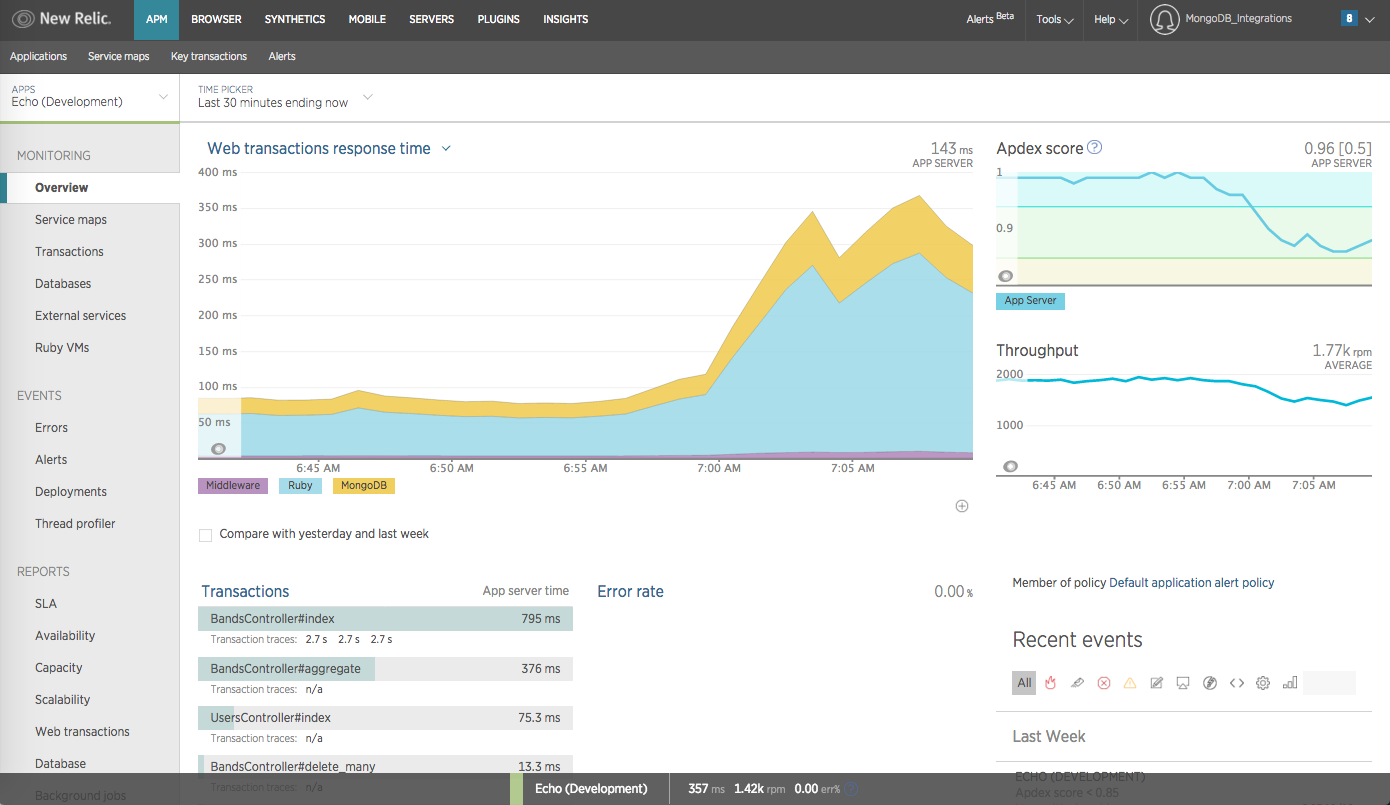
MongoDB Screenshots

Screenshot of Screenshot of Screenshot of Screenshot of Screenshot of Screenshot of