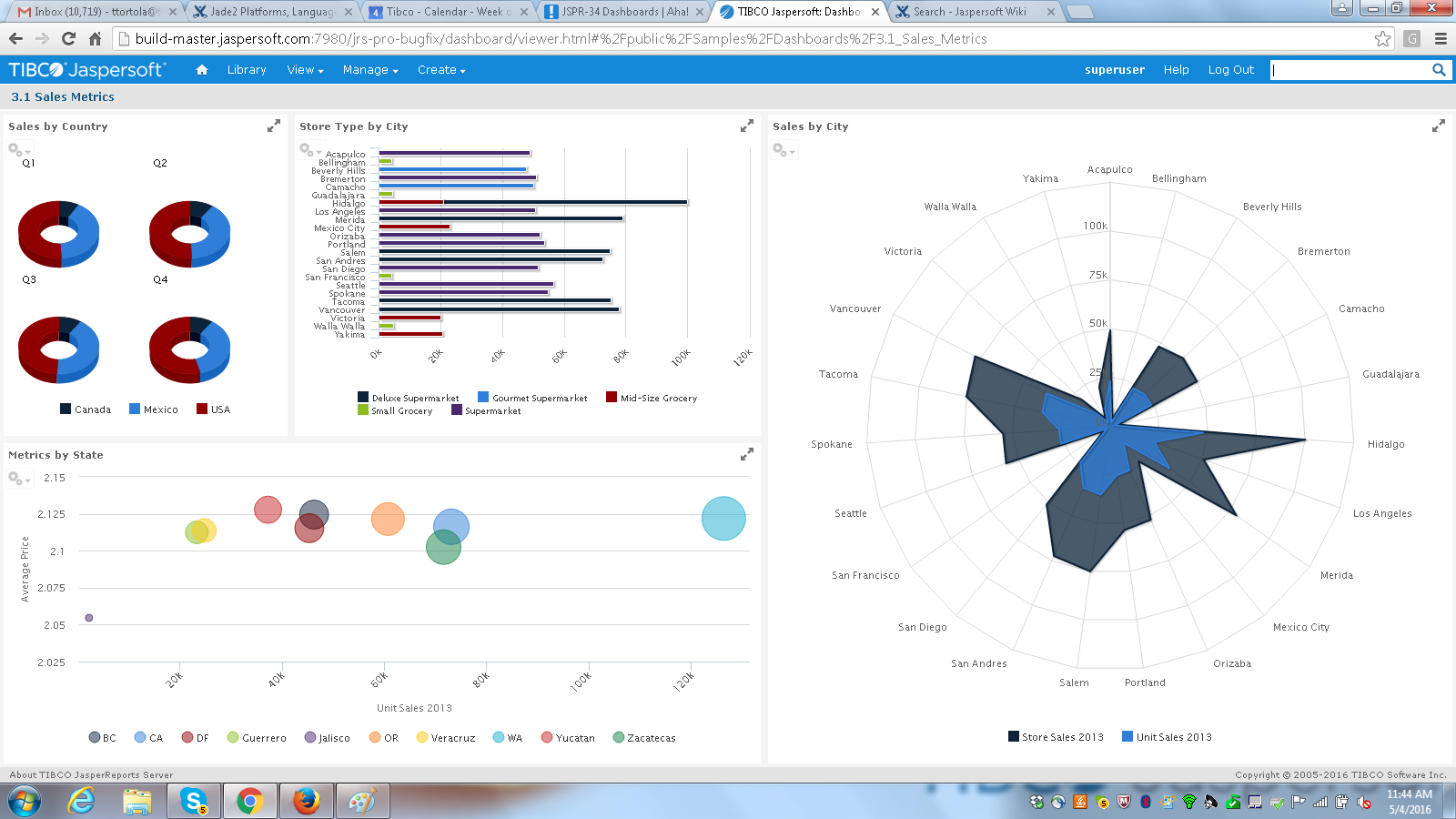
Jaspersoft commercial edition is an embedded business intelligence suite designed to be built-into SaaS products as an integrated reporting engine. It provides reports and dashboards for customer-facing applications without requiring app developers to build their own reporting engine.
N/A
Oracle Database
Score 8.3 out of 10
N/A
Oracle Database, currently in edition 23ai, is a converged, multimodel database management system. It is designed to simplify development for AI, microservices, graph, document, spatial, and relational applications.
$0.05
per hour
Microsoft SQL Server
Score 8.6 out of 10
N/A
Microsoft SQL Server is a relational database.
$1,418
Per License
Pricing
Jaspersoft
Oracle Database
Microsoft SQL Server
Editions & Modules
No answers on this topic
Oracle Base Database Service - Standard
$0.0538
per hour
Oracle Base Database Service - Enterprise
$0.1075
per hour
Oracle Base Database Service - High Performance
$0.2218
per hour
Standard Edition
Contact Sales
Enterprise Edition
Contact Sales
Personal Edition
Contact Sales
Subscription
$1,418.00
Per License
Enterprise
$13,748.00
Per License
Offerings
Pricing Offerings
Jaspersoft
Oracle Database
Microsoft SQL Server
Free Trial
Yes
Yes
No
Free/Freemium Version
Yes
Yes
No
Premium Consulting/Integration Services
Yes
No
No
Entry-level Setup Fee
No setup fee
No setup fee
No setup fee
Additional Details
Jaspersoft offers flexible pricing for ISVs and SaaS per customer or by CPU core.
We decided to move from the reporting solution provided by Microsoft SQL Server to TIBCO Jaspersoft mostly because of the ease to let end users to design their own reports by themselves, within the custom business application, with a friendly user interface, and with the …
I have used Crystal Reports, SQL Server Reporting Services (SSRS), and Business Objects prior to my experience with Jaspersoft. Unlike SSRS, Jaspersoft works easily with multiple database platforms. Crystal Reports is aimed more directly at the end-user, and Business Objects …
Mostly because of better looking reports than Microsoft. Other useful scenario for us was adhoc reports which reduced our development time. We were not satisfied about Microsoft reporting services improvements over the years, and hoped to get more from Jaspersoft. Simply when …
Having an open source version was critical in our final decision. Another important aspect was the ability to embed Jasper server into our application UI and the rich features provided by Jasper Studio for report design.
The breadth of features and functionality, Ease of access to a vast community of users for support. The key factor after comparing features and functionality was price. The Jaspersoft suite is hands down the best value bay a large margin..
Oracle Database
Verified User
Engineer
Chose Oracle Database
Oracle Database 12c is far superior to Microsoft SQL Server (or any other database in fact). For starters, Oracle 12c offers much better performance and higher reliability. That itself should make the difference. Oracle 12c is also superior in terms of features. On a high level, …
We currently use all of the above database technologies in different applications, but where the application is mission-critical we use Oracle. Microsoft SQL Server is good for canned applications such as back-office or HR. MySQL does not have the same level of logging or …
Oracle is placed in a good spot against its competitors. It has advantages over its competitors in its legacy stability and high availability. A common engine to handle relational, JSON, Vector, and graph data makes it more cost-effective. Given all the good features, the …
Oracle 12c is good for all business applications but still consider Microsoft SQLServer for internal/other applications to save on cost.
Verified User
Consultant
Chose Oracle Database
Oracle Database is best in business, consistent, and robust. Even the standard version is sufficient for the best performance. The main thing is I have never seen corruption and in my opinion, it is best when used with Linux.
We use SQL Server for other modules of our MLFF Tolling System, so I work on a daily basic with both database engines. Oracle is recognized and distinguished by scalability and performance, ensuring a secure environment to host our critical data that comes from multiple …
In my opinion, Oracle Database is highly reliable, has better performance with large databases and little to no maintenance once everything is setup. Also, recovery of the Oracle database is much simpler and easier.
Microsoft SQL is just as stable and almost as sellable with a much lower cost of ownership (staff and licensing). But as our primary application doesn't support Microsoft SQL we had to license Oracle.
Oracle Database is among the easiest to integrate with, program against, have a reliable cluster with DR, and has the most understood and well-documented databases. It suits really well if the software shop is primarily Java-based, and deals with large volumes of data with a …
Oracle is more of an enterprise-level database than Access and SAP Adaptive Server Enterprise isn't getting developed much (some people wonder how close it is to end of life) but SQL Server is miles ahead of Oracle IMO in terms of user experience and comparable in terms of …
We use IBM DB2 in AS400 to handle part of our accounting system and our legacy ERP. We are migrating all functionalities to Oracle Database 12c because it is more secure and stable. We have some applications using SQL Server but we want to handle those systems in it because at …
Oracle Database 12c is head and shoulders above SQL Server for what we need it to do, and the performance is much better. Oracle Database has been in place at our company for a while, and it was really a no brainer going to Oracle Database version 12c instead of another …
While I was not available for the original selection, the reason I have fought to keep it in place and not change is mainly due to performance and security. The company has sought other options, however, I continue to maintain that this is the best course of action in our …
We used SQL Server mainly because customers have some legacy applications that can only run on that environment, but SQL Server is good as well. It is easiest to manage users privileges, set up maintenance plans or create a new database from scratch by just using a backup file. …
Microsoft SQL Server is a comprehensive solution as transactional database, data warehouse, analytics, reporting, and ETL. It also integrates with the cloud well (Azure). The ease of use and setup makes this better than Oracle Database because the query syntax is also different …
UI of the Microsoft SQL Server makes it easy to use and learn. The better technical support and documentation give it an extra edge over other databases. The Microsoft ecosystem provides additional advantages, as we can seamlessly use other Microsoft products, such as Power …
Microsoft SQL Server is one of the fastest RDBMS systems available in the market. Pricing is a bit on the higher side but all the features it provides pretty much justifies it. It can be integrated with a large number of frameworks thus enabling to work on multiple frameworks …
I think both tools are really powerful and close to each other but since I moved to Europe I realized that most of the companies have been using SQL Server which in my opinion means something. The support from Microsoft I also consider a bit better and you can also find more …
Microsoft SQL Server and Oracle are both extremely powerful and scalable enterprise relational database platforms. Microsoft SQL sets itself apart with its ease of use and licensing and support model. Microsoft is good company to work with and they provide clear and …
The free version is very powerfull and easy to install and use for small companies. Going to Professional and Standard, gives you all the support and the flexibility needed. It is known within the Database Administrator crew, and you can get support very easily over the …
We use both Oracle and Microsoft SQL Server for our entire product line, using the best features of each of them to solve different business requirements and technical challenges. Microsoft SQL Server is simpler to install and use, but lacks some advanced features and has fewer …
I was not too impressed with Oracle. Following the manual prohibited installation. They did provide a phone number and explained the manual was wrong and provided me with the correct information with which I was able to install the product. This was awhile back and I do not …
Oracle DB and SQL Server are very much alike. They provide the same quality of service and applications. The difference is only the price and support from them. Development codes and almost similar and can be used either way, which is very favorable for users. They can adopt to …
For a single vendor solution, SQL Server is the best choice in my opinion. Most of the other solutions do not offer the full range of products in a single package. Also, for a largely Microsoft shop, there are additional integrations which increase the value proposition. …
Compared to free versions, SQL Server just blows away the free/open-source software. Things just run faster, and better, and at less overhead. This is truer and truer with the later versions. Microsoft just invests so much into research and development into their product. And …
It is well suited for the fact of scalability itself and the breadth of features this application has in order to make the migration from legacy systems to the newer different versions more seamless and effective. Data integrity and security are the main aspects of this tool which does not lose their value when doing day-to-day operations for data mapping.
We migrated from NoSQL to an Oracle database. One of the reasons was robust backup and recovery options available in the Oracle database, which provide zero data loss. A transactional database like Oracle is a better fit for our use case than NoSQL. On a large scale, deployment was evaluated as a cheaper option than the NoSQL engine. This conclusion came even after considering Oracle license is expensive.
Microsoft SQL is ubiquitous, while MySQL runs under the hood all over the place. Microsoft SQL is the platform taught in colleges and certification courses and is the one most likely to be used by businesses because it is backed by Microsoft. Its interface is friendly (well, as pleasant as SQL can be) and has been used by so many for so long that resources are freely available if you encounter any issues.
TIBCO Jaspersoft allows you to embed reports into your own application, which gives users the feeling they are using a single product.
TIBCO Jaspersoft Studio allows for more advanced report development, such as adding subreports, drilldown to detail reports, images, page headers, page footers, maps, and more.
TIBCO's Jaspersoft Domain Designer is very easy to use and navigate.
One of the issues we found during our implementation was that the reporting software would work faster for certain data sources and not the others. Extracting CSVs and XML was slower in comparison to JSON in our experience.
Jaspersoft Studio was the main IDE we used for development. Built atop the Eclipse IDE, we found that the tool was really resource intensive and generally take long time to initialize.
Microsoft SQL Server Enterprise edition has a high cost but is the only edition which supports SQL Always On Availability Groups. It would be nice to include this feature in the Standard version.
Licensing of Microsoft SQL Server is a quite complex matter, it would be good to simplify licensing in the future. For example, per core vs per user CAL licensing, as well as complex licensing scenarios in the Cloud and on Edge locations.
It would be good to include native tools for converting Oracle, DB2, Postgresql and MySQL/MariaDB databases (schema and data) for import into Microsoft SQL Server.
JasperSoft has been amazing. It is well documented, fast, and transparent in how it functions. We have been very confident in JasperSoft in every aspect of our business and offerings where we've used it. On top of that, their improvements to the product have been fantastic. I am really looking forward to seeing where they take their product and how we can leverage that to please our clients
There is a lot of sunk cost in a product like Oracle 12c. It is doing a great job, it would not provide us much benefit to switch to another product even if it did the same thing due to the work involved in making such a switch. It would not be cost effective.
We understand that the Microsoft SQL Server will continue to advance, offering the same robust and reliable platform while adding new features that enable us, as a software center, to create a superior product. That provides excellent performance while reducing the hardware requirements and the total cost of ownership of our solution.
I think it's a tool well suited for a software developer. Others with less coding skills could struggle somewhat with the tool. I find java a little unforgiving as a language for expressions and not very user friendly for the technically dis-inclined. Sometimes the numeric conversions cause issues (who knew that 0 and 0.0 would cause different things to happen). Previous experience with a reporting tool that used visual basic for its' expressions that I found much simpler to use. On the other hand, java is so widespread, you can easily google the syntax to accomplish what you need to do.
Many of the powerful options can be auto-configured but there are still many things to take into account at the moment of installing and configuring an Oracle Database, compared with SQL Server or other databases. At the same time, that extra complexity allows for detailed configuration and guarantees performance, scalability, availability and security.
SQL Server mostly 'just works' or generates error messages to help you sort out the trouble. You can usually count on the product to get the job done and keep an eye on your potential mistakes. Interaction with other Microsoft products makes operating as a Windows user pretty straight forward. Digging through the multitude of dialogs and wizards can be a pain, but the answer is usually there somewhere.
They have a great customer support ticketing system in which they always respond same-day. They offer conference calls with srcreensharing as well in order to better understand your issues.
I wish that the lower level support access came with more than just 12 cases per year though as this makes us less likely to reach out for questions on things that we then instead try to solve ourselves which results in loss of time in trying to acquire new features and or solve a problem.
1. I have very good experience with Oracle Database support team. Oracle support team has pool of talented Oracle Analyst resources in different regions. To name a few regions - EMEA, Asia, USA(EST, MST, PST), Australia. Their support staffs are very supportive, well trained, and customer focused. Whenever I open Oracle Sev1 SR(service request), I always get prompt update on my case timely. 2. Oracle has zoom call and chat session option linked to Oracle SR. Whenever you are in Oracle portal - you can chat with the Oracle Analyst who is working on your case. You can request for Oracle zoom call thru which you can share the your problem server screen in no time. This is very nice as it saves lot of time and energy in case you have to follow up with oracle support for your case. 3.Oracle has excellent knowledge base in which all the customer databases critical problems and their solutions are well documented. It is very easy to follow without consulting to support team at first.
We managed to handle most of our problems by looking into Microsoft's official documentation that has everything explained and almost every function has an example that illustrates in detail how a particular functionality works. Just like PowerShell has the ability to show you an example of how some cmdlet works, that is the case also here, and in my opinion, it is a very good practice and I like it.
It did the job of getting us to our deadline we set for ourselves for initial launch. The customer we launched the product for was also there to learn about it at the same in order to better understand the capabilities. This helped greatly so that the customer was on the same page on what was possible when using jaspersoft. I think most people would not want their customers aware the product they are using is third-party but in this case it was a new experience for us both and so as we learned more about jaspersoft, we both had better communication on what the future road map was for their business needs in BI.
Resources available in the TIBCO Knowledge Base are covering almost everything. They are well organized, and covering almost every possibility. There is always the change to get back to the TIBCO support or to the dedicated Customer Success Manager whenever something very specific or bound to a customization is not covered.
Having just completed an upgrade to the latest version of Jaspersoft, I am happy to say their support was very good. There were a couple of small challenges which were not easily resolved, but they were primarily related to the fact that we had skipped updates for a couple of versions. The current update procedures assumed we were upgrading from the prior latest version (6.4) to to the new version (7.1).
Overall the implementation went very well and after that everything came out as expected - in terms of performance and scalability. People should always install and upgrade a stable version for production with the latest patch set updates, test properly as much as possible, and should have a backup plan if anything unexpected happens
Other than SQL taking quite a bit of time to actually install there are no problems with installation. Even on hardware that has good performance SQL can still take close to an hour to install a typical server with management and reporting services.
When looking at the different features of these reporting engines, and what we were going to be using it for, the answer seemed clear. Jasper offered exactly what we were looking for, and did so for a price that we were happy with. For a scalable, feature-rich reporting engine that doesn't break the bank, Jaspersoft is the way to go.
Because of a rich user base and support for any critical issue, this is one of the best options to choose. In case the project has a TCO issue, it can compromise and choose Postgres as the best alternative. SQL server is also good and easy to code and maintain but performance is not as good as the Oracle
[Microsoft] SQL Server has a much better community and professional support and is overall just a more reliable system with Microsoft behind it. I've used MySQL in the past and SQL Server has just become more comfortable for me and is my go to RDBMS.
When we demo our Jaspersoft environment to potential clients, their eyes light up and they sit up in their chairs a bit more. A lot of our meetings have ended with with the client very interested in our product due to Jaspersoft.
Our existing clients have been very satisfied with the adhoc features of Jaspersoft. We've been able to provide them better access to their data on their terms instead of ours. Of course this turns into a huge win for us.
We've always used SQL Server Reporting Services to deliver our reports to our clients. Converting to Jaspersoft has allowed us to generate the reporting layer that our clients demand. They no longer feel like they are settling for what we offer.
Increased accuracy - We went from multiple users having different versions of an Excel spreadsheet to a single source of truth for our reporting.
Increased Efficiency - We can now generate reports at any time from a single source rather than multiple users spending their time collating data and generating reports.
Improved Security - Enterprise level security on a dedicated server rather than financial files on multiple laptop hard drives.