
Steve Adams
General Manager
Chose Jedox
Jedox has the edge over these products on total cost of ownership, borne through its quick deployment roll out, ease of use for end users and ease of maintenance.

| Product | Rating | Most Used By | Product Summary | Starting Price |
|---|---|---|---|---|
 Jedox | N/A | Jedox is a Business Intelligence and Corporate Performance Management solution. According to the vendor, their solution’s unified planning, analysis and reporting empowers decision makers from finance, sales, purchasing and marketing. Additionally, the vendor says this solution helps business users work smarter, streamline business collaboration, and make insight-based decisions with confidence. The vendor also says 1,900 organizations in 127 countries are using Jedox for real-time planning… | N/A | |
 MicroStrategy Analytics | N/A | MicroStrategy Analytics is an enterprise business analytics and mobility platform. Key features include automatic big data analysis and reporting, data discovery and visualization, digital security credentials, and support for mobile devices. | N/A | |
 Tableau Desktop | N/A | Tableau Desktop is a data visualization product from Tableau. It connects to a variety of data sources for combining disparate data sources without coding. It provides tools for discovering patterns and insights, data calculations, forecasts, and statistical summaries and visual storytelling. | $1,380 per year (purchased via a Creator license) |
| Jedox | MicroStrategy Analytics | Tableau Desktop | ||||||||||||||||||||||
|---|---|---|---|---|---|---|---|---|---|---|---|---|---|---|---|---|---|---|---|---|---|---|---|---|
| Editions & Modules | No answers on this topic | No answers on this topic |
| |||||||||||||||||||||
| Offerings |
| |||||||||||||||||||||||
| Entry-level Setup Fee | No setup fee | No setup fee | No setup fee | |||||||||||||||||||||
| Additional Details | — | Must contact sales team for pricing information. | All pricing plans are billed annually. A Creator license includes Tableau Desktop, Tableau Prep Builder, and Tableau Pulse. Discounts sometimes available for volume. | |||||||||||||||||||||
| More Pricing Information | ||||||||||||||||||||||||
| Jedox | MicroStrategy Analytics | Tableau Desktop | |
|---|---|---|---|
| Considered Multiple Products | Jedox Steve Adams General Manager Chose Jedox Jedox has the edge over these products on total cost of ownership, borne through its quick deployment roll out, ease of use for end users and ease of maintenance.  Manuel Ramirez Director Chose Jedox We normally compete with Cognos TM1, Hyperion and SAP BPC. Functionalities, price and implementation time have no comparison. Jedox is a large the leader in these areas. |  MicroStrategy Analytics  Eli Chan Director, Strategy & Analytics Chose MicroStrategy Analytics We didn't select MicroStrategy, our IT department did. The team has since moved to Tableau, which is better suited to their needs.  Pablo Tempone Analista BI Senior Chose MicroStrategy Analytics  Rishi Bavishi, CSSGB, CAPM Forecasting Analyst Chose MicroStrategy Analytics Microstrategy is already used in the organization and it clearly is used by many leading industries. Tableau and Salesforce are comparatively new to this.  Dharmesh Shah Associate Principal Chose MicroStrategy Analytics
 Vineet Rai BI Architect Chose MicroStrategy Analytics Microstrategy integrated architecture and ease of deployment.  Mario Ferrer BI / DW Architect Chose MicroStrategy Analytics I found Birst to be a good tool when using perfectly normalized data, like they do on their demo. If your data or model are not perfect, the tool doesn't automatically figure out anything, so you have to do a lot of manual work. Also, the tool is not mature enough. For …  Golan Nahum CEO and owner Chose MicroStrategy Analytics BO Tableau  Wm. Dexter Jones Manager, Business Intelligence and Reporting Services Chose MicroStrategy Analytics As a whole Microstrategy is good in more areas than the others are great in specific ones. It is probably not #1 in any particular category of BI Tool evaluations, but they are #2 or #3 in more categories than the all of the other tools we have evaluated. We selected … |  Tableau Desktop  Abanish Mishra Business Intelligence Analyst Chose Tableau Desktop My current work environment uses both Tableau Online, MicroStrategy & SSRS in parallel. Tableau is much closer to the SSRS in terms of visualization tool where as MicroStrategy is an enterprise data modeling and reporting tool. Based on the use case we use different tools. Here …  Libardo Lambrano eCommerce Manager Florida/Latin America & Caribbean Chose Tableau Desktop Tableau focuses in telling the story, which is a fundamental piece that is hardly found today on any analytics suite. Adobe Analytics is fantastic collecting data but it is very rigid when manipulating the data and building meaningful reports. In my opinion Adobe Analytics is a …  Wallace Hu Sr. Director, Principal Big Data Architect Chose Tableau Desktop Performance: Power BI does not stack up against Tableau if there are huge amounts of data needs to report or dashboarding. The visualization interface of Tableau is much more user-friendly than its competitors. Therefore, we are using the Tableau for our reporting, …  MeghanMarie Fowler-Finn Performance Analyst Chose Tableau Desktop Tableau Desktop is less complex and has a better array of visualizations.  David Shi Technical Business Analyst Chose Tableau Desktop Tableau is clearly the most intuitive and best looking product out of the box. Whereas other competitors appear to be playing catch up with Tableau. It also has the biggest online community which enables new users to become proficient in this application very quickly. It also …  Ivan Miller Business Intelligence Engineer Chose Tableau Desktop In comparison to Tableau, the other dashboarding/BI tools I've used feel clunky, are very slow to develop in, and seem to lack features of a more modernized tool like Tableau. In Pentaho Analyzer, for instance, trying to include multiple worksheets or reports in a single …  Matthew McLaughlin Systems Analyst Chose Tableau Desktop I had the trial version of Tableau Desktop downloaded, installed, configured and was creating meaningful dashboards in almost 15 minutes. While other software we used had great features, none of them were able to compare with this trial experience. Tableau's user forums were … |
| Jedox | MicroStrategy Analytics | Tableau Desktop | |||||||||||||||||||||||||||
|---|---|---|---|---|---|---|---|---|---|---|---|---|---|---|---|---|---|---|---|---|---|---|---|---|---|---|---|---|---|
| BI Standard Reporting |
| ||||||||||||||||||||||||||||
| Ad-hoc Reporting |
| ||||||||||||||||||||||||||||
| Report Output and Scheduling |
| ||||||||||||||||||||||||||||
| Data Discovery and Visualization |
| ||||||||||||||||||||||||||||
| Access Control and Security |
| ||||||||||||||||||||||||||||
| Mobile Capabilities |
| ||||||||||||||||||||||||||||
| Budgeting, Planning, and Forecasting |
| ||||||||||||||||||||||||||||
| Consolidation and Close |
| ||||||||||||||||||||||||||||
| Financial Reporting and Compliance |
| ||||||||||||||||||||||||||||
| Analytics and Reporting |
| ||||||||||||||||||||||||||||
| Integration |
| ||||||||||||||||||||||||||||
| Application Program Interfaces (APIs) / Embedding |
|
| Jedox | MicroStrategy Analytics | Tableau Desktop | |
|---|---|---|---|
| Small Businesses | No answers on this topic |  Yellowfin Score 8.7 out of 10 | Yellowfin Score 8.7 out of 10 |
| Medium-sized Companies |  Centage Score 9.4 out of 10 |  Reveal Score 10.0 out of 10 | Reveal Score 10.0 out of 10 |
| Enterprises |  OneStream Score 8.8 out of 10 |  Kyvos Semantic Layer Score 9.5 out of 10 | Kyvos Semantic Layer Score 9.5 out of 10 |
| All Alternatives | View all alternatives | View all alternatives | View all alternatives |
| Jedox | MicroStrategy Analytics | Tableau Desktop | |
|---|---|---|---|
| Likelihood to Recommend | 9.0 (8 ratings) | 10.0 (47 ratings) | 8.8 (203 ratings) |
| Likelihood to Renew | 9.0 (3 ratings) | 9.9 (27 ratings) | 7.5 (41 ratings) |
| Usability | 9.0 (2 ratings) | 3.2 (5 ratings) | 8.3 (73 ratings) |
| Availability | 8.0 (2 ratings) | 9.0 (2 ratings) | 10.0 (11 ratings) |
| Performance | 7.0 (2 ratings) | 9.0 (2 ratings) | 8.0 (10 ratings) |
| Support Rating | 9.0 (3 ratings) | 2.2 (5 ratings) | 1.0 (57 ratings) |
| In-Person Training | - (0 ratings) | - (0 ratings) | 9.4 (4 ratings) |
| Online Training | 8.0 (1 ratings) | 9.0 (5 ratings) | 8.0 (5 ratings) |
| Implementation Rating | 9.0 (2 ratings) | 9.0 (4 ratings) | 8.0 (34 ratings) |
| Configurability | 9.0 (2 ratings) | 9.0 (1 ratings) | 7.0 (3 ratings) |
| Ease of integration | 9.0 (1 ratings) | - (0 ratings) | 10.0 (1 ratings) |
| Product Scalability | 4.0 (2 ratings) | 9.0 (2 ratings) | 9.0 (4 ratings) |
| Vendor post-sale | 10.0 (1 ratings) | 10.0 (1 ratings) | 10.0 (1 ratings) |
| Vendor pre-sale | 10.0 (1 ratings) | 10.0 (1 ratings) | 10.0 (1 ratings) |
| Jedox | MicroStrategy Analytics | Tableau Desktop | |
|---|---|---|---|
| Likelihood to Recommend | Jedox AG
 Karolis Aušra Business Analytics | MicroStrategy
| Tableau
 Karol Kozłowski Project manager |
| Pros | Jedox AG
 Tobias Crush Director of Finance | MicroStrategy
 Jeff Harris Hospitality Consultant | Tableau
 Afia Tamanna Information Technology Business Consultant |
| Cons | Jedox AG
Steve Adams General Manager | MicroStrategy
| Tableau
|
| Likelihood to Renew | Jedox AG
 Steven Koelemeijer Director | MicroStrategy
 Paul Campbell Professional Services Engineer | Tableau
|
| Usability | Jedox AG
Steven Koelemeijer Director | MicroStrategy
Wm. Dexter Jones Manager, Business Intelligence and Reporting Services | Tableau
 Al Mubassir Muin Software Engineer |
| Reliability and Availability | Jedox AG
Steven Koelemeijer Director | MicroStrategy
Paul Campbell Professional Services Engineer | Tableau
 Brad Llewellyn Associate Data Analytics Consultant |
| Performance | Jedox AG
Steven Koelemeijer Director | MicroStrategy
Paul Campbell Professional Services Engineer | Tableau
|
| Support Rating | Jedox AG
Karolis Aušra Business Analytics | MicroStrategy
Dharmesh Shah Associate Principal | Tableau
|
| In-Person Training | Jedox AG No answers on this topic | MicroStrategy No answers on this topic | Tableau
 Jon Boeckenstedt Associate Vice President |
| Online Training | Jedox AG No answers on this topic | MicroStrategy
 Shawn Stephens Senior BI Developer | Tableau
|
| Implementation Rating | Jedox AG
Karolis Aušra Business Analytics | MicroStrategy
Dharmesh Shah Associate Principal | Tableau
 David Fickes Decision Sciences - Modeling, Simulation & Analysis |
| Alternatives Considered | Jedox AG
 Amol Ghoddke Manager, Finance and Business Intelligence | MicroStrategy
| Tableau
|
| Scalability | Jedox AG
Steven Koelemeijer Director | MicroStrategy
Paul Campbell Professional Services Engineer | Tableau
|
| Return on Investment | Jedox AG
Amol Ghoddke Manager, Finance and Business Intelligence | MicroStrategy
 Toreyan Clarke Strategy and Market Development Analyst | Tableau
|
| ScreenShots | Jedox Screenshots  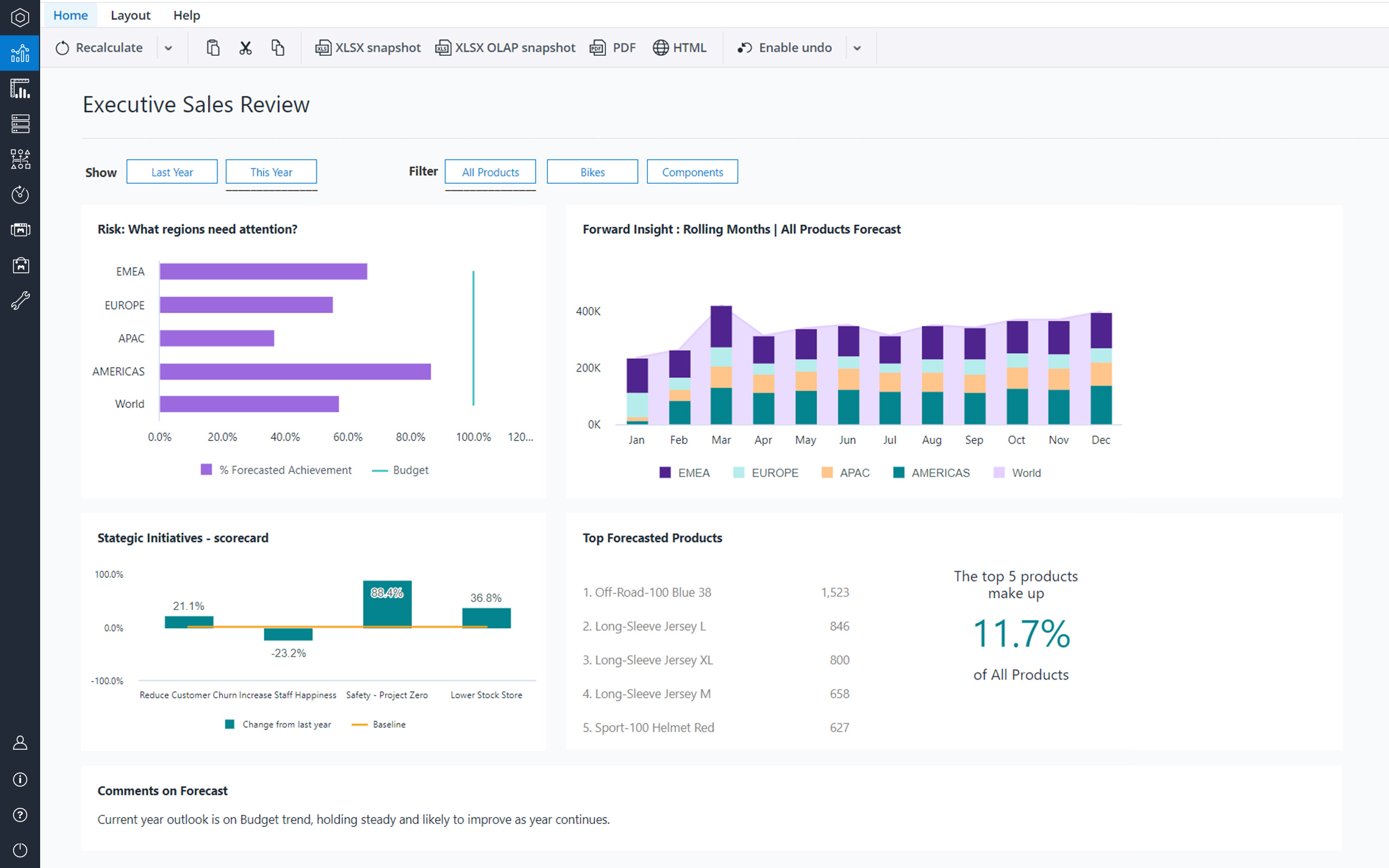    |