Laravel is a free, open source web application PHP framework.
N/A
Sana Commerce Cloud
Score 7.7 out of 10
Mid-Size Companies (51-1,000 employees)
Sana Commerce is an eCommerce platform that provides an integrated shopping cart software for both Microsoft Dynamics and SAP.
N/A
Volusion
Score 4.8 out of 10
N/A
Volusion is a cloud-based ecommerce solution from the company of the same name in Austin, TX. It features an intuitive dashboard, built-in marketing and promos, SEO, templates, and tools to customize look and appearance.
$29
per month
Pricing
Laravel PHP Framework
Sana Commerce Cloud
Volusion
Editions & Modules
No answers on this topic
Essential
Request pricing
per year per installation
Pro
Request pricing
per year per installation
Advanced
Request pricing
per year per installation
Personal
$29
per month
Pro
$79
per month
Startup
$179
per month
Business
$299
per month
Offerings
Pricing Offerings
Laravel PHP Framework
Sana Commerce Cloud
Volusion
Free Trial
No
No
Yes
Free/Freemium Version
No
No
No
Premium Consulting/Integration Services
No
Yes
Yes
Entry-level Setup Fee
No setup fee
Required
No setup fee
Additional Details
—
Sana's pricing model is made up of two parts. It includes:
•A one-time setup fee
•A monthly subscription fee, including hosting and services
Sana also offers add-ons to supplement customers’ web stores, an enterprise license, or the possibility to add additional web stores (subject to pricing adjustments as needed).
—
More Pricing Information
Community Pulse
Laravel PHP Framework
Sana Commerce Cloud
Volusion
Features
Laravel PHP Framework
Sana Commerce Cloud
Volusion
Online Storefront
Comparison of Online Storefront features of Product A and Product B
Laravel PHP Framework
-
Ratings
Sana Commerce Cloud
7.4
1 Ratings
5% below category average
Volusion
3.6
9 Ratings
73% below category average
Product catalog & listings
00 Ratings
7.01 Ratings
4.39 Ratings
Product management
00 Ratings
8.01 Ratings
4.39 Ratings
Bulk product upload
00 Ratings
7.01 Ratings
4.28 Ratings
Branding
00 Ratings
8.01 Ratings
3.69 Ratings
Mobile storefront
00 Ratings
8.01 Ratings
1.28 Ratings
Website integration
00 Ratings
6.01 Ratings
3.38 Ratings
Visual customization
00 Ratings
7.01 Ratings
5.19 Ratings
CMS
00 Ratings
8.01 Ratings
2.27 Ratings
Product variations
00 Ratings
00 Ratings
4.78 Ratings
Online Shopping Cart
Comparison of Online Shopping Cart features of Product A and Product B
Laravel PHP Framework
-
Ratings
Sana Commerce Cloud
7.0
1 Ratings
9% below category average
Volusion
3.6
9 Ratings
72% below category average
Checkout user experience
00 Ratings
7.01 Ratings
3.79 Ratings
Abandoned cart recovery
00 Ratings
00 Ratings
3.67 Ratings
Online Payment System
Comparison of Online Payment System features of Product A and Product B
Laravel PHP Framework
-
Ratings
Sana Commerce Cloud
8.0
1 Ratings
4% below category average
Volusion
4.1
8 Ratings
68% below category average
eCommerce security
00 Ratings
8.01 Ratings
4.18 Ratings
eCommerce Marketing
Comparison of eCommerce Marketing features of Product A and Product B
Laravel PHP Framework
-
Ratings
Sana Commerce Cloud
7.7
1 Ratings
0% above category average
Volusion
2.6
9 Ratings
99% below category average
Promotions & discounts
00 Ratings
8.01 Ratings
4.89 Ratings
Personalized recommendations
00 Ratings
7.01 Ratings
1.88 Ratings
SEO
00 Ratings
8.01 Ratings
1.28 Ratings
eCommerce Business Management
Comparison of eCommerce Business Management features of Product A and Product B
I would say that Laravel is not a suitable framework for high-frequency, high-volume, real-time interaction or processing millions of records in batch operations. It shines for standard database web applications (CRUD, Admin Panels, etc.) and is a fantastic multi-developer framework.
Its suited more for B2B-focused or mid-size companies that want to have a more robust platform for their eCommerce and don't want to invest that much (like the case of Magento and other big names). If you want to make constant UX and design enhancements and tests, you'll have a couple of headaches. It's not that bad but; you wont be able to do it all without customizing and spending good money on it.
Volusion is a good company if you're starting out. The problem is that, if you want more complexity out of the program, you're kind of stuck. Also the regular time out errors and slow downs can be very frustrating. Packages that miss overnight deadlines because your system stops working can cost you customers. In today's highly competitive market, that's just something that's hard to put up with. If you have a lower volume of business you might be able to work around these issues.
Laravel utilizes the best possible PHP standards and coding practices.
Laravel uses many widely-accepted community libraries and builds upon them, rather than re-inventing everything.
Laravel has many components available from the community and is extremely easy to build custom components for, either with custom code or by integrating existing third-party PHP libraries.
Laravel is flexible enough to power pretty much any kind of application I can imagine.
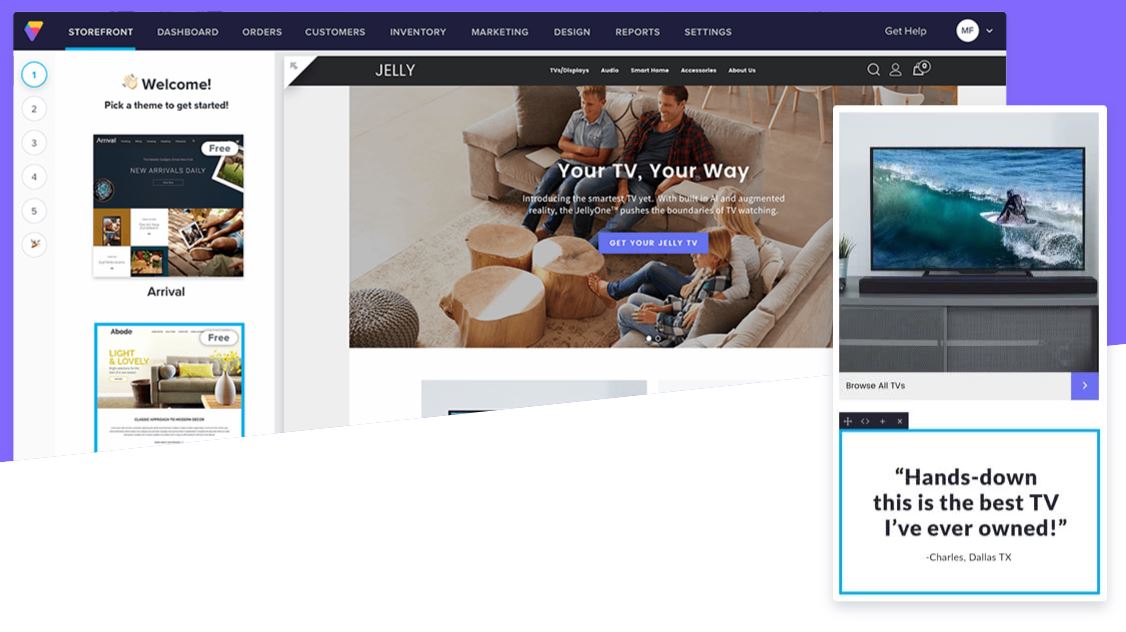
Templates are pre-built for a good end user experience. I've gone through the process of building custom sites as well as tweaking both free and paid templates that Volusion's design team provides.
Their support team didn't use to be as helpful, but in recent years have answered nearly all questions I've had. Their support section within the database provides detailed walkthrus as well.
Order processing is easy once you've been trained on the system. We got to a point where nearly the entire process was automated from initial purchase through shipping.
Laravel is updated regularly, which is great. However, in order to get the latest features, use the newest 3rd party libraries, have the most current security updates, and ensure that the newest features of PHP are usable, you have to continuously upgrade your Laravel application. This costs time and money, obviously, and if you don't stay on top of the updates you will quickly fall behind. This is the case with any open source software, but it needs to be considered for any team considering using Laravel or any other software.
Because of the size of the Laravel community, there are a LOT of 3rd party libraries. Some of these are great, some are less than great. Sometimes it's difficult to evaluate the quality of a library, making it difficult to trust many libraries. Developers need to be cautious and thoughtful when considering using new software.
Because of the rapid development of the Laravel framework, the size of the community, and the simplicity of being able to publish content online - it is very easy to find documentation, tutorials, or other "advice" that is not up to date, or that has outdated information.
The service could be much better. It's expensive and hard to monitor because they only check cases twice a week (if you don't have a pre-plan).
The language and different time schedules have been an issue for tech problems. They're in Holland and Ukraine and we're in Mexico, and is really hard to find developers who know the platform to hire as an extra resource.
You can't import SKUS to populate a landing page programmatically.
API calls use the previous call as a reference, even if you weren't the one we made the previous call. Can lead to data gaps, so you often have to set a manual date range to look back to make sure you aren't missing any data.
Laravel PHP Framework has continued to exceed my expectations. It supported me in the development of a high quality and stable web application that is mission critical for the organization. I cannot imagine wanting to use any other tool for web development. Documentation, unit tests, and numerous integration options make using Laravel PHP Framework a natural choice.
When you spend so much time with a product like this and not only have you witnessed its growth, but you almost feel like you are next those that make the decisions of building features a certain way, you can't help but want to stay and be a part of their continued growth. It's simply a great product. Can it improve? By all means! But it will only improve because of users and avid resellers like me.
As I mentioned earlier Laravel PHP Framework has lot of in built feature as well as there is vast set of packages available to add the features in your application. It has very large community who can help when you feel stuck somewhere. This is why this rating is justified.
You have to wait on hold for at least 45 minutes every call—the tech support person never knows the answer right away so they put you on 10 minute holds only to come back and say they're still looking for answers. The chat function could take days to get a response. Our "Dedicated Account Manager" never checks in or answers, nor are they ever in the office when we call. It's like they try to be as unavailable as possible until you forget why you even called in the first place. Insane.
It is best to use the built-in features and recommended services for the most turn-key experience (ie. Skipjack for payment processing so that it can all be done from the Volusion backend).
Supporting unit testing is bigger plus point in Laravel than any other framework. Developing with Laravel is much easier. Other frameworks have value in market, but Laravel has taken the lead in popularity among PHP developers in recent years. The large community supports you if you have problems. Using Laravel, integration became easy with third-party libraries, but it was costly too.
Sana Commerce is not as robust, flexible (or expensive) as Magento but is better (and more expensive) than Shopify. It is well balanced and you can customize according to your clients' needs. They are constantly upgrading their platform so you can keep your eCommerce up to date, but you must consider an extra cost to adapt it to the latest version.
While k-eCommerce was very glamorous to us because it integrates with our main workflow, it just didn't have some of the marketing features that are so integral to the way we do business online. The set-up costs were also way too high. Volusion is so affordable and feature heavy, it makes it very difficult for any shopping cart provider to compete. You can find others who are competitively priced and have similar features, but they simply aren't as robust (at least for the way we use it)
Honestly, when you're in the dashboard, the UX is simply horrendous. I mean, everything that should be 1-2 clicks away is 4-6 clicks away, and each pages takes at least four seconds to load. You just find yourself wasting a lot of time waiting for things to load. This should be more simple.