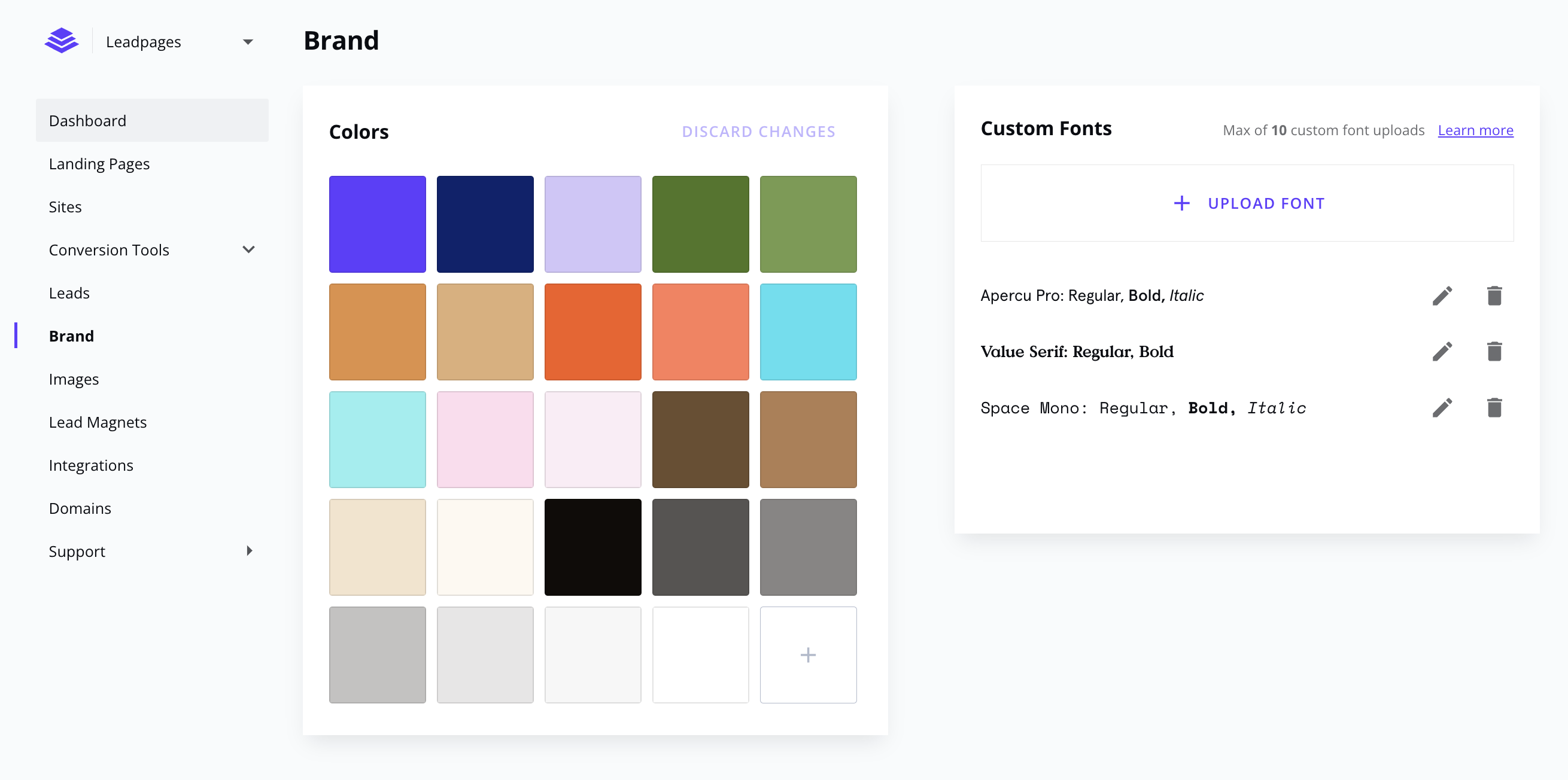
Leadpages is a landing page software that helps to grow small businesses without tech headaches. Leadpages can be used with or without WordPress, on Leadpages' servers or on the user's own. Leadpages aims to eliminate the high cost of website developers and freelancers when creating a company's most important marketing web pages. Included in all plans: Unlimited landing pages, pop-ups, and alert bars for lead generation and sales Website builder for a…
$49
per month
Metadata.io
Score8.8 out of 10
N/A
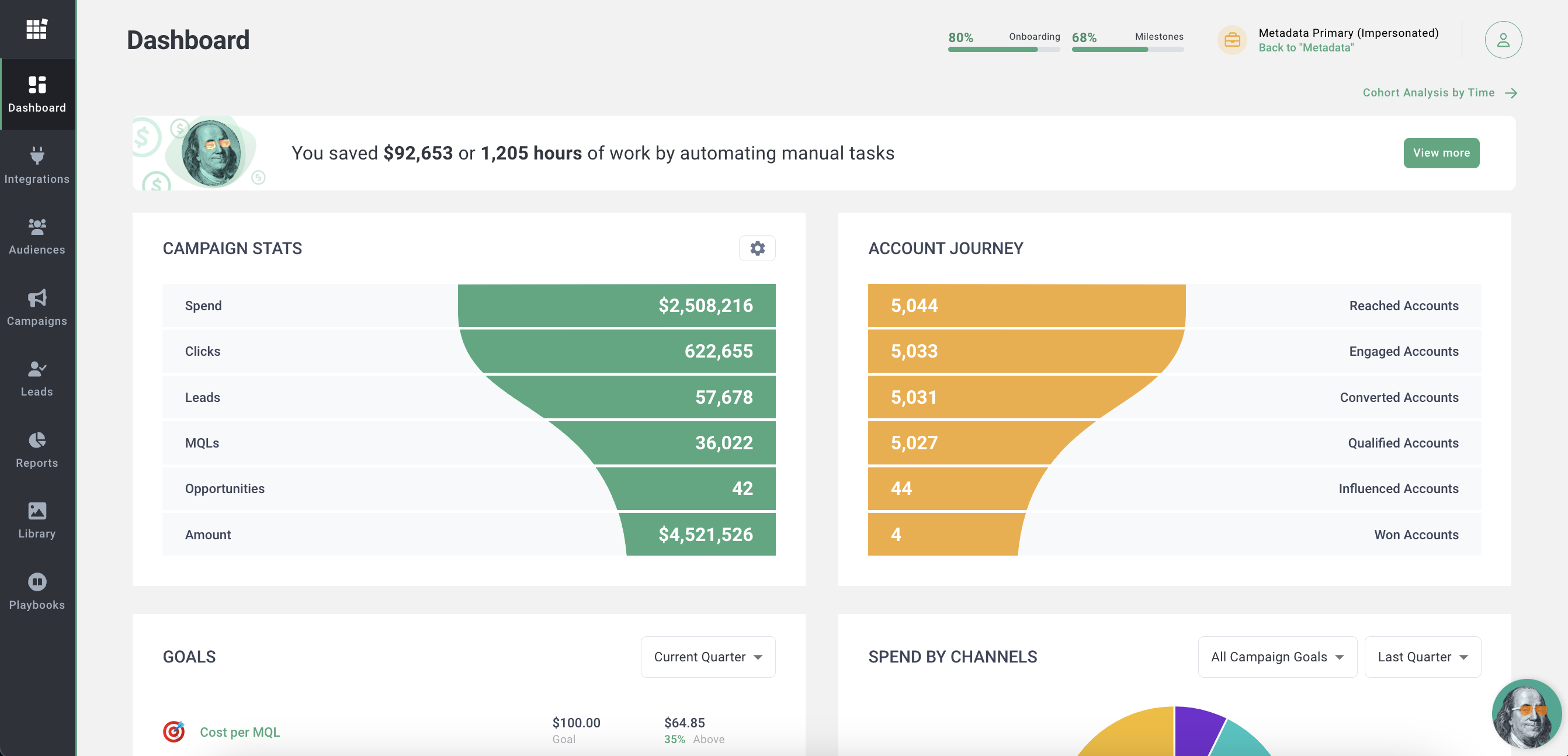
Based in San Francisco, Metadata.io is a Demand Generation and ABM platform designed to execute thousands of B2B campaigns in a matter of hours, automatically optimizing campaigns for pipeline impact at a high velocity.
$24,000
per year
Pricing
Leadpages
Metadata.io
Editions & Modules
Standard
$49
per month
Pro
$99
per month
Advanced
$399
per month
Standard Annual
$444
per year
Pro Annual
$888
per year
MetaMatch
$295
per month per installation
Web Personalization
$24,000
per year
Audience Targeting
$24,000
per year
Metadata Base Platform
$60,000
per year
Offerings
Pricing Offerings
Leadpages
Metadata.io
Free Trial
Yes
No
Free/Freemium Version
No
No
Premium Consulting/Integration Services
Yes
Yes
Entry-level Setup Fee
No setup fee
$2,500 one-time fee per installation
Additional Details
Save 25% by choosing an annual plan (3 months free). Standard ($444), Pro ($888), Advanced (Call Us)
It's great if you want an easy-to-use but extremely robust tool for producing effective online marketing pages since it makes production work enjoyable and inspires fresh creativity. It also offers wonderful split-testing capabilities which can enhance marketing results. But if you're looking for an out-of-the-box collection of standardized, one-size-fits-all marketing resources, you really might want to consider looking elsewhere.
A de minimis incentive was given to thank the reviewer for their time. The incentive was not used to bias or drive a particular response, nor was the incentive contingent on a positive endorsement. More Info
Metadata is well suited when you have a really large ad budget (>50k per month at least). This is because the power of metadata lies in the ability to quickly set up and run a large number of experiments (combinations of channel, audience, creative, and conversion assets). To evaluate these variations, all of them need a large number of impressions, clicks, and conversions to be statistically relevant. If your budget is smaller, you will either have a very small number of experiments (not fully utilizing the power of metadata), or your experiments will not have enough clicks to make informed decisions. We had expected a better explanation of this from metadata before signing up.
A de minimis incentive was given to thank the reviewer for their time. The incentive was not used to bias or drive a particular response, nor was the incentive contingent on a positive endorsement. More Info
Leadpages integrates well with many of the main software that businesses use like Infusionsoft, Hubspot, Marketo, Mailchimp, GoToWebinar, and Wordpress. This allows your landing pages to be integrated well into the other processes you have with your business.
Leadpages makes it easy to build professional looking landing pages without having to hire someone else or have coding skills. Their drag and drop builder makes it easy enough to use and get the hang of. I particularly love the hundreds of templates they provide for you to help give you ideas and get you going faster.
They also have a Leadbox function that has also been super useful in being able to get other types of forms up on our website. These forms provide some functionality that our website wouldn't have had without them.
A de minimis incentive was given to thank the reviewer for their time. The incentive was not used to bias or drive a particular response, nor was the incentive contingent on a positive endorsement. More Info
A de minimis incentive was given to thank the reviewer for their time. The incentive was not used to bias or drive a particular response, nor was the incentive contingent on a positive endorsement. More Info
While most of the editing functions are easy to figure out, some of the finer details to get spacing, sizing, alignment and layout just right can take some trial and error if you don't have formal training in the tool. A lot of the editing tools are collapsed into sections, and finding just what you're looking for can sometimes be a challenge.
I don't believe the version we used had a page optimizer or optimization score, which I have seen on other landing page builders. This may be a feature of a more premium version of the tool or may have been turned off by the product manager, but it would be a helpful feature.
A de minimis incentive was given to thank the reviewer for their time. The incentive was not used to bias or drive a particular response, nor was the incentive contingent on a positive endorsement. More Info
If you don't have a large budget and audience it's hard to meaningfully optimize. If I have 4 ad creatives, to 2 audience groups on FB and LinkedIn, that creates 16 experiments, each of which needs an ample enough budget, say $40/day, that's now $640 per day or $19K per month.
Limited ability to edit ads after they've been launched. You usually have to stop the ad, clone it, and launch a new campaign.
Can't add new ads to existing campaigns which limits the ability to optimize. If I start an MD campaign with 4 ads, and in a few weeks we see that one is working well and the other 2 are not performing, I can pause those (or it can autopause by rules), but I can't add 2 more new creatives to the mix against the high performer. I'd have to either stop the high performer, and recreate it in a new campaign (losing likes and comments), OR - leave the high performer in the first campaign, and create. a second campaign with the new ones, which will only optimize against each other.
Limited to a single conversion event on a landing page. I'm not able to choose either a Demo Request OR a Sign-Up conversion, I can only choose one.
Google search ads are doable but aren't necessarily more feature-rich or easy-to use than native, so there's no value added to doing it through Metadata in my opinion aside from unifying ad reporting.
A de minimis incentive was given to thank the reviewer for their time. The incentive was not used to bias or drive a particular response, nor was the incentive contingent on a positive endorsement. More Info
I would give it a 10, for me, I love all the features. For the average person, the number of choices on a landing page could create a decision paradox. Thankfully the pre-designed landing page templates do not require a lot of decisions for a landing page newbie.
A de minimis incentive was given to thank the reviewer for their time. The incentive was not used to bias or drive a particular response, nor was the incentive contingent on a positive endorsement. More Info
Leadpages support is helpful, they also created many resources to help people create good funnels and learn about small things that matter when doing marketing. The affiliate program is good and could be something which pays for your subscription. People like Leadpages because its been recommended by many influencers participating in affiliate program and also because it just works without problems and does the job. But right now alternatives should be taken in consideration, as there are many other projects that could do it better and cheaper.
A de minimis incentive was given to thank the reviewer for their time. The incentive was not used to bias or drive a particular response, nor was the incentive contingent on a positive endorsement. More Info
A de minimis incentive was given to thank the reviewer for their time. The incentive was not used to bias or drive a particular response, nor was the incentive contingent on a positive endorsement. More Info
I have used Mailchimp for clients, and use ActiveCampaign personally for my email marketing and have used it for clients, but prefer Leadpages for the frontend of the opt-in process because of its analytics and performance metrics. Leadpages makes it super easy to see what's performing well, without having to dive into Google Analytics or aggregate any other data. Leadpages also integrates really well with WordPress, my primary platform, with opt-in forms (wayyyy better than Mailchimp).
A de minimis incentive was given to thank the reviewer for their time. The incentive was not used to bias or drive a particular response, nor was the incentive contingent on a positive endorsement. More Info
We chose [Metadata.io] because it was a smaller company and could get more personalized attention. The price was better and they seemed more eager to support us. The feature set was what we were looking for and not more - it was exactly as robust as we needed it to be. Didn't want to pay for features we weren't going to use.
A de minimis incentive was given to thank the reviewer for their time. The incentive was not used to bias or drive a particular response, nor was the incentive contingent on a positive endorsement. More Info
Leadpages, as long as you have it set up properly, will have a quick ROI within days of your first campaign.
For those that are not familiar, it is probably best to hire someone to take over this part and still your ROI will be very quick, including the cost of this professional.
Overall, Leadpages has a very fast ROI if used and implemented in a timely manner, and used to constantly evolve what you are doing with new fresh content.
A de minimis incentive was given to thank the reviewer for their time. The incentive was not used to bias or drive a particular response, nor was the incentive contingent on a positive endorsement. More Info
Huge decrease in CPLs, CPMQL and Cost Per Opportunity
Big improvement in MQL to SQL rates
90%+ of our leads from paid social now have valid business emails, before it was like 30%
Saving us hundreds of hours over the course of the next year doing daily manual optimization and budget management tasks for us so we can focus on strategy and testing new things
A de minimis incentive was given to thank the reviewer for their time. The incentive was not used to bias or drive a particular response, nor was the incentive contingent on a positive endorsement. More Info